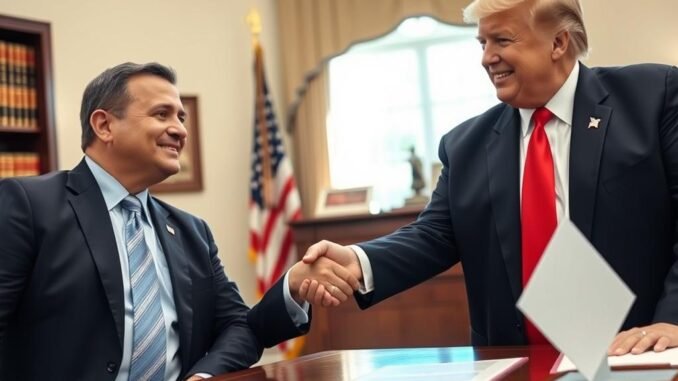

Only 1 in 10 presidential pardons have gone to members of the opposite party. This makes Trump’s pardon of Rep. Henry Cuellar a big deal. It has high stakes for debates on the border and justice.
Donald Trump gave a full pardon to the Texas Democrat and his wife. This was for a federal bribery and conspiracy case. Trump said it was a blow against a “weaponized” system.
He linked it to Cuellar’s harsh words against Joe Biden and his immigration policies. In a social post, Trump told Cuellar to “sleep well tonight.” This shows Trump’s message on the border will focus on fairness.
Cuellar represents a Texas-Mexico border district. He often disagrees with Democrats on immigration and guns. He also opposes abortion rights.
Federal filings accused the couple of taking payments from an Azerbaijan-controlled energy company and a Mexican bank. They were accused of shaping legislation and giving a pro-Azerbaijan speech. The House Ethics Committee is reviewing this, working with the Department of Justice.
This sets the stage for what happened, why it’s important, and what’s next. It’s a clear, timely post that covers the intersection of law, politics, and the border debate under Joe Biden.
Overview of the Trump pardon and why it matters for border and justice politics
The Trump pardon for Rep. Henry Cuellar is a big deal. It’s at the center of debates on immigration and law enforcement. It also affects Joe Biden, the Department of Justice, and how people see the southern border.
Voters are curious about who Trump has pardoned and why. This case is different from others.
Key facts: who was pardoned and under what charges
Donald Trump pardoned Rep. Henry Cuellar of Texas and his wife, Imelda Cuellar. They were charged with bribery, money laundering, and conspiracy.
Prosecutors said the couple was involved in schemes with an Azerbaijan energy company and a Mexican bank. They claimed up to $600,000 was moved through shell companies owned by Imelda.
Trump’s reasoning: “weaponized” justice system and border policy criticism
On Truth Social, Trump said the justice system was unfair. He saw the pardon as supporting a Democrat who disagreed with Biden on border policies.
Trump linked the case to Joe Biden and the DOJ. He claimed it was against political targeting. This message is similar to his past views on prosecutors and immigration.
Why this case stands out: a Democrat receiving a Trump pardon
This case is rare because Trump doesn’t usually pardon Democrats. It shows how border politics can make parties less important when a Democrat disagrees with Biden.
This moment is significant for those watching Trump’s pardons. It shows Trump’s pardon policy can include immigration allies, even if they’re not from his party.
Background on Henry Cuellar: a moderate Democrat on the Texas-Mexico border
Henry Cuellar represents a part of South Texas near the Rio Grande and major ports. His actions show he’s practical and focused on details. He often disagrees with national trends, even those from Joe Biden.
He puts local needs first in debates, even when they clash with national policies. This approach is shaped by border issues and the impact of biden’s policies.
Cuellar’s district and history of breaking with his party
For over 20 years, Cuellar has served a district that’s key to Texas. It includes Laredo and the Rio Grande Valley. He’s often at odds with Democrats on funding for security, saying it’s needed for ports, ranches, and highways.
His views on this issue have helped him stay competitive in his district. They contrast with some of biden’s policies in Washington.
Public stance on immigration and firearms policy
Cuellar has pushed for the White House to reduce border crossings and increase deportations. He believes local communities bear the costs of these issues. He’s called for clearer and faster action from biden’s administration.
He also supports legal ways for people to enter the country, based on labor needs. On guns, Cuellar supports background checks but opposes broad bans. He sees this as a way to respect gun owners while fighting against illegal sales and cartel activity.
Position on abortion rights and implications for bipartisan appeal
Cuellar is one of the few Democrats who doesn’t support abortion rights. This stance helps him appeal to voters who are socially conservative. It also shows he’s willing to stand apart from Joe Biden on some issues.
His views on guns, enforcement, and abortion make him a unique voice from the border. His critiques of national policies are often well-received, thanks to his border-focused approach.
Charges and allegations: bribery, unlawful foreign influence, and money laundering
Federal filings detailed bribery and money laundering charges. These involved Congress and actors from abroad. The case emerged as discussions about Joe Biden’s policies and New York cases dominated headlines.
Prosecutors outlined two alleged schemes and a flow of funds up to $600,000. Henry Cuellar’s age was reported differently, at 69 or 70. His wife, Imelda, was also named in the filings. Both denied any wrongdoing.
Alleged schemes involving Azerbaijan and a Mexican bank
The indictment linked payments to Azerbaijan’s government and a Mexican bank. It claimed these funds aimed to influence the U.S. Congress. This came as foreign ties were under intense scrutiny.
How prosecutors say money moved through shell companies
Prosecutors said money went through shell companies owned by Imelda Cuellar. They claimed invoices and consulting labels hid the money’s source and purpose. The defense argued this was a legitimate business practice, similar to other New York cases.
Accusations of influencing legislation and delivering a pro-Azerbaijan speech
Authorities accused Henry Cuellar of shaping U.S. laws to benefit Azerbaijan. They also mentioned a planned speech supporting Azerbaijan. The indictment fell during a charged political season, with Joe Biden facing scrutiny over his policies.
Timeline: indictment, trial scheduling, and the sudden pardon

Weeks of legal back and forth ended in a day with a trump pardon. The sudden change was highlighted by trump’s post and statements from the congressman. Joe Biden’s border plans were also in the mix. Here’s how the timeline shifted at each step.
Indictment details and ages reported for the couple
In 2024, Henry Cuellar and his wife, Imelda Cuellar, faced federal charges. Henry’s age was reported as 69 or 70, depending on the source. This reflected different birthdays mentioned in the news.
The charges claimed a complex scheme. Early debates in Washington focused on the case’s link to border politics and past disputes with Joe Biden.
Trial dates cited in reports and what changed post-pardon
One report said the couple’s trial was set for April 2024. Another mentioned an April 2026 start. Despite the difference, both agreed a trial was scheduled before the pardon.
On a Wednesday, Donald Trump issued a full pardon. This stopped federal prosecution, froze court dates, and ended immediate criminal jeopardy. Trump’s post quickly spread the news to many.
Cuellar’s response: proclaiming innocence and thanking Trump
Henry Cuellar said he and Imelda are innocent. He thanked Trump on X for reviewing the facts. He called the pardon a “clean slate” that clears “noise.”
Trump’s post expressed relief: “Henry, I don’t know you, but you can sleep well tonight — Your nightmare is over!” Even critics who support Joe Biden noted the timing’s effect on the docket and news cycle.
Trump’s message and social media narrative around the pardon
After the pardon, Trump’s post set the tone. It portrayed Henry Cuellar as a truth-teller on the border. It also framed the pardon as relief after months of chaos.
The message highlighted a rivalry with Joe Biden and the debate over his policies.
Quotes: “speaking the TRUTH,” “Open Borders,” and “sleep well tonight”
The statement praised Cuellar for “speaking the TRUTH” on the southern border. It noted he “bravely spoke out against Open Borders.”
It ended with a personal note: “Henry, I don’t know you, but you can sleep well tonight — Your nightmare is over!”
The phrasing echoed themes that link border control to public safety. It contrasted with Biden’s policies.
The letter attributed to Cuellar’s children requesting a pardon
The post shared a letter from Cuellar’s children asking for clemency. It showed their father as independent and honest. It suggested these traits brought heat.
The appeal humanized the case. It gave Trump’s post a family voice that resonated beyond legal notes and press releases.
Context: Trump’s broader claims about DOJ and political opponents
The message repeated a familiar claim. It said Joe Biden used the Justice Department against rivals. It offered no new proof but reinforced a long-running storyline.
Critics argue Trump has pushed outcomes too. The post kept attention on Biden’s policies at the border and the politics surrounding enforcement.
Legal and congressional fallout: House Ethics Committee and DOJ coordination
The House is facing a big test of trust and process. A recent pardon has raised questions about oversight under Joe Biden’s policies. The public is watching closely, influenced by new york cases.
Ethics investigation reauthorization and scope
The House Ethics Committee started its review in May 2024 and renewed it in July. They will look into actions related to official duties, travel, and benefits from laws. This is true even with the pardon and changing views on Joe Biden.
The committee aims to work with the Department of Justice while following its own rules. This balance is important, even as debates over fairness grow.
Dual-investigation risks and institutional safeguards
Having two investigations at once can be risky. There’s a chance of witness conflicts, document issues, and early leaks. To avoid these problems, there are rules about sharing information and coordinating efforts.
These rules help keep the investigations independent. They show how oversight can continue while the DOJ focuses on its work. This is often tested by the attention drawn by new york cases and national politics.
What a presidential pardon does—and does not—resolve
A presidential pardon clears someone of federal crimes. But it doesn’t stop ethics reviews or settle questions about Congress. The person’s reputation and campaign donors’ reactions can affect future elections.
Even with a pardon, the committee can take action. This could include warnings or referrals. This situation highlights that legal closure is different from ethical closure.
Comparisons: other high-profile clemency moves and political parallels
Recent clemency decisions are sparking debates. They involve justice, border policy, and influence. People are looking at Joe Biden and Donald Trump’s moves closely.
Rod Blagojevich and Trump’s pattern of controversial clemency
Donald Trump pardoned Rod Blagojevich in February. This was five years after cutting his sentence short. It shows a pattern of giving clemency to famous names, often after they’ve been in the news a lot.
This pattern has raised questions about Trump’s pardons. It has made people wonder if he’s using clemency for political gain. Both parties have spoken out, questioning the limits of presidential mercy.
References to New York cases and federal actions involving Eric Adams
Trump linked scrutiny of New York City Mayor Eric Adams to border policy debates with Joe Biden. Adams didn’t get a pardon, but his legal issues are tied to New York cases and federal decisions. This has sparked a lot of debate about Trump’s motives.
An analysis of parallel prosecutions shows how legal stories move between levels of government. This mix of local, state, and national issues has made the story more complex.
Who has Trump pardoned and how this fits his clemency record
The list of those Trump has pardoned includes political figures and celebrities. It raises a simple question: why has Trump pardoned these people? Allies and famous names are common, but pardoning a Democrat is rare and gets a lot of attention.
These comparisons link New York cases, border issues, and Joe Biden’s policies. They show how power, prosecution, and clemency play out in today’s politics.
Border politics and messaging: how the pardon plays into immigration debates

Border communities saw the pardon as a test of strength and trust. It mixed crime, migration, and politics, putting Joe Biden under the microscope. The debate pits border trump talking points against biden’s policies in real time.
Cuellar’s critique of the administration’s border response
Henry Cuellar wants more agents, better funding, and stricter asylum rules. He says biden’s policies are unclear, confusing migrants and straining local budgets.
He advocates for quicker returns and faster processing. This appeals to sheriffs, mayors, and clinics along the Rio Grande. His message balances empathy with the need for enforcement under Joe Biden.
“Border Trump” narratives versus Biden’s policies
After the pardon, border trump messaging portrayed Cuellar as a Democrat who supports tough borders. This narrative frames him as a champion who challenged “Open Borders” and faced consequences.
Biden’s policies, on the other hand, focus on legal pathways, technology, and cooperation with Mexico. Supporters say these policies have reduced chaos at key sectors. Critics argue that gaps remain, inviting repeat crossings.
Implications for voters along the U.S.-Mexico border
Voters along the border care about safety, legal process, and dignity. They want clear rules and quick results, not mixed signals. The pardon has turned these priorities into a test for both parties.
Republicans see an opportunity with voters who want stricter controls but not cruelty. Democrats aim to defend Joe Biden, arguing that his policies manage flows while upholding the law.
| Message Frame | Core Claim | Policy Emphasis | Voter Reaction Trend |
|---|---|---|---|
| Border Trump Narrative | Pardon proves toughness and bipartisanship on enforcement | Deterrence, more agents, rapid removals | Appeals to moderates seeking strict but predictable rules |
| Biden’s Policies Defense | Order through legal pathways and coordination | Asylum reform, technology, regional cooperation | Resonates with voters backing humane control and stability |
| Local Priority Lens | Relief for cities and counties bearing costs | Funding, court capacity, faster case resolution | High salience among border residents across parties |
Key political questions readers are asking
After the Cuellar pardon, readers want clear answers. They look at Joe Biden, Donald Trump, and the scope of clemency. They also consider what it means for Capitol Hill and the courts.
How many pardons did Biden give, and how do they compare?
People search “how many pardons did biden give” to understand trends. They compare Biden’s approach to Trump’s. They also look at timing, offense types, and if policy messaging played a role.
Did criticism of Biden’s policies drive prosecutorial decisions?
Some wonder if sharp border critiques led to legal trouble for outspoken figures. They see Trump’s claims as part of a political fight. Others say routine prosecutorial steps, not speeches, drive cases.
What this means for Democrats like Sen. Bob Menendez and Rob Menendez
Observers watch cases involving sen. bob menendez and the reelection debate around rob menendez. They see if party pressure changes, or if legal timelines and ethics reviews follow their own paths.
Related search curiosities: “beneficial in a sentence,” “pardon seek sell trump his own”
Searches for beneficial in a sentence show a desire to understand legal jargon. Queries about “pardon seek sell trump his own” reflect interest in the pardon power’s reach and limits. They also look at how it fits with federal norms and political stakes.
Conclusion
Henry Cuellar’s case closed one chapter and opened another. The trump pardon halted a federal trial, yet it did not settle the core debate over power, politics, and the border. Donald Trump framed the move as a fix for a “weaponized” Justice Department targeting a Democrat who challenged Joe Biden on immigration.
Prosecutors had alleged bribery and foreign influence tied to Azerbaijan and a Mexican bank. This left voters to weigh evidence against rhetoric.
Cuellar’s record explains the shock and the appeal. He has long broken with his party on immigration and firearms. He also opposes abortion rights. This made a cross-party grant of clemency both plausible and provocative.
The House Ethics Committee is reviewing conduct in coordination with DOJ. This reminds us that a pardon ends criminal exposure but not institutional scrutiny or political cost tied to biden’s policies.
The broader clemency landscape matters, too. From Rod Blagojevich to controversies touching New York and Eric Adams, the trump pardon for Cuellar fits a pattern. This pattern blurs legal judgment and campaign messaging.
For border communities and swing voters, this story will echo in ads, town halls, and Spanish-language media along the Rio Grande. It challenges both parties to defend their records and their motives. In that contest, facts, process, and public trust will decide whose narrative sticks—and how far the fallout travels beyond Texas.
Be the first to comment