Twenty-five years after hijackers flew planes into the World Trade Center, the Pentagon and a field in Shanksville, Pennsylvania, a growing share of the generation that grew up in its aftermath has no independent memory of the day itself. The youngest millennials, born in the mid-to-late 1990s, were toddlers or not yet born when the attacks happened on September 11, 2001. They came of age entirely inside the world 9/11 built: shoe removal at airport security, two ongoing wars, and a domestic surveillance apparatus that expanded largely without public debate. For them, the attacks aren’t a memory to be recalled. They’re a set of conditions to be inherited.
That distinction sits at the center of coverage marking the 25th anniversary this year, including a New York Times piece bluntly titled “An entire generation is too young to remember a day that shaped their lives.” The headline captures a demographic reality that’s now hard to avoid: the population of Americans who experienced September 11 as a formed, functioning adult is shrinking every year, while the share who know it only through textbooks, museum exhibits and family retellings keeps growing.
The 25th anniversary lands as the last cohort who lived through it as adults ages into their 40s
Anyone old enough to have processed the attacks as an adult in 2001 is now at least in their mid-40s. That means the entire pool of Americans with a firsthand, adult understanding of the day is aging out of the workforce’s younger ranks and into its senior tiers. College freshmen this fall were born around 2008, seven years after the towers fell. For them, 9/11 sits alongside events like the moon landing or the Kennedy assassination: significant, but abstract, absorbed secondhand rather than lived.
Where the “too young to remember” line falls: birth years and school-age cutoffs
The dividing line runs roughly through people born in the mid-1990s. Someone born in 1996, commonly cited as the last millennial birth year, was five years old in September 2001, an age at which most children retain few if any durable memories of national events. Someone born even a few years earlier, in the early 1990s, might recall fragments: a teacher crying, a television left on in a classroom, a parent who didn’t come home from work on time. But the detailed, contextual memory that adults carry, of what a hijacking meant, why the towers collapsed, what “Ground Zero” signified, belongs almost exclusively to people who were already in middle school or older that day. Below that age threshold, 9/11 isn’t remembered. It’s studied.
How the day still shapes millennials who don’t remember it firsthand
The absence of memory hasn’t meant an absence of impact. Millennials without any recollection of the attacks still spent their entire adolescence and adulthood inside institutions and policies built in direct response to them. They’ve never known air travel without the Transportation Security Administration, created in the months after 9/11. They’ve never known a version of the federal government without the Department of Homeland Security. For this cohort, these aren’t post-9/11 changes. They’re simply how the country works, with no “before” to compare against.
Post-9/11 airport security, wars in Afghanistan and Iraq, and the surveillance state as inherited norms, not new changes
Older generations experienced the shift: the sudden appearance of long security lines, the debates over the Patriot Act, the arguments over invading Iraq in 2003. Younger millennials and the members of Generation Z who followed them experienced none of that as a shift. They grew up already inside it. The war in Afghanistan, launched in October 2001, ran for nearly 20 years before the U.S. withdrawal in 2021, so it was the backdrop to the entire childhood and adolescence of anyone born around the time of the attacks. Surveillance programs revealed publicly years later, in disclosures like Edward Snowden’s in 2013, arrived as confirmation of an assumed reality for a generation that had never known government data collection to be a live political question rather than a settled fact.
Growing up under a permanent “War on Terror” backdrop during childhood and adolescence
The phrase “War on Terror” itself functioned less as breaking news and more as ambient noise for younger millennials, the same way “Cold War” might have for their parents’ generation. School lockdown drills, news segments about terror threat levels, and deployments of family members or family friends were simply part of growing up in the 2000s and early 2010s. The formative political memory for this slice of the generation isn’t the attacks themselves. It’s the two-decade military and security apparatus that followed them.
What the 25th anniversary commemorations looked like in 2026
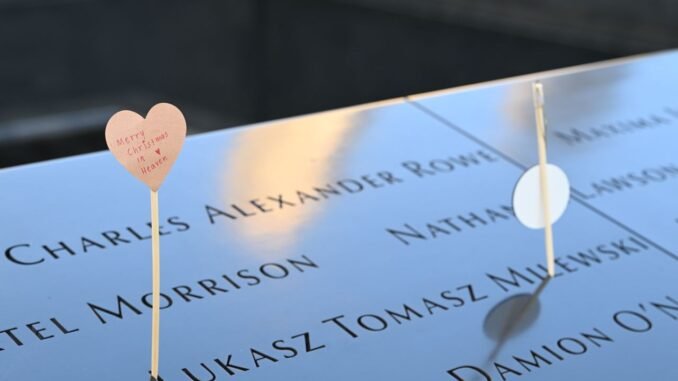
Ceremonies this year followed a familiar pattern but carried a different generational weight. According to a nationwide roundup of tributes marking the milestone, Americans gathered to honor the roughly 3,000 people killed in the attacks with a message repeated across memorial sites: “We will always remember you.” What made this year’s observances notable wasn’t the ritual itself, but who was carrying it forward. Increasingly, the people reciting names and laying flowers were children and grandchildren of victims who never met the person they were honoring.
Families honoring relatives they never knew, including younger generations at memorial events
In Mobile, Alabama, that dynamic played out in the story of Marsha Stallworth Ratchford, a Navy information technician and mother of three from Prichard who was killed in the attack on the Pentagon, according to WKRG. Twenty-five years later, her daughter, Angelia Stallworth Blunt, has kept her mother’s memory alive for a family that includes members too young to have known her at all. Ratchford’s story shows how 9/11 is now passed down: not as a memory shared between people who lived it, but as a family history reconstructed and retold by those who didn’t.
Renewed public calls for unity accompanying the tributes
Commemorations this year also carried renewed appeals for national unity, echoing the language used in the immediate aftermath of the attacks in 2001. Those calls land differently a quarter-century later, aimed increasingly at an audience for whom the unity of September 2001 is itself a historical claim rather than a remembered feeling. The emotional register of the anniversary hasn’t changed much over 25 years. The composition of the audience receiving it has.
The generational transmission problem: how 9/11 is taught and remembered secondhand
For anyone born after the mid-1990s, understanding of 9/11 arrives filtered through three main channels: classroom curricula, museum exhibits, and family conversation. None of those channels can fully replicate the disorientation and immediacy that people who lived through the day describe. A textbook timeline of the hijackings, the collapse of the Twin Towers, and the eventual U.S. response can convey facts. It can’t convey what it felt like to watch it unfold live, without knowing yet how it would end or what would come next.
Schools, museums, and families as the primary channels for a memory that is no longer lived experience
That transmission gap is now the central challenge facing educators and institutions like the National September 11 Memorial & Museum in New York, which has spent years adapting its programming for students with no personal connection to the day. Family accounts, like the one kept alive by the Stallworth family in Alabama, fill part of that gap, offering emotional specificity that formal curricula often can’t. But family memory only reaches as far as the families willing and able to tell it. For the roughly 3,000 victims of the attacks, that means thousands of individual, uneven efforts to keep a single life present for relatives who arrived after it ended.
Why this year’s anniversary draws sharper attention to generational distance from the attacks
The 25-year mark forces a kind of demographic accounting that smaller anniversaries didn’t. A decade after the attacks, in 2011, most Americans of working age still remembered the day directly. A quarter-century out, that’s no longer true. The pool of Americans who experienced 9/11 as adults, capable of grasping its scale and consequences in real time, keeps shrinking relative to the total population, while the pool who know it only as history keeps expanding with every graduating high school class.
The shrinking pool of Americans who remember 9/11 as adults versus those who only know it as history
That shift matters beyond sentiment. Policy decisions made in direct response to 9/11, from airport screening protocols to the legal architecture underpinning post-9/11 surveillance, are now administered, and in some cases questioned, by people with no lived reference point for why those systems exist. As the population of Americans who remember the day firsthand continues to decline, the job of explaining not just what happened on September 11, 2001, but why it still shapes daily life a quarter-century later, falls increasingly on schools, museums and families: the only institutions positioned to carry a lived memory into a generation that will only ever know it secondhand.
Be the first to comment