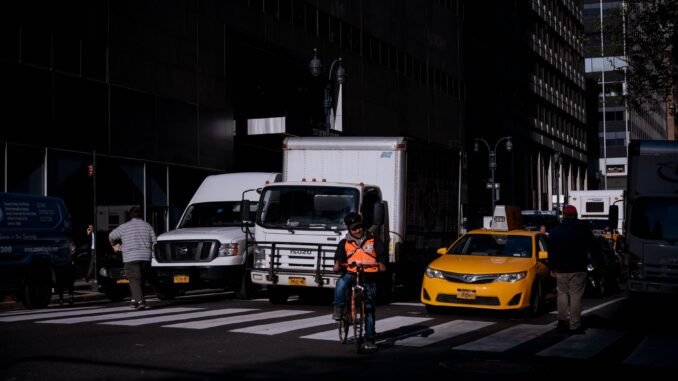
A 15-year-old girl died Saturday after the Citi Bike she was riding with a second teenager was struck by a truck making a turn in Manhattan’s East Village, according to the New York Times. The surviving girl, 16, was listed in stable condition following the crash, the paper reported. The collision happened Friday, based on the timing of the Times report published early Saturday morning, and it has renewed scrutiny of how trucks and cyclists share narrow Manhattan streets.
The crash: two teens on one bicycle, struck by a turning truck
Both teenagers were riding on a single Citi Bike when a truck turning at an intersection struck them, the New York Times reported. The younger girl, 15, did not survive. Riding two-up on one bike violates Citi Bike’s terms of service, but how the girls ended up sharing a ride hasn’t been explained publicly beyond the fact that they were together when the truck hit them.
Where and when the collision occurred
The crash took place in the East Village, a dense residential and commercial neighborhood on Manhattan’s Lower East Side with narrow streets, heavy foot traffic and frequent delivery truck activity. The New York Times published its report at 12:45 a.m. Eastern time, meaning the collision happened in the hours before that. No specific cross streets or intersection details were included in the available reporting.
Condition of the surviving 16-year-old
The 16-year-old girl who was riding with the victim survived and was in stable condition, according to the New York Times. No further details on the nature or severity of her injuries, or on her recovery timeline, have been released.
What remains unknown: details investigators have not yet released
A lot about this crash is still unreported. The exact intersection, the time of day, the direction the truck was turning, and the type or size of the vehicle involved haven’t been specified in available coverage. It’s also unclear whether the truck driver stopped at the scene, whether any citations or charges have been issued, or which agency is leading the investigation. The New York Times report that broke the story didn’t include comment from the NYPD, Citi Bike’s operator, or the truck’s driver or company. Those details typically surface in the days after a fatal crash, once police release preliminary findings and, sometimes, footage from nearby traffic or security cameras.
Citi Bike’s rules on underage riders and how two teens ended up sharing one bike
Citi Bike sets minimum age and usage requirements for riders, and its bikes are built for a single occupant. Two teenagers riding the same bike at the time of the crash raises obvious questions about how they got access to it and why they rode together on a one-rider vehicle. Bike-share systems in New York generally require users, or an adult account holder, to accept terms limiting use to one rider per bike and setting age minimums for renting. Nothing in the available reporting says how the girls got access to the bike or whether an adult’s account was used to unlock it. That detail, like much of what happened, hasn’t been made public yet.
Truck turning accidents and cyclist safety in Manhattan’s East Village
The East Village sits in a part of Lower Manhattan where delivery trucks, small commercial vehicles and passenger cars routinely compete for road space with a growing number of cyclists, including Citi Bike riders and food-delivery workers on e-bikes. The neighborhood’s grid has several narrow east-west streets and intersections without protected bike infrastructure, conditions safety advocates have long called hazardous when large vehicles turn across a cyclist’s path. This crash adds to a pattern of turning-vehicle collisions that traffic safety researchers and city officials have identified as one of the most persistent threats to cyclists in dense corridors like the East Village.
Why turning trucks pose an outsized risk to cyclists
Turning trucks are dangerous because of blind spots created by the vehicle’s height, length and mirror placement. When a driver turns right or left across a bike lane or adjacent travel lane, a cyclist riding alongside or slightly behind the cab can fall outside the driver’s line of sight. The truck’s turning radius often forces it to swing wide or cut close to the curb, narrowing the space available to a cyclist already committed to crossing the intersection. This dynamic shows up again and again in fatal cyclist crashes across major cities, and it’s why safety advocates have pushed for protected intersections, mandated side guards on trucks, and stricter enforcement of turning speeds.
Broader context: New York City’s push for cyclist safety and where this case fits
New York City has spent the past decade expanding its cycling infrastructure, including protected bike lanes and the Citi Bike network itself, while pursuing Vision Zero, its initiative aimed at eliminating traffic deaths. Despite that expansion, cyclist deaths involving trucks and other large vehicles making turns remain a recurring category of fatal crash citywide. This case, involving a bike-share vehicle and two riders well below Citi Bike’s expected user profile, touches several ongoing debates: how the city polices bike-share misuse, whether current street design protects cyclists from turning vehicles, and how enforcement of truck routes and turning restrictions holds up in dense residential neighborhoods like the East Village.
What comes next: investigation, potential charges, and calls for street redesign
Investigators haven’t disclosed whether the truck driver will face charges, and there’s no public timeline for when the investigation will wrap up. As is standard in fatal New York City traffic crashes, police are likely to review any available camera footage, interview witnesses, and determine whether the driver violated turning or right-of-way rules at the time of the collision. No further medical updates on the surviving 16-year-old have been released beyond her being listed as stable. Advocacy groups that track New York City’s cyclist deaths are likely to cite this crash in renewed calls for protected intersections and stricter truck-turning enforcement in neighborhoods like the East Village, where narrow streets and heavy delivery traffic keep putting cyclists at risk. The next step will be confirmation from the NYPD or the Manhattan District Attorney’s office on whether any charges are coming against the truck’s driver.
Be the first to comment