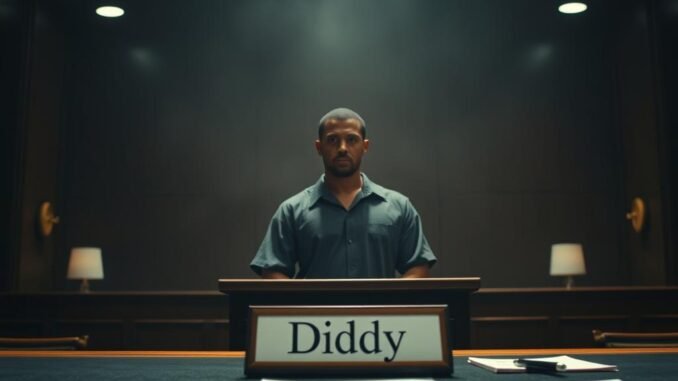

Sean “Diddy” Combs was part of the 1% of federal cases that go to trial. After an eight-week trial in July 2025, a jury found him guilty on two Mann Act counts. These counts involve transporting people for prostitution. He was also found not guilty on other charges.
Cassie Ventura and a woman named “Jane” testified about the planning and funding. Judge Arun Subramanian sentenced him to 50 months in prison and a $500,000 fine. This shows accountability, even considering Combs’ contributions to society.
With one year of time served, he faces about three more years in prison. This is based on national reporting. Now, Diddy’s team is considering appeals and what’s next for him.
Sentencing at a Glance: The Sean Combs Verdict and Prison Term
The sean combs verdict caught everyone’s attention in the music and media world. People wondered if diddy was found guilty and what the verdict would mean for his future. It turned out diddy was guilty on two federal counts, leading to a prison term and a big fine.
Judge Arun Subramanian’s decision and rationale
Judge Arun Subramanian looked at letters about Combs’ good deeds, business success, and family. But he said these things couldn’t erase the wrongdoing in this case. He mentioned abuse of women close to Combs and the importance of accountability.
The judge also talked about Combs’ pride, pointing out his public appearances before sentencing. This showed he didn’t fully understand the gravity of his actions.
50 months in prison and a $500,000 maximum fine
The verdict meant 50 months in prison and a possible $500,000 fine. This was after both sides argued about the evidence, public safety, and the need for a strong message. The ruling confirmed diddy was guilty on the counts that led to these penalties.
Time already served and likely remaining incarceration
Combs has already spent about a year in jail. With time off for good behavior, he has about three years left. This is based on federal rules and his participation in programs.
Statements acknowledging survivors, including Cassie Ventura
Judge Subramanian acknowledged the survivors, including Cassie Ventura, and said their voices were heard. He mentioned the impact statements that called for more time in jail due to fear of retaliation. Combs wrote a letter saying he had lost his way and felt humbled.
His lawyers talked about his cultural and business impact. They said the verdict and the question of whether diddy was guilty would have lasting effects.
What Did Diddy Get Charged With? Understanding the Counts
Many wondered what did diddy get charged with as the case unfolded. The indictment listed several counts for the jury to consider. Each count had its own weight and legal standards.
Acquittals: racketeering conspiracy and sex trafficking
The jury found Sean Combs not guilty on racketeering conspiracy and two sex-trafficking charges. This verdict partially answered the question of was diddy found not guilty. The acquittals also removed the risk of a life sentence from racketeering.
Convictions: two counts under the federal Mann Act
The jury found Combs guilty on two Mann Act counts. These counts relate to transporting people for prostitution. These convictions defined the legal outcome for what did diddy get charged with. Each Mann Act count can carry up to ten years in prison.
How the charges centered on Cassie Ventura and “Jane”
Testimony and evidence focused on Cassie Ventura and a woman called “Jane.” They talked about “freak-offs,” where male escorts were hired, and Combs allegedly watched or recorded. Prosecutors claimed he paid for interstate travel for these encounters. The defense argued participants were willing and there was no broader criminal enterprise.
Related keywords: what did diddy get charged with, what was diddy charged with
The first Mann Act count involved Ventura’s travel. The second count was about “Jane,” with charges filed on April 3. These details help clear up what was diddy charged with. They also address the confusion over was diddy found not guilty on other counts. The mixed verdict makes the legal situation seem complex.
Inside the Mann Act: History, Controversies, and Modern Use
The Mann Act is at the heart of debates on federal power and personal conduct. Reporters often explore its role in high-profile cases and the diddy verdict. They also look into how guilty explanations shape public views. A key question is: was diddy found guilty under this law, and what does it mean for the future?
Origins as the White-Slave Traffic Act of 1910
In 1910, Congress created the law, named after Representative James Robert Mann. It aimed to stop the transport of “any woman or girl” for immoral purposes. The law’s early enforcement mixed morality and crime, a debate that continues today.
Key legal shifts in 1917 and the 1986 gender-neutral update
In 1917, the Supreme Court widened the law’s scope. Later, in 1986, Congress made it gender-neutral. This change replaced old moral terms with modern legal language, guiding court decisions.
How it applies today: interstate prostitution and illegal sexual activity
Today, the law targets interstate travel for prostitution or illegal sex acts. It focuses on whether travel was for a criminal offense. This helps answer questions about the diddy verdict and similar cases.
Notable cases: R. Kelly, Ghislaine Maxwell, Chuck Berry, Jack Johnson
Federal prosecutors have used the Mann Act in famous cases. R. Kelly and Ghislaine Maxwell faced Mann Act charges. Earlier, Chuck Berry and Jack Johnson were also prosecuted under it. These cases highlight the importance of consent, commerce, and travel in guilty explanations.
Recently, analysts have noted the law’s shift from a moral code to a crime-based standard. This change offers a clearer view of the diddy verdict and how juries consider evidence.
Trial Highlights: Evidence, Testimony, and The Court’s View

The eight-week federal trial was fast-paced and intense. Jurors had to consider graphic testimony, travel records, and hotel logs. These were all linked to events across state lines.
The court later noted the need for deterrence. It credited survivor accounts. The defense argued consent and the lack of staff complicity.
Short answer: guilty on two Mann Act counts; not guilty on racketeering and two sex-trafficking counts
From May to July 2025, the jury delivered a mixed verdict. They found Diddy guilty on two counts of transportation for prostitution under the Mann Act. But they acquitted him on racketeering conspiracy and two sex-trafficking charges.
This led to questions about whether Diddy was found not guilty on broader enterprise claims. Media coverage saw it as a narrow but significant win for prosecutors.
Public debate continues on the phrasing, diddy guilty, versus the acquittals. The mixed verdict shaped how both sides described the trial and what each emphasized after the verdict.
What “transportation for prostitution” means in plain English
The Mann Act charge means arranging or causing someone to cross state lines for paid sex. It covers directing travel, booking rooms, or coordinating escorts for illegal sexual activity.
Testimony from Cassie Ventura and a witness identified as “Jane” described “freak-offs” or “hotel nights” with hired male escorts. Sean Combs allegedly directed or filmed these events. “Jane” said she was beaten after refusing; Ventura described being beaten and dragged down a hotel hallway when she tried to leave.
| Element | Evidence Presented | Prosecution Framing | Defense Framing |
|---|---|---|---|
| Interstate Travel | Flight itineraries and hotel bookings tied to multi-state events | Planned movement to facilitate illegal sexual activity | Routine travel for work and social events |
| Escort Involvement | Accounts of hired male escorts at “hotel nights” | Coordinated procurement consistent with prostitution | Consensual adult conduct without criminal intent |
| Direction and Control | Witnesses describing Combs directing or filming | Shows orchestration meeting the Act’s “transportation” element | Voluntary participation; no enterprise or coercion |
| Violence Allegations | Ventura and “Jane” describing beatings tied to events | Corroborates coercive context and illegal purpose | Challenges to credibility and causation |
| Verdict Impact | Guilty on two Mann Act counts; acquittals on others | Supports answer to is diddy guilty on transportation charges | Points to was diddy found not guilty on racketeering and sex trafficking |
How Much Time Is Diddy Facing? Sentencing Guidelines and What Was Possible
The diddy verdict made everyone curious about federal guidelines and possible sentences. People want to know the range, how sentences can add up, and how the sean diddy combs verdict fits into this.
Maximum exposure: up to 10 years per Mann Act count
Each Mann Act count has a maximum of ten years. With two counts, the total could be twenty years if they run one after the other. If they run together, the total is ten years. This framework guided the court’s options after the diddy verdict.
Concurrent vs. consecutive sentences explained
Concurrent sentences mean you serve them at the same time, with the longest one determining the total time. Consecutive sentences mean you serve them one after the other, adding to the total time. The judge considers many factors, including the severity of the crime and the impact on the victim. This decision is key to understanding how much time Diddy could face.
Prosecutors’ ask (at least 11 years, 3 months) vs. defense request (no more than 14 months)
Prosecutors wanted at least 11 years and three months, focusing on the seriousness of the crime. The defense asked for no more than 14 months, highlighting Diddy’s personal history and mitigating factors. These requests shaped the final hearing after the sean diddy combs verdict.
Final outcome: 50 months and what remains after time served
The court decided on a 50-month sentence and a $500,000 fine, aiming to deter others. A request for $1 million bail was denied. With about a year credited, it’s estimated that Diddy could serve roughly three more years, pending calculations by the Bureau of Prisons.
| Sentencing Element | Prosecution Position | Defense Position | Court’s Decision | Practical Impact |
|---|---|---|---|---|
| Statutory Maximum | 10 years per count; up to 20 years if consecutive | Highlight concurrent cap at 10 years | Recognized both pathways | Defines outer limits for how much time is diddy facing |
| Requested Term | At least 11 years, 3 months | No more than 14 months | 50 months | Placed the sean diddy combs verdict within mid-range outcomes |
| Fine | Significant financial penalty | Seek minimal financial burden | $500,000 imposed | Monetary deterrent alongside custody |
| Time Served Credit | Account for custody to date | Maximize credit toward release | Approx. one year credited | Roughly three years likely remain, subject to BOP |
| Bail Post-Verdict | Oppose release | Request $1 million bail | Denied | Custody continues after the diddy verdict |
Why Racketeering Was Hard to Prove
The diddy verdict was all about details. Jurors had to look closely at the claims against strict rules. The focus was on the sean combs verdict and the p diddy verdict, but racketeering was different. It needed proof of a group working together, not just individual wrongdoings.
What racketeering requires under federal law
Federal RICO law asks for an “enterprise” and a pattern of crimes that help it. Prosecutors must show at least two acts that are connected by a common goal. These acts must be more than similar; they must be coordinated and ongoing.
This standard is tough. Jurors look for signs of structure, like roles and methods. Without clear evidence of shared goals, proving an enterprise is hard.
The role of employees and alleged “freak-offs” in prosecutors’ theory
Prosecutors said staff helped plan and arrange alleged “freak-offs,” handling travel and logistics. They argued this showed an organized network serving one aim. The theory linked schedules, venues, and movement to a broader system.
The defense argued that employees managed routine tasks, not illegal acts. If staff were not present or knowingly involved, the enterprise link weakens. This gap mattered in the diddy verdict narrative as much as in the sean combs verdict headlines.
Why the jury acquitted on the racketeering conspiracy count
Jurors needed proof that at least two crimes were done to conduct an enterprise, with agreement among members. Testimony about coercive “freak-offs” and other alleged acts did not, on its own, prove coordinated enterprise control. The p diddy verdict reflects that distinction.
Analysts like Robert Mintz pointed out RICO’s high burden and need for clear patterns. The jury’s split outcome shows how intent, structure, and shared purpose can decide a case.
| Element | What Law Requires | What Prosecutors Claimed | What Jurors Likely Weighed |
|---|---|---|---|
| Enterprise | Ongoing group with roles and purpose | A network of associates around Combs | Whether staff actions showed shared intent |
| Pattern of Racketeering | At least two related predicate acts | Logistics tied to alleged “freak-offs” and coercion | If acts were coordinated, not isolated |
| Agreement | Knowing participation in the scheme | Employees facilitated travel and setups | Evidence that staff knew and agreed |
| Continuity | Ongoing or long-term criminal conduct | Repeated planning across events | Proof of durable structure over time |
| Outcome Context | Meets all RICO elements beyond a reasonable doubt | Enterprise built around alleged encounters | Acquittal on conspiracy in the diddy verdict and sean combs verdict |
The Role of ‘Hubris’ and Character in Sentencing
Prosecutors called out Sean Combs for booking a Miami event before his sentencing. They saw it as a sign of confidence in his quick release. The judge looked at Combs’ character, history, and the need to deter others, along with the crime.
Judge Arun Subramanian praised Combs for his rise as a mogul and his charity work. He also noted Combs’ family devotion but mentioned abuse allegations. Survivor letters, including one from Cassie Ventura, warned of retaliation risks.
Combs wrote, “I lost my way,” showing care for his children and mother. His supporters talked about jobs and scholarships. The judge called survivors brave, showing the impact and safety concerns mattered.
Public actions can change how we see someone. A big event in Miami or quiet service can show sincerity. In this case, Combs’ confidence was seen as a negative.
Letters, charity, and remorse can help get a lighter sentence. But survivor impact and the need to deter can push for a harsher sentence. It all depends on credibility and context.
| Sentencing Factor | What the Court Considered | Illustrative Details | Influence on Outcome |
|---|---|---|---|
| Character and History | Career, philanthropy, family responsibilities | Business success; scholarships; seven children; elderly mother | Weighed as mitigating, but not decisive |
| Remorse and Acceptance | Content and timing of statements | Letter with “I lost my way”; public messaging before sentencing | Credibility assessed against conduct |
| Victim Impact | Safety fears and trauma descriptions | Letters from survivors, including Cassie Ventura | Supported continued incarceration |
| Public Conduct | Signals of humility vs. overconfidence | Miami speaking engagement highlighted as “hubris” | Undercut mitigation narrative |
| Deterrence and Protection | Need to deter similar conduct and safeguard victims | Judge praised “brave survivors” and said, “We heard you” | Aligned with a significant sentence |
| Legal Context | Guidelines and statutory aims | Nature of the offense balanced with personal history | Framed the final calculation |
The Broader Legal Landscape: Lawsuits, Public Evidence, and Reputational Fallout

The criminal case settled the core question of what was diddy found guilty of, yet the public lens widened fast after diddy’s verdict. Civil claims, leaked evidence, and brand reactions now shape the narrative that follows the courtroom.
More than 100 intended or filed civil suits, per plaintiffs’ counsel
Attorney Tony Buzbee said more than 100 women and men across the United States had filed or intended to file lawsuits. They allege rape, assault, drugging, and coercion tied to promised career opportunities. Many claims reference high-profile parties and industry gatekeeping. These filings surged in the wake of diddy’s verdict and ongoing media coverage.
Counts vary by state law and venue, and several suits name additional individuals or companies. While the criminal record answers what was diddy found guilty of, the civil docket spans a much broader set of conduct and timelines.
The 2016 hotel video and subsequent public apology
In 2024, CNN published 2016 hotel surveillance footage depicting Sean Combs kicking Cassie Ventura while she was on a hallway floor. Soon after, he issued a public apology, stating, “I take full responsibility for my actions in that video.” The clip reshaped public perception beyond diddy’s verdict and pressures that arose around corporate partnerships.
The video became a focal point for plaintiffs’ lawyers and advocacy groups. It also fueled discussions about how misinformation and high-profile trials can collide with viral content, accelerating reputational damage even before depositions or discovery conclude.
How civil actions differ from criminal convictions
Civil cases use a lower burden of proof—usually a preponderance of the evidence—unlike criminal trials. That difference means outcomes may diverge from what was diddy found guilty of in federal court. Monetary damages, injunctions, and settlements are common endpoints.
Because discovery can be extensive, filings often surface emails, contracts, and messages that never appeared at trial. As these records circulate, diddy’s verdict remains part of the story, but civil fact-finding can extend the news cycle and intensify scrutiny.
Defense responses to the wave of lawsuits
Combs’ legal team has described the suits as publicity-driven and meritless, pledging to contest them case by case. They emphasize that diddy’s verdict does not predetermine liability in civil forums. Strategy has focused on challenging credibility, timelines, and jurisdiction.
Defense attorneys also point to settlements that include no admission of wrongdoing, while plaintiffs highlight patterns of conduct. Even so, what was diddy found guilty of is frequently cited in complaints to frame context, as both sides prepare for motions and possible depositions.
| Dimension | Criminal Case | Civil Litigation | Reputational Impact |
|---|---|---|---|
| Burden of Proof | Beyond a reasonable doubt | Preponderance of the evidence | Public opinion shaped by coverage and visuals |
| Scope of Claims | Narrow, tied to specific counts | Broad patterns across venues and years | Extends beyond diddy’s verdict to conduct narratives |
| Evidence Flow | Strict admissibility rules | Expansive discovery and filings | Viral clips and archives influence perception |
| Outcomes | Convictions or acquittals | Damages, settlements, injunctions | Brand deals, partnerships, long-term trust |
| Timeline | Fixed by trial and sentencing | Staggered cases over years | Prolonged cycles post-sentencing |
What Comes Next: Appeals, Prison Time, and Possible Release Timeline
With sentencing done, everyone wonders what’s next. Questions pop up: will diddy be convicted on appeal, what does the sean diddy combs verdict mean for the next steps, and how much time is diddy facing under federal rules after credits?
Appeal options and likely arguments
His legal team might challenge the Mann Act rulings. They could argue about how the court applied “transportation for prostitution.” They might also question evidentiary calls, jury instructions, or procedural limits.
They could raise constitutional claims tied to due process or the scope of federal power. Appeals go through the Second Circuit on a set schedule. Briefing windows, response deadlines, and oral argument dates can stretch across many months.
During that time, the sean diddy combs verdict stays in place unless a stay is granted.
Credit for time served and estimated three years remaining
With a 50‑month term, public reports say about three years left after credit for time already served. The Bureau of Prisons will calculate good‑time credits and any earned‑time benefits. This can change the date by weeks or months.
Calculations in federal cases are routine. For readers asking how much time is diddy facing, the answer depends on custody credits, good‑time rules, and program eligibility, not a single fixed number.
Conditions, fines, and possible supervision post-release
The court also ordered financial penalties, including a $500,000 fine. After release, standard federal conditions can apply. These include supervised release, travel approvals, and compliance checks.
Program participation, employment, and counseling requirements are common in similar cases. Each condition ties back to risk management and reintegration, not the sean diddy combs verdict alone.
- Custody: remaining term shaped by credits and program eligibility.
- Financial: mandatory fine and assessments.
- Supervision: reporting duties and possible restrictions.
As appellate steps unfold, observers keep asking will diddy be convicted after review or see relief on specific counts. For now, practical timelines depend on the docket, credit math, and how much time is diddy facing under current calculations.
Conclusion
Was diddy found guilty? Yes. He was found guilty on two Mann Act counts for transporting women for prostitution. This included Cassie Ventura and “Jane.”
He was not found guilty of racketeering conspiracy or two sex-trafficking counts. This shows how hard it is to prove an organized crime group. Judge Arun Subramanian sentenced him to 50 months in prison and a $500,000 fine.
This was to deter others and because of the survivor’s testimony. The Mann Act has a long history. It started in 1910 and has changed over time.
It was updated in 1986 to include both men and women. This law has been used in many famous cases. It helped the jury understand the case better.
With about a year already served, he will spend about three more years in prison. The verdict is not the end. Civil suits are also ongoing.
These suits are because of a 2016 hotel video and his apology. This shows he will face legal and financial challenges after his prison time.
The case answered the question of guilt. But it also raises bigger questions about power, consent, and accountability. What diddy was found guilty of is now part of history. The impact of this verdict will be seen outside the courtroom.
Be the first to comment