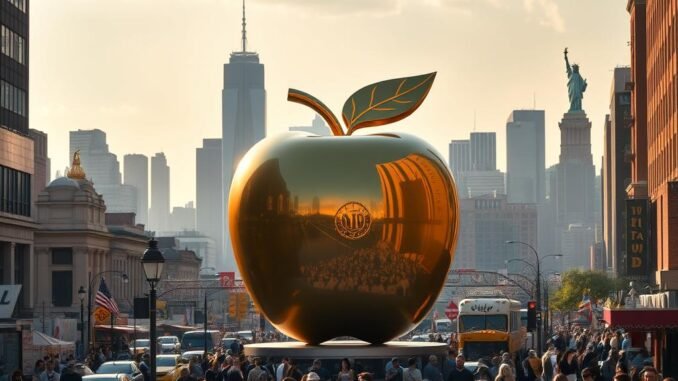

In 1997, New York City named a corner in Midtown “Big Apple Corner.” This was to honor the phrase that now defines it. The sign is at West 54th Street and Broadway. It shows how a racetrack slang term became the city’s most famous nickname.
Many ask, what is New York’s nickname? And what has New York been called in history and pop culture? The answer is always the big apple. The term was first used in the 1920s by John J. Fitz Gerald of the New York Morning Telegraph.
Then, in the 1970s, city tourism leaders brought it back. Researchers Barry Popik and Gerald Cohen later uncovered the truth. They debunked myths and set the record straight.
Today, the big apple is one of New York’s nicknames. It’s alongside “Gotham,” “Empire City,” and “The City That Never Sleeps.” But this phrase captures the city’s spirit best. It connects horse racing, jazz clubs, and a bold tourism effort into one image. This image shows what New York is and what it will be next.
What is the nickname for New York City and what does “The Big Apple” mean?
In newspapers and on TV, New York City is often called “The Big Apple.” When people ask about New York’s nickname, this is the answer they usually get. It’s used in headlines, ads, and everyday talk, showing the city’s grandeur.
What is New York City’s nickname?
Locals and writers often call NYC “The Big Apple.” It’s the most common nickname for the city. Unlike other names, it refers to the city itself, not just a part of it.
Journalists worldwide use it for catchy headlines. It clearly answers what New York is called, adding a touch of prestige. Over time, it became the go-to nickname in media.
The Big Apple meaning in culture and media
The term “The Big Apple” has evolved from a racetrack prize to a symbol of excellence in arts and business. In music and movies, it represents a place where talent can shine. From jazz in Harlem to Broadway, it symbolizes opportunity and ambition.
Radio hosts, song lyrics, and late-night shows keep the idea alive. Ad campaigns with red apples made it instantly recognizable. Searching for “The Big Apple” reveals a mix of culture, ambition, and global appeal.
How “The Big Apple” became synonymous with NYC
As the term moved beyond sports, it started appearing in city stories. By the late 1920s, it was used in lifestyle and gossip columns. Stars and brands soon followed, making it a staple in public discourse.
Tourism efforts and celebrity endorsements solidified the nickname. Over the years, the answer to “What is New York’s nickname?” became clear: The Big Apple.
| Question | Short Answer | Why It Matters | Where You’ll See It |
|---|---|---|---|
| What is the nickname for New York? | The Big Apple | Recognized across the U.S. and abroad | Headlines, signs, souvenirs |
| Nickname for NYC in media? | The Big Apple | Sets tone of prestige and scale | TV intros, radio tags, streaming titles |
| The Big Apple meaning? | Pinnacle of opportunity and culture | Links ambition with place | Tourism slogans, arts coverage |
| What do they call New York in ads? | The Big Apple | Instant brand recognition | Campaign posters, billboards |
Early mentions: from metaphors to monikers
Before it became famous, writers used “big apple” as a metaphor. This early use helped shape the nickname of New York. It shows how the nickname evolved over time.
1909 metaphor in The Wayfarer in New York
In 1909, Edward Sandford Martin wrote in The Wayfarer in New York. He called New York the “big apple” that gets a lot of energy from the country. This was more of an image than a fixed nickname.
Later, columnists and lexicographers noted this passage as the earliest known print flash of the idea. But it was not yet a fixed nickname. It used metaphor to highlight New York’s influence.
Why early uses weren’t yet a city nickname
In the 1920s, the Chicago Defender quoted “Ragtime” Billy Tucker using “big apple” for New York and even Los Angeles. This showed the phrase was not yet fixed as New York’s nickname.
Because it was used in different places, it didn’t feel like a single, stable nickname. It wasn’t until later that it became widely accepted.
Debunking false origins and hoaxes
Myths about the phrase’s origins have circulated. But researchers like Barry Popik and Gerald Cohen have debunked these. They found the phrase’s true origins in racetrack and jazz contexts. Their work is detailed in the Big Apple history section.
As these myths fade, the true story of the nickname becomes clearer. This clarity shows how the nickname gained acceptance in both print and everyday speech.
| Year | Source | Context of “big apple” | Why it wasn’t yet the city’s fixed nickname |
|---|---|---|---|
| 1909 | Edward Sandford Martin, The Wayfarer in New York | National-sap metaphor casting New York as a prized fruit | Used as imagery; not presented as an official tag answering what is new york called |
| 1922 | Chicago Defender citing “Ragtime” Billy Tucker | Casual references to New York, then Los Angeles | Term floated between cities, so not yet the nickname of New York |
| 1920s | Early press and conversation | Loose slang across entertainment and travel notes | Lacked consistent, city-anchored repetition to define what is new york city’s nickname |
Horse racing roots: John J. Fitz Gerald and the racetrack circuit
To understand why it’s called the Big Apple, look to the track. In the 1920s, horse racing shaped language and odds. Writers, riders, and bettors exchanged slang from barn to backstretch.
How a Morning Telegraph sportswriter popularized the phrase
John J. Fitz Gerald of the New York Morning Telegraph first used the term on May 3, 1921. He saw New York as the ultimate goal, a city that made winners. In 1924, he wrote that the dream for horsemen had one true name.
This explains why New York is called the Big Apple in racing. For trainers and owners, it meant winning the highest purse and the brightest stage.
Stablehands in New Orleans and the “big apple” of racetracks
Fitz Gerald credited two African American stablehands at the Fair Grounds in New Orleans for the phrase. They called New York the “big apple” on the circuit, where the stakes were richest.
This path shows why New York City is called the Big Apple in sports talk. By 1920 and after, the phrase moved with horses, grooms, and writers from Louisiana to Long Island.
“Around the Big Apple” column and its influence
Fitz Gerald’s column, Around the Big Apple, repeated the phrase until it stuck. It linked barns, bookmakers, and Broadway, showing the apple meant New York’s peak.
As the term spread to other writers, it answered why NYC is called the Big Apple. The idea left the paddock and entered everyday speech.
Big Apple Corner at 54th Street and Broadway
In 1997, Mayor Rudy Giuliani named the southwest corner of West 54th Street and Broadway “Big Apple Corner.” It was near where Fitz Gerald lived for decades. The city marked how the racetrack nickname rooted itself in Midtown life.
The honor echoes why New York is called the Big Apple today. A phrase born in racing, reinforced in print, and etched into the streets where the writer walked.
From the tracks to the bandstands: jazz, Harlem, and 1930s pop culture
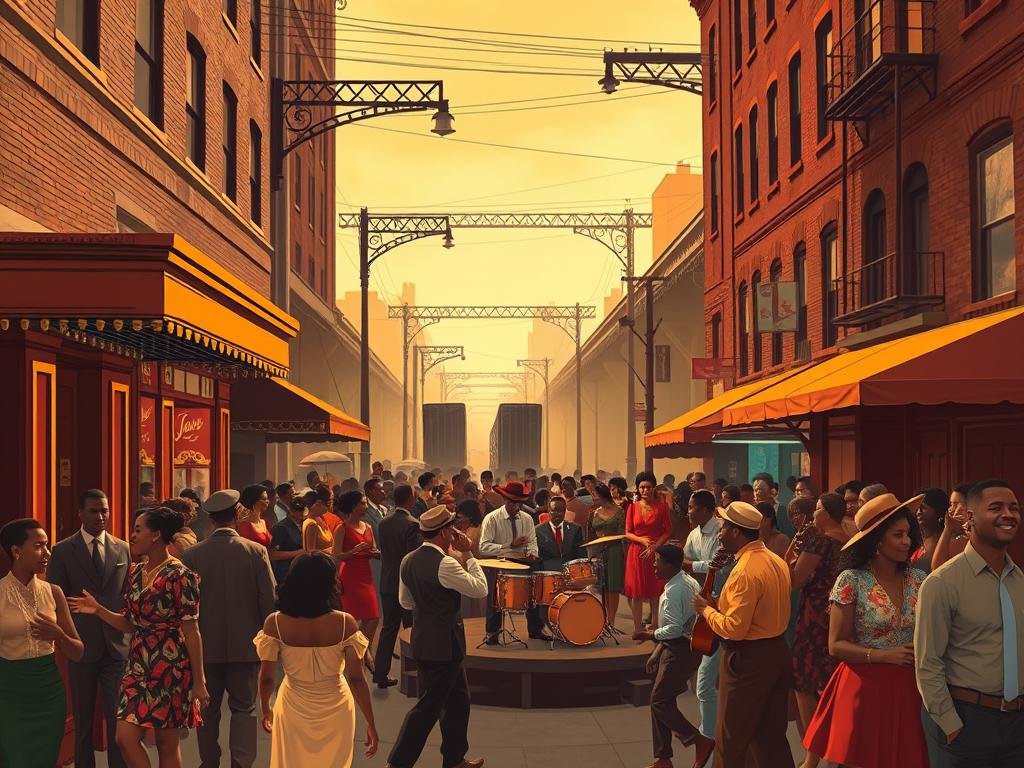
In the 1930s, the term “the big apple” moved from racetracks to bandstands. Writers, musicians, and club owners saw New York City as a place of opportunity. In Harlem, this phrase took on a new meaning, attracting a wider audience.
Jazz musicians and Harlem’s embrace of the nickname
Bandleaders and musicians flocked to Harlem, drawn by the city’s vibrant energy. At places like the Savoy Ballroom and the Cotton Club, stars like Duke Ellington and Benny Goodman performed. Harlem celebrated the big apple as a symbol of excellence in music.
Traveling musicians saw New York as the pinnacle of their careers. Success in Harlem meant their music could reach far and wide. The big apple became synonymous with achieving greatness in the music world.
Clubs, songs, and the 1937 Big Apple dance craze
By the mid-1930s, clubs and songs were named after the big apple. In 1937, the “Big Apple” dance craze swept the nation. It was featured in movies, including Mickey Rooney’s Love Finds Andy Hardy.
The dance craze not only sold steps but also promoted the city. People from all over the country followed Harlem’s rhythm. Each dance move connected back to New York’s vibrant nightlife.
Why performers said there’s only one Big Apple
Entertainers believed there was only one true big apple. It represented the pinnacle of success, the toughest audience, and the highest standard. For them, the big apple was not just a nickname but a badge of honor.
Artists sought the approval of Harlem’s audiences because it defined their careers. New York City was the stage where talent and ambition met. It was where a simple nickname became a measure of greatness.
The 1970s revival: tourism, branding, and city pride
In the 1970s, New York faced tough times. Budget cuts and worries were everywhere. Yet, the city needed a symbol of hope.
People wondered, why do they call New York the Big Apple? Could this phrase bring back the city’s sparkle? Tourism leaders believed it could, and they set out to show it.
NYC’s fiscal crisis and the search for a unifying image
The early 1970s brought bad news: debt, crime, and decline. But civic leaders knew visitors wanted a positive story. So, “The Big Apple” became more than a slogan; it was a beacon of hope and second chances.
Even with layoffs and service cuts, the nickname held strong. It reminded everyone that New York was the ultimate prize. It was a symbol that both locals and visitors could rally behind.
Charles Gillett, Ogilvy & Mather, and the Big Apple campaign
Charles Gillett, leading the New York Convention and Visitors Bureau, teamed up with Ogilvy & Mather. They worked with Bill Phillips to launch a city-wide campaign. It was all about showing the city’s bright side.
They asked, why call New York the Big Apple when things seem tough? They answered by turning the city’s grit into its charm. Media, press kits, and visuals all told the same story: come see the city’s comeback for yourself.
How red apples, pins, and celebrities spread the nickname
Red apples appeared everywhere: on subways, buses, and in newspapers. T-shirts, pins, and stickers were in shops and arenas. The slogan “take a bite out of the Big Apple” encouraged action, not just admiration.
Local stars like New York Knicks legend Dave DeBusschere supported the campaign. As the campaign grew, so did the pride in the nickname. Travelers and locals alike repeated the phrase with joy.
By 1997, Mayor Rudy Giuliani noted the nickname’s success. It had surpassed “Fun City” as the world’s symbol for New York. Today, “The Big Apple” represents resilience, welcome, and progress.
New York Nickname in everyday life and sports
Walking a few blocks in any borough, you’ll see the city’s spirit everywhere. People often ask about New York’s nickname with a smile. The answer is clear in ballparks, theaters, and on screens everywhere. For those new to the city, the nickname comes alive in daily life.
Mets Home Run Apple: from Shea to Citi Field
Every Mets home run brings up the Home Run Apple. It started at Shea Stadium and now welcomes fans at Citi Field. A bigger apple lights up inside after a home run. This symbol is a big part of New York City’s identity.
Big Apple Circus and citywide references
The Big Apple Circus began in Manhattan in 1977. It brought excitement to parks and arenas. Today, you see the nickname everywhere, from subway art to parade floats. Even newcomers know why New York is called the Big Apple.
For more on the nickname’s history, check out this nickname history.
Lyrics, films, and TV that keep the nickname alive
Pop culture often references New York’s nickname in fun ways. Michael Jackson sings about taking a bite of the Big Apple in “Human Nature.” Anchorman 2 jokes about apple trees on every corner. The Real Housewives of New York City even use apples in their opening shots.
Radio has also played a role. A 1950 chat between Frank Sinatra and Dorothy Kirsten mentioned the city’s nickname. This helped make the nickname a part of everyday conversation.
What New York was called before “The Big Apple”
Before we knew New York as “The Big Apple,” it had other names. These names came from its role in trade and empire. Understanding these names helps us see how the city’s identity changed over time.
From New Amsterdam to New York
In 1624, Dutch settlers built a fort and market in Manhattan. They named it New Amsterdam, the center of New Netherland. It was a key spot for fur trading and Atlantic shipping.
In 1664, the English took over and renamed it New York. This was in honor of the Duke of York. This change is why we often ask what is new york called today.
Other nicknames: Gotham, Empire City, and The City That Never Sleeps
Before “Big Apple,” New York had other nicknames. Washington Irving made Gotham famous in the 19th century. It gave the city a clever, literary feel.
As New York grew, it became known as Empire City. This name showed its ambition and reach. Later, its lively nightlife earned it The City That Never Sleeps. These names show how New York’s nickname has evolved over time.
Why do they call New York the Big Apple today?
Many wonder what nickname New York City has and why it’s called the big apple today. The answer is simple. It’s used in headlines, on T-shirts, and during tours. It symbolizes energy, culture, and a goal worth striving for.
The nickname’s roots are deep. Jazz, racetracks, and dance floors helped shape it. A 1970s campaign made it a symbol on posters and ads. Now, it’s clear why New York is called the big apple: it’s familiar, lively, and known worldwide.
City landmarks make the nickname official. Big Apple Corner at 54th Street and Broadway is a visible reminder. Sports, like the Mets’ Home Run Apple, keep the name alive for newcomers.
Celebrities, late-night shows, and travel features keep the nickname alive. When people ask about New York’s nickname, they get a quick answer. Locals point to pride, excitement, and a city that rewards hard work.
Today, the phrase is a quick way to understand the city’s spirit—bold, public, and always ready for the stage.
| Modern Anchor | How It Reinforces the Name | Example in Use |
|---|---|---|
| Journalism and Headlines | Frequent mentions cement recall and authority | National papers call it “the Big Apple” in travel and arts coverage |
| Tourism Branding | Merchandise and campaigns normalize the phrase | Red-apple logos on pins, posters, and transit ads |
| Public Landmarks | Official signs validate tradition | Big Apple Corner at 54th Street and Broadway |
| Sports Traditions | High-visibility rituals reach mass audiences | Mets’ Home Run Apple at Citi Field |
| Entertainment Media | Film, TV, and music echo the nickname worldwide | Late-night monologues and artist shout-outs |
Conclusion
The story of New York’s nickname is a fascinating journey. It started as a 1909 metaphor. Then, it became racetrack slang in the 1920s under John J. Fitz Gerald.
It later made its way to jazz clubs and 1930s pop culture. Researchers Barry Popik and Gerald Cohen uncovered this history. They cleared up myths, answering what New York’s nickname is and why it’s called the Big Apple.
In the 1970s, the nickname saw a resurgence. Charles Gillett and the New York Convention and Visitors Bureau used red apples and upbeat ads. Bill Phillips’ creativity and celebrity endorsements made it a global term.
City Hall marked “Big Apple Corner” to honor Fitz Gerald. The Mets’ Home Run Apple and the Big Apple Circus keep the spirit alive.
Today, the nickname tells a story of ambition and style. It reflects New York’s pulse. So, what does New York’s nickname mean to the world? It’s the Big Apple, a name that tells a true New York story.
Be the first to comment