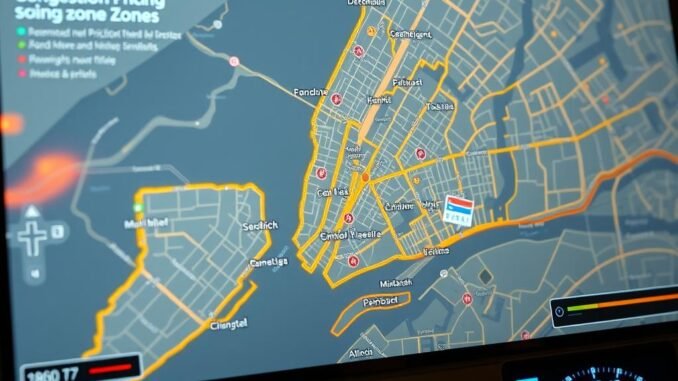

The Metropolitan Transportation Authority says congestion pricing could cut Manhattan traffic by up to 17%. This change starts when a vehicle turns onto local streets at or below 60th Street. This guide will explain the costs, hours, and routes involved. It also covers where you might get exemptions or credits to lower your bill.
Use the official congestion pricing map from the MTA to see exact boundaries and ramps. If you’re wondering, “where is the congestion zone in nyc,” the new york congestion pricing map and its toll calculator are your best friends. They provide clear directions on when a daily charge applies to cars and motorcycles. They also show how trucks or buses are tolled on every entry.
Many drivers will pay less with E‑ZPass because it links to a license plate and avoids higher Tolls by Mail. There’s a 60‑day grace period with no extra fees through March 5, 2025. Unpaid transactions dated March 6 and later can incur costs. Time Out New York notes that highways like FDR Drive and Route 9A remain toll‑free unless a driver exits into the zone—details you’ll also find on the congestion pricing map.
Whether planning a daily commute or a weekend drop‑off, this overview of congestion pricing nyc covers the manhattan congestion fee, operating hours, and who qualifies for relief. The sections ahead break down rates, overnight discounts, tunnel crossing credits, and exemptions—plus how to read the new york congestion pricing map with confidence.
What congestion pricing is and how the Manhattan Congestion Relief Zone works
New York’s plan charges drivers to enter the busiest areas. This makes streets move better and helps fund transit. The congestion pricing nyc map shows the zone in Midtown and Lower Manhattan, where traffic is heavy.
Definition and goals: less traffic, cleaner air, safer streets
Congestion pricing is a toll for vehicles in high-demand areas. It aims to reduce cars, speed up trips, and improve air quality. It also funds the MTA to upgrade signals and trains, making streets safer.
Where the zone applies: local streets and avenues south of and including 60th Street
The zone covers streets and avenues at 60th Street and below. This answers where are the congestion tolls in nyc and shows the nyc congestion tax map. The Lincoln, Holland, and Hugh L. Carey tunnels, plus East River bridges, are key entry points.
For a clear view, see this NYC congestion pricing maps guide that outlines the area and entries.
Excluded roadways: FDR Drive, West Side Highway/Route 9A, Hugh L. Carey Tunnel connections
Some routes are toll-free if drivers stay on them. The FDR Drive and West Side Highway/Route 9A are excluded. So are the Hugh L. Carey Tunnel connections to West Street. Use them as bypasses to avoid the charge.
When you’re tolled for exiting excluded roads onto local streets
Exit an excluded highway onto a local street in the zone and you’re charged. This rule captures trips that add to congestion. It’s the practical answer to where is congestion pricing in nyc when moving from a highway to an avenue.
Drivers crossing from the Bronx or Upper Manhattan are tolled at 60th Street. This matches what a detailed nyc congestion tax map or any vetted congestion pricing nyc map would show.
Operating hours and peak vs. overnight periods
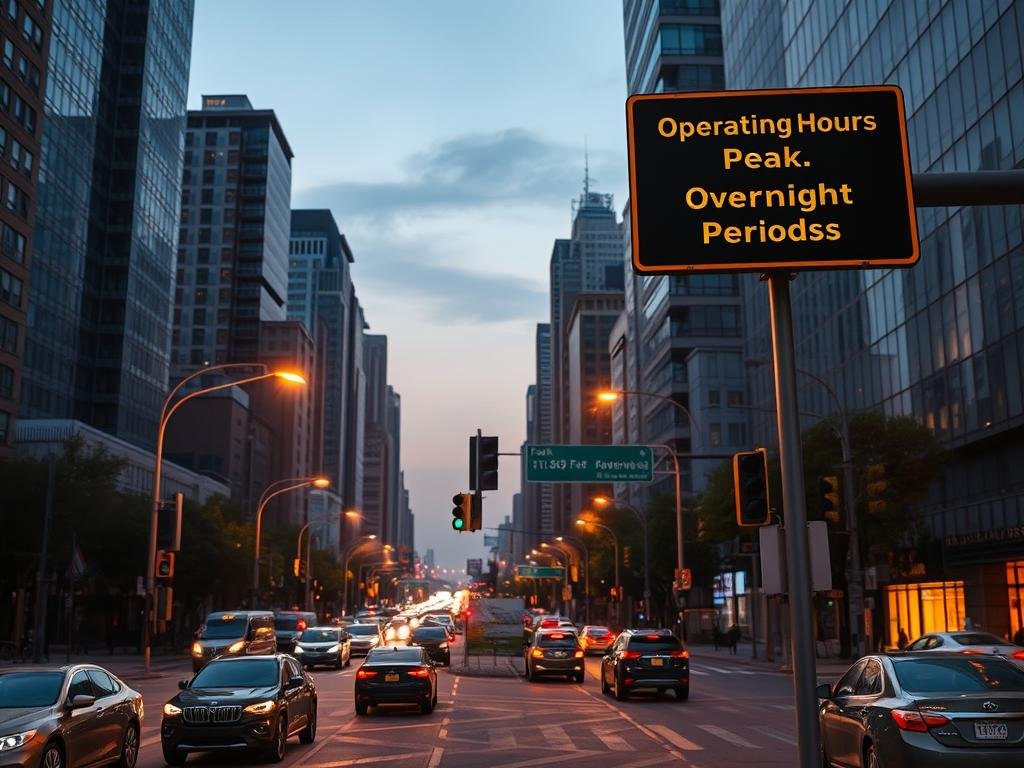
Daily schedules affect how much drivers pay in the Manhattan Congestion Relief Zone. For those using congestion pricing nyc: map tools, timing is key. It influences trip planning, delivery times, and how to handle manhattan surge pricing.
Weekday peak hours: 5 a.m.–9 p.m.
Full tolls apply Monday to Friday, from early morning to evening. Drivers entering between 5 a.m. and 9 p.m. face the peak schedule. This aligns with manhattan surge pricing and what many congestion pricing nyc: map overlays show for planning.
Weekend peak hours: 9 a.m.–9 p.m.
On Saturday and Sunday, the peak hours start later. From 9 a.m. to 9 p.m., higher daytime rates apply for all vehicles. Before brunch or a show, visitors often check where is the congestion zone in nyc. The same peak rules apply for entry.
Overnight rates: 75% lower than peak
Outside these times, tolls are about three-quarters lower. Overnight entries get a big discount, no matter the vehicle type. Freight operators often plan trips for these hours. Commuters check congestion pricing nyc: map to avoid manhattan surge pricing during the day.
Tip: Confirm the exact clock before driving—minutes matter at the edge of each period, specially if you’re judging where is the congestion zone in nyc and planning your route.
Cost breakdown by vehicle type
Travelers can use the manhattan congestion pricing map, ny congestion pricing map, or congestion toll nyc map to figure out costs. The rates below are current MTA-published E‑ZPass prices. They apply when a vehicle enters the zone during the set hours.
Passenger cars and small commercial vehicles: $9 peak, $2.25 overnight with E-ZPass
Sedans, SUVs, pickups, and small vans cost $9 during peak hours with E‑ZPass. At night, it’s $2.25. These vehicles are charged once a day, even if they go back into the zone.
Motorcycles: $4.50 peak, $1.05 overnight with E-ZPass
Motorcycles are charged $4.50 during peak times with E‑ZPass. At night, it’s $1.05. Like cars, motorcycles are charged only once a day.
Small trucks and some buses: $14.40 peak, $3.60 overnight
Single‑unit trucks and some buses cost $14.40 at peak and $3.60 at night. Unlike cars, trucks and buses are charged every time they enter the zone.
Large trucks and tour buses: $21.60 peak, $5.40 overnight
Multi‑unit trucks and tour buses cost $21.60 during peak hours and $5.40 at night. Each entry is charged. The MTA says some buses and specialized vehicles might be exempt.
| Vehicle category | Peak E‑ZPass | Overnight E‑ZPass | Daily/Per‑Entry Rule | Map reference |
|---|---|---|---|---|
| Passenger cars & small commercial | $9.00 | $2.25 | Once per day | manhattan congestion pricing map |
| Motorcycles | $4.50 | $1.05 | Once per day | ny congestion pricing map |
| Small trucks & some buses | $14.40 | $3.60 | Every entry | congestion toll nyc map |
| Large trucks & tour buses | $21.60 | $5.40 | Every entry | manhattan congestion pricing map |
For planning routes, check entry points on a congestion toll nyc map. Also, look at the official zone limits on the manhattan congestion pricing map. The ny congestion pricing map helps see where charges apply and how time of day affects tolls.
Payment methods, E-ZPass vs. Tolls by Mail, and billing timeline
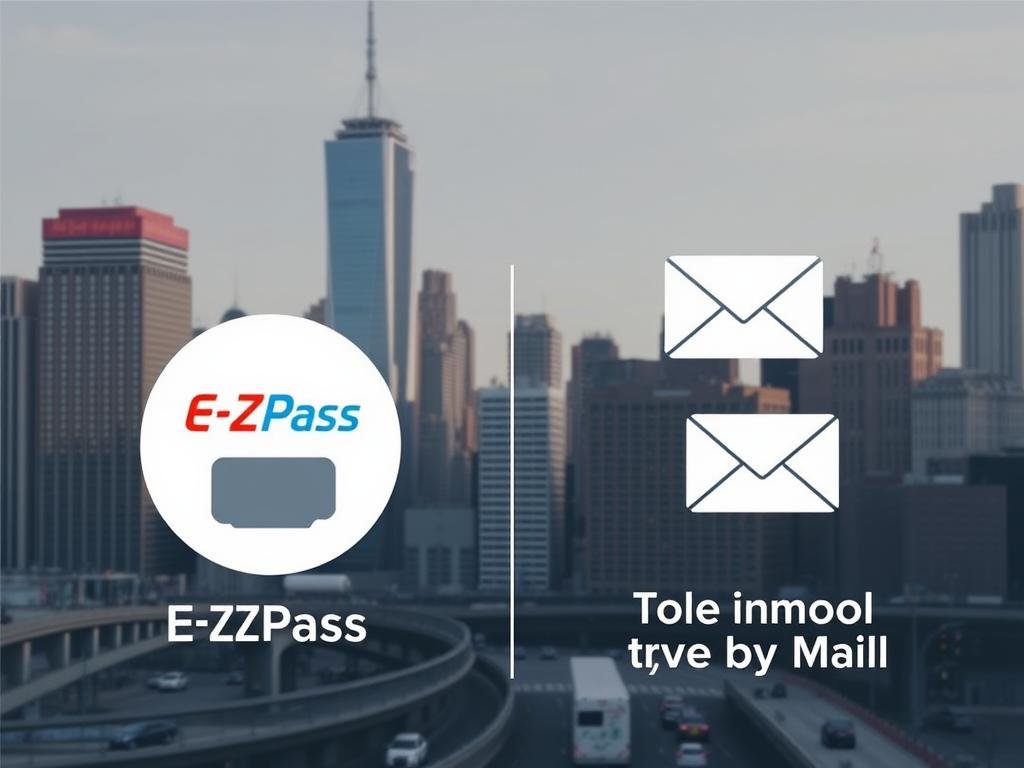
New Yorkers have two easy ways to pay for nyc congestion tolls. Automatic reads by congestion pricing nyc cameras match plates to an account or a mailed invoice. The nyc congestion pricing map shows where these charges trigger, but the way they pay changes what a driver owes.
E-ZPass delivers the lowest rate at the new zone. It works the same way it does on bridges and tunnels, and it is accepted by the MTA for this program.
E-ZPass best rate and license plate linkage
With E-ZPass, the tag and plate must match the account to secure the best price. Drivers should confirm the current license plate is linked before heading below 60th Street. New York-issued E-ZPass users can update details on the E-ZPass NY site, while out-of-state users should check their home agency.
This match helps congestion pricing nyc cameras post the correct toll without delay. It also speeds up any review tied to the nyc congestion pricing map and keeps bills predictable.
Tolls by Mail: higher rates and mailed invoices
Without E-ZPass, drivers are billed via Tolls by Mail at a higher rate. An invoice goes to the registered owner at the address on file. Payment windows and due dates appear on that bill, so they should watch the mailbox and pay on time.
Tolls by Mail relies on the same congestion pricing nyc cameras, but the lack of an account means less discounting and more risk of late fees. For frequent trips shown on the nyc congestion pricing map, switching to E-ZPass can cut costs.
Initial 60-day grace period for fees and when late fees can apply (transactions dated March 6 and later)
By law, only tolls are collected during the first 60 days after launch. No extra fees, charges, or fines apply in that window. The grace period ends March 5, 2025.
For transactions dated March 6 or later, standard fee rules return. If a bill remains unpaid 30 or more days after the bill date, applicable fees can be added under the program’s policies for nyc congestion tolls.
| Method | How It Works | Rate Level | Billing Delivery | Best For |
|---|---|---|---|---|
| E-ZPass | Tag and plate read by congestion pricing nyc cameras; plate linked to account | Lowest available rate | Auto-deduct from account | Frequent drivers crossing the nyc congestion pricing map |
| Tolls by Mail | Plate image triggers mailed invoice to registered owner | Higher than E-ZPass | Paper invoice by mail | Occasional visitors who enter the zone and prefer mail billing |
| Grace Period Rules | First 60 days: tolls only, no extra fees | Applies to both methods | Follows standard bill cycle | All users of nyc congestion tolls during the launch window |
Crossing credits at tunnels and how they reduce your toll
Drivers can save money when they enter the Congestion Relief Zone through certain tunnels with an E-ZPass. On the congestion pricing nyc map and other guides, these credits are marked near key tunnels. This makes it easier for travelers to plan their routes.
Checking the new york congestion pricing map shows where credits apply. It also shows how they affect the final bill across different locations.
Credits apply only once per entry during peak hours and do not stack with other entries or exemptions. They are separate from discounts and apply after a vehicle crosses at an eligible point.
Eligible entries: Lincoln, Holland, Queens-Midtown, Hugh L. Carey
The Lincoln Tunnel, Holland Tunnel, Queens-Midtown Tunnel, and Hugh L. Carey Tunnel offer crossing credits. On the congestion pricing nyc map and the new york congestion pricing map, these locations are marked. A valid toll crossing can lower the zone charge here.
Credit amounts: up to $3 cars, $1.50 motorcycles, $7.20 small trucks/charter buses, $12 large trucks/tour buses
When a vehicle with E-ZPass enters during peak hours via one of the four tunnels, a credit reduces the congestion toll. Passenger cars can get up to $3, motorcycles up to $1.50, small trucks and charter buses up to $7.20, and large trucks or tour buses up to $12.
| Vehicle type | Peak-hour crossing credit (up to) | Where it applies |
|---|---|---|
| Passenger car | $3.00 | Lincoln, Holland, Queens-Midtown, Hugh L. Carey |
| Motorcycle | $1.50 | Lincoln, Holland, Queens-Midtown, Hugh L. Carey |
| Small truck / charter bus | $7.20 | Lincoln, Holland, Queens-Midtown, Hugh L. Carey |
| Large truck / tour bus | $12.00 | Lincoln, Holland, Queens-Midtown, Hugh L. Carey |
One qualifying entry earns one credit; additional same-day entries do not add extra credits.
No overnight crossing credits when tolls are already reduced
There are no crossing credits overnight because rates drop by 75% during those hours. Planning with the new york congestion pricing map or a current congestion pricing nyc map helps drivers see when overnight pricing applies. This way, they don’t expect an extra credit when the base rate is already lower.
Discounts and exemptions you may qualify for
Before you apply, check the nyc congestion pricing map to see where the costs apply. Knowing where the congestion zone is in NYC is key. The ny congestion pricing map shows the area and entry points that trigger the toll.
Low-income driver discounts via E-ZPass NY
Drivers with lower incomes can save on peak charges after a set number of trips each month. The MTA runs the application through E-ZPass NY. Your account must stay linked to the plate used in the zone.
To apply, you’ll need last year’s federal adjusted gross income. You also need to show enrollment in a qualifying program like SNAP, WIC, or TANF.
For more information, see this guide on how to apply for discounts. It’s also helpful to check the nyc congestion pricing map to ensure your trips meet eligibility rules.
Exemptions for people with disabilities and qualifying organizations
People with disabilities who can’t use public transit may qualify for an exemption. Organizations that transport people with disabilities can also apply. They need to show proof of enrollment, a qualifying disability certification, and vehicle registration.
When planning routes, review the nyc congestion pricing map. This helps confirm when the exemption should apply at entry points.
Exempt emergency vehicles, buses, and specialized government vehicles
Emergency vehicles defined under New York law are exempt. Commuter, transit, and intercity buses with fixed public routes do not pay the toll. Licensed commuter vans and school buses contracted with the New York City Department of Education are exempt as well.
Vehicles designed for specialized public functions and owned or controlled by a government agency can qualify. Operators should verify coverage against the nyc congestion pricing map, near zone borders.
What’s typically not exempt and documentation you may need
Employee shuttles and private vehicles owned by municipal employees are typically not exempt. Most personal travel incurs a toll. Drivers should confirm status before entering.
Keep your E-ZPass NY account current. Mismatched plates or missing documents can block a discount. Have income proof, assistance program records, disability certifications, and vehicle registrations ready. Cross-check your route on the ny congestion pricing map to avoid errors when entering the zone.
| Category | Who Qualifies | What You May Get | Key Documents | Routing Tip |
|---|---|---|---|---|
| Low-income drivers | Individuals under the income threshold using E-ZPass NY | 50% off peak tolls after the first 10 trips in a month | Prior-year federal AGI, SNAP/WIC/TANF proof, E-ZPass account link | Verify entries on the nyc congestion pricing map before commuting |
| People with disabilities | Individuals unable to use public transit due to a disability | Exemption from the congestion toll | Disability certification, vehicle/plate details, program enrollment | Check where is the congestion zone in nyc to confirm trigger points |
| Organizations transporting people with disabilities | Nonprofits, agencies, or providers operating qualifying vehicles | Exemption for vehicles used to transport eligible riders | Proof of organizational control, registration, service purpose | Align trips with the ny congestion pricing map to ensure coverage |
| Emergency vehicles | Units defined under New York state law | Full exemption | Agency ownership and vehicle designation | Confirm paths near zone borders to prevent misreads |
| Public-route buses and commuter vans | MTA, NJ Transit, intercity buses; licensed commuter vans; DOE school buses | Exemption | Route license, contract, registration | Match fixed routes to the ny congestion pricing map for accuracy |
| Specialized government vehicles | Vehicles for specific public functions, owned or controlled by government | Exemption | Agency proof, vehicle purpose and control | Use where is the congestion zone in nyc to plan entries |
| Typically not exempt | Employee shuttles; municipal employees’ private cars | No discount or exemption | Standard billing via E-ZPass or Tolls by Mail | Consult the ny congestion pricing map to budget trips |
Taxis and for-hire vehicles: per-trip charges instead of the daily toll
New York’s taxis and app-based rides don’t pay the daily toll. Instead, a small fee is added for each trip in the Congestion Relief Zone. This makes costs match the trip and keeps vehicles moving.
For those checking the congestion pricing nyc: map or wondering where are the congestion tolls in nyc, the fee is clear on the fare. It’s added when the ride touches the zone.
These fees make comparing routes easier across congestion pricing nyc locations. Whether starting in Midtown or passing through Lower Manhattan, the rule is the same. The surcharge is added when the ride goes to, from, within, or through the zone.
Passenger-paid surcharges for trips to, from, within, or through the zone
When a TLC-licensed ride enters the Congestion Relief Zone, the fee is automatically added. Riders will see a clear surcharge on their receipt for any eligible trip. This makes costs clear for those planning with the congestion pricing nyc: map and wondering about tolls during peak or overnight hours.
Rates: $1.50 for high-volume FHVs; $0.75 for taxis, green cabs, and black cars
High-volume services like Uber and Lyft charge $1.50 per trip. Yellow taxis, green cabs, and black cars charge $0.75. These rates are the same day or night and are separate from the daily toll for private cars. The rates are simple across all congestion pricing nyc locations, making it easy to budget before booking.
How TLC-licensed vehicle trips are calculated and applied
The Taxi & Limousine Commission flags rides that start, end, or pass through the zone. Once a trip qualifies, the system adds the surcharge to the fare. It lists it as a distinct line item.
This approach works whether a driver follows the congestion pricing nyc: map or takes a detour. If the route touches the zone, the fee applies. For anyone asking where are the congestion tolls in nyc, the charge reflects zone contact, not the number of entries.
Key takeaways for riders include predictable fees, clear receipts, and no daily double-charge on TLC-licensed trips. The result is a consistent rider experience across all congestion pricing nyc locations.
Future rate changes and phased increases through 2031
The MTA has a plan to raise nyc congestion tolls over six years. For cars with E‑ZPass, the toll starts at $9 and goes up to $15 by 2031. Other vehicles will see similar increases, with lower rates at night.
Drivers can find out when these changes happen by using the official toll calculator. This tool helps fleets plan their budgets. It also lets commuters see where they’ll pay tolls on the nyc congestion pricing map and manhattan congestion pricing map.
With prices going up in set steps, the phase-in makes costs easier to manage. Motorcycles, small trucks, and tour buses can check their future tolls. The ny congestion pricing map helps understand where tolls apply as rates change.
What to watch:
- Published milestones for 2028 and 2031, including peak and overnight adjustments.
- Differences between E‑ZPass and Tolls by Mail as rates step up.
- How crossing credits interact with each phase for eligible tunnels.
Local news from Time Out New York has followed these changes and the politics behind them. But the MTA’s plan shows how tolls will increase. As updates come, the nyc congestion pricing map and manhattan congestion pricing map will help plan routes with the new nyc congestion tolls.
Conclusion
New York’s Congestion Relief Zone is easy to understand once you get the basics. It covers local streets and avenues south of and including 60th Street. Key highways like FDR Drive and West Side Highway/Route 9A are free unless you exit onto local streets.
For a quick guide, check the official nyc congestion pricing map. This will help you know where to enter Manhattan and where the congestion zone is.
When it comes to the cost, timing matters. Peak hours are 5 a.m.–9 p.m. on weekdays and 9 a.m.–9 p.m. on weekends. Overnight tolls are 75% lower. E-ZPass users get the best rates, while Tolls by Mail costs more.
A 60-day grace period is available until March 5, 2025. After that, unpaid tolls will start to incur fees after 30 days.
Drivers using certain tunnels get credits during peak times. Discounts and exemptions are available for low-income drivers, people with disabilities, and emergency vehicles. TLC-licensed taxis and for-hire vehicles pay per trip, not a daily toll.
Rates will increase gradually until 2031. It’s wise to use the official MTA congestion pricing nyc map and toll calculator before your trip. This way, you can plan better routes, compare costs, and know where the congestion zone is.
With the right tools, you can save money, reduce stress, and help keep city streets moving.
FAQ
What is NYC congestion pricing and what are its goals?
Where is the congestion zone in NYC?
Which roads are excluded from the congestion toll?
When do I get tolled if I’m on an excluded highway?
What are the weekday peak hours for congestion pricing?
What are the weekend peak hours?
How much lower are overnight tolls?
How much do passenger cars and small commercial vehicles pay with E-ZPass?
What are the motorcycle rates?
FAQ
What is NYC congestion pricing and what are its goals?
NYC congestion pricing is a toll for cars in busy areas. It aims to cut traffic, improve safety, and clean the air. It also raises money for public transit.
Where is the congestion zone in NYC?
The zone is in Manhattan, south of 60th Street. It includes local streets and avenues.
Which roads are excluded from the congestion toll?
The FDR Drive, West Side Highway, and Hugh L. Carey Tunnel connections are toll-free. But, exiting onto local streets within the zone triggers the toll.
When do I get tolled if I’m on an excluded highway?
You’ll get tolled if you exit onto a local street or avenue within the zone. This applies to the FDR Drive, West Side Highway, and Hugh L. Carey Tunnel connections.
What are the weekday peak hours for congestion pricing?
Peak hours are 5 a.m. to 9 p.m. on weekdays. During this time, full tolls apply by vehicle class and payment method.
What are the weekend peak hours?
Weekend peak hours are 9 a.m. to 9 p.m. Trips outside these times are charged at overnight rates.
How much lower are overnight tolls?
Overnight tolls are 75% lower than peak rates. This applies to all vehicle types entering the zone.
How much do passenger cars and small commercial vehicles pay with E-ZPass?
With E-ZPass, sedans, SUVs, pickups, and small vans pay during peak and .25 overnight. They are tolled once per day.
What are the motorcycle rates?
Motorcycles pay .50 during peak and
FAQ
What is NYC congestion pricing and what are its goals?
NYC congestion pricing is a toll for cars in busy areas. It aims to cut traffic, improve safety, and clean the air. It also raises money for public transit.
Where is the congestion zone in NYC?
The zone is in Manhattan, south of 60th Street. It includes local streets and avenues.
Which roads are excluded from the congestion toll?
The FDR Drive, West Side Highway, and Hugh L. Carey Tunnel connections are toll-free. But, exiting onto local streets within the zone triggers the toll.
When do I get tolled if I’m on an excluded highway?
You’ll get tolled if you exit onto a local street or avenue within the zone. This applies to the FDR Drive, West Side Highway, and Hugh L. Carey Tunnel connections.
What are the weekday peak hours for congestion pricing?
Peak hours are 5 a.m. to 9 p.m. on weekdays. During this time, full tolls apply by vehicle class and payment method.
What are the weekend peak hours?
Weekend peak hours are 9 a.m. to 9 p.m. Trips outside these times are charged at overnight rates.
How much lower are overnight tolls?
Overnight tolls are 75% lower than peak rates. This applies to all vehicle types entering the zone.
How much do passenger cars and small commercial vehicles pay with E-ZPass?
With E-ZPass, sedans, SUVs, pickups, and small vans pay $9 during peak and $2.25 overnight. They are tolled once per day.
What are the motorcycle rates?
Motorcycles pay $4.50 during peak and $1.05 overnight with E-ZPass. They are tolled once per day.
What do small trucks and some buses pay?
Single-unit trucks and some buses pay $14.40 during peak and $3.60 overnight. They are tolled for every entry into the zone.
What are the rates for large trucks and tour buses?
Large multi-unit trucks and tour buses pay $21.60 during peak and $5.40 overnight. Each entry is tolled.
Why is E-ZPass the best way to pay?
E-ZPass offers the lowest rate and most convenience. Make sure your vehicle’s license plate is linked to your E-ZPass account to avoid higher rates.
How does Tolls by Mail work?
If you don’t have E-ZPass, cameras read your plate and mail an invoice. Tolls by Mail rates are higher than E-ZPass.
When do late fees start for congestion pricing bills?
Only tolls are collected in the first 60 days, with no extra fees. The grace period ends March 5, 2025. Transactions dated March 6 or later can accrue fees if unpaid 30 or more days after the bill date.
Which entries qualify for crossing credits?
Crossing credits apply when entering the zone during peak via the Lincoln Tunnel, Holland Tunnel, Queens-Midtown Tunnel, or Hugh L. Carey Tunnel and paying with a valid E-ZPass.
How much are the crossing credits?
During peak, credits are up to $3 for passenger cars, up to $1.50 for motorcycles, up to $7.20 for small trucks and charter buses, and up to $12 for large trucks and tour buses. Credits apply once per eligible entry.
Are there crossing credits overnight?
No. Overnight tolls are already reduced by 75%, so crossing credits are not offered overnight.
Who can get discounts under congestion pricing?
The MTA offers a low-income discount plan through E-ZPass NY. Eligible households can apply online and must link their plate to receive the discount.
Which vehicles or people are exempt?
Exemptions exist for individuals with disabilities and qualifying organizations that transport people with disabilities, as well as emergency vehicles, buses, and specialized government-owned vehicles. Check the MTA portal for eligibility and how to apply.
What is typically not exempt, and what documents are needed?
Employee shuttles and private vehicles of municipal employees are typically not exempt. Applicants for discounts or exemptions usually need proof of eligibility and must keep their E-ZPass account current and linked.
How are taxis and for-hire vehicles charged?
TLC-licensed vehicles don’t pay the daily zone toll. Instead, passengers pay per-trip surcharges for rides to, from, within, or through the zone.
What are the TLC surcharge amounts?
The per-trip charge is $1.50 for high-volume for-hire vehicles like Uber and Lyft, and $0.75 for taxis, green cabs, and black cars. These apply in both peak and overnight periods.
How are TLC surcharges applied to trips?
The surcharge is added to each eligible trip based on whether the ride goes to, from, within, or through the Congestion Relief Zone. It’s separate from the daily toll drivers of non-TLC vehicles pay.
Are future rate increases planned?
Yes. The MTA is phasing in tolls over six years. For cars with E-ZPass, the peak toll starts at $9, rising to $12 in 2028 and $15 in 2031. Other vehicle classes also see phased increases through 2031.
Where can I find the official NYC congestion pricing map and toll calculator?
The MTA provides the official NYC congestion pricing map, the congestion pricing NYC toll calculator, and the full schedule on its website. Use these tools for the latest rates, the nyc congestion pricing map boundaries, and eligibility details.
Where are the congestion tolls in NYC and how are they enforced?
Tolls apply on local streets and avenues south of and including 60th Street. The system uses gantries and congestion pricing NYC cameras to read license plates and bill via E-ZPass or Tolls by Mail.
Does using the FDR Drive or West Side Highway keep my trip toll-free?
Yes, if you stay on those excluded highways or the Hugh L. Carey Tunnel connections without exiting to local streets. Exiting within the zone triggers the manhattan congestion fee.
Is there a congestion pricing NYC map I can check before driving?
Yes. The MTA’s new york congestion pricing map shows the exact boundary and excluded roads. It’s the most reliable congestion pricing map for up-to-date details.
How many times per day will I be tolled?
Passenger vehicles and motorcycles are tolled once per day upon entering the zone. Trucks and buses are tolled for every entry.
What if I don’t have E-ZPass but drive into the zone?
You’ll receive a Tolls by Mail invoice at higher rates. To avoid paying more, sign up for E-ZPass and link your license plate before your next trip.
Does congestion pricing affect rideshare and taxi fares?
Yes. Riders pay the TLC surcharges—$1.50 for high-volume FHVs and $0.75 for taxis, green cabs, and black cars—for trips tied to the zone. These are separate from bridge or tunnel tolls.
Where can I confirm proposed vs. current rates?
Use the MTA’s toll rate calculator and official schedule. While outlets like Time Out New York report updates, the MTA’s published rates and the congestion pricing nyc map are the authoritative sources.
.05 overnight with E-ZPass. They are tolled once per day.
What do small trucks and some buses pay?
Single-unit trucks and some buses pay .40 during peak and .60 overnight. They are tolled for every entry into the zone.
What are the rates for large trucks and tour buses?
Large multi-unit trucks and tour buses pay .60 during peak and .40 overnight. Each entry is tolled.
Why is E-ZPass the best way to pay?
E-ZPass offers the lowest rate and most convenience. Make sure your vehicle’s license plate is linked to your E-ZPass account to avoid higher rates.
How does Tolls by Mail work?
If you don’t have E-ZPass, cameras read your plate and mail an invoice. Tolls by Mail rates are higher than E-ZPass.
When do late fees start for congestion pricing bills?
Only tolls are collected in the first 60 days, with no extra fees. The grace period ends March 5, 2025. Transactions dated March 6 or later can accrue fees if unpaid 30 or more days after the bill date.
Which entries qualify for crossing credits?
Crossing credits apply when entering the zone during peak via the Lincoln Tunnel, Holland Tunnel, Queens-Midtown Tunnel, or Hugh L. Carey Tunnel and paying with a valid E-ZPass.
How much are the crossing credits?
During peak, credits are up to for passenger cars, up to
FAQ
What is NYC congestion pricing and what are its goals?
NYC congestion pricing is a toll for cars in busy areas. It aims to cut traffic, improve safety, and clean the air. It also raises money for public transit.
Where is the congestion zone in NYC?
The zone is in Manhattan, south of 60th Street. It includes local streets and avenues.
Which roads are excluded from the congestion toll?
The FDR Drive, West Side Highway, and Hugh L. Carey Tunnel connections are toll-free. But, exiting onto local streets within the zone triggers the toll.
When do I get tolled if I’m on an excluded highway?
You’ll get tolled if you exit onto a local street or avenue within the zone. This applies to the FDR Drive, West Side Highway, and Hugh L. Carey Tunnel connections.
What are the weekday peak hours for congestion pricing?
Peak hours are 5 a.m. to 9 p.m. on weekdays. During this time, full tolls apply by vehicle class and payment method.
What are the weekend peak hours?
Weekend peak hours are 9 a.m. to 9 p.m. Trips outside these times are charged at overnight rates.
How much lower are overnight tolls?
Overnight tolls are 75% lower than peak rates. This applies to all vehicle types entering the zone.
How much do passenger cars and small commercial vehicles pay with E-ZPass?
With E-ZPass, sedans, SUVs, pickups, and small vans pay $9 during peak and $2.25 overnight. They are tolled once per day.
What are the motorcycle rates?
Motorcycles pay $4.50 during peak and $1.05 overnight with E-ZPass. They are tolled once per day.
What do small trucks and some buses pay?
Single-unit trucks and some buses pay $14.40 during peak and $3.60 overnight. They are tolled for every entry into the zone.
What are the rates for large trucks and tour buses?
Large multi-unit trucks and tour buses pay $21.60 during peak and $5.40 overnight. Each entry is tolled.
Why is E-ZPass the best way to pay?
E-ZPass offers the lowest rate and most convenience. Make sure your vehicle’s license plate is linked to your E-ZPass account to avoid higher rates.
How does Tolls by Mail work?
If you don’t have E-ZPass, cameras read your plate and mail an invoice. Tolls by Mail rates are higher than E-ZPass.
When do late fees start for congestion pricing bills?
Only tolls are collected in the first 60 days, with no extra fees. The grace period ends March 5, 2025. Transactions dated March 6 or later can accrue fees if unpaid 30 or more days after the bill date.
Which entries qualify for crossing credits?
Crossing credits apply when entering the zone during peak via the Lincoln Tunnel, Holland Tunnel, Queens-Midtown Tunnel, or Hugh L. Carey Tunnel and paying with a valid E-ZPass.
How much are the crossing credits?
During peak, credits are up to $3 for passenger cars, up to $1.50 for motorcycles, up to $7.20 for small trucks and charter buses, and up to $12 for large trucks and tour buses. Credits apply once per eligible entry.
Are there crossing credits overnight?
No. Overnight tolls are already reduced by 75%, so crossing credits are not offered overnight.
Who can get discounts under congestion pricing?
The MTA offers a low-income discount plan through E-ZPass NY. Eligible households can apply online and must link their plate to receive the discount.
Which vehicles or people are exempt?
Exemptions exist for individuals with disabilities and qualifying organizations that transport people with disabilities, as well as emergency vehicles, buses, and specialized government-owned vehicles. Check the MTA portal for eligibility and how to apply.
What is typically not exempt, and what documents are needed?
Employee shuttles and private vehicles of municipal employees are typically not exempt. Applicants for discounts or exemptions usually need proof of eligibility and must keep their E-ZPass account current and linked.
How are taxis and for-hire vehicles charged?
TLC-licensed vehicles don’t pay the daily zone toll. Instead, passengers pay per-trip surcharges for rides to, from, within, or through the zone.
What are the TLC surcharge amounts?
The per-trip charge is $1.50 for high-volume for-hire vehicles like Uber and Lyft, and $0.75 for taxis, green cabs, and black cars. These apply in both peak and overnight periods.
How are TLC surcharges applied to trips?
The surcharge is added to each eligible trip based on whether the ride goes to, from, within, or through the Congestion Relief Zone. It’s separate from the daily toll drivers of non-TLC vehicles pay.
Are future rate increases planned?
Yes. The MTA is phasing in tolls over six years. For cars with E-ZPass, the peak toll starts at $9, rising to $12 in 2028 and $15 in 2031. Other vehicle classes also see phased increases through 2031.
Where can I find the official NYC congestion pricing map and toll calculator?
The MTA provides the official NYC congestion pricing map, the congestion pricing NYC toll calculator, and the full schedule on its website. Use these tools for the latest rates, the nyc congestion pricing map boundaries, and eligibility details.
Where are the congestion tolls in NYC and how are they enforced?
Tolls apply on local streets and avenues south of and including 60th Street. The system uses gantries and congestion pricing NYC cameras to read license plates and bill via E-ZPass or Tolls by Mail.
Does using the FDR Drive or West Side Highway keep my trip toll-free?
Yes, if you stay on those excluded highways or the Hugh L. Carey Tunnel connections without exiting to local streets. Exiting within the zone triggers the manhattan congestion fee.
Is there a congestion pricing NYC map I can check before driving?
Yes. The MTA’s new york congestion pricing map shows the exact boundary and excluded roads. It’s the most reliable congestion pricing map for up-to-date details.
How many times per day will I be tolled?
Passenger vehicles and motorcycles are tolled once per day upon entering the zone. Trucks and buses are tolled for every entry.
What if I don’t have E-ZPass but drive into the zone?
You’ll receive a Tolls by Mail invoice at higher rates. To avoid paying more, sign up for E-ZPass and link your license plate before your next trip.
Does congestion pricing affect rideshare and taxi fares?
Yes. Riders pay the TLC surcharges—$1.50 for high-volume FHVs and $0.75 for taxis, green cabs, and black cars—for trips tied to the zone. These are separate from bridge or tunnel tolls.
Where can I confirm proposed vs. current rates?
Use the MTA’s toll rate calculator and official schedule. While outlets like Time Out New York report updates, the MTA’s published rates and the congestion pricing nyc map are the authoritative sources.
.50 for motorcycles, up to .20 for small trucks and charter buses, and up to for large trucks and tour buses. Credits apply once per eligible entry.
Are there crossing credits overnight?
No. Overnight tolls are already reduced by 75%, so crossing credits are not offered overnight.
Who can get discounts under congestion pricing?
The MTA offers a low-income discount plan through E-ZPass NY. Eligible households can apply online and must link their plate to receive the discount.
Which vehicles or people are exempt?
Exemptions exist for individuals with disabilities and qualifying organizations that transport people with disabilities, as well as emergency vehicles, buses, and specialized government-owned vehicles. Check the MTA portal for eligibility and how to apply.
What is typically not exempt, and what documents are needed?
Employee shuttles and private vehicles of municipal employees are typically not exempt. Applicants for discounts or exemptions usually need proof of eligibility and must keep their E-ZPass account current and linked.
How are taxis and for-hire vehicles charged?
TLC-licensed vehicles don’t pay the daily zone toll. Instead, passengers pay per-trip surcharges for rides to, from, within, or through the zone.
What are the TLC surcharge amounts?
The per-trip charge is
FAQ
What is NYC congestion pricing and what are its goals?
NYC congestion pricing is a toll for cars in busy areas. It aims to cut traffic, improve safety, and clean the air. It also raises money for public transit.
Where is the congestion zone in NYC?
The zone is in Manhattan, south of 60th Street. It includes local streets and avenues.
Which roads are excluded from the congestion toll?
The FDR Drive, West Side Highway, and Hugh L. Carey Tunnel connections are toll-free. But, exiting onto local streets within the zone triggers the toll.
When do I get tolled if I’m on an excluded highway?
You’ll get tolled if you exit onto a local street or avenue within the zone. This applies to the FDR Drive, West Side Highway, and Hugh L. Carey Tunnel connections.
What are the weekday peak hours for congestion pricing?
Peak hours are 5 a.m. to 9 p.m. on weekdays. During this time, full tolls apply by vehicle class and payment method.
What are the weekend peak hours?
Weekend peak hours are 9 a.m. to 9 p.m. Trips outside these times are charged at overnight rates.
How much lower are overnight tolls?
Overnight tolls are 75% lower than peak rates. This applies to all vehicle types entering the zone.
How much do passenger cars and small commercial vehicles pay with E-ZPass?
With E-ZPass, sedans, SUVs, pickups, and small vans pay $9 during peak and $2.25 overnight. They are tolled once per day.
What are the motorcycle rates?
Motorcycles pay $4.50 during peak and $1.05 overnight with E-ZPass. They are tolled once per day.
What do small trucks and some buses pay?
Single-unit trucks and some buses pay $14.40 during peak and $3.60 overnight. They are tolled for every entry into the zone.
What are the rates for large trucks and tour buses?
Large multi-unit trucks and tour buses pay $21.60 during peak and $5.40 overnight. Each entry is tolled.
Why is E-ZPass the best way to pay?
E-ZPass offers the lowest rate and most convenience. Make sure your vehicle’s license plate is linked to your E-ZPass account to avoid higher rates.
How does Tolls by Mail work?
If you don’t have E-ZPass, cameras read your plate and mail an invoice. Tolls by Mail rates are higher than E-ZPass.
When do late fees start for congestion pricing bills?
Only tolls are collected in the first 60 days, with no extra fees. The grace period ends March 5, 2025. Transactions dated March 6 or later can accrue fees if unpaid 30 or more days after the bill date.
Which entries qualify for crossing credits?
Crossing credits apply when entering the zone during peak via the Lincoln Tunnel, Holland Tunnel, Queens-Midtown Tunnel, or Hugh L. Carey Tunnel and paying with a valid E-ZPass.
How much are the crossing credits?
During peak, credits are up to $3 for passenger cars, up to $1.50 for motorcycles, up to $7.20 for small trucks and charter buses, and up to $12 for large trucks and tour buses. Credits apply once per eligible entry.
Are there crossing credits overnight?
No. Overnight tolls are already reduced by 75%, so crossing credits are not offered overnight.
Who can get discounts under congestion pricing?
The MTA offers a low-income discount plan through E-ZPass NY. Eligible households can apply online and must link their plate to receive the discount.
Which vehicles or people are exempt?
Exemptions exist for individuals with disabilities and qualifying organizations that transport people with disabilities, as well as emergency vehicles, buses, and specialized government-owned vehicles. Check the MTA portal for eligibility and how to apply.
What is typically not exempt, and what documents are needed?
Employee shuttles and private vehicles of municipal employees are typically not exempt. Applicants for discounts or exemptions usually need proof of eligibility and must keep their E-ZPass account current and linked.
How are taxis and for-hire vehicles charged?
TLC-licensed vehicles don’t pay the daily zone toll. Instead, passengers pay per-trip surcharges for rides to, from, within, or through the zone.
What are the TLC surcharge amounts?
The per-trip charge is $1.50 for high-volume for-hire vehicles like Uber and Lyft, and $0.75 for taxis, green cabs, and black cars. These apply in both peak and overnight periods.
How are TLC surcharges applied to trips?
The surcharge is added to each eligible trip based on whether the ride goes to, from, within, or through the Congestion Relief Zone. It’s separate from the daily toll drivers of non-TLC vehicles pay.
Are future rate increases planned?
Yes. The MTA is phasing in tolls over six years. For cars with E-ZPass, the peak toll starts at $9, rising to $12 in 2028 and $15 in 2031. Other vehicle classes also see phased increases through 2031.
Where can I find the official NYC congestion pricing map and toll calculator?
The MTA provides the official NYC congestion pricing map, the congestion pricing NYC toll calculator, and the full schedule on its website. Use these tools for the latest rates, the nyc congestion pricing map boundaries, and eligibility details.
Where are the congestion tolls in NYC and how are they enforced?
Tolls apply on local streets and avenues south of and including 60th Street. The system uses gantries and congestion pricing NYC cameras to read license plates and bill via E-ZPass or Tolls by Mail.
Does using the FDR Drive or West Side Highway keep my trip toll-free?
Yes, if you stay on those excluded highways or the Hugh L. Carey Tunnel connections without exiting to local streets. Exiting within the zone triggers the manhattan congestion fee.
Is there a congestion pricing NYC map I can check before driving?
Yes. The MTA’s new york congestion pricing map shows the exact boundary and excluded roads. It’s the most reliable congestion pricing map for up-to-date details.
How many times per day will I be tolled?
Passenger vehicles and motorcycles are tolled once per day upon entering the zone. Trucks and buses are tolled for every entry.
What if I don’t have E-ZPass but drive into the zone?
You’ll receive a Tolls by Mail invoice at higher rates. To avoid paying more, sign up for E-ZPass and link your license plate before your next trip.
Does congestion pricing affect rideshare and taxi fares?
Yes. Riders pay the TLC surcharges—$1.50 for high-volume FHVs and $0.75 for taxis, green cabs, and black cars—for trips tied to the zone. These are separate from bridge or tunnel tolls.
Where can I confirm proposed vs. current rates?
Use the MTA’s toll rate calculator and official schedule. While outlets like Time Out New York report updates, the MTA’s published rates and the congestion pricing nyc map are the authoritative sources.
.50 for high-volume for-hire vehicles like Uber and Lyft, and
FAQ
What is NYC congestion pricing and what are its goals?
NYC congestion pricing is a toll for cars in busy areas. It aims to cut traffic, improve safety, and clean the air. It also raises money for public transit.
Where is the congestion zone in NYC?
The zone is in Manhattan, south of 60th Street. It includes local streets and avenues.
Which roads are excluded from the congestion toll?
The FDR Drive, West Side Highway, and Hugh L. Carey Tunnel connections are toll-free. But, exiting onto local streets within the zone triggers the toll.
When do I get tolled if I’m on an excluded highway?
You’ll get tolled if you exit onto a local street or avenue within the zone. This applies to the FDR Drive, West Side Highway, and Hugh L. Carey Tunnel connections.
What are the weekday peak hours for congestion pricing?
Peak hours are 5 a.m. to 9 p.m. on weekdays. During this time, full tolls apply by vehicle class and payment method.
What are the weekend peak hours?
Weekend peak hours are 9 a.m. to 9 p.m. Trips outside these times are charged at overnight rates.
How much lower are overnight tolls?
Overnight tolls are 75% lower than peak rates. This applies to all vehicle types entering the zone.
How much do passenger cars and small commercial vehicles pay with E-ZPass?
With E-ZPass, sedans, SUVs, pickups, and small vans pay $9 during peak and $2.25 overnight. They are tolled once per day.
What are the motorcycle rates?
Motorcycles pay $4.50 during peak and $1.05 overnight with E-ZPass. They are tolled once per day.
What do small trucks and some buses pay?
Single-unit trucks and some buses pay $14.40 during peak and $3.60 overnight. They are tolled for every entry into the zone.
What are the rates for large trucks and tour buses?
Large multi-unit trucks and tour buses pay $21.60 during peak and $5.40 overnight. Each entry is tolled.
Why is E-ZPass the best way to pay?
E-ZPass offers the lowest rate and most convenience. Make sure your vehicle’s license plate is linked to your E-ZPass account to avoid higher rates.
How does Tolls by Mail work?
If you don’t have E-ZPass, cameras read your plate and mail an invoice. Tolls by Mail rates are higher than E-ZPass.
When do late fees start for congestion pricing bills?
Only tolls are collected in the first 60 days, with no extra fees. The grace period ends March 5, 2025. Transactions dated March 6 or later can accrue fees if unpaid 30 or more days after the bill date.
Which entries qualify for crossing credits?
Crossing credits apply when entering the zone during peak via the Lincoln Tunnel, Holland Tunnel, Queens-Midtown Tunnel, or Hugh L. Carey Tunnel and paying with a valid E-ZPass.
How much are the crossing credits?
During peak, credits are up to $3 for passenger cars, up to $1.50 for motorcycles, up to $7.20 for small trucks and charter buses, and up to $12 for large trucks and tour buses. Credits apply once per eligible entry.
Are there crossing credits overnight?
No. Overnight tolls are already reduced by 75%, so crossing credits are not offered overnight.
Who can get discounts under congestion pricing?
The MTA offers a low-income discount plan through E-ZPass NY. Eligible households can apply online and must link their plate to receive the discount.
Which vehicles or people are exempt?
Exemptions exist for individuals with disabilities and qualifying organizations that transport people with disabilities, as well as emergency vehicles, buses, and specialized government-owned vehicles. Check the MTA portal for eligibility and how to apply.
What is typically not exempt, and what documents are needed?
Employee shuttles and private vehicles of municipal employees are typically not exempt. Applicants for discounts or exemptions usually need proof of eligibility and must keep their E-ZPass account current and linked.
How are taxis and for-hire vehicles charged?
TLC-licensed vehicles don’t pay the daily zone toll. Instead, passengers pay per-trip surcharges for rides to, from, within, or through the zone.
What are the TLC surcharge amounts?
The per-trip charge is $1.50 for high-volume for-hire vehicles like Uber and Lyft, and $0.75 for taxis, green cabs, and black cars. These apply in both peak and overnight periods.
How are TLC surcharges applied to trips?
The surcharge is added to each eligible trip based on whether the ride goes to, from, within, or through the Congestion Relief Zone. It’s separate from the daily toll drivers of non-TLC vehicles pay.
Are future rate increases planned?
Yes. The MTA is phasing in tolls over six years. For cars with E-ZPass, the peak toll starts at $9, rising to $12 in 2028 and $15 in 2031. Other vehicle classes also see phased increases through 2031.
Where can I find the official NYC congestion pricing map and toll calculator?
The MTA provides the official NYC congestion pricing map, the congestion pricing NYC toll calculator, and the full schedule on its website. Use these tools for the latest rates, the nyc congestion pricing map boundaries, and eligibility details.
Where are the congestion tolls in NYC and how are they enforced?
Tolls apply on local streets and avenues south of and including 60th Street. The system uses gantries and congestion pricing NYC cameras to read license plates and bill via E-ZPass or Tolls by Mail.
Does using the FDR Drive or West Side Highway keep my trip toll-free?
Yes, if you stay on those excluded highways or the Hugh L. Carey Tunnel connections without exiting to local streets. Exiting within the zone triggers the manhattan congestion fee.
Is there a congestion pricing NYC map I can check before driving?
Yes. The MTA’s new york congestion pricing map shows the exact boundary and excluded roads. It’s the most reliable congestion pricing map for up-to-date details.
How many times per day will I be tolled?
Passenger vehicles and motorcycles are tolled once per day upon entering the zone. Trucks and buses are tolled for every entry.
What if I don’t have E-ZPass but drive into the zone?
You’ll receive a Tolls by Mail invoice at higher rates. To avoid paying more, sign up for E-ZPass and link your license plate before your next trip.
Does congestion pricing affect rideshare and taxi fares?
Yes. Riders pay the TLC surcharges—$1.50 for high-volume FHVs and $0.75 for taxis, green cabs, and black cars—for trips tied to the zone. These are separate from bridge or tunnel tolls.
Where can I confirm proposed vs. current rates?
Use the MTA’s toll rate calculator and official schedule. While outlets like Time Out New York report updates, the MTA’s published rates and the congestion pricing nyc map are the authoritative sources.
FAQ
What is NYC congestion pricing and what are its goals?
NYC congestion pricing is a toll for cars in busy areas. It aims to cut traffic, improve safety, and clean the air. It also raises money for public transit.
Where is the congestion zone in NYC?
The zone is in Manhattan, south of 60th Street. It includes local streets and avenues.
Which roads are excluded from the congestion toll?
The FDR Drive, West Side Highway, and Hugh L. Carey Tunnel connections are toll-free. But, exiting onto local streets within the zone triggers the toll.
When do I get tolled if I’m on an excluded highway?
You’ll get tolled if you exit onto a local street or avenue within the zone. This applies to the FDR Drive, West Side Highway, and Hugh L. Carey Tunnel connections.
What are the weekday peak hours for congestion pricing?
Peak hours are 5 a.m. to 9 p.m. on weekdays. During this time, full tolls apply by vehicle class and payment method.
What are the weekend peak hours?
Weekend peak hours are 9 a.m. to 9 p.m. Trips outside these times are charged at overnight rates.
How much lower are overnight tolls?
Overnight tolls are 75% lower than peak rates. This applies to all vehicle types entering the zone.
How much do passenger cars and small commercial vehicles pay with E-ZPass?
With E-ZPass, sedans, SUVs, pickups, and small vans pay during peak and .25 overnight. They are tolled once per day.
What are the motorcycle rates?
Motorcycles pay .50 during peak and
FAQ
What is NYC congestion pricing and what are its goals?
NYC congestion pricing is a toll for cars in busy areas. It aims to cut traffic, improve safety, and clean the air. It also raises money for public transit.
Where is the congestion zone in NYC?
The zone is in Manhattan, south of 60th Street. It includes local streets and avenues.
Which roads are excluded from the congestion toll?
The FDR Drive, West Side Highway, and Hugh L. Carey Tunnel connections are toll-free. But, exiting onto local streets within the zone triggers the toll.
When do I get tolled if I’m on an excluded highway?
You’ll get tolled if you exit onto a local street or avenue within the zone. This applies to the FDR Drive, West Side Highway, and Hugh L. Carey Tunnel connections.
What are the weekday peak hours for congestion pricing?
Peak hours are 5 a.m. to 9 p.m. on weekdays. During this time, full tolls apply by vehicle class and payment method.
What are the weekend peak hours?
Weekend peak hours are 9 a.m. to 9 p.m. Trips outside these times are charged at overnight rates.
How much lower are overnight tolls?
Overnight tolls are 75% lower than peak rates. This applies to all vehicle types entering the zone.
How much do passenger cars and small commercial vehicles pay with E-ZPass?
With E-ZPass, sedans, SUVs, pickups, and small vans pay $9 during peak and $2.25 overnight. They are tolled once per day.
What are the motorcycle rates?
Motorcycles pay $4.50 during peak and $1.05 overnight with E-ZPass. They are tolled once per day.
What do small trucks and some buses pay?
Single-unit trucks and some buses pay $14.40 during peak and $3.60 overnight. They are tolled for every entry into the zone.
What are the rates for large trucks and tour buses?
Large multi-unit trucks and tour buses pay $21.60 during peak and $5.40 overnight. Each entry is tolled.
Why is E-ZPass the best way to pay?
E-ZPass offers the lowest rate and most convenience. Make sure your vehicle’s license plate is linked to your E-ZPass account to avoid higher rates.
How does Tolls by Mail work?
If you don’t have E-ZPass, cameras read your plate and mail an invoice. Tolls by Mail rates are higher than E-ZPass.
When do late fees start for congestion pricing bills?
Only tolls are collected in the first 60 days, with no extra fees. The grace period ends March 5, 2025. Transactions dated March 6 or later can accrue fees if unpaid 30 or more days after the bill date.
Which entries qualify for crossing credits?
Crossing credits apply when entering the zone during peak via the Lincoln Tunnel, Holland Tunnel, Queens-Midtown Tunnel, or Hugh L. Carey Tunnel and paying with a valid E-ZPass.
How much are the crossing credits?
During peak, credits are up to $3 for passenger cars, up to $1.50 for motorcycles, up to $7.20 for small trucks and charter buses, and up to $12 for large trucks and tour buses. Credits apply once per eligible entry.
Are there crossing credits overnight?
No. Overnight tolls are already reduced by 75%, so crossing credits are not offered overnight.
Who can get discounts under congestion pricing?
The MTA offers a low-income discount plan through E-ZPass NY. Eligible households can apply online and must link their plate to receive the discount.
Which vehicles or people are exempt?
Exemptions exist for individuals with disabilities and qualifying organizations that transport people with disabilities, as well as emergency vehicles, buses, and specialized government-owned vehicles. Check the MTA portal for eligibility and how to apply.
What is typically not exempt, and what documents are needed?
Employee shuttles and private vehicles of municipal employees are typically not exempt. Applicants for discounts or exemptions usually need proof of eligibility and must keep their E-ZPass account current and linked.
How are taxis and for-hire vehicles charged?
TLC-licensed vehicles don’t pay the daily zone toll. Instead, passengers pay per-trip surcharges for rides to, from, within, or through the zone.
What are the TLC surcharge amounts?
The per-trip charge is $1.50 for high-volume for-hire vehicles like Uber and Lyft, and $0.75 for taxis, green cabs, and black cars. These apply in both peak and overnight periods.
How are TLC surcharges applied to trips?
The surcharge is added to each eligible trip based on whether the ride goes to, from, within, or through the Congestion Relief Zone. It’s separate from the daily toll drivers of non-TLC vehicles pay.
Are future rate increases planned?
Yes. The MTA is phasing in tolls over six years. For cars with E-ZPass, the peak toll starts at $9, rising to $12 in 2028 and $15 in 2031. Other vehicle classes also see phased increases through 2031.
Where can I find the official NYC congestion pricing map and toll calculator?
The MTA provides the official NYC congestion pricing map, the congestion pricing NYC toll calculator, and the full schedule on its website. Use these tools for the latest rates, the nyc congestion pricing map boundaries, and eligibility details.
Where are the congestion tolls in NYC and how are they enforced?
Tolls apply on local streets and avenues south of and including 60th Street. The system uses gantries and congestion pricing NYC cameras to read license plates and bill via E-ZPass or Tolls by Mail.
Does using the FDR Drive or West Side Highway keep my trip toll-free?
Yes, if you stay on those excluded highways or the Hugh L. Carey Tunnel connections without exiting to local streets. Exiting within the zone triggers the manhattan congestion fee.
Is there a congestion pricing NYC map I can check before driving?
Yes. The MTA’s new york congestion pricing map shows the exact boundary and excluded roads. It’s the most reliable congestion pricing map for up-to-date details.
How many times per day will I be tolled?
Passenger vehicles and motorcycles are tolled once per day upon entering the zone. Trucks and buses are tolled for every entry.
What if I don’t have E-ZPass but drive into the zone?
You’ll receive a Tolls by Mail invoice at higher rates. To avoid paying more, sign up for E-ZPass and link your license plate before your next trip.
Does congestion pricing affect rideshare and taxi fares?
Yes. Riders pay the TLC surcharges—$1.50 for high-volume FHVs and $0.75 for taxis, green cabs, and black cars—for trips tied to the zone. These are separate from bridge or tunnel tolls.
Where can I confirm proposed vs. current rates?
Use the MTA’s toll rate calculator and official schedule. While outlets like Time Out New York report updates, the MTA’s published rates and the congestion pricing nyc map are the authoritative sources.
.05 overnight with E-ZPass. They are tolled once per day.
What do small trucks and some buses pay?
Single-unit trucks and some buses pay .40 during peak and .60 overnight. They are tolled for every entry into the zone.
What are the rates for large trucks and tour buses?
Large multi-unit trucks and tour buses pay .60 during peak and .40 overnight. Each entry is tolled.
Why is E-ZPass the best way to pay?
E-ZPass offers the lowest rate and most convenience. Make sure your vehicle’s license plate is linked to your E-ZPass account to avoid higher rates.
How does Tolls by Mail work?
If you don’t have E-ZPass, cameras read your plate and mail an invoice. Tolls by Mail rates are higher than E-ZPass.
When do late fees start for congestion pricing bills?
Only tolls are collected in the first 60 days, with no extra fees. The grace period ends March 5, 2025. Transactions dated March 6 or later can accrue fees if unpaid 30 or more days after the bill date.
Which entries qualify for crossing credits?
Crossing credits apply when entering the zone during peak via the Lincoln Tunnel, Holland Tunnel, Queens-Midtown Tunnel, or Hugh L. Carey Tunnel and paying with a valid E-ZPass.
How much are the crossing credits?
During peak, credits are up to for passenger cars, up to
FAQ
What is NYC congestion pricing and what are its goals?
NYC congestion pricing is a toll for cars in busy areas. It aims to cut traffic, improve safety, and clean the air. It also raises money for public transit.
Where is the congestion zone in NYC?
The zone is in Manhattan, south of 60th Street. It includes local streets and avenues.
Which roads are excluded from the congestion toll?
The FDR Drive, West Side Highway, and Hugh L. Carey Tunnel connections are toll-free. But, exiting onto local streets within the zone triggers the toll.
When do I get tolled if I’m on an excluded highway?
You’ll get tolled if you exit onto a local street or avenue within the zone. This applies to the FDR Drive, West Side Highway, and Hugh L. Carey Tunnel connections.
What are the weekday peak hours for congestion pricing?
Peak hours are 5 a.m. to 9 p.m. on weekdays. During this time, full tolls apply by vehicle class and payment method.
What are the weekend peak hours?
Weekend peak hours are 9 a.m. to 9 p.m. Trips outside these times are charged at overnight rates.
How much lower are overnight tolls?
Overnight tolls are 75% lower than peak rates. This applies to all vehicle types entering the zone.
How much do passenger cars and small commercial vehicles pay with E-ZPass?
With E-ZPass, sedans, SUVs, pickups, and small vans pay $9 during peak and $2.25 overnight. They are tolled once per day.
What are the motorcycle rates?
Motorcycles pay $4.50 during peak and $1.05 overnight with E-ZPass. They are tolled once per day.
What do small trucks and some buses pay?
Single-unit trucks and some buses pay $14.40 during peak and $3.60 overnight. They are tolled for every entry into the zone.
What are the rates for large trucks and tour buses?
Large multi-unit trucks and tour buses pay $21.60 during peak and $5.40 overnight. Each entry is tolled.
Why is E-ZPass the best way to pay?
E-ZPass offers the lowest rate and most convenience. Make sure your vehicle’s license plate is linked to your E-ZPass account to avoid higher rates.
How does Tolls by Mail work?
If you don’t have E-ZPass, cameras read your plate and mail an invoice. Tolls by Mail rates are higher than E-ZPass.
When do late fees start for congestion pricing bills?
Only tolls are collected in the first 60 days, with no extra fees. The grace period ends March 5, 2025. Transactions dated March 6 or later can accrue fees if unpaid 30 or more days after the bill date.
Which entries qualify for crossing credits?
Crossing credits apply when entering the zone during peak via the Lincoln Tunnel, Holland Tunnel, Queens-Midtown Tunnel, or Hugh L. Carey Tunnel and paying with a valid E-ZPass.
How much are the crossing credits?
During peak, credits are up to $3 for passenger cars, up to $1.50 for motorcycles, up to $7.20 for small trucks and charter buses, and up to $12 for large trucks and tour buses. Credits apply once per eligible entry.
Are there crossing credits overnight?
No. Overnight tolls are already reduced by 75%, so crossing credits are not offered overnight.
Who can get discounts under congestion pricing?
The MTA offers a low-income discount plan through E-ZPass NY. Eligible households can apply online and must link their plate to receive the discount.
Which vehicles or people are exempt?
Exemptions exist for individuals with disabilities and qualifying organizations that transport people with disabilities, as well as emergency vehicles, buses, and specialized government-owned vehicles. Check the MTA portal for eligibility and how to apply.
What is typically not exempt, and what documents are needed?
Employee shuttles and private vehicles of municipal employees are typically not exempt. Applicants for discounts or exemptions usually need proof of eligibility and must keep their E-ZPass account current and linked.
How are taxis and for-hire vehicles charged?
TLC-licensed vehicles don’t pay the daily zone toll. Instead, passengers pay per-trip surcharges for rides to, from, within, or through the zone.
What are the TLC surcharge amounts?
The per-trip charge is $1.50 for high-volume for-hire vehicles like Uber and Lyft, and $0.75 for taxis, green cabs, and black cars. These apply in both peak and overnight periods.
How are TLC surcharges applied to trips?
The surcharge is added to each eligible trip based on whether the ride goes to, from, within, or through the Congestion Relief Zone. It’s separate from the daily toll drivers of non-TLC vehicles pay.
Are future rate increases planned?
Yes. The MTA is phasing in tolls over six years. For cars with E-ZPass, the peak toll starts at $9, rising to $12 in 2028 and $15 in 2031. Other vehicle classes also see phased increases through 2031.
Where can I find the official NYC congestion pricing map and toll calculator?
The MTA provides the official NYC congestion pricing map, the congestion pricing NYC toll calculator, and the full schedule on its website. Use these tools for the latest rates, the nyc congestion pricing map boundaries, and eligibility details.
Where are the congestion tolls in NYC and how are they enforced?
Tolls apply on local streets and avenues south of and including 60th Street. The system uses gantries and congestion pricing NYC cameras to read license plates and bill via E-ZPass or Tolls by Mail.
Does using the FDR Drive or West Side Highway keep my trip toll-free?
Yes, if you stay on those excluded highways or the Hugh L. Carey Tunnel connections without exiting to local streets. Exiting within the zone triggers the manhattan congestion fee.
Is there a congestion pricing NYC map I can check before driving?
Yes. The MTA’s new york congestion pricing map shows the exact boundary and excluded roads. It’s the most reliable congestion pricing map for up-to-date details.
How many times per day will I be tolled?
Passenger vehicles and motorcycles are tolled once per day upon entering the zone. Trucks and buses are tolled for every entry.
What if I don’t have E-ZPass but drive into the zone?
You’ll receive a Tolls by Mail invoice at higher rates. To avoid paying more, sign up for E-ZPass and link your license plate before your next trip.
Does congestion pricing affect rideshare and taxi fares?
Yes. Riders pay the TLC surcharges—$1.50 for high-volume FHVs and $0.75 for taxis, green cabs, and black cars—for trips tied to the zone. These are separate from bridge or tunnel tolls.
Where can I confirm proposed vs. current rates?
Use the MTA’s toll rate calculator and official schedule. While outlets like Time Out New York report updates, the MTA’s published rates and the congestion pricing nyc map are the authoritative sources.
.50 for motorcycles, up to .20 for small trucks and charter buses, and up to for large trucks and tour buses. Credits apply once per eligible entry.
Are there crossing credits overnight?
No. Overnight tolls are already reduced by 75%, so crossing credits are not offered overnight.
Who can get discounts under congestion pricing?
The MTA offers a low-income discount plan through E-ZPass NY. Eligible households can apply online and must link their plate to receive the discount.
Which vehicles or people are exempt?
Exemptions exist for individuals with disabilities and qualifying organizations that transport people with disabilities, as well as emergency vehicles, buses, and specialized government-owned vehicles. Check the MTA portal for eligibility and how to apply.
What is typically not exempt, and what documents are needed?
Employee shuttles and private vehicles of municipal employees are typically not exempt. Applicants for discounts or exemptions usually need proof of eligibility and must keep their E-ZPass account current and linked.
How are taxis and for-hire vehicles charged?
TLC-licensed vehicles don’t pay the daily zone toll. Instead, passengers pay per-trip surcharges for rides to, from, within, or through the zone.
What are the TLC surcharge amounts?
The per-trip charge is
FAQ
What is NYC congestion pricing and what are its goals?
NYC congestion pricing is a toll for cars in busy areas. It aims to cut traffic, improve safety, and clean the air. It also raises money for public transit.
Where is the congestion zone in NYC?
The zone is in Manhattan, south of 60th Street. It includes local streets and avenues.
Which roads are excluded from the congestion toll?
The FDR Drive, West Side Highway, and Hugh L. Carey Tunnel connections are toll-free. But, exiting onto local streets within the zone triggers the toll.
When do I get tolled if I’m on an excluded highway?
You’ll get tolled if you exit onto a local street or avenue within the zone. This applies to the FDR Drive, West Side Highway, and Hugh L. Carey Tunnel connections.
What are the weekday peak hours for congestion pricing?
Peak hours are 5 a.m. to 9 p.m. on weekdays. During this time, full tolls apply by vehicle class and payment method.
What are the weekend peak hours?
Weekend peak hours are 9 a.m. to 9 p.m. Trips outside these times are charged at overnight rates.
How much lower are overnight tolls?
Overnight tolls are 75% lower than peak rates. This applies to all vehicle types entering the zone.
How much do passenger cars and small commercial vehicles pay with E-ZPass?
With E-ZPass, sedans, SUVs, pickups, and small vans pay $9 during peak and $2.25 overnight. They are tolled once per day.
What are the motorcycle rates?
Motorcycles pay $4.50 during peak and $1.05 overnight with E-ZPass. They are tolled once per day.
What do small trucks and some buses pay?
Single-unit trucks and some buses pay $14.40 during peak and $3.60 overnight. They are tolled for every entry into the zone.
What are the rates for large trucks and tour buses?
Large multi-unit trucks and tour buses pay $21.60 during peak and $5.40 overnight. Each entry is tolled.
Why is E-ZPass the best way to pay?
E-ZPass offers the lowest rate and most convenience. Make sure your vehicle’s license plate is linked to your E-ZPass account to avoid higher rates.
How does Tolls by Mail work?
If you don’t have E-ZPass, cameras read your plate and mail an invoice. Tolls by Mail rates are higher than E-ZPass.
When do late fees start for congestion pricing bills?
Only tolls are collected in the first 60 days, with no extra fees. The grace period ends March 5, 2025. Transactions dated March 6 or later can accrue fees if unpaid 30 or more days after the bill date.
Which entries qualify for crossing credits?
Crossing credits apply when entering the zone during peak via the Lincoln Tunnel, Holland Tunnel, Queens-Midtown Tunnel, or Hugh L. Carey Tunnel and paying with a valid E-ZPass.
How much are the crossing credits?
During peak, credits are up to $3 for passenger cars, up to $1.50 for motorcycles, up to $7.20 for small trucks and charter buses, and up to $12 for large trucks and tour buses. Credits apply once per eligible entry.
Are there crossing credits overnight?
No. Overnight tolls are already reduced by 75%, so crossing credits are not offered overnight.
Who can get discounts under congestion pricing?
The MTA offers a low-income discount plan through E-ZPass NY. Eligible households can apply online and must link their plate to receive the discount.
Which vehicles or people are exempt?
Exemptions exist for individuals with disabilities and qualifying organizations that transport people with disabilities, as well as emergency vehicles, buses, and specialized government-owned vehicles. Check the MTA portal for eligibility and how to apply.
What is typically not exempt, and what documents are needed?
Employee shuttles and private vehicles of municipal employees are typically not exempt. Applicants for discounts or exemptions usually need proof of eligibility and must keep their E-ZPass account current and linked.
How are taxis and for-hire vehicles charged?
TLC-licensed vehicles don’t pay the daily zone toll. Instead, passengers pay per-trip surcharges for rides to, from, within, or through the zone.
What are the TLC surcharge amounts?
The per-trip charge is $1.50 for high-volume for-hire vehicles like Uber and Lyft, and $0.75 for taxis, green cabs, and black cars. These apply in both peak and overnight periods.
How are TLC surcharges applied to trips?
The surcharge is added to each eligible trip based on whether the ride goes to, from, within, or through the Congestion Relief Zone. It’s separate from the daily toll drivers of non-TLC vehicles pay.
Are future rate increases planned?
Yes. The MTA is phasing in tolls over six years. For cars with E-ZPass, the peak toll starts at $9, rising to $12 in 2028 and $15 in 2031. Other vehicle classes also see phased increases through 2031.
Where can I find the official NYC congestion pricing map and toll calculator?
The MTA provides the official NYC congestion pricing map, the congestion pricing NYC toll calculator, and the full schedule on its website. Use these tools for the latest rates, the nyc congestion pricing map boundaries, and eligibility details.
Where are the congestion tolls in NYC and how are they enforced?
Tolls apply on local streets and avenues south of and including 60th Street. The system uses gantries and congestion pricing NYC cameras to read license plates and bill via E-ZPass or Tolls by Mail.
Does using the FDR Drive or West Side Highway keep my trip toll-free?
Yes, if you stay on those excluded highways or the Hugh L. Carey Tunnel connections without exiting to local streets. Exiting within the zone triggers the manhattan congestion fee.
Is there a congestion pricing NYC map I can check before driving?
Yes. The MTA’s new york congestion pricing map shows the exact boundary and excluded roads. It’s the most reliable congestion pricing map for up-to-date details.
How many times per day will I be tolled?
Passenger vehicles and motorcycles are tolled once per day upon entering the zone. Trucks and buses are tolled for every entry.
What if I don’t have E-ZPass but drive into the zone?
You’ll receive a Tolls by Mail invoice at higher rates. To avoid paying more, sign up for E-ZPass and link your license plate before your next trip.
Does congestion pricing affect rideshare and taxi fares?
Yes. Riders pay the TLC surcharges—$1.50 for high-volume FHVs and $0.75 for taxis, green cabs, and black cars—for trips tied to the zone. These are separate from bridge or tunnel tolls.
Where can I confirm proposed vs. current rates?
Use the MTA’s toll rate calculator and official schedule. While outlets like Time Out New York report updates, the MTA’s published rates and the congestion pricing nyc map are the authoritative sources.
.50 for high-volume for-hire vehicles like Uber and Lyft, and
FAQ
What is NYC congestion pricing and what are its goals?
NYC congestion pricing is a toll for cars in busy areas. It aims to cut traffic, improve safety, and clean the air. It also raises money for public transit.
Where is the congestion zone in NYC?
The zone is in Manhattan, south of 60th Street. It includes local streets and avenues.
Which roads are excluded from the congestion toll?
The FDR Drive, West Side Highway, and Hugh L. Carey Tunnel connections are toll-free. But, exiting onto local streets within the zone triggers the toll.
When do I get tolled if I’m on an excluded highway?
You’ll get tolled if you exit onto a local street or avenue within the zone. This applies to the FDR Drive, West Side Highway, and Hugh L. Carey Tunnel connections.
What are the weekday peak hours for congestion pricing?
Peak hours are 5 a.m. to 9 p.m. on weekdays. During this time, full tolls apply by vehicle class and payment method.
What are the weekend peak hours?
Weekend peak hours are 9 a.m. to 9 p.m. Trips outside these times are charged at overnight rates.
How much lower are overnight tolls?
Overnight tolls are 75% lower than peak rates. This applies to all vehicle types entering the zone.
How much do passenger cars and small commercial vehicles pay with E-ZPass?
With E-ZPass, sedans, SUVs, pickups, and small vans pay $9 during peak and $2.25 overnight. They are tolled once per day.
What are the motorcycle rates?
Motorcycles pay $4.50 during peak and $1.05 overnight with E-ZPass. They are tolled once per day.
What do small trucks and some buses pay?
Single-unit trucks and some buses pay $14.40 during peak and $3.60 overnight. They are tolled for every entry into the zone.
What are the rates for large trucks and tour buses?
Large multi-unit trucks and tour buses pay $21.60 during peak and $5.40 overnight. Each entry is tolled.
Why is E-ZPass the best way to pay?
E-ZPass offers the lowest rate and most convenience. Make sure your vehicle’s license plate is linked to your E-ZPass account to avoid higher rates.
How does Tolls by Mail work?
If you don’t have E-ZPass, cameras read your plate and mail an invoice. Tolls by Mail rates are higher than E-ZPass.
When do late fees start for congestion pricing bills?
Only tolls are collected in the first 60 days, with no extra fees. The grace period ends March 5, 2025. Transactions dated March 6 or later can accrue fees if unpaid 30 or more days after the bill date.
Which entries qualify for crossing credits?
Crossing credits apply when entering the zone during peak via the Lincoln Tunnel, Holland Tunnel, Queens-Midtown Tunnel, or Hugh L. Carey Tunnel and paying with a valid E-ZPass.
How much are the crossing credits?
During peak, credits are up to $3 for passenger cars, up to $1.50 for motorcycles, up to $7.20 for small trucks and charter buses, and up to $12 for large trucks and tour buses. Credits apply once per eligible entry.
Are there crossing credits overnight?
No. Overnight tolls are already reduced by 75%, so crossing credits are not offered overnight.
Who can get discounts under congestion pricing?
The MTA offers a low-income discount plan through E-ZPass NY. Eligible households can apply online and must link their plate to receive the discount.
Which vehicles or people are exempt?
Exemptions exist for individuals with disabilities and qualifying organizations that transport people with disabilities, as well as emergency vehicles, buses, and specialized government-owned vehicles. Check the MTA portal for eligibility and how to apply.
What is typically not exempt, and what documents are needed?
Employee shuttles and private vehicles of municipal employees are typically not exempt. Applicants for discounts or exemptions usually need proof of eligibility and must keep their E-ZPass account current and linked.
How are taxis and for-hire vehicles charged?
TLC-licensed vehicles don’t pay the daily zone toll. Instead, passengers pay per-trip surcharges for rides to, from, within, or through the zone.
What are the TLC surcharge amounts?
The per-trip charge is $1.50 for high-volume for-hire vehicles like Uber and Lyft, and $0.75 for taxis, green cabs, and black cars. These apply in both peak and overnight periods.
How are TLC surcharges applied to trips?
The surcharge is added to each eligible trip based on whether the ride goes to, from, within, or through the Congestion Relief Zone. It’s separate from the daily toll drivers of non-TLC vehicles pay.
Are future rate increases planned?
Yes. The MTA is phasing in tolls over six years. For cars with E-ZPass, the peak toll starts at $9, rising to $12 in 2028 and $15 in 2031. Other vehicle classes also see phased increases through 2031.
Where can I find the official NYC congestion pricing map and toll calculator?
The MTA provides the official NYC congestion pricing map, the congestion pricing NYC toll calculator, and the full schedule on its website. Use these tools for the latest rates, the nyc congestion pricing map boundaries, and eligibility details.
Where are the congestion tolls in NYC and how are they enforced?
Tolls apply on local streets and avenues south of and including 60th Street. The system uses gantries and congestion pricing NYC cameras to read license plates and bill via E-ZPass or Tolls by Mail.
Does using the FDR Drive or West Side Highway keep my trip toll-free?
Yes, if you stay on those excluded highways or the Hugh L. Carey Tunnel connections without exiting to local streets. Exiting within the zone triggers the manhattan congestion fee.
Is there a congestion pricing NYC map I can check before driving?
Yes. The MTA’s new york congestion pricing map shows the exact boundary and excluded roads. It’s the most reliable congestion pricing map for up-to-date details.
How many times per day will I be tolled?
Passenger vehicles and motorcycles are tolled once per day upon entering the zone. Trucks and buses are tolled for every entry.
What if I don’t have E-ZPass but drive into the zone?
You’ll receive a Tolls by Mail invoice at higher rates. To avoid paying more, sign up for E-ZPass and link your license plate before your next trip.
Does congestion pricing affect rideshare and taxi fares?
Yes. Riders pay the TLC surcharges—$1.50 for high-volume FHVs and $0.75 for taxis, green cabs, and black cars—for trips tied to the zone. These are separate from bridge or tunnel tolls.
Where can I confirm proposed vs. current rates?
Use the MTA’s toll rate calculator and official schedule. While outlets like Time Out New York report updates, the MTA’s published rates and the congestion pricing nyc map are the authoritative sources.
FAQ
What is NYC congestion pricing and what are its goals?
NYC congestion pricing is a toll for cars in busy areas. It aims to cut traffic, improve safety, and clean the air. It also raises money for public transit.
Where is the congestion zone in NYC?
The zone is in Manhattan, south of 60th Street. It includes local streets and avenues.
Which roads are excluded from the congestion toll?
The FDR Drive, West Side Highway, and Hugh L. Carey Tunnel connections are toll-free. But, exiting onto local streets within the zone triggers the toll.
When do I get tolled if I’m on an excluded highway?
You’ll get tolled if you exit onto a local street or avenue within the zone. This applies to the FDR Drive, West Side Highway, and Hugh L. Carey Tunnel connections.
What are the weekday peak hours for congestion pricing?
Peak hours are 5 a.m. to 9 p.m. on weekdays. During this time, full tolls apply by vehicle class and payment method.
What are the weekend peak hours?
Weekend peak hours are 9 a.m. to 9 p.m. Trips outside these times are charged at overnight rates.
How much lower are overnight tolls?
Overnight tolls are 75% lower than peak rates. This applies to all vehicle types entering the zone.
How much do passenger cars and small commercial vehicles pay with E-ZPass?
With E-ZPass, sedans, SUVs, pickups, and small vans pay during peak and .25 overnight. They are tolled once per day.
What are the motorcycle rates?
Motorcycles pay .50 during peak and
FAQ
What is NYC congestion pricing and what are its goals?
NYC congestion pricing is a toll for cars in busy areas. It aims to cut traffic, improve safety, and clean the air. It also raises money for public transit.
Where is the congestion zone in NYC?
The zone is in Manhattan, south of 60th Street. It includes local streets and avenues.
Which roads are excluded from the congestion toll?
The FDR Drive, West Side Highway, and Hugh L. Carey Tunnel connections are toll-free. But, exiting onto local streets within the zone triggers the toll.
When do I get tolled if I’m on an excluded highway?
You’ll get tolled if you exit onto a local street or avenue within the zone. This applies to the FDR Drive, West Side Highway, and Hugh L. Carey Tunnel connections.
What are the weekday peak hours for congestion pricing?
Peak hours are 5 a.m. to 9 p.m. on weekdays. During this time, full tolls apply by vehicle class and payment method.
What are the weekend peak hours?
Weekend peak hours are 9 a.m. to 9 p.m. Trips outside these times are charged at overnight rates.
How much lower are overnight tolls?
Overnight tolls are 75% lower than peak rates. This applies to all vehicle types entering the zone.
How much do passenger cars and small commercial vehicles pay with E-ZPass?
With E-ZPass, sedans, SUVs, pickups, and small vans pay $9 during peak and $2.25 overnight. They are tolled once per day.
What are the motorcycle rates?
Motorcycles pay $4.50 during peak and $1.05 overnight with E-ZPass. They are tolled once per day.
What do small trucks and some buses pay?
Single-unit trucks and some buses pay $14.40 during peak and $3.60 overnight. They are tolled for every entry into the zone.
What are the rates for large trucks and tour buses?
Large multi-unit trucks and tour buses pay $21.60 during peak and $5.40 overnight. Each entry is tolled.
Why is E-ZPass the best way to pay?
E-ZPass offers the lowest rate and most convenience. Make sure your vehicle’s license plate is linked to your E-ZPass account to avoid higher rates.
How does Tolls by Mail work?
If you don’t have E-ZPass, cameras read your plate and mail an invoice. Tolls by Mail rates are higher than E-ZPass.
When do late fees start for congestion pricing bills?
Only tolls are collected in the first 60 days, with no extra fees. The grace period ends March 5, 2025. Transactions dated March 6 or later can accrue fees if unpaid 30 or more days after the bill date.
Which entries qualify for crossing credits?
Crossing credits apply when entering the zone during peak via the Lincoln Tunnel, Holland Tunnel, Queens-Midtown Tunnel, or Hugh L. Carey Tunnel and paying with a valid E-ZPass.
How much are the crossing credits?
During peak, credits are up to $3 for passenger cars, up to $1.50 for motorcycles, up to $7.20 for small trucks and charter buses, and up to $12 for large trucks and tour buses. Credits apply once per eligible entry.
Are there crossing credits overnight?
No. Overnight tolls are already reduced by 75%, so crossing credits are not offered overnight.
Who can get discounts under congestion pricing?
The MTA offers a low-income discount plan through E-ZPass NY. Eligible households can apply online and must link their plate to receive the discount.
Which vehicles or people are exempt?
Exemptions exist for individuals with disabilities and qualifying organizations that transport people with disabilities, as well as emergency vehicles, buses, and specialized government-owned vehicles. Check the MTA portal for eligibility and how to apply.
What is typically not exempt, and what documents are needed?
Employee shuttles and private vehicles of municipal employees are typically not exempt. Applicants for discounts or exemptions usually need proof of eligibility and must keep their E-ZPass account current and linked.
How are taxis and for-hire vehicles charged?
TLC-licensed vehicles don’t pay the daily zone toll. Instead, passengers pay per-trip surcharges for rides to, from, within, or through the zone.
What are the TLC surcharge amounts?
The per-trip charge is $1.50 for high-volume for-hire vehicles like Uber and Lyft, and $0.75 for taxis, green cabs, and black cars. These apply in both peak and overnight periods.
How are TLC surcharges applied to trips?
The surcharge is added to each eligible trip based on whether the ride goes to, from, within, or through the Congestion Relief Zone. It’s separate from the daily toll drivers of non-TLC vehicles pay.
Are future rate increases planned?
Yes. The MTA is phasing in tolls over six years. For cars with E-ZPass, the peak toll starts at $9, rising to $12 in 2028 and $15 in 2031. Other vehicle classes also see phased increases through 2031.
Where can I find the official NYC congestion pricing map and toll calculator?
The MTA provides the official NYC congestion pricing map, the congestion pricing NYC toll calculator, and the full schedule on its website. Use these tools for the latest rates, the nyc congestion pricing map boundaries, and eligibility details.
Where are the congestion tolls in NYC and how are they enforced?
Tolls apply on local streets and avenues south of and including 60th Street. The system uses gantries and congestion pricing NYC cameras to read license plates and bill via E-ZPass or Tolls by Mail.
Does using the FDR Drive or West Side Highway keep my trip toll-free?
Yes, if you stay on those excluded highways or the Hugh L. Carey Tunnel connections without exiting to local streets. Exiting within the zone triggers the manhattan congestion fee.
Is there a congestion pricing NYC map I can check before driving?
Yes. The MTA’s new york congestion pricing map shows the exact boundary and excluded roads. It’s the most reliable congestion pricing map for up-to-date details.
How many times per day will I be tolled?
Passenger vehicles and motorcycles are tolled once per day upon entering the zone. Trucks and buses are tolled for every entry.
What if I don’t have E-ZPass but drive into the zone?
You’ll receive a Tolls by Mail invoice at higher rates. To avoid paying more, sign up for E-ZPass and link your license plate before your next trip.
Does congestion pricing affect rideshare and taxi fares?
Yes. Riders pay the TLC surcharges—$1.50 for high-volume FHVs and $0.75 for taxis, green cabs, and black cars—for trips tied to the zone. These are separate from bridge or tunnel tolls.
Where can I confirm proposed vs. current rates?
Use the MTA’s toll rate calculator and official schedule. While outlets like Time Out New York report updates, the MTA’s published rates and the congestion pricing nyc map are the authoritative sources.
.05 overnight with E-ZPass. They are tolled once per day.
What do small trucks and some buses pay?
Single-unit trucks and some buses pay .40 during peak and .60 overnight. They are tolled for every entry into the zone.
What are the rates for large trucks and tour buses?
Large multi-unit trucks and tour buses pay .60 during peak and .40 overnight. Each entry is tolled.
Why is E-ZPass the best way to pay?
E-ZPass offers the lowest rate and most convenience. Make sure your vehicle’s license plate is linked to your E-ZPass account to avoid higher rates.
How does Tolls by Mail work?
If you don’t have E-ZPass, cameras read your plate and mail an invoice. Tolls by Mail rates are higher than E-ZPass.
When do late fees start for congestion pricing bills?
Only tolls are collected in the first 60 days, with no extra fees. The grace period ends March 5, 2025. Transactions dated March 6 or later can accrue fees if unpaid 30 or more days after the bill date.
Which entries qualify for crossing credits?
Crossing credits apply when entering the zone during peak via the Lincoln Tunnel, Holland Tunnel, Queens-Midtown Tunnel, or Hugh L. Carey Tunnel and paying with a valid E-ZPass.
How much are the crossing credits?
During peak, credits are up to for passenger cars, up to
FAQ
What is NYC congestion pricing and what are its goals?
NYC congestion pricing is a toll for cars in busy areas. It aims to cut traffic, improve safety, and clean the air. It also raises money for public transit.
Where is the congestion zone in NYC?
The zone is in Manhattan, south of 60th Street. It includes local streets and avenues.
Which roads are excluded from the congestion toll?
The FDR Drive, West Side Highway, and Hugh L. Carey Tunnel connections are toll-free. But, exiting onto local streets within the zone triggers the toll.
When do I get tolled if I’m on an excluded highway?
You’ll get tolled if you exit onto a local street or avenue within the zone. This applies to the FDR Drive, West Side Highway, and Hugh L. Carey Tunnel connections.
What are the weekday peak hours for congestion pricing?
Peak hours are 5 a.m. to 9 p.m. on weekdays. During this time, full tolls apply by vehicle class and payment method.
What are the weekend peak hours?
Weekend peak hours are 9 a.m. to 9 p.m. Trips outside these times are charged at overnight rates.
How much lower are overnight tolls?
Overnight tolls are 75% lower than peak rates. This applies to all vehicle types entering the zone.
How much do passenger cars and small commercial vehicles pay with E-ZPass?
With E-ZPass, sedans, SUVs, pickups, and small vans pay $9 during peak and $2.25 overnight. They are tolled once per day.
What are the motorcycle rates?
Motorcycles pay $4.50 during peak and $1.05 overnight with E-ZPass. They are tolled once per day.
What do small trucks and some buses pay?
Single-unit trucks and some buses pay $14.40 during peak and $3.60 overnight. They are tolled for every entry into the zone.
What are the rates for large trucks and tour buses?
Large multi-unit trucks and tour buses pay $21.60 during peak and $5.40 overnight. Each entry is tolled.
Why is E-ZPass the best way to pay?
E-ZPass offers the lowest rate and most convenience. Make sure your vehicle’s license plate is linked to your E-ZPass account to avoid higher rates.
How does Tolls by Mail work?
If you don’t have E-ZPass, cameras read your plate and mail an invoice. Tolls by Mail rates are higher than E-ZPass.
When do late fees start for congestion pricing bills?
Only tolls are collected in the first 60 days, with no extra fees. The grace period ends March 5, 2025. Transactions dated March 6 or later can accrue fees if unpaid 30 or more days after the bill date.
Which entries qualify for crossing credits?
Crossing credits apply when entering the zone during peak via the Lincoln Tunnel, Holland Tunnel, Queens-Midtown Tunnel, or Hugh L. Carey Tunnel and paying with a valid E-ZPass.
How much are the crossing credits?
During peak, credits are up to $3 for passenger cars, up to $1.50 for motorcycles, up to $7.20 for small trucks and charter buses, and up to $12 for large trucks and tour buses. Credits apply once per eligible entry.
Are there crossing credits overnight?
No. Overnight tolls are already reduced by 75%, so crossing credits are not offered overnight.
Who can get discounts under congestion pricing?
The MTA offers a low-income discount plan through E-ZPass NY. Eligible households can apply online and must link their plate to receive the discount.
Which vehicles or people are exempt?
Exemptions exist for individuals with disabilities and qualifying organizations that transport people with disabilities, as well as emergency vehicles, buses, and specialized government-owned vehicles. Check the MTA portal for eligibility and how to apply.
What is typically not exempt, and what documents are needed?
Employee shuttles and private vehicles of municipal employees are typically not exempt. Applicants for discounts or exemptions usually need proof of eligibility and must keep their E-ZPass account current and linked.
How are taxis and for-hire vehicles charged?
TLC-licensed vehicles don’t pay the daily zone toll. Instead, passengers pay per-trip surcharges for rides to, from, within, or through the zone.
What are the TLC surcharge amounts?
The per-trip charge is $1.50 for high-volume for-hire vehicles like Uber and Lyft, and $0.75 for taxis, green cabs, and black cars. These apply in both peak and overnight periods.
How are TLC surcharges applied to trips?
The surcharge is added to each eligible trip based on whether the ride goes to, from, within, or through the Congestion Relief Zone. It’s separate from the daily toll drivers of non-TLC vehicles pay.
Are future rate increases planned?
Yes. The MTA is phasing in tolls over six years. For cars with E-ZPass, the peak toll starts at $9, rising to $12 in 2028 and $15 in 2031. Other vehicle classes also see phased increases through 2031.
Where can I find the official NYC congestion pricing map and toll calculator?
The MTA provides the official NYC congestion pricing map, the congestion pricing NYC toll calculator, and the full schedule on its website. Use these tools for the latest rates, the nyc congestion pricing map boundaries, and eligibility details.
Where are the congestion tolls in NYC and how are they enforced?
Tolls apply on local streets and avenues south of and including 60th Street. The system uses gantries and congestion pricing NYC cameras to read license plates and bill via E-ZPass or Tolls by Mail.
Does using the FDR Drive or West Side Highway keep my trip toll-free?
Yes, if you stay on those excluded highways or the Hugh L. Carey Tunnel connections without exiting to local streets. Exiting within the zone triggers the manhattan congestion fee.
Is there a congestion pricing NYC map I can check before driving?
Yes. The MTA’s new york congestion pricing map shows the exact boundary and excluded roads. It’s the most reliable congestion pricing map for up-to-date details.
How many times per day will I be tolled?
Passenger vehicles and motorcycles are tolled once per day upon entering the zone. Trucks and buses are tolled for every entry.
What if I don’t have E-ZPass but drive into the zone?
You’ll receive a Tolls by Mail invoice at higher rates. To avoid paying more, sign up for E-ZPass and link your license plate before your next trip.
Does congestion pricing affect rideshare and taxi fares?
Yes. Riders pay the TLC surcharges—$1.50 for high-volume FHVs and $0.75 for taxis, green cabs, and black cars—for trips tied to the zone. These are separate from bridge or tunnel tolls.
Where can I confirm proposed vs. current rates?
Use the MTA’s toll rate calculator and official schedule. While outlets like Time Out New York report updates, the MTA’s published rates and the congestion pricing nyc map are the authoritative sources.
.50 for motorcycles, up to .20 for small trucks and charter buses, and up to for large trucks and tour buses. Credits apply once per eligible entry.
Are there crossing credits overnight?
No. Overnight tolls are already reduced by 75%, so crossing credits are not offered overnight.
Who can get discounts under congestion pricing?
The MTA offers a low-income discount plan through E-ZPass NY. Eligible households can apply online and must link their plate to receive the discount.
Which vehicles or people are exempt?
Exemptions exist for individuals with disabilities and qualifying organizations that transport people with disabilities, as well as emergency vehicles, buses, and specialized government-owned vehicles. Check the MTA portal for eligibility and how to apply.
What is typically not exempt, and what documents are needed?
Employee shuttles and private vehicles of municipal employees are typically not exempt. Applicants for discounts or exemptions usually need proof of eligibility and must keep their E-ZPass account current and linked.
How are taxis and for-hire vehicles charged?
TLC-licensed vehicles don’t pay the daily zone toll. Instead, passengers pay per-trip surcharges for rides to, from, within, or through the zone.
What are the TLC surcharge amounts?
The per-trip charge is
FAQ
What is NYC congestion pricing and what are its goals?
NYC congestion pricing is a toll for cars in busy areas. It aims to cut traffic, improve safety, and clean the air. It also raises money for public transit.
Where is the congestion zone in NYC?
The zone is in Manhattan, south of 60th Street. It includes local streets and avenues.
Which roads are excluded from the congestion toll?
The FDR Drive, West Side Highway, and Hugh L. Carey Tunnel connections are toll-free. But, exiting onto local streets within the zone triggers the toll.
When do I get tolled if I’m on an excluded highway?
You’ll get tolled if you exit onto a local street or avenue within the zone. This applies to the FDR Drive, West Side Highway, and Hugh L. Carey Tunnel connections.
What are the weekday peak hours for congestion pricing?
Peak hours are 5 a.m. to 9 p.m. on weekdays. During this time, full tolls apply by vehicle class and payment method.
What are the weekend peak hours?
Weekend peak hours are 9 a.m. to 9 p.m. Trips outside these times are charged at overnight rates.
How much lower are overnight tolls?
Overnight tolls are 75% lower than peak rates. This applies to all vehicle types entering the zone.
How much do passenger cars and small commercial vehicles pay with E-ZPass?
With E-ZPass, sedans, SUVs, pickups, and small vans pay $9 during peak and $2.25 overnight. They are tolled once per day.
What are the motorcycle rates?
Motorcycles pay $4.50 during peak and $1.05 overnight with E-ZPass. They are tolled once per day.
What do small trucks and some buses pay?
Single-unit trucks and some buses pay $14.40 during peak and $3.60 overnight. They are tolled for every entry into the zone.
What are the rates for large trucks and tour buses?
Large multi-unit trucks and tour buses pay $21.60 during peak and $5.40 overnight. Each entry is tolled.
Why is E-ZPass the best way to pay?
E-ZPass offers the lowest rate and most convenience. Make sure your vehicle’s license plate is linked to your E-ZPass account to avoid higher rates.
How does Tolls by Mail work?
If you don’t have E-ZPass, cameras read your plate and mail an invoice. Tolls by Mail rates are higher than E-ZPass.
When do late fees start for congestion pricing bills?
Only tolls are collected in the first 60 days, with no extra fees. The grace period ends March 5, 2025. Transactions dated March 6 or later can accrue fees if unpaid 30 or more days after the bill date.
Which entries qualify for crossing credits?
Crossing credits apply when entering the zone during peak via the Lincoln Tunnel, Holland Tunnel, Queens-Midtown Tunnel, or Hugh L. Carey Tunnel and paying with a valid E-ZPass.
How much are the crossing credits?
During peak, credits are up to $3 for passenger cars, up to $1.50 for motorcycles, up to $7.20 for small trucks and charter buses, and up to $12 for large trucks and tour buses. Credits apply once per eligible entry.
Are there crossing credits overnight?
No. Overnight tolls are already reduced by 75%, so crossing credits are not offered overnight.
Who can get discounts under congestion pricing?
The MTA offers a low-income discount plan through E-ZPass NY. Eligible households can apply online and must link their plate to receive the discount.
Which vehicles or people are exempt?
Exemptions exist for individuals with disabilities and qualifying organizations that transport people with disabilities, as well as emergency vehicles, buses, and specialized government-owned vehicles. Check the MTA portal for eligibility and how to apply.
What is typically not exempt, and what documents are needed?
Employee shuttles and private vehicles of municipal employees are typically not exempt. Applicants for discounts or exemptions usually need proof of eligibility and must keep their E-ZPass account current and linked.
How are taxis and for-hire vehicles charged?
TLC-licensed vehicles don’t pay the daily zone toll. Instead, passengers pay per-trip surcharges for rides to, from, within, or through the zone.
What are the TLC surcharge amounts?
The per-trip charge is $1.50 for high-volume for-hire vehicles like Uber and Lyft, and $0.75 for taxis, green cabs, and black cars. These apply in both peak and overnight periods.
How are TLC surcharges applied to trips?
The surcharge is added to each eligible trip based on whether the ride goes to, from, within, or through the Congestion Relief Zone. It’s separate from the daily toll drivers of non-TLC vehicles pay.
Are future rate increases planned?
Yes. The MTA is phasing in tolls over six years. For cars with E-ZPass, the peak toll starts at $9, rising to $12 in 2028 and $15 in 2031. Other vehicle classes also see phased increases through 2031.
Where can I find the official NYC congestion pricing map and toll calculator?
The MTA provides the official NYC congestion pricing map, the congestion pricing NYC toll calculator, and the full schedule on its website. Use these tools for the latest rates, the nyc congestion pricing map boundaries, and eligibility details.
Where are the congestion tolls in NYC and how are they enforced?
Tolls apply on local streets and avenues south of and including 60th Street. The system uses gantries and congestion pricing NYC cameras to read license plates and bill via E-ZPass or Tolls by Mail.
Does using the FDR Drive or West Side Highway keep my trip toll-free?
Yes, if you stay on those excluded highways or the Hugh L. Carey Tunnel connections without exiting to local streets. Exiting within the zone triggers the manhattan congestion fee.
Is there a congestion pricing NYC map I can check before driving?
Yes. The MTA’s new york congestion pricing map shows the exact boundary and excluded roads. It’s the most reliable congestion pricing map for up-to-date details.
How many times per day will I be tolled?
Passenger vehicles and motorcycles are tolled once per day upon entering the zone. Trucks and buses are tolled for every entry.
What if I don’t have E-ZPass but drive into the zone?
You’ll receive a Tolls by Mail invoice at higher rates. To avoid paying more, sign up for E-ZPass and link your license plate before your next trip.
Does congestion pricing affect rideshare and taxi fares?
Yes. Riders pay the TLC surcharges—$1.50 for high-volume FHVs and $0.75 for taxis, green cabs, and black cars—for trips tied to the zone. These are separate from bridge or tunnel tolls.
Where can I confirm proposed vs. current rates?
Use the MTA’s toll rate calculator and official schedule. While outlets like Time Out New York report updates, the MTA’s published rates and the congestion pricing nyc map are the authoritative sources.
.50 for high-volume for-hire vehicles like Uber and Lyft, and
FAQ
What is NYC congestion pricing and what are its goals?
NYC congestion pricing is a toll for cars in busy areas. It aims to cut traffic, improve safety, and clean the air. It also raises money for public transit.
Where is the congestion zone in NYC?
The zone is in Manhattan, south of 60th Street. It includes local streets and avenues.
Which roads are excluded from the congestion toll?
The FDR Drive, West Side Highway, and Hugh L. Carey Tunnel connections are toll-free. But, exiting onto local streets within the zone triggers the toll.
When do I get tolled if I’m on an excluded highway?
You’ll get tolled if you exit onto a local street or avenue within the zone. This applies to the FDR Drive, West Side Highway, and Hugh L. Carey Tunnel connections.
What are the weekday peak hours for congestion pricing?
Peak hours are 5 a.m. to 9 p.m. on weekdays. During this time, full tolls apply by vehicle class and payment method.
What are the weekend peak hours?
Weekend peak hours are 9 a.m. to 9 p.m. Trips outside these times are charged at overnight rates.
How much lower are overnight tolls?
Overnight tolls are 75% lower than peak rates. This applies to all vehicle types entering the zone.
How much do passenger cars and small commercial vehicles pay with E-ZPass?
With E-ZPass, sedans, SUVs, pickups, and small vans pay $9 during peak and $2.25 overnight. They are tolled once per day.
What are the motorcycle rates?
Motorcycles pay $4.50 during peak and $1.05 overnight with E-ZPass. They are tolled once per day.
What do small trucks and some buses pay?
Single-unit trucks and some buses pay $14.40 during peak and $3.60 overnight. They are tolled for every entry into the zone.
What are the rates for large trucks and tour buses?
Large multi-unit trucks and tour buses pay $21.60 during peak and $5.40 overnight. Each entry is tolled.
Why is E-ZPass the best way to pay?
E-ZPass offers the lowest rate and most convenience. Make sure your vehicle’s license plate is linked to your E-ZPass account to avoid higher rates.
How does Tolls by Mail work?
If you don’t have E-ZPass, cameras read your plate and mail an invoice. Tolls by Mail rates are higher than E-ZPass.
When do late fees start for congestion pricing bills?
Only tolls are collected in the first 60 days, with no extra fees. The grace period ends March 5, 2025. Transactions dated March 6 or later can accrue fees if unpaid 30 or more days after the bill date.
Which entries qualify for crossing credits?
Crossing credits apply when entering the zone during peak via the Lincoln Tunnel, Holland Tunnel, Queens-Midtown Tunnel, or Hugh L. Carey Tunnel and paying with a valid E-ZPass.
How much are the crossing credits?
During peak, credits are up to $3 for passenger cars, up to $1.50 for motorcycles, up to $7.20 for small trucks and charter buses, and up to $12 for large trucks and tour buses. Credits apply once per eligible entry.
Are there crossing credits overnight?
No. Overnight tolls are already reduced by 75%, so crossing credits are not offered overnight.
Who can get discounts under congestion pricing?
The MTA offers a low-income discount plan through E-ZPass NY. Eligible households can apply online and must link their plate to receive the discount.
Which vehicles or people are exempt?
Exemptions exist for individuals with disabilities and qualifying organizations that transport people with disabilities, as well as emergency vehicles, buses, and specialized government-owned vehicles. Check the MTA portal for eligibility and how to apply.
What is typically not exempt, and what documents are needed?
Employee shuttles and private vehicles of municipal employees are typically not exempt. Applicants for discounts or exemptions usually need proof of eligibility and must keep their E-ZPass account current and linked.
How are taxis and for-hire vehicles charged?
TLC-licensed vehicles don’t pay the daily zone toll. Instead, passengers pay per-trip surcharges for rides to, from, within, or through the zone.
What are the TLC surcharge amounts?
The per-trip charge is $1.50 for high-volume for-hire vehicles like Uber and Lyft, and $0.75 for taxis, green cabs, and black cars. These apply in both peak and overnight periods.
How are TLC surcharges applied to trips?
The surcharge is added to each eligible trip based on whether the ride goes to, from, within, or through the Congestion Relief Zone. It’s separate from the daily toll drivers of non-TLC vehicles pay.
Are future rate increases planned?
Yes. The MTA is phasing in tolls over six years. For cars with E-ZPass, the peak toll starts at $9, rising to $12 in 2028 and $15 in 2031. Other vehicle classes also see phased increases through 2031.
Where can I find the official NYC congestion pricing map and toll calculator?
The MTA provides the official NYC congestion pricing map, the congestion pricing NYC toll calculator, and the full schedule on its website. Use these tools for the latest rates, the nyc congestion pricing map boundaries, and eligibility details.
Where are the congestion tolls in NYC and how are they enforced?
Tolls apply on local streets and avenues south of and including 60th Street. The system uses gantries and congestion pricing NYC cameras to read license plates and bill via E-ZPass or Tolls by Mail.
Does using the FDR Drive or West Side Highway keep my trip toll-free?
Yes, if you stay on those excluded highways or the Hugh L. Carey Tunnel connections without exiting to local streets. Exiting within the zone triggers the manhattan congestion fee.
Is there a congestion pricing NYC map I can check before driving?
Yes. The MTA’s new york congestion pricing map shows the exact boundary and excluded roads. It’s the most reliable congestion pricing map for up-to-date details.
How many times per day will I be tolled?
Passenger vehicles and motorcycles are tolled once per day upon entering the zone. Trucks and buses are tolled for every entry.
What if I don’t have E-ZPass but drive into the zone?
You’ll receive a Tolls by Mail invoice at higher rates. To avoid paying more, sign up for E-ZPass and link your license plate before your next trip.
Does congestion pricing affect rideshare and taxi fares?
Yes. Riders pay the TLC surcharges—$1.50 for high-volume FHVs and $0.75 for taxis, green cabs, and black cars—for trips tied to the zone. These are separate from bridge or tunnel tolls.
Where can I confirm proposed vs. current rates?
Use the MTA’s toll rate calculator and official schedule. While outlets like Time Out New York report updates, the MTA’s published rates and the congestion pricing nyc map are the authoritative sources.
FAQ
What is NYC congestion pricing and what are its goals?
NYC congestion pricing is a toll for cars in busy areas. It aims to cut traffic, improve safety, and clean the air. It also raises money for public transit.
Where is the congestion zone in NYC?
The zone is in Manhattan, south of 60th Street. It includes local streets and avenues.
Which roads are excluded from the congestion toll?
The FDR Drive, West Side Highway, and Hugh L. Carey Tunnel connections are toll-free. But, exiting onto local streets within the zone triggers the toll.
When do I get tolled if I’m on an excluded highway?
You’ll get tolled if you exit onto a local street or avenue within the zone. This applies to the FDR Drive, West Side Highway, and Hugh L. Carey Tunnel connections.
What are the weekday peak hours for congestion pricing?
Peak hours are 5 a.m. to 9 p.m. on weekdays. During this time, full tolls apply by vehicle class and payment method.
What are the weekend peak hours?
Weekend peak hours are 9 a.m. to 9 p.m. Trips outside these times are charged at overnight rates.
How much lower are overnight tolls?
Overnight tolls are 75% lower than peak rates. This applies to all vehicle types entering the zone.
How much do passenger cars and small commercial vehicles pay with E-ZPass?
With E-ZPass, sedans, SUVs, pickups, and small vans pay during peak and .25 overnight. They are tolled once per day.
What are the motorcycle rates?
Motorcycles pay .50 during peak and
FAQ
What is NYC congestion pricing and what are its goals?
NYC congestion pricing is a toll for cars in busy areas. It aims to cut traffic, improve safety, and clean the air. It also raises money for public transit.
Where is the congestion zone in NYC?
The zone is in Manhattan, south of 60th Street. It includes local streets and avenues.
Which roads are excluded from the congestion toll?
The FDR Drive, West Side Highway, and Hugh L. Carey Tunnel connections are toll-free. But, exiting onto local streets within the zone triggers the toll.
When do I get tolled if I’m on an excluded highway?
You’ll get tolled if you exit onto a local street or avenue within the zone. This applies to the FDR Drive, West Side Highway, and Hugh L. Carey Tunnel connections.
What are the weekday peak hours for congestion pricing?
Peak hours are 5 a.m. to 9 p.m. on weekdays. During this time, full tolls apply by vehicle class and payment method.
What are the weekend peak hours?
Weekend peak hours are 9 a.m. to 9 p.m. Trips outside these times are charged at overnight rates.
How much lower are overnight tolls?
Overnight tolls are 75% lower than peak rates. This applies to all vehicle types entering the zone.
How much do passenger cars and small commercial vehicles pay with E-ZPass?
With E-ZPass, sedans, SUVs, pickups, and small vans pay $9 during peak and $2.25 overnight. They are tolled once per day.
What are the motorcycle rates?
Motorcycles pay $4.50 during peak and $1.05 overnight with E-ZPass. They are tolled once per day.
What do small trucks and some buses pay?
Single-unit trucks and some buses pay $14.40 during peak and $3.60 overnight. They are tolled for every entry into the zone.
What are the rates for large trucks and tour buses?
Large multi-unit trucks and tour buses pay $21.60 during peak and $5.40 overnight. Each entry is tolled.
Why is E-ZPass the best way to pay?
E-ZPass offers the lowest rate and most convenience. Make sure your vehicle’s license plate is linked to your E-ZPass account to avoid higher rates.
How does Tolls by Mail work?
If you don’t have E-ZPass, cameras read your plate and mail an invoice. Tolls by Mail rates are higher than E-ZPass.
When do late fees start for congestion pricing bills?
Only tolls are collected in the first 60 days, with no extra fees. The grace period ends March 5, 2025. Transactions dated March 6 or later can accrue fees if unpaid 30 or more days after the bill date.
Which entries qualify for crossing credits?
Crossing credits apply when entering the zone during peak via the Lincoln Tunnel, Holland Tunnel, Queens-Midtown Tunnel, or Hugh L. Carey Tunnel and paying with a valid E-ZPass.
How much are the crossing credits?
During peak, credits are up to $3 for passenger cars, up to $1.50 for motorcycles, up to $7.20 for small trucks and charter buses, and up to $12 for large trucks and tour buses. Credits apply once per eligible entry.
Are there crossing credits overnight?
No. Overnight tolls are already reduced by 75%, so crossing credits are not offered overnight.
Who can get discounts under congestion pricing?
The MTA offers a low-income discount plan through E-ZPass NY. Eligible households can apply online and must link their plate to receive the discount.
Which vehicles or people are exempt?
Exemptions exist for individuals with disabilities and qualifying organizations that transport people with disabilities, as well as emergency vehicles, buses, and specialized government-owned vehicles. Check the MTA portal for eligibility and how to apply.
What is typically not exempt, and what documents are needed?
Employee shuttles and private vehicles of municipal employees are typically not exempt. Applicants for discounts or exemptions usually need proof of eligibility and must keep their E-ZPass account current and linked.
How are taxis and for-hire vehicles charged?
TLC-licensed vehicles don’t pay the daily zone toll. Instead, passengers pay per-trip surcharges for rides to, from, within, or through the zone.
What are the TLC surcharge amounts?
The per-trip charge is $1.50 for high-volume for-hire vehicles like Uber and Lyft, and $0.75 for taxis, green cabs, and black cars. These apply in both peak and overnight periods.
How are TLC surcharges applied to trips?
The surcharge is added to each eligible trip based on whether the ride goes to, from, within, or through the Congestion Relief Zone. It’s separate from the daily toll drivers of non-TLC vehicles pay.
Are future rate increases planned?
Yes. The MTA is phasing in tolls over six years. For cars with E-ZPass, the peak toll starts at $9, rising to $12 in 2028 and $15 in 2031. Other vehicle classes also see phased increases through 2031.
Where can I find the official NYC congestion pricing map and toll calculator?
The MTA provides the official NYC congestion pricing map, the congestion pricing NYC toll calculator, and the full schedule on its website. Use these tools for the latest rates, the nyc congestion pricing map boundaries, and eligibility details.
Where are the congestion tolls in NYC and how are they enforced?
Tolls apply on local streets and avenues south of and including 60th Street. The system uses gantries and congestion pricing NYC cameras to read license plates and bill via E-ZPass or Tolls by Mail.
Does using the FDR Drive or West Side Highway keep my trip toll-free?
Yes, if you stay on those excluded highways or the Hugh L. Carey Tunnel connections without exiting to local streets. Exiting within the zone triggers the manhattan congestion fee.
Is there a congestion pricing NYC map I can check before driving?
Yes. The MTA’s new york congestion pricing map shows the exact boundary and excluded roads. It’s the most reliable congestion pricing map for up-to-date details.
How many times per day will I be tolled?
Passenger vehicles and motorcycles are tolled once per day upon entering the zone. Trucks and buses are tolled for every entry.
What if I don’t have E-ZPass but drive into the zone?
You’ll receive a Tolls by Mail invoice at higher rates. To avoid paying more, sign up for E-ZPass and link your license plate before your next trip.
Does congestion pricing affect rideshare and taxi fares?
Yes. Riders pay the TLC surcharges—$1.50 for high-volume FHVs and $0.75 for taxis, green cabs, and black cars—for trips tied to the zone. These are separate from bridge or tunnel tolls.
Where can I confirm proposed vs. current rates?
Use the MTA’s toll rate calculator and official schedule. While outlets like Time Out New York report updates, the MTA’s published rates and the congestion pricing nyc map are the authoritative sources.
.05 overnight with E-ZPass. They are tolled once per day.
What do small trucks and some buses pay?
Single-unit trucks and some buses pay .40 during peak and .60 overnight. They are tolled for every entry into the zone.
What are the rates for large trucks and tour buses?
Large multi-unit trucks and tour buses pay .60 during peak and .40 overnight. Each entry is tolled.
Why is E-ZPass the best way to pay?
E-ZPass offers the lowest rate and most convenience. Make sure your vehicle’s license plate is linked to your E-ZPass account to avoid higher rates.
How does Tolls by Mail work?
If you don’t have E-ZPass, cameras read your plate and mail an invoice. Tolls by Mail rates are higher than E-ZPass.
When do late fees start for congestion pricing bills?
Only tolls are collected in the first 60 days, with no extra fees. The grace period ends March 5, 2025. Transactions dated March 6 or later can accrue fees if unpaid 30 or more days after the bill date.
Which entries qualify for crossing credits?
Crossing credits apply when entering the zone during peak via the Lincoln Tunnel, Holland Tunnel, Queens-Midtown Tunnel, or Hugh L. Carey Tunnel and paying with a valid E-ZPass.
How much are the crossing credits?
During peak, credits are up to for passenger cars, up to
FAQ
What is NYC congestion pricing and what are its goals?
NYC congestion pricing is a toll for cars in busy areas. It aims to cut traffic, improve safety, and clean the air. It also raises money for public transit.
Where is the congestion zone in NYC?
The zone is in Manhattan, south of 60th Street. It includes local streets and avenues.
Which roads are excluded from the congestion toll?
The FDR Drive, West Side Highway, and Hugh L. Carey Tunnel connections are toll-free. But, exiting onto local streets within the zone triggers the toll.
When do I get tolled if I’m on an excluded highway?
You’ll get tolled if you exit onto a local street or avenue within the zone. This applies to the FDR Drive, West Side Highway, and Hugh L. Carey Tunnel connections.
What are the weekday peak hours for congestion pricing?
Peak hours are 5 a.m. to 9 p.m. on weekdays. During this time, full tolls apply by vehicle class and payment method.
What are the weekend peak hours?
Weekend peak hours are 9 a.m. to 9 p.m. Trips outside these times are charged at overnight rates.
How much lower are overnight tolls?
Overnight tolls are 75% lower than peak rates. This applies to all vehicle types entering the zone.
How much do passenger cars and small commercial vehicles pay with E-ZPass?
With E-ZPass, sedans, SUVs, pickups, and small vans pay $9 during peak and $2.25 overnight. They are tolled once per day.
What are the motorcycle rates?
Motorcycles pay $4.50 during peak and $1.05 overnight with E-ZPass. They are tolled once per day.
What do small trucks and some buses pay?
Single-unit trucks and some buses pay $14.40 during peak and $3.60 overnight. They are tolled for every entry into the zone.
What are the rates for large trucks and tour buses?
Large multi-unit trucks and tour buses pay $21.60 during peak and $5.40 overnight. Each entry is tolled.
Why is E-ZPass the best way to pay?
E-ZPass offers the lowest rate and most convenience. Make sure your vehicle’s license plate is linked to your E-ZPass account to avoid higher rates.
How does Tolls by Mail work?
If you don’t have E-ZPass, cameras read your plate and mail an invoice. Tolls by Mail rates are higher than E-ZPass.
When do late fees start for congestion pricing bills?
Only tolls are collected in the first 60 days, with no extra fees. The grace period ends March 5, 2025. Transactions dated March 6 or later can accrue fees if unpaid 30 or more days after the bill date.
Which entries qualify for crossing credits?
Crossing credits apply when entering the zone during peak via the Lincoln Tunnel, Holland Tunnel, Queens-Midtown Tunnel, or Hugh L. Carey Tunnel and paying with a valid E-ZPass.
How much are the crossing credits?
During peak, credits are up to $3 for passenger cars, up to $1.50 for motorcycles, up to $7.20 for small trucks and charter buses, and up to $12 for large trucks and tour buses. Credits apply once per eligible entry.
Are there crossing credits overnight?
No. Overnight tolls are already reduced by 75%, so crossing credits are not offered overnight.
Who can get discounts under congestion pricing?
The MTA offers a low-income discount plan through E-ZPass NY. Eligible households can apply online and must link their plate to receive the discount.
Which vehicles or people are exempt?
Exemptions exist for individuals with disabilities and qualifying organizations that transport people with disabilities, as well as emergency vehicles, buses, and specialized government-owned vehicles. Check the MTA portal for eligibility and how to apply.
What is typically not exempt, and what documents are needed?
Employee shuttles and private vehicles of municipal employees are typically not exempt. Applicants for discounts or exemptions usually need proof of eligibility and must keep their E-ZPass account current and linked.
How are taxis and for-hire vehicles charged?
TLC-licensed vehicles don’t pay the daily zone toll. Instead, passengers pay per-trip surcharges for rides to, from, within, or through the zone.
What are the TLC surcharge amounts?
The per-trip charge is $1.50 for high-volume for-hire vehicles like Uber and Lyft, and $0.75 for taxis, green cabs, and black cars. These apply in both peak and overnight periods.
How are TLC surcharges applied to trips?
The surcharge is added to each eligible trip based on whether the ride goes to, from, within, or through the Congestion Relief Zone. It’s separate from the daily toll drivers of non-TLC vehicles pay.
Are future rate increases planned?
Yes. The MTA is phasing in tolls over six years. For cars with E-ZPass, the peak toll starts at $9, rising to $12 in 2028 and $15 in 2031. Other vehicle classes also see phased increases through 2031.
Where can I find the official NYC congestion pricing map and toll calculator?
The MTA provides the official NYC congestion pricing map, the congestion pricing NYC toll calculator, and the full schedule on its website. Use these tools for the latest rates, the nyc congestion pricing map boundaries, and eligibility details.
Where are the congestion tolls in NYC and how are they enforced?
Tolls apply on local streets and avenues south of and including 60th Street. The system uses gantries and congestion pricing NYC cameras to read license plates and bill via E-ZPass or Tolls by Mail.
Does using the FDR Drive or West Side Highway keep my trip toll-free?
Yes, if you stay on those excluded highways or the Hugh L. Carey Tunnel connections without exiting to local streets. Exiting within the zone triggers the manhattan congestion fee.
Is there a congestion pricing NYC map I can check before driving?
Yes. The MTA’s new york congestion pricing map shows the exact boundary and excluded roads. It’s the most reliable congestion pricing map for up-to-date details.
How many times per day will I be tolled?
Passenger vehicles and motorcycles are tolled once per day upon entering the zone. Trucks and buses are tolled for every entry.
What if I don’t have E-ZPass but drive into the zone?
You’ll receive a Tolls by Mail invoice at higher rates. To avoid paying more, sign up for E-ZPass and link your license plate before your next trip.
Does congestion pricing affect rideshare and taxi fares?
Yes. Riders pay the TLC surcharges—$1.50 for high-volume FHVs and $0.75 for taxis, green cabs, and black cars—for trips tied to the zone. These are separate from bridge or tunnel tolls.
Where can I confirm proposed vs. current rates?
Use the MTA’s toll rate calculator and official schedule. While outlets like Time Out New York report updates, the MTA’s published rates and the congestion pricing nyc map are the authoritative sources.
.50 for motorcycles, up to .20 for small trucks and charter buses, and up to for large trucks and tour buses. Credits apply once per eligible entry.
Are there crossing credits overnight?
No. Overnight tolls are already reduced by 75%, so crossing credits are not offered overnight.
Who can get discounts under congestion pricing?
The MTA offers a low-income discount plan through E-ZPass NY. Eligible households can apply online and must link their plate to receive the discount.
Which vehicles or people are exempt?
Exemptions exist for individuals with disabilities and qualifying organizations that transport people with disabilities, as well as emergency vehicles, buses, and specialized government-owned vehicles. Check the MTA portal for eligibility and how to apply.
What is typically not exempt, and what documents are needed?
Employee shuttles and private vehicles of municipal employees are typically not exempt. Applicants for discounts or exemptions usually need proof of eligibility and must keep their E-ZPass account current and linked.
How are taxis and for-hire vehicles charged?
TLC-licensed vehicles don’t pay the daily zone toll. Instead, passengers pay per-trip surcharges for rides to, from, within, or through the zone.
What are the TLC surcharge amounts?
The per-trip charge is
FAQ
What is NYC congestion pricing and what are its goals?
NYC congestion pricing is a toll for cars in busy areas. It aims to cut traffic, improve safety, and clean the air. It also raises money for public transit.
Where is the congestion zone in NYC?
The zone is in Manhattan, south of 60th Street. It includes local streets and avenues.
Which roads are excluded from the congestion toll?
The FDR Drive, West Side Highway, and Hugh L. Carey Tunnel connections are toll-free. But, exiting onto local streets within the zone triggers the toll.
When do I get tolled if I’m on an excluded highway?
You’ll get tolled if you exit onto a local street or avenue within the zone. This applies to the FDR Drive, West Side Highway, and Hugh L. Carey Tunnel connections.
What are the weekday peak hours for congestion pricing?
Peak hours are 5 a.m. to 9 p.m. on weekdays. During this time, full tolls apply by vehicle class and payment method.
What are the weekend peak hours?
Weekend peak hours are 9 a.m. to 9 p.m. Trips outside these times are charged at overnight rates.
How much lower are overnight tolls?
Overnight tolls are 75% lower than peak rates. This applies to all vehicle types entering the zone.
How much do passenger cars and small commercial vehicles pay with E-ZPass?
With E-ZPass, sedans, SUVs, pickups, and small vans pay $9 during peak and $2.25 overnight. They are tolled once per day.
What are the motorcycle rates?
Motorcycles pay $4.50 during peak and $1.05 overnight with E-ZPass. They are tolled once per day.
What do small trucks and some buses pay?
Single-unit trucks and some buses pay $14.40 during peak and $3.60 overnight. They are tolled for every entry into the zone.
What are the rates for large trucks and tour buses?
Large multi-unit trucks and tour buses pay $21.60 during peak and $5.40 overnight. Each entry is tolled.
Why is E-ZPass the best way to pay?
E-ZPass offers the lowest rate and most convenience. Make sure your vehicle’s license plate is linked to your E-ZPass account to avoid higher rates.
How does Tolls by Mail work?
If you don’t have E-ZPass, cameras read your plate and mail an invoice. Tolls by Mail rates are higher than E-ZPass.
When do late fees start for congestion pricing bills?
Only tolls are collected in the first 60 days, with no extra fees. The grace period ends March 5, 2025. Transactions dated March 6 or later can accrue fees if unpaid 30 or more days after the bill date.
Which entries qualify for crossing credits?
Crossing credits apply when entering the zone during peak via the Lincoln Tunnel, Holland Tunnel, Queens-Midtown Tunnel, or Hugh L. Carey Tunnel and paying with a valid E-ZPass.
How much are the crossing credits?
During peak, credits are up to $3 for passenger cars, up to $1.50 for motorcycles, up to $7.20 for small trucks and charter buses, and up to $12 for large trucks and tour buses. Credits apply once per eligible entry.
Are there crossing credits overnight?
No. Overnight tolls are already reduced by 75%, so crossing credits are not offered overnight.
Who can get discounts under congestion pricing?
The MTA offers a low-income discount plan through E-ZPass NY. Eligible households can apply online and must link their plate to receive the discount.
Which vehicles or people are exempt?
Exemptions exist for individuals with disabilities and qualifying organizations that transport people with disabilities, as well as emergency vehicles, buses, and specialized government-owned vehicles. Check the MTA portal for eligibility and how to apply.
What is typically not exempt, and what documents are needed?
Employee shuttles and private vehicles of municipal employees are typically not exempt. Applicants for discounts or exemptions usually need proof of eligibility and must keep their E-ZPass account current and linked.
How are taxis and for-hire vehicles charged?
TLC-licensed vehicles don’t pay the daily zone toll. Instead, passengers pay per-trip surcharges for rides to, from, within, or through the zone.
What are the TLC surcharge amounts?
The per-trip charge is $1.50 for high-volume for-hire vehicles like Uber and Lyft, and $0.75 for taxis, green cabs, and black cars. These apply in both peak and overnight periods.
How are TLC surcharges applied to trips?
The surcharge is added to each eligible trip based on whether the ride goes to, from, within, or through the Congestion Relief Zone. It’s separate from the daily toll drivers of non-TLC vehicles pay.
Are future rate increases planned?
Yes. The MTA is phasing in tolls over six years. For cars with E-ZPass, the peak toll starts at $9, rising to $12 in 2028 and $15 in 2031. Other vehicle classes also see phased increases through 2031.
Where can I find the official NYC congestion pricing map and toll calculator?
The MTA provides the official NYC congestion pricing map, the congestion pricing NYC toll calculator, and the full schedule on its website. Use these tools for the latest rates, the nyc congestion pricing map boundaries, and eligibility details.
Where are the congestion tolls in NYC and how are they enforced?
Tolls apply on local streets and avenues south of and including 60th Street. The system uses gantries and congestion pricing NYC cameras to read license plates and bill via E-ZPass or Tolls by Mail.
Does using the FDR Drive or West Side Highway keep my trip toll-free?
Yes, if you stay on those excluded highways or the Hugh L. Carey Tunnel connections without exiting to local streets. Exiting within the zone triggers the manhattan congestion fee.
Is there a congestion pricing NYC map I can check before driving?
Yes. The MTA’s new york congestion pricing map shows the exact boundary and excluded roads. It’s the most reliable congestion pricing map for up-to-date details.
How many times per day will I be tolled?
Passenger vehicles and motorcycles are tolled once per day upon entering the zone. Trucks and buses are tolled for every entry.
What if I don’t have E-ZPass but drive into the zone?
You’ll receive a Tolls by Mail invoice at higher rates. To avoid paying more, sign up for E-ZPass and link your license plate before your next trip.
Does congestion pricing affect rideshare and taxi fares?
Yes. Riders pay the TLC surcharges—$1.50 for high-volume FHVs and $0.75 for taxis, green cabs, and black cars—for trips tied to the zone. These are separate from bridge or tunnel tolls.
Where can I confirm proposed vs. current rates?
Use the MTA’s toll rate calculator and official schedule. While outlets like Time Out New York report updates, the MTA’s published rates and the congestion pricing nyc map are the authoritative sources.
.50 for high-volume for-hire vehicles like Uber and Lyft, and
FAQ
What is NYC congestion pricing and what are its goals?
NYC congestion pricing is a toll for cars in busy areas. It aims to cut traffic, improve safety, and clean the air. It also raises money for public transit.
Where is the congestion zone in NYC?
The zone is in Manhattan, south of 60th Street. It includes local streets and avenues.
Which roads are excluded from the congestion toll?
The FDR Drive, West Side Highway, and Hugh L. Carey Tunnel connections are toll-free. But, exiting onto local streets within the zone triggers the toll.
When do I get tolled if I’m on an excluded highway?
You’ll get tolled if you exit onto a local street or avenue within the zone. This applies to the FDR Drive, West Side Highway, and Hugh L. Carey Tunnel connections.
What are the weekday peak hours for congestion pricing?
Peak hours are 5 a.m. to 9 p.m. on weekdays. During this time, full tolls apply by vehicle class and payment method.
What are the weekend peak hours?
Weekend peak hours are 9 a.m. to 9 p.m. Trips outside these times are charged at overnight rates.
How much lower are overnight tolls?
Overnight tolls are 75% lower than peak rates. This applies to all vehicle types entering the zone.
How much do passenger cars and small commercial vehicles pay with E-ZPass?
With E-ZPass, sedans, SUVs, pickups, and small vans pay $9 during peak and $2.25 overnight. They are tolled once per day.
What are the motorcycle rates?
Motorcycles pay $4.50 during peak and $1.05 overnight with E-ZPass. They are tolled once per day.
What do small trucks and some buses pay?
Single-unit trucks and some buses pay $14.40 during peak and $3.60 overnight. They are tolled for every entry into the zone.
What are the rates for large trucks and tour buses?
Large multi-unit trucks and tour buses pay $21.60 during peak and $5.40 overnight. Each entry is tolled.
Why is E-ZPass the best way to pay?
E-ZPass offers the lowest rate and most convenience. Make sure your vehicle’s license plate is linked to your E-ZPass account to avoid higher rates.
How does Tolls by Mail work?
If you don’t have E-ZPass, cameras read your plate and mail an invoice. Tolls by Mail rates are higher than E-ZPass.
When do late fees start for congestion pricing bills?
Only tolls are collected in the first 60 days, with no extra fees. The grace period ends March 5, 2025. Transactions dated March 6 or later can accrue fees if unpaid 30 or more days after the bill date.
Which entries qualify for crossing credits?
Crossing credits apply when entering the zone during peak via the Lincoln Tunnel, Holland Tunnel, Queens-Midtown Tunnel, or Hugh L. Carey Tunnel and paying with a valid E-ZPass.
How much are the crossing credits?
During peak, credits are up to $3 for passenger cars, up to $1.50 for motorcycles, up to $7.20 for small trucks and charter buses, and up to $12 for large trucks and tour buses. Credits apply once per eligible entry.
Are there crossing credits overnight?
No. Overnight tolls are already reduced by 75%, so crossing credits are not offered overnight.
Who can get discounts under congestion pricing?
The MTA offers a low-income discount plan through E-ZPass NY. Eligible households can apply online and must link their plate to receive the discount.
Which vehicles or people are exempt?
Exemptions exist for individuals with disabilities and qualifying organizations that transport people with disabilities, as well as emergency vehicles, buses, and specialized government-owned vehicles. Check the MTA portal for eligibility and how to apply.
What is typically not exempt, and what documents are needed?
Employee shuttles and private vehicles of municipal employees are typically not exempt. Applicants for discounts or exemptions usually need proof of eligibility and must keep their E-ZPass account current and linked.
How are taxis and for-hire vehicles charged?
TLC-licensed vehicles don’t pay the daily zone toll. Instead, passengers pay per-trip surcharges for rides to, from, within, or through the zone.
What are the TLC surcharge amounts?
The per-trip charge is $1.50 for high-volume for-hire vehicles like Uber and Lyft, and $0.75 for taxis, green cabs, and black cars. These apply in both peak and overnight periods.
How are TLC surcharges applied to trips?
The surcharge is added to each eligible trip based on whether the ride goes to, from, within, or through the Congestion Relief Zone. It’s separate from the daily toll drivers of non-TLC vehicles pay.
Are future rate increases planned?
Yes. The MTA is phasing in tolls over six years. For cars with E-ZPass, the peak toll starts at $9, rising to $12 in 2028 and $15 in 2031. Other vehicle classes also see phased increases through 2031.
Where can I find the official NYC congestion pricing map and toll calculator?
The MTA provides the official NYC congestion pricing map, the congestion pricing NYC toll calculator, and the full schedule on its website. Use these tools for the latest rates, the nyc congestion pricing map boundaries, and eligibility details.
Where are the congestion tolls in NYC and how are they enforced?
Tolls apply on local streets and avenues south of and including 60th Street. The system uses gantries and congestion pricing NYC cameras to read license plates and bill via E-ZPass or Tolls by Mail.
Does using the FDR Drive or West Side Highway keep my trip toll-free?
Yes, if you stay on those excluded highways or the Hugh L. Carey Tunnel connections without exiting to local streets. Exiting within the zone triggers the manhattan congestion fee.
Is there a congestion pricing NYC map I can check before driving?
Yes. The MTA’s new york congestion pricing map shows the exact boundary and excluded roads. It’s the most reliable congestion pricing map for up-to-date details.
How many times per day will I be tolled?
Passenger vehicles and motorcycles are tolled once per day upon entering the zone. Trucks and buses are tolled for every entry.
What if I don’t have E-ZPass but drive into the zone?
You’ll receive a Tolls by Mail invoice at higher rates. To avoid paying more, sign up for E-ZPass and link your license plate before your next trip.
Does congestion pricing affect rideshare and taxi fares?
Yes. Riders pay the TLC surcharges—$1.50 for high-volume FHVs and $0.75 for taxis, green cabs, and black cars—for trips tied to the zone. These are separate from bridge or tunnel tolls.
Where can I confirm proposed vs. current rates?
Use the MTA’s toll rate calculator and official schedule. While outlets like Time Out New York report updates, the MTA’s published rates and the congestion pricing nyc map are the authoritative sources.
FAQ
What is NYC congestion pricing and what are its goals?
NYC congestion pricing is a toll for cars in busy areas. It aims to cut traffic, improve safety, and clean the air. It also raises money for public transit.
Where is the congestion zone in NYC?
The zone is in Manhattan, south of 60th Street. It includes local streets and avenues.
Which roads are excluded from the congestion toll?
The FDR Drive, West Side Highway, and Hugh L. Carey Tunnel connections are toll-free. But, exiting onto local streets within the zone triggers the toll.
When do I get tolled if I’m on an excluded highway?
You’ll get tolled if you exit onto a local street or avenue within the zone. This applies to the FDR Drive, West Side Highway, and Hugh L. Carey Tunnel connections.
What are the weekday peak hours for congestion pricing?
Peak hours are 5 a.m. to 9 p.m. on weekdays. During this time, full tolls apply by vehicle class and payment method.
What are the weekend peak hours?
Weekend peak hours are 9 a.m. to 9 p.m. Trips outside these times are charged at overnight rates.
How much lower are overnight tolls?
Overnight tolls are 75% lower than peak rates. This applies to all vehicle types entering the zone.
How much do passenger cars and small commercial vehicles pay with E-ZPass?
With E-ZPass, sedans, SUVs, pickups, and small vans pay during peak and .25 overnight. They are tolled once per day.
What are the motorcycle rates?
Motorcycles pay .50 during peak and
FAQ
What is NYC congestion pricing and what are its goals?
NYC congestion pricing is a toll for cars in busy areas. It aims to cut traffic, improve safety, and clean the air. It also raises money for public transit.
Where is the congestion zone in NYC?
The zone is in Manhattan, south of 60th Street. It includes local streets and avenues.
Which roads are excluded from the congestion toll?
The FDR Drive, West Side Highway, and Hugh L. Carey Tunnel connections are toll-free. But, exiting onto local streets within the zone triggers the toll.
When do I get tolled if I’m on an excluded highway?
You’ll get tolled if you exit onto a local street or avenue within the zone. This applies to the FDR Drive, West Side Highway, and Hugh L. Carey Tunnel connections.
What are the weekday peak hours for congestion pricing?
Peak hours are 5 a.m. to 9 p.m. on weekdays. During this time, full tolls apply by vehicle class and payment method.
What are the weekend peak hours?
Weekend peak hours are 9 a.m. to 9 p.m. Trips outside these times are charged at overnight rates.
How much lower are overnight tolls?
Overnight tolls are 75% lower than peak rates. This applies to all vehicle types entering the zone.
How much do passenger cars and small commercial vehicles pay with E-ZPass?
With E-ZPass, sedans, SUVs, pickups, and small vans pay $9 during peak and $2.25 overnight. They are tolled once per day.
What are the motorcycle rates?
Motorcycles pay $4.50 during peak and $1.05 overnight with E-ZPass. They are tolled once per day.
What do small trucks and some buses pay?
Single-unit trucks and some buses pay $14.40 during peak and $3.60 overnight. They are tolled for every entry into the zone.
What are the rates for large trucks and tour buses?
Large multi-unit trucks and tour buses pay $21.60 during peak and $5.40 overnight. Each entry is tolled.
Why is E-ZPass the best way to pay?
E-ZPass offers the lowest rate and most convenience. Make sure your vehicle’s license plate is linked to your E-ZPass account to avoid higher rates.
How does Tolls by Mail work?
If you don’t have E-ZPass, cameras read your plate and mail an invoice. Tolls by Mail rates are higher than E-ZPass.
When do late fees start for congestion pricing bills?
Only tolls are collected in the first 60 days, with no extra fees. The grace period ends March 5, 2025. Transactions dated March 6 or later can accrue fees if unpaid 30 or more days after the bill date.
Which entries qualify for crossing credits?
Crossing credits apply when entering the zone during peak via the Lincoln Tunnel, Holland Tunnel, Queens-Midtown Tunnel, or Hugh L. Carey Tunnel and paying with a valid E-ZPass.
How much are the crossing credits?
During peak, credits are up to $3 for passenger cars, up to $1.50 for motorcycles, up to $7.20 for small trucks and charter buses, and up to $12 for large trucks and tour buses. Credits apply once per eligible entry.
Are there crossing credits overnight?
No. Overnight tolls are already reduced by 75%, so crossing credits are not offered overnight.
Who can get discounts under congestion pricing?
The MTA offers a low-income discount plan through E-ZPass NY. Eligible households can apply online and must link their plate to receive the discount.
Which vehicles or people are exempt?
Exemptions exist for individuals with disabilities and qualifying organizations that transport people with disabilities, as well as emergency vehicles, buses, and specialized government-owned vehicles. Check the MTA portal for eligibility and how to apply.
What is typically not exempt, and what documents are needed?
Employee shuttles and private vehicles of municipal employees are typically not exempt. Applicants for discounts or exemptions usually need proof of eligibility and must keep their E-ZPass account current and linked.
How are taxis and for-hire vehicles charged?
TLC-licensed vehicles don’t pay the daily zone toll. Instead, passengers pay per-trip surcharges for rides to, from, within, or through the zone.
What are the TLC surcharge amounts?
The per-trip charge is $1.50 for high-volume for-hire vehicles like Uber and Lyft, and $0.75 for taxis, green cabs, and black cars. These apply in both peak and overnight periods.
How are TLC surcharges applied to trips?
The surcharge is added to each eligible trip based on whether the ride goes to, from, within, or through the Congestion Relief Zone. It’s separate from the daily toll drivers of non-TLC vehicles pay.
Are future rate increases planned?
Yes. The MTA is phasing in tolls over six years. For cars with E-ZPass, the peak toll starts at $9, rising to $12 in 2028 and $15 in 2031. Other vehicle classes also see phased increases through 2031.
Where can I find the official NYC congestion pricing map and toll calculator?
The MTA provides the official NYC congestion pricing map, the congestion pricing NYC toll calculator, and the full schedule on its website. Use these tools for the latest rates, the nyc congestion pricing map boundaries, and eligibility details.
Where are the congestion tolls in NYC and how are they enforced?
Tolls apply on local streets and avenues south of and including 60th Street. The system uses gantries and congestion pricing NYC cameras to read license plates and bill via E-ZPass or Tolls by Mail.
Does using the FDR Drive or West Side Highway keep my trip toll-free?
Yes, if you stay on those excluded highways or the Hugh L. Carey Tunnel connections without exiting to local streets. Exiting within the zone triggers the manhattan congestion fee.
Is there a congestion pricing NYC map I can check before driving?
Yes. The MTA’s new york congestion pricing map shows the exact boundary and excluded roads. It’s the most reliable congestion pricing map for up-to-date details.
How many times per day will I be tolled?
Passenger vehicles and motorcycles are tolled once per day upon entering the zone. Trucks and buses are tolled for every entry.
What if I don’t have E-ZPass but drive into the zone?
You’ll receive a Tolls by Mail invoice at higher rates. To avoid paying more, sign up for E-ZPass and link your license plate before your next trip.
Does congestion pricing affect rideshare and taxi fares?
Yes. Riders pay the TLC surcharges—$1.50 for high-volume FHVs and $0.75 for taxis, green cabs, and black cars—for trips tied to the zone. These are separate from bridge or tunnel tolls.
Where can I confirm proposed vs. current rates?
Use the MTA’s toll rate calculator and official schedule. While outlets like Time Out New York report updates, the MTA’s published rates and the congestion pricing nyc map are the authoritative sources.
.05 overnight with E-ZPass. They are tolled once per day.
What do small trucks and some buses pay?
Single-unit trucks and some buses pay .40 during peak and .60 overnight. They are tolled for every entry into the zone.
What are the rates for large trucks and tour buses?
Large multi-unit trucks and tour buses pay .60 during peak and .40 overnight. Each entry is tolled.
Why is E-ZPass the best way to pay?
E-ZPass offers the lowest rate and most convenience. Make sure your vehicle’s license plate is linked to your E-ZPass account to avoid higher rates.
How does Tolls by Mail work?
If you don’t have E-ZPass, cameras read your plate and mail an invoice. Tolls by Mail rates are higher than E-ZPass.
When do late fees start for congestion pricing bills?
Only tolls are collected in the first 60 days, with no extra fees. The grace period ends March 5, 2025. Transactions dated March 6 or later can accrue fees if unpaid 30 or more days after the bill date.
Which entries qualify for crossing credits?
Crossing credits apply when entering the zone during peak via the Lincoln Tunnel, Holland Tunnel, Queens-Midtown Tunnel, or Hugh L. Carey Tunnel and paying with a valid E-ZPass.
How much are the crossing credits?
During peak, credits are up to for passenger cars, up to
FAQ
What is NYC congestion pricing and what are its goals?
NYC congestion pricing is a toll for cars in busy areas. It aims to cut traffic, improve safety, and clean the air. It also raises money for public transit.
Where is the congestion zone in NYC?
The zone is in Manhattan, south of 60th Street. It includes local streets and avenues.
Which roads are excluded from the congestion toll?
The FDR Drive, West Side Highway, and Hugh L. Carey Tunnel connections are toll-free. But, exiting onto local streets within the zone triggers the toll.
When do I get tolled if I’m on an excluded highway?
You’ll get tolled if you exit onto a local street or avenue within the zone. This applies to the FDR Drive, West Side Highway, and Hugh L. Carey Tunnel connections.
What are the weekday peak hours for congestion pricing?
Peak hours are 5 a.m. to 9 p.m. on weekdays. During this time, full tolls apply by vehicle class and payment method.
What are the weekend peak hours?
Weekend peak hours are 9 a.m. to 9 p.m. Trips outside these times are charged at overnight rates.
How much lower are overnight tolls?
Overnight tolls are 75% lower than peak rates. This applies to all vehicle types entering the zone.
How much do passenger cars and small commercial vehicles pay with E-ZPass?
With E-ZPass, sedans, SUVs, pickups, and small vans pay $9 during peak and $2.25 overnight. They are tolled once per day.
What are the motorcycle rates?
Motorcycles pay $4.50 during peak and $1.05 overnight with E-ZPass. They are tolled once per day.
What do small trucks and some buses pay?
Single-unit trucks and some buses pay $14.40 during peak and $3.60 overnight. They are tolled for every entry into the zone.
What are the rates for large trucks and tour buses?
Large multi-unit trucks and tour buses pay $21.60 during peak and $5.40 overnight. Each entry is tolled.
Why is E-ZPass the best way to pay?
E-ZPass offers the lowest rate and most convenience. Make sure your vehicle’s license plate is linked to your E-ZPass account to avoid higher rates.
How does Tolls by Mail work?
If you don’t have E-ZPass, cameras read your plate and mail an invoice. Tolls by Mail rates are higher than E-ZPass.
When do late fees start for congestion pricing bills?
Only tolls are collected in the first 60 days, with no extra fees. The grace period ends March 5, 2025. Transactions dated March 6 or later can accrue fees if unpaid 30 or more days after the bill date.
Which entries qualify for crossing credits?
Crossing credits apply when entering the zone during peak via the Lincoln Tunnel, Holland Tunnel, Queens-Midtown Tunnel, or Hugh L. Carey Tunnel and paying with a valid E-ZPass.
How much are the crossing credits?
During peak, credits are up to $3 for passenger cars, up to $1.50 for motorcycles, up to $7.20 for small trucks and charter buses, and up to $12 for large trucks and tour buses. Credits apply once per eligible entry.
Are there crossing credits overnight?
No. Overnight tolls are already reduced by 75%, so crossing credits are not offered overnight.
Who can get discounts under congestion pricing?
The MTA offers a low-income discount plan through E-ZPass NY. Eligible households can apply online and must link their plate to receive the discount.
Which vehicles or people are exempt?
Exemptions exist for individuals with disabilities and qualifying organizations that transport people with disabilities, as well as emergency vehicles, buses, and specialized government-owned vehicles. Check the MTA portal for eligibility and how to apply.
What is typically not exempt, and what documents are needed?
Employee shuttles and private vehicles of municipal employees are typically not exempt. Applicants for discounts or exemptions usually need proof of eligibility and must keep their E-ZPass account current and linked.
How are taxis and for-hire vehicles charged?
TLC-licensed vehicles don’t pay the daily zone toll. Instead, passengers pay per-trip surcharges for rides to, from, within, or through the zone.
What are the TLC surcharge amounts?
The per-trip charge is $1.50 for high-volume for-hire vehicles like Uber and Lyft, and $0.75 for taxis, green cabs, and black cars. These apply in both peak and overnight periods.
How are TLC surcharges applied to trips?
The surcharge is added to each eligible trip based on whether the ride goes to, from, within, or through the Congestion Relief Zone. It’s separate from the daily toll drivers of non-TLC vehicles pay.
Are future rate increases planned?
Yes. The MTA is phasing in tolls over six years. For cars with E-ZPass, the peak toll starts at $9, rising to $12 in 2028 and $15 in 2031. Other vehicle classes also see phased increases through 2031.
Where can I find the official NYC congestion pricing map and toll calculator?
The MTA provides the official NYC congestion pricing map, the congestion pricing NYC toll calculator, and the full schedule on its website. Use these tools for the latest rates, the nyc congestion pricing map boundaries, and eligibility details.
Where are the congestion tolls in NYC and how are they enforced?
Tolls apply on local streets and avenues south of and including 60th Street. The system uses gantries and congestion pricing NYC cameras to read license plates and bill via E-ZPass or Tolls by Mail.
Does using the FDR Drive or West Side Highway keep my trip toll-free?
Yes, if you stay on those excluded highways or the Hugh L. Carey Tunnel connections without exiting to local streets. Exiting within the zone triggers the manhattan congestion fee.
Is there a congestion pricing NYC map I can check before driving?
Yes. The MTA’s new york congestion pricing map shows the exact boundary and excluded roads. It’s the most reliable congestion pricing map for up-to-date details.
How many times per day will I be tolled?
Passenger vehicles and motorcycles are tolled once per day upon entering the zone. Trucks and buses are tolled for every entry.
What if I don’t have E-ZPass but drive into the zone?
You’ll receive a Tolls by Mail invoice at higher rates. To avoid paying more, sign up for E-ZPass and link your license plate before your next trip.
Does congestion pricing affect rideshare and taxi fares?
Yes. Riders pay the TLC surcharges—$1.50 for high-volume FHVs and $0.75 for taxis, green cabs, and black cars—for trips tied to the zone. These are separate from bridge or tunnel tolls.
Where can I confirm proposed vs. current rates?
Use the MTA’s toll rate calculator and official schedule. While outlets like Time Out New York report updates, the MTA’s published rates and the congestion pricing nyc map are the authoritative sources.
.50 for motorcycles, up to .20 for small trucks and charter buses, and up to for large trucks and tour buses. Credits apply once per eligible entry.
Are there crossing credits overnight?
No. Overnight tolls are already reduced by 75%, so crossing credits are not offered overnight.
Who can get discounts under congestion pricing?
The MTA offers a low-income discount plan through E-ZPass NY. Eligible households can apply online and must link their plate to receive the discount.
Which vehicles or people are exempt?
Exemptions exist for individuals with disabilities and qualifying organizations that transport people with disabilities, as well as emergency vehicles, buses, and specialized government-owned vehicles. Check the MTA portal for eligibility and how to apply.
What is typically not exempt, and what documents are needed?
Employee shuttles and private vehicles of municipal employees are typically not exempt. Applicants for discounts or exemptions usually need proof of eligibility and must keep their E-ZPass account current and linked.
How are taxis and for-hire vehicles charged?
TLC-licensed vehicles don’t pay the daily zone toll. Instead, passengers pay per-trip surcharges for rides to, from, within, or through the zone.
What are the TLC surcharge amounts?
The per-trip charge is
FAQ
What is NYC congestion pricing and what are its goals?
NYC congestion pricing is a toll for cars in busy areas. It aims to cut traffic, improve safety, and clean the air. It also raises money for public transit.
Where is the congestion zone in NYC?
The zone is in Manhattan, south of 60th Street. It includes local streets and avenues.
Which roads are excluded from the congestion toll?
The FDR Drive, West Side Highway, and Hugh L. Carey Tunnel connections are toll-free. But, exiting onto local streets within the zone triggers the toll.
When do I get tolled if I’m on an excluded highway?
You’ll get tolled if you exit onto a local street or avenue within the zone. This applies to the FDR Drive, West Side Highway, and Hugh L. Carey Tunnel connections.
What are the weekday peak hours for congestion pricing?
Peak hours are 5 a.m. to 9 p.m. on weekdays. During this time, full tolls apply by vehicle class and payment method.
What are the weekend peak hours?
Weekend peak hours are 9 a.m. to 9 p.m. Trips outside these times are charged at overnight rates.
How much lower are overnight tolls?
Overnight tolls are 75% lower than peak rates. This applies to all vehicle types entering the zone.
How much do passenger cars and small commercial vehicles pay with E-ZPass?
With E-ZPass, sedans, SUVs, pickups, and small vans pay $9 during peak and $2.25 overnight. They are tolled once per day.
What are the motorcycle rates?
Motorcycles pay $4.50 during peak and $1.05 overnight with E-ZPass. They are tolled once per day.
What do small trucks and some buses pay?
Single-unit trucks and some buses pay $14.40 during peak and $3.60 overnight. They are tolled for every entry into the zone.
What are the rates for large trucks and tour buses?
Large multi-unit trucks and tour buses pay $21.60 during peak and $5.40 overnight. Each entry is tolled.
Why is E-ZPass the best way to pay?
E-ZPass offers the lowest rate and most convenience. Make sure your vehicle’s license plate is linked to your E-ZPass account to avoid higher rates.
How does Tolls by Mail work?
If you don’t have E-ZPass, cameras read your plate and mail an invoice. Tolls by Mail rates are higher than E-ZPass.
When do late fees start for congestion pricing bills?
Only tolls are collected in the first 60 days, with no extra fees. The grace period ends March 5, 2025. Transactions dated March 6 or later can accrue fees if unpaid 30 or more days after the bill date.
Which entries qualify for crossing credits?
Crossing credits apply when entering the zone during peak via the Lincoln Tunnel, Holland Tunnel, Queens-Midtown Tunnel, or Hugh L. Carey Tunnel and paying with a valid E-ZPass.
How much are the crossing credits?
During peak, credits are up to $3 for passenger cars, up to $1.50 for motorcycles, up to $7.20 for small trucks and charter buses, and up to $12 for large trucks and tour buses. Credits apply once per eligible entry.
Are there crossing credits overnight?
No. Overnight tolls are already reduced by 75%, so crossing credits are not offered overnight.
Who can get discounts under congestion pricing?
The MTA offers a low-income discount plan through E-ZPass NY. Eligible households can apply online and must link their plate to receive the discount.
Which vehicles or people are exempt?
Exemptions exist for individuals with disabilities and qualifying organizations that transport people with disabilities, as well as emergency vehicles, buses, and specialized government-owned vehicles. Check the MTA portal for eligibility and how to apply.
What is typically not exempt, and what documents are needed?
Employee shuttles and private vehicles of municipal employees are typically not exempt. Applicants for discounts or exemptions usually need proof of eligibility and must keep their E-ZPass account current and linked.
How are taxis and for-hire vehicles charged?
TLC-licensed vehicles don’t pay the daily zone toll. Instead, passengers pay per-trip surcharges for rides to, from, within, or through the zone.
What are the TLC surcharge amounts?
The per-trip charge is $1.50 for high-volume for-hire vehicles like Uber and Lyft, and $0.75 for taxis, green cabs, and black cars. These apply in both peak and overnight periods.
How are TLC surcharges applied to trips?
The surcharge is added to each eligible trip based on whether the ride goes to, from, within, or through the Congestion Relief Zone. It’s separate from the daily toll drivers of non-TLC vehicles pay.
Are future rate increases planned?
Yes. The MTA is phasing in tolls over six years. For cars with E-ZPass, the peak toll starts at $9, rising to $12 in 2028 and $15 in 2031. Other vehicle classes also see phased increases through 2031.
Where can I find the official NYC congestion pricing map and toll calculator?
The MTA provides the official NYC congestion pricing map, the congestion pricing NYC toll calculator, and the full schedule on its website. Use these tools for the latest rates, the nyc congestion pricing map boundaries, and eligibility details.
Where are the congestion tolls in NYC and how are they enforced?
Tolls apply on local streets and avenues south of and including 60th Street. The system uses gantries and congestion pricing NYC cameras to read license plates and bill via E-ZPass or Tolls by Mail.
Does using the FDR Drive or West Side Highway keep my trip toll-free?
Yes, if you stay on those excluded highways or the Hugh L. Carey Tunnel connections without exiting to local streets. Exiting within the zone triggers the manhattan congestion fee.
Is there a congestion pricing NYC map I can check before driving?
Yes. The MTA’s new york congestion pricing map shows the exact boundary and excluded roads. It’s the most reliable congestion pricing map for up-to-date details.
How many times per day will I be tolled?
Passenger vehicles and motorcycles are tolled once per day upon entering the zone. Trucks and buses are tolled for every entry.
What if I don’t have E-ZPass but drive into the zone?
You’ll receive a Tolls by Mail invoice at higher rates. To avoid paying more, sign up for E-ZPass and link your license plate before your next trip.
Does congestion pricing affect rideshare and taxi fares?
Yes. Riders pay the TLC surcharges—$1.50 for high-volume FHVs and $0.75 for taxis, green cabs, and black cars—for trips tied to the zone. These are separate from bridge or tunnel tolls.
Where can I confirm proposed vs. current rates?
Use the MTA’s toll rate calculator and official schedule. While outlets like Time Out New York report updates, the MTA’s published rates and the congestion pricing nyc map are the authoritative sources.
.50 for high-volume for-hire vehicles like Uber and Lyft, and
FAQ
What is NYC congestion pricing and what are its goals?
NYC congestion pricing is a toll for cars in busy areas. It aims to cut traffic, improve safety, and clean the air. It also raises money for public transit.
Where is the congestion zone in NYC?
The zone is in Manhattan, south of 60th Street. It includes local streets and avenues.
Which roads are excluded from the congestion toll?
The FDR Drive, West Side Highway, and Hugh L. Carey Tunnel connections are toll-free. But, exiting onto local streets within the zone triggers the toll.
When do I get tolled if I’m on an excluded highway?
You’ll get tolled if you exit onto a local street or avenue within the zone. This applies to the FDR Drive, West Side Highway, and Hugh L. Carey Tunnel connections.
What are the weekday peak hours for congestion pricing?
Peak hours are 5 a.m. to 9 p.m. on weekdays. During this time, full tolls apply by vehicle class and payment method.
What are the weekend peak hours?
Weekend peak hours are 9 a.m. to 9 p.m. Trips outside these times are charged at overnight rates.
How much lower are overnight tolls?
Overnight tolls are 75% lower than peak rates. This applies to all vehicle types entering the zone.
How much do passenger cars and small commercial vehicles pay with E-ZPass?
With E-ZPass, sedans, SUVs, pickups, and small vans pay $9 during peak and $2.25 overnight. They are tolled once per day.
What are the motorcycle rates?
Motorcycles pay $4.50 during peak and $1.05 overnight with E-ZPass. They are tolled once per day.
What do small trucks and some buses pay?
Single-unit trucks and some buses pay $14.40 during peak and $3.60 overnight. They are tolled for every entry into the zone.
What are the rates for large trucks and tour buses?
Large multi-unit trucks and tour buses pay $21.60 during peak and $5.40 overnight. Each entry is tolled.
Why is E-ZPass the best way to pay?
E-ZPass offers the lowest rate and most convenience. Make sure your vehicle’s license plate is linked to your E-ZPass account to avoid higher rates.
How does Tolls by Mail work?
If you don’t have E-ZPass, cameras read your plate and mail an invoice. Tolls by Mail rates are higher than E-ZPass.
When do late fees start for congestion pricing bills?
Only tolls are collected in the first 60 days, with no extra fees. The grace period ends March 5, 2025. Transactions dated March 6 or later can accrue fees if unpaid 30 or more days after the bill date.
Which entries qualify for crossing credits?
Crossing credits apply when entering the zone during peak via the Lincoln Tunnel, Holland Tunnel, Queens-Midtown Tunnel, or Hugh L. Carey Tunnel and paying with a valid E-ZPass.
How much are the crossing credits?
During peak, credits are up to $3 for passenger cars, up to $1.50 for motorcycles, up to $7.20 for small trucks and charter buses, and up to $12 for large trucks and tour buses. Credits apply once per eligible entry.
Are there crossing credits overnight?
No. Overnight tolls are already reduced by 75%, so crossing credits are not offered overnight.
Who can get discounts under congestion pricing?
The MTA offers a low-income discount plan through E-ZPass NY. Eligible households can apply online and must link their plate to receive the discount.
Which vehicles or people are exempt?
Exemptions exist for individuals with disabilities and qualifying organizations that transport people with disabilities, as well as emergency vehicles, buses, and specialized government-owned vehicles. Check the MTA portal for eligibility and how to apply.
What is typically not exempt, and what documents are needed?
Employee shuttles and private vehicles of municipal employees are typically not exempt. Applicants for discounts or exemptions usually need proof of eligibility and must keep their E-ZPass account current and linked.
How are taxis and for-hire vehicles charged?
TLC-licensed vehicles don’t pay the daily zone toll. Instead, passengers pay per-trip surcharges for rides to, from, within, or through the zone.
What are the TLC surcharge amounts?
The per-trip charge is $1.50 for high-volume for-hire vehicles like Uber and Lyft, and $0.75 for taxis, green cabs, and black cars. These apply in both peak and overnight periods.
How are TLC surcharges applied to trips?
The surcharge is added to each eligible trip based on whether the ride goes to, from, within, or through the Congestion Relief Zone. It’s separate from the daily toll drivers of non-TLC vehicles pay.
Are future rate increases planned?
Yes. The MTA is phasing in tolls over six years. For cars with E-ZPass, the peak toll starts at $9, rising to $12 in 2028 and $15 in 2031. Other vehicle classes also see phased increases through 2031.
Where can I find the official NYC congestion pricing map and toll calculator?
The MTA provides the official NYC congestion pricing map, the congestion pricing NYC toll calculator, and the full schedule on its website. Use these tools for the latest rates, the nyc congestion pricing map boundaries, and eligibility details.
Where are the congestion tolls in NYC and how are they enforced?
Tolls apply on local streets and avenues south of and including 60th Street. The system uses gantries and congestion pricing NYC cameras to read license plates and bill via E-ZPass or Tolls by Mail.
Does using the FDR Drive or West Side Highway keep my trip toll-free?
Yes, if you stay on those excluded highways or the Hugh L. Carey Tunnel connections without exiting to local streets. Exiting within the zone triggers the manhattan congestion fee.
Is there a congestion pricing NYC map I can check before driving?
Yes. The MTA’s new york congestion pricing map shows the exact boundary and excluded roads. It’s the most reliable congestion pricing map for up-to-date details.
How many times per day will I be tolled?
Passenger vehicles and motorcycles are tolled once per day upon entering the zone. Trucks and buses are tolled for every entry.
What if I don’t have E-ZPass but drive into the zone?
You’ll receive a Tolls by Mail invoice at higher rates. To avoid paying more, sign up for E-ZPass and link your license plate before your next trip.
Does congestion pricing affect rideshare and taxi fares?
Yes. Riders pay the TLC surcharges—$1.50 for high-volume FHVs and $0.75 for taxis, green cabs, and black cars—for trips tied to the zone. These are separate from bridge or tunnel tolls.
Where can I confirm proposed vs. current rates?
Use the MTA’s toll rate calculator and official schedule. While outlets like Time Out New York report updates, the MTA’s published rates and the congestion pricing nyc map are the authoritative sources.
FAQ
What is NYC congestion pricing and what are its goals?
NYC congestion pricing is a toll for cars in busy areas. It aims to cut traffic, improve safety, and clean the air. It also raises money for public transit.
Where is the congestion zone in NYC?
The zone is in Manhattan, south of 60th Street. It includes local streets and avenues.
Which roads are excluded from the congestion toll?
The FDR Drive, West Side Highway, and Hugh L. Carey Tunnel connections are toll-free. But, exiting onto local streets within the zone triggers the toll.
When do I get tolled if I’m on an excluded highway?
You’ll get tolled if you exit onto a local street or avenue within the zone. This applies to the FDR Drive, West Side Highway, and Hugh L. Carey Tunnel connections.
What are the weekday peak hours for congestion pricing?
Peak hours are 5 a.m. to 9 p.m. on weekdays. During this time, full tolls apply by vehicle class and payment method.
What are the weekend peak hours?
Weekend peak hours are 9 a.m. to 9 p.m. Trips outside these times are charged at overnight rates.
How much lower are overnight tolls?
Overnight tolls are 75% lower than peak rates. This applies to all vehicle types entering the zone.
How much do passenger cars and small commercial vehicles pay with E-ZPass?
With E-ZPass, sedans, SUVs, pickups, and small vans pay during peak and .25 overnight. They are tolled once per day.
What are the motorcycle rates?
Motorcycles pay .50 during peak and
FAQ
What is NYC congestion pricing and what are its goals?
NYC congestion pricing is a toll for cars in busy areas. It aims to cut traffic, improve safety, and clean the air. It also raises money for public transit.
Where is the congestion zone in NYC?
The zone is in Manhattan, south of 60th Street. It includes local streets and avenues.
Which roads are excluded from the congestion toll?
The FDR Drive, West Side Highway, and Hugh L. Carey Tunnel connections are toll-free. But, exiting onto local streets within the zone triggers the toll.
When do I get tolled if I’m on an excluded highway?
You’ll get tolled if you exit onto a local street or avenue within the zone. This applies to the FDR Drive, West Side Highway, and Hugh L. Carey Tunnel connections.
What are the weekday peak hours for congestion pricing?
Peak hours are 5 a.m. to 9 p.m. on weekdays. During this time, full tolls apply by vehicle class and payment method.
What are the weekend peak hours?
Weekend peak hours are 9 a.m. to 9 p.m. Trips outside these times are charged at overnight rates.
How much lower are overnight tolls?
Overnight tolls are 75% lower than peak rates. This applies to all vehicle types entering the zone.
How much do passenger cars and small commercial vehicles pay with E-ZPass?
With E-ZPass, sedans, SUVs, pickups, and small vans pay $9 during peak and $2.25 overnight. They are tolled once per day.
What are the motorcycle rates?
Motorcycles pay $4.50 during peak and $1.05 overnight with E-ZPass. They are tolled once per day.
What do small trucks and some buses pay?
Single-unit trucks and some buses pay $14.40 during peak and $3.60 overnight. They are tolled for every entry into the zone.
What are the rates for large trucks and tour buses?
Large multi-unit trucks and tour buses pay $21.60 during peak and $5.40 overnight. Each entry is tolled.
Why is E-ZPass the best way to pay?
E-ZPass offers the lowest rate and most convenience. Make sure your vehicle’s license plate is linked to your E-ZPass account to avoid higher rates.
How does Tolls by Mail work?
If you don’t have E-ZPass, cameras read your plate and mail an invoice. Tolls by Mail rates are higher than E-ZPass.
When do late fees start for congestion pricing bills?
Only tolls are collected in the first 60 days, with no extra fees. The grace period ends March 5, 2025. Transactions dated March 6 or later can accrue fees if unpaid 30 or more days after the bill date.
Which entries qualify for crossing credits?
Crossing credits apply when entering the zone during peak via the Lincoln Tunnel, Holland Tunnel, Queens-Midtown Tunnel, or Hugh L. Carey Tunnel and paying with a valid E-ZPass.
How much are the crossing credits?
During peak, credits are up to $3 for passenger cars, up to $1.50 for motorcycles, up to $7.20 for small trucks and charter buses, and up to $12 for large trucks and tour buses. Credits apply once per eligible entry.
Are there crossing credits overnight?
No. Overnight tolls are already reduced by 75%, so crossing credits are not offered overnight.
Who can get discounts under congestion pricing?
The MTA offers a low-income discount plan through E-ZPass NY. Eligible households can apply online and must link their plate to receive the discount.
Which vehicles or people are exempt?
Exemptions exist for individuals with disabilities and qualifying organizations that transport people with disabilities, as well as emergency vehicles, buses, and specialized government-owned vehicles. Check the MTA portal for eligibility and how to apply.
What is typically not exempt, and what documents are needed?
Employee shuttles and private vehicles of municipal employees are typically not exempt. Applicants for discounts or exemptions usually need proof of eligibility and must keep their E-ZPass account current and linked.
How are taxis and for-hire vehicles charged?
TLC-licensed vehicles don’t pay the daily zone toll. Instead, passengers pay per-trip surcharges for rides to, from, within, or through the zone.
What are the TLC surcharge amounts?
The per-trip charge is $1.50 for high-volume for-hire vehicles like Uber and Lyft, and $0.75 for taxis, green cabs, and black cars. These apply in both peak and overnight periods.
How are TLC surcharges applied to trips?
The surcharge is added to each eligible trip based on whether the ride goes to, from, within, or through the Congestion Relief Zone. It’s separate from the daily toll drivers of non-TLC vehicles pay.
Are future rate increases planned?
Yes. The MTA is phasing in tolls over six years. For cars with E-ZPass, the peak toll starts at $9, rising to $12 in 2028 and $15 in 2031. Other vehicle classes also see phased increases through 2031.
Where can I find the official NYC congestion pricing map and toll calculator?
The MTA provides the official NYC congestion pricing map, the congestion pricing NYC toll calculator, and the full schedule on its website. Use these tools for the latest rates, the nyc congestion pricing map boundaries, and eligibility details.
Where are the congestion tolls in NYC and how are they enforced?
Tolls apply on local streets and avenues south of and including 60th Street. The system uses gantries and congestion pricing NYC cameras to read license plates and bill via E-ZPass or Tolls by Mail.
Does using the FDR Drive or West Side Highway keep my trip toll-free?
Yes, if you stay on those excluded highways or the Hugh L. Carey Tunnel connections without exiting to local streets. Exiting within the zone triggers the manhattan congestion fee.
Is there a congestion pricing NYC map I can check before driving?
Yes. The MTA’s new york congestion pricing map shows the exact boundary and excluded roads. It’s the most reliable congestion pricing map for up-to-date details.
How many times per day will I be tolled?
Passenger vehicles and motorcycles are tolled once per day upon entering the zone. Trucks and buses are tolled for every entry.
What if I don’t have E-ZPass but drive into the zone?
You’ll receive a Tolls by Mail invoice at higher rates. To avoid paying more, sign up for E-ZPass and link your license plate before your next trip.
Does congestion pricing affect rideshare and taxi fares?
Yes. Riders pay the TLC surcharges—$1.50 for high-volume FHVs and $0.75 for taxis, green cabs, and black cars—for trips tied to the zone. These are separate from bridge or tunnel tolls.
Where can I confirm proposed vs. current rates?
Use the MTA’s toll rate calculator and official schedule. While outlets like Time Out New York report updates, the MTA’s published rates and the congestion pricing nyc map are the authoritative sources.
.05 overnight with E-ZPass. They are tolled once per day.
What do small trucks and some buses pay?
Single-unit trucks and some buses pay .40 during peak and .60 overnight. They are tolled for every entry into the zone.
What are the rates for large trucks and tour buses?
Large multi-unit trucks and tour buses pay .60 during peak and .40 overnight. Each entry is tolled.
Why is E-ZPass the best way to pay?
E-ZPass offers the lowest rate and most convenience. Make sure your vehicle’s license plate is linked to your E-ZPass account to avoid higher rates.
How does Tolls by Mail work?
If you don’t have E-ZPass, cameras read your plate and mail an invoice. Tolls by Mail rates are higher than E-ZPass.
When do late fees start for congestion pricing bills?
Only tolls are collected in the first 60 days, with no extra fees. The grace period ends March 5, 2025. Transactions dated March 6 or later can accrue fees if unpaid 30 or more days after the bill date.
Which entries qualify for crossing credits?
Crossing credits apply when entering the zone during peak via the Lincoln Tunnel, Holland Tunnel, Queens-Midtown Tunnel, or Hugh L. Carey Tunnel and paying with a valid E-ZPass.
How much are the crossing credits?
During peak, credits are up to for passenger cars, up to
FAQ
What is NYC congestion pricing and what are its goals?
NYC congestion pricing is a toll for cars in busy areas. It aims to cut traffic, improve safety, and clean the air. It also raises money for public transit.
Where is the congestion zone in NYC?
The zone is in Manhattan, south of 60th Street. It includes local streets and avenues.
Which roads are excluded from the congestion toll?
The FDR Drive, West Side Highway, and Hugh L. Carey Tunnel connections are toll-free. But, exiting onto local streets within the zone triggers the toll.
When do I get tolled if I’m on an excluded highway?
You’ll get tolled if you exit onto a local street or avenue within the zone. This applies to the FDR Drive, West Side Highway, and Hugh L. Carey Tunnel connections.
What are the weekday peak hours for congestion pricing?
Peak hours are 5 a.m. to 9 p.m. on weekdays. During this time, full tolls apply by vehicle class and payment method.
What are the weekend peak hours?
Weekend peak hours are 9 a.m. to 9 p.m. Trips outside these times are charged at overnight rates.
How much lower are overnight tolls?
Overnight tolls are 75% lower than peak rates. This applies to all vehicle types entering the zone.
How much do passenger cars and small commercial vehicles pay with E-ZPass?
With E-ZPass, sedans, SUVs, pickups, and small vans pay $9 during peak and $2.25 overnight. They are tolled once per day.
What are the motorcycle rates?
Motorcycles pay $4.50 during peak and $1.05 overnight with E-ZPass. They are tolled once per day.
What do small trucks and some buses pay?
Single-unit trucks and some buses pay $14.40 during peak and $3.60 overnight. They are tolled for every entry into the zone.
What are the rates for large trucks and tour buses?
Large multi-unit trucks and tour buses pay $21.60 during peak and $5.40 overnight. Each entry is tolled.
Why is E-ZPass the best way to pay?
E-ZPass offers the lowest rate and most convenience. Make sure your vehicle’s license plate is linked to your E-ZPass account to avoid higher rates.
How does Tolls by Mail work?
If you don’t have E-ZPass, cameras read your plate and mail an invoice. Tolls by Mail rates are higher than E-ZPass.
When do late fees start for congestion pricing bills?
Only tolls are collected in the first 60 days, with no extra fees. The grace period ends March 5, 2025. Transactions dated March 6 or later can accrue fees if unpaid 30 or more days after the bill date.
Which entries qualify for crossing credits?
Crossing credits apply when entering the zone during peak via the Lincoln Tunnel, Holland Tunnel, Queens-Midtown Tunnel, or Hugh L. Carey Tunnel and paying with a valid E-ZPass.
How much are the crossing credits?
During peak, credits are up to $3 for passenger cars, up to $1.50 for motorcycles, up to $7.20 for small trucks and charter buses, and up to $12 for large trucks and tour buses. Credits apply once per eligible entry.
Are there crossing credits overnight?
No. Overnight tolls are already reduced by 75%, so crossing credits are not offered overnight.
Who can get discounts under congestion pricing?
The MTA offers a low-income discount plan through E-ZPass NY. Eligible households can apply online and must link their plate to receive the discount.
Which vehicles or people are exempt?
Exemptions exist for individuals with disabilities and qualifying organizations that transport people with disabilities, as well as emergency vehicles, buses, and specialized government-owned vehicles. Check the MTA portal for eligibility and how to apply.
What is typically not exempt, and what documents are needed?
Employee shuttles and private vehicles of municipal employees are typically not exempt. Applicants for discounts or exemptions usually need proof of eligibility and must keep their E-ZPass account current and linked.
How are taxis and for-hire vehicles charged?
TLC-licensed vehicles don’t pay the daily zone toll. Instead, passengers pay per-trip surcharges for rides to, from, within, or through the zone.
What are the TLC surcharge amounts?
The per-trip charge is $1.50 for high-volume for-hire vehicles like Uber and Lyft, and $0.75 for taxis, green cabs, and black cars. These apply in both peak and overnight periods.
How are TLC surcharges applied to trips?
The surcharge is added to each eligible trip based on whether the ride goes to, from, within, or through the Congestion Relief Zone. It’s separate from the daily toll drivers of non-TLC vehicles pay.
Are future rate increases planned?
Yes. The MTA is phasing in tolls over six years. For cars with E-ZPass, the peak toll starts at $9, rising to $12 in 2028 and $15 in 2031. Other vehicle classes also see phased increases through 2031.
Where can I find the official NYC congestion pricing map and toll calculator?
The MTA provides the official NYC congestion pricing map, the congestion pricing NYC toll calculator, and the full schedule on its website. Use these tools for the latest rates, the nyc congestion pricing map boundaries, and eligibility details.
Where are the congestion tolls in NYC and how are they enforced?
Tolls apply on local streets and avenues south of and including 60th Street. The system uses gantries and congestion pricing NYC cameras to read license plates and bill via E-ZPass or Tolls by Mail.
Does using the FDR Drive or West Side Highway keep my trip toll-free?
Yes, if you stay on those excluded highways or the Hugh L. Carey Tunnel connections without exiting to local streets. Exiting within the zone triggers the manhattan congestion fee.
Is there a congestion pricing NYC map I can check before driving?
Yes. The MTA’s new york congestion pricing map shows the exact boundary and excluded roads. It’s the most reliable congestion pricing map for up-to-date details.
How many times per day will I be tolled?
Passenger vehicles and motorcycles are tolled once per day upon entering the zone. Trucks and buses are tolled for every entry.
What if I don’t have E-ZPass but drive into the zone?
You’ll receive a Tolls by Mail invoice at higher rates. To avoid paying more, sign up for E-ZPass and link your license plate before your next trip.
Does congestion pricing affect rideshare and taxi fares?
Yes. Riders pay the TLC surcharges—$1.50 for high-volume FHVs and $0.75 for taxis, green cabs, and black cars—for trips tied to the zone. These are separate from bridge or tunnel tolls.
Where can I confirm proposed vs. current rates?
Use the MTA’s toll rate calculator and official schedule. While outlets like Time Out New York report updates, the MTA’s published rates and the congestion pricing nyc map are the authoritative sources.
.50 for motorcycles, up to .20 for small trucks and charter buses, and up to for large trucks and tour buses. Credits apply once per eligible entry.
Are there crossing credits overnight?
No. Overnight tolls are already reduced by 75%, so crossing credits are not offered overnight.
Who can get discounts under congestion pricing?
The MTA offers a low-income discount plan through E-ZPass NY. Eligible households can apply online and must link their plate to receive the discount.
Which vehicles or people are exempt?
Exemptions exist for individuals with disabilities and qualifying organizations that transport people with disabilities, as well as emergency vehicles, buses, and specialized government-owned vehicles. Check the MTA portal for eligibility and how to apply.
What is typically not exempt, and what documents are needed?
Employee shuttles and private vehicles of municipal employees are typically not exempt. Applicants for discounts or exemptions usually need proof of eligibility and must keep their E-ZPass account current and linked.
How are taxis and for-hire vehicles charged?
TLC-licensed vehicles don’t pay the daily zone toll. Instead, passengers pay per-trip surcharges for rides to, from, within, or through the zone.
What are the TLC surcharge amounts?
The per-trip charge is
FAQ
What is NYC congestion pricing and what are its goals?
NYC congestion pricing is a toll for cars in busy areas. It aims to cut traffic, improve safety, and clean the air. It also raises money for public transit.
Where is the congestion zone in NYC?
The zone is in Manhattan, south of 60th Street. It includes local streets and avenues.
Which roads are excluded from the congestion toll?
The FDR Drive, West Side Highway, and Hugh L. Carey Tunnel connections are toll-free. But, exiting onto local streets within the zone triggers the toll.
When do I get tolled if I’m on an excluded highway?
You’ll get tolled if you exit onto a local street or avenue within the zone. This applies to the FDR Drive, West Side Highway, and Hugh L. Carey Tunnel connections.
What are the weekday peak hours for congestion pricing?
Peak hours are 5 a.m. to 9 p.m. on weekdays. During this time, full tolls apply by vehicle class and payment method.
What are the weekend peak hours?
Weekend peak hours are 9 a.m. to 9 p.m. Trips outside these times are charged at overnight rates.
How much lower are overnight tolls?
Overnight tolls are 75% lower than peak rates. This applies to all vehicle types entering the zone.
How much do passenger cars and small commercial vehicles pay with E-ZPass?
With E-ZPass, sedans, SUVs, pickups, and small vans pay $9 during peak and $2.25 overnight. They are tolled once per day.
What are the motorcycle rates?
Motorcycles pay $4.50 during peak and $1.05 overnight with E-ZPass. They are tolled once per day.
What do small trucks and some buses pay?
Single-unit trucks and some buses pay $14.40 during peak and $3.60 overnight. They are tolled for every entry into the zone.
What are the rates for large trucks and tour buses?
Large multi-unit trucks and tour buses pay $21.60 during peak and $5.40 overnight. Each entry is tolled.
Why is E-ZPass the best way to pay?
E-ZPass offers the lowest rate and most convenience. Make sure your vehicle’s license plate is linked to your E-ZPass account to avoid higher rates.
How does Tolls by Mail work?
If you don’t have E-ZPass, cameras read your plate and mail an invoice. Tolls by Mail rates are higher than E-ZPass.
When do late fees start for congestion pricing bills?
Only tolls are collected in the first 60 days, with no extra fees. The grace period ends March 5, 2025. Transactions dated March 6 or later can accrue fees if unpaid 30 or more days after the bill date.
Which entries qualify for crossing credits?
Crossing credits apply when entering the zone during peak via the Lincoln Tunnel, Holland Tunnel, Queens-Midtown Tunnel, or Hugh L. Carey Tunnel and paying with a valid E-ZPass.
How much are the crossing credits?
During peak, credits are up to $3 for passenger cars, up to $1.50 for motorcycles, up to $7.20 for small trucks and charter buses, and up to $12 for large trucks and tour buses. Credits apply once per eligible entry.
Are there crossing credits overnight?
No. Overnight tolls are already reduced by 75%, so crossing credits are not offered overnight.
Who can get discounts under congestion pricing?
The MTA offers a low-income discount plan through E-ZPass NY. Eligible households can apply online and must link their plate to receive the discount.
Which vehicles or people are exempt?
Exemptions exist for individuals with disabilities and qualifying organizations that transport people with disabilities, as well as emergency vehicles, buses, and specialized government-owned vehicles. Check the MTA portal for eligibility and how to apply.
What is typically not exempt, and what documents are needed?
Employee shuttles and private vehicles of municipal employees are typically not exempt. Applicants for discounts or exemptions usually need proof of eligibility and must keep their E-ZPass account current and linked.
How are taxis and for-hire vehicles charged?
TLC-licensed vehicles don’t pay the daily zone toll. Instead, passengers pay per-trip surcharges for rides to, from, within, or through the zone.
What are the TLC surcharge amounts?
The per-trip charge is $1.50 for high-volume for-hire vehicles like Uber and Lyft, and $0.75 for taxis, green cabs, and black cars. These apply in both peak and overnight periods.
How are TLC surcharges applied to trips?
The surcharge is added to each eligible trip based on whether the ride goes to, from, within, or through the Congestion Relief Zone. It’s separate from the daily toll drivers of non-TLC vehicles pay.
Are future rate increases planned?
Yes. The MTA is phasing in tolls over six years. For cars with E-ZPass, the peak toll starts at $9, rising to $12 in 2028 and $15 in 2031. Other vehicle classes also see phased increases through 2031.
Where can I find the official NYC congestion pricing map and toll calculator?
The MTA provides the official NYC congestion pricing map, the congestion pricing NYC toll calculator, and the full schedule on its website. Use these tools for the latest rates, the nyc congestion pricing map boundaries, and eligibility details.
Where are the congestion tolls in NYC and how are they enforced?
Tolls apply on local streets and avenues south of and including 60th Street. The system uses gantries and congestion pricing NYC cameras to read license plates and bill via E-ZPass or Tolls by Mail.
Does using the FDR Drive or West Side Highway keep my trip toll-free?
Yes, if you stay on those excluded highways or the Hugh L. Carey Tunnel connections without exiting to local streets. Exiting within the zone triggers the manhattan congestion fee.
Is there a congestion pricing NYC map I can check before driving?
Yes. The MTA’s new york congestion pricing map shows the exact boundary and excluded roads. It’s the most reliable congestion pricing map for up-to-date details.
How many times per day will I be tolled?
Passenger vehicles and motorcycles are tolled once per day upon entering the zone. Trucks and buses are tolled for every entry.
What if I don’t have E-ZPass but drive into the zone?
You’ll receive a Tolls by Mail invoice at higher rates. To avoid paying more, sign up for E-ZPass and link your license plate before your next trip.
Does congestion pricing affect rideshare and taxi fares?
Yes. Riders pay the TLC surcharges—$1.50 for high-volume FHVs and $0.75 for taxis, green cabs, and black cars—for trips tied to the zone. These are separate from bridge or tunnel tolls.
Where can I confirm proposed vs. current rates?
Use the MTA’s toll rate calculator and official schedule. While outlets like Time Out New York report updates, the MTA’s published rates and the congestion pricing nyc map are the authoritative sources.
.50 for high-volume for-hire vehicles like Uber and Lyft, and
FAQ
What is NYC congestion pricing and what are its goals?
NYC congestion pricing is a toll for cars in busy areas. It aims to cut traffic, improve safety, and clean the air. It also raises money for public transit.
Where is the congestion zone in NYC?
The zone is in Manhattan, south of 60th Street. It includes local streets and avenues.
Which roads are excluded from the congestion toll?
The FDR Drive, West Side Highway, and Hugh L. Carey Tunnel connections are toll-free. But, exiting onto local streets within the zone triggers the toll.
When do I get tolled if I’m on an excluded highway?
You’ll get tolled if you exit onto a local street or avenue within the zone. This applies to the FDR Drive, West Side Highway, and Hugh L. Carey Tunnel connections.
What are the weekday peak hours for congestion pricing?
Peak hours are 5 a.m. to 9 p.m. on weekdays. During this time, full tolls apply by vehicle class and payment method.
What are the weekend peak hours?
Weekend peak hours are 9 a.m. to 9 p.m. Trips outside these times are charged at overnight rates.
How much lower are overnight tolls?
Overnight tolls are 75% lower than peak rates. This applies to all vehicle types entering the zone.
How much do passenger cars and small commercial vehicles pay with E-ZPass?
With E-ZPass, sedans, SUVs, pickups, and small vans pay $9 during peak and $2.25 overnight. They are tolled once per day.
What are the motorcycle rates?
Motorcycles pay $4.50 during peak and $1.05 overnight with E-ZPass. They are tolled once per day.
What do small trucks and some buses pay?
Single-unit trucks and some buses pay $14.40 during peak and $3.60 overnight. They are tolled for every entry into the zone.
What are the rates for large trucks and tour buses?
Large multi-unit trucks and tour buses pay $21.60 during peak and $5.40 overnight. Each entry is tolled.
Why is E-ZPass the best way to pay?
E-ZPass offers the lowest rate and most convenience. Make sure your vehicle’s license plate is linked to your E-ZPass account to avoid higher rates.
How does Tolls by Mail work?
If you don’t have E-ZPass, cameras read your plate and mail an invoice. Tolls by Mail rates are higher than E-ZPass.
When do late fees start for congestion pricing bills?
Only tolls are collected in the first 60 days, with no extra fees. The grace period ends March 5, 2025. Transactions dated March 6 or later can accrue fees if unpaid 30 or more days after the bill date.
Which entries qualify for crossing credits?
Crossing credits apply when entering the zone during peak via the Lincoln Tunnel, Holland Tunnel, Queens-Midtown Tunnel, or Hugh L. Carey Tunnel and paying with a valid E-ZPass.
How much are the crossing credits?
During peak, credits are up to $3 for passenger cars, up to $1.50 for motorcycles, up to $7.20 for small trucks and charter buses, and up to $12 for large trucks and tour buses. Credits apply once per eligible entry.
Are there crossing credits overnight?
No. Overnight tolls are already reduced by 75%, so crossing credits are not offered overnight.
Who can get discounts under congestion pricing?
The MTA offers a low-income discount plan through E-ZPass NY. Eligible households can apply online and must link their plate to receive the discount.
Which vehicles or people are exempt?
Exemptions exist for individuals with disabilities and qualifying organizations that transport people with disabilities, as well as emergency vehicles, buses, and specialized government-owned vehicles. Check the MTA portal for eligibility and how to apply.
What is typically not exempt, and what documents are needed?
Employee shuttles and private vehicles of municipal employees are typically not exempt. Applicants for discounts or exemptions usually need proof of eligibility and must keep their E-ZPass account current and linked.
How are taxis and for-hire vehicles charged?
TLC-licensed vehicles don’t pay the daily zone toll. Instead, passengers pay per-trip surcharges for rides to, from, within, or through the zone.
What are the TLC surcharge amounts?
The per-trip charge is $1.50 for high-volume for-hire vehicles like Uber and Lyft, and $0.75 for taxis, green cabs, and black cars. These apply in both peak and overnight periods.
How are TLC surcharges applied to trips?
The surcharge is added to each eligible trip based on whether the ride goes to, from, within, or through the Congestion Relief Zone. It’s separate from the daily toll drivers of non-TLC vehicles pay.
Are future rate increases planned?
Yes. The MTA is phasing in tolls over six years. For cars with E-ZPass, the peak toll starts at $9, rising to $12 in 2028 and $15 in 2031. Other vehicle classes also see phased increases through 2031.
Where can I find the official NYC congestion pricing map and toll calculator?
The MTA provides the official NYC congestion pricing map, the congestion pricing NYC toll calculator, and the full schedule on its website. Use these tools for the latest rates, the nyc congestion pricing map boundaries, and eligibility details.
Where are the congestion tolls in NYC and how are they enforced?
Tolls apply on local streets and avenues south of and including 60th Street. The system uses gantries and congestion pricing NYC cameras to read license plates and bill via E-ZPass or Tolls by Mail.
Does using the FDR Drive or West Side Highway keep my trip toll-free?
Yes, if you stay on those excluded highways or the Hugh L. Carey Tunnel connections without exiting to local streets. Exiting within the zone triggers the manhattan congestion fee.
Is there a congestion pricing NYC map I can check before driving?
Yes. The MTA’s new york congestion pricing map shows the exact boundary and excluded roads. It’s the most reliable congestion pricing map for up-to-date details.
How many times per day will I be tolled?
Passenger vehicles and motorcycles are tolled once per day upon entering the zone. Trucks and buses are tolled for every entry.
What if I don’t have E-ZPass but drive into the zone?
You’ll receive a Tolls by Mail invoice at higher rates. To avoid paying more, sign up for E-ZPass and link your license plate before your next trip.
Does congestion pricing affect rideshare and taxi fares?
Yes. Riders pay the TLC surcharges—$1.50 for high-volume FHVs and $0.75 for taxis, green cabs, and black cars—for trips tied to the zone. These are separate from bridge or tunnel tolls.
Where can I confirm proposed vs. current rates?
Use the MTA’s toll rate calculator and official schedule. While outlets like Time Out New York report updates, the MTA’s published rates and the congestion pricing nyc map are the authoritative sources.
What do small trucks and some buses pay?
What are the rates for large trucks and tour buses?
Why is E-ZPass the best way to pay?
How does Tolls by Mail work?
When do late fees start for congestion pricing bills?
Which entries qualify for crossing credits?
How much are the crossing credits?
FAQ
What is NYC congestion pricing and what are its goals?
NYC congestion pricing is a toll for cars in busy areas. It aims to cut traffic, improve safety, and clean the air. It also raises money for public transit.
Where is the congestion zone in NYC?
The zone is in Manhattan, south of 60th Street. It includes local streets and avenues.
Which roads are excluded from the congestion toll?
The FDR Drive, West Side Highway, and Hugh L. Carey Tunnel connections are toll-free. But, exiting onto local streets within the zone triggers the toll.
When do I get tolled if I’m on an excluded highway?
You’ll get tolled if you exit onto a local street or avenue within the zone. This applies to the FDR Drive, West Side Highway, and Hugh L. Carey Tunnel connections.
What are the weekday peak hours for congestion pricing?
Peak hours are 5 a.m. to 9 p.m. on weekdays. During this time, full tolls apply by vehicle class and payment method.
What are the weekend peak hours?
Weekend peak hours are 9 a.m. to 9 p.m. Trips outside these times are charged at overnight rates.
How much lower are overnight tolls?
Overnight tolls are 75% lower than peak rates. This applies to all vehicle types entering the zone.
How much do passenger cars and small commercial vehicles pay with E-ZPass?
With E-ZPass, sedans, SUVs, pickups, and small vans pay during peak and .25 overnight. They are tolled once per day.
What are the motorcycle rates?
Motorcycles pay .50 during peak and
FAQ
What is NYC congestion pricing and what are its goals?
NYC congestion pricing is a toll for cars in busy areas. It aims to cut traffic, improve safety, and clean the air. It also raises money for public transit.
Where is the congestion zone in NYC?
The zone is in Manhattan, south of 60th Street. It includes local streets and avenues.
Which roads are excluded from the congestion toll?
The FDR Drive, West Side Highway, and Hugh L. Carey Tunnel connections are toll-free. But, exiting onto local streets within the zone triggers the toll.
When do I get tolled if I’m on an excluded highway?
You’ll get tolled if you exit onto a local street or avenue within the zone. This applies to the FDR Drive, West Side Highway, and Hugh L. Carey Tunnel connections.
What are the weekday peak hours for congestion pricing?
Peak hours are 5 a.m. to 9 p.m. on weekdays. During this time, full tolls apply by vehicle class and payment method.
What are the weekend peak hours?
Weekend peak hours are 9 a.m. to 9 p.m. Trips outside these times are charged at overnight rates.
How much lower are overnight tolls?
Overnight tolls are 75% lower than peak rates. This applies to all vehicle types entering the zone.
How much do passenger cars and small commercial vehicles pay with E-ZPass?
With E-ZPass, sedans, SUVs, pickups, and small vans pay $9 during peak and $2.25 overnight. They are tolled once per day.
What are the motorcycle rates?
Motorcycles pay $4.50 during peak and $1.05 overnight with E-ZPass. They are tolled once per day.
What do small trucks and some buses pay?
Single-unit trucks and some buses pay $14.40 during peak and $3.60 overnight. They are tolled for every entry into the zone.
What are the rates for large trucks and tour buses?
Large multi-unit trucks and tour buses pay $21.60 during peak and $5.40 overnight. Each entry is tolled.
Why is E-ZPass the best way to pay?
E-ZPass offers the lowest rate and most convenience. Make sure your vehicle’s license plate is linked to your E-ZPass account to avoid higher rates.
How does Tolls by Mail work?
If you don’t have E-ZPass, cameras read your plate and mail an invoice. Tolls by Mail rates are higher than E-ZPass.
When do late fees start for congestion pricing bills?
Only tolls are collected in the first 60 days, with no extra fees. The grace period ends March 5, 2025. Transactions dated March 6 or later can accrue fees if unpaid 30 or more days after the bill date.
Which entries qualify for crossing credits?
Crossing credits apply when entering the zone during peak via the Lincoln Tunnel, Holland Tunnel, Queens-Midtown Tunnel, or Hugh L. Carey Tunnel and paying with a valid E-ZPass.
How much are the crossing credits?
During peak, credits are up to $3 for passenger cars, up to $1.50 for motorcycles, up to $7.20 for small trucks and charter buses, and up to $12 for large trucks and tour buses. Credits apply once per eligible entry.
Are there crossing credits overnight?
No. Overnight tolls are already reduced by 75%, so crossing credits are not offered overnight.
Who can get discounts under congestion pricing?
The MTA offers a low-income discount plan through E-ZPass NY. Eligible households can apply online and must link their plate to receive the discount.
Which vehicles or people are exempt?
Exemptions exist for individuals with disabilities and qualifying organizations that transport people with disabilities, as well as emergency vehicles, buses, and specialized government-owned vehicles. Check the MTA portal for eligibility and how to apply.
What is typically not exempt, and what documents are needed?
Employee shuttles and private vehicles of municipal employees are typically not exempt. Applicants for discounts or exemptions usually need proof of eligibility and must keep their E-ZPass account current and linked.
How are taxis and for-hire vehicles charged?
TLC-licensed vehicles don’t pay the daily zone toll. Instead, passengers pay per-trip surcharges for rides to, from, within, or through the zone.
What are the TLC surcharge amounts?
The per-trip charge is $1.50 for high-volume for-hire vehicles like Uber and Lyft, and $0.75 for taxis, green cabs, and black cars. These apply in both peak and overnight periods.
How are TLC surcharges applied to trips?
The surcharge is added to each eligible trip based on whether the ride goes to, from, within, or through the Congestion Relief Zone. It’s separate from the daily toll drivers of non-TLC vehicles pay.
Are future rate increases planned?
Yes. The MTA is phasing in tolls over six years. For cars with E-ZPass, the peak toll starts at $9, rising to $12 in 2028 and $15 in 2031. Other vehicle classes also see phased increases through 2031.
Where can I find the official NYC congestion pricing map and toll calculator?
The MTA provides the official NYC congestion pricing map, the congestion pricing NYC toll calculator, and the full schedule on its website. Use these tools for the latest rates, the nyc congestion pricing map boundaries, and eligibility details.
Where are the congestion tolls in NYC and how are they enforced?
Tolls apply on local streets and avenues south of and including 60th Street. The system uses gantries and congestion pricing NYC cameras to read license plates and bill via E-ZPass or Tolls by Mail.
Does using the FDR Drive or West Side Highway keep my trip toll-free?
Yes, if you stay on those excluded highways or the Hugh L. Carey Tunnel connections without exiting to local streets. Exiting within the zone triggers the manhattan congestion fee.
Is there a congestion pricing NYC map I can check before driving?
Yes. The MTA’s new york congestion pricing map shows the exact boundary and excluded roads. It’s the most reliable congestion pricing map for up-to-date details.
How many times per day will I be tolled?
Passenger vehicles and motorcycles are tolled once per day upon entering the zone. Trucks and buses are tolled for every entry.
What if I don’t have E-ZPass but drive into the zone?
You’ll receive a Tolls by Mail invoice at higher rates. To avoid paying more, sign up for E-ZPass and link your license plate before your next trip.
Does congestion pricing affect rideshare and taxi fares?
Yes. Riders pay the TLC surcharges—$1.50 for high-volume FHVs and $0.75 for taxis, green cabs, and black cars—for trips tied to the zone. These are separate from bridge or tunnel tolls.
Where can I confirm proposed vs. current rates?
Use the MTA’s toll rate calculator and official schedule. While outlets like Time Out New York report updates, the MTA’s published rates and the congestion pricing nyc map are the authoritative sources.
.05 overnight with E-ZPass. They are tolled once per day.
What do small trucks and some buses pay?
Single-unit trucks and some buses pay .40 during peak and .60 overnight. They are tolled for every entry into the zone.
What are the rates for large trucks and tour buses?
Large multi-unit trucks and tour buses pay .60 during peak and .40 overnight. Each entry is tolled.
Why is E-ZPass the best way to pay?
E-ZPass offers the lowest rate and most convenience. Make sure your vehicle’s license plate is linked to your E-ZPass account to avoid higher rates.
How does Tolls by Mail work?
If you don’t have E-ZPass, cameras read your plate and mail an invoice. Tolls by Mail rates are higher than E-ZPass.
When do late fees start for congestion pricing bills?
Only tolls are collected in the first 60 days, with no extra fees. The grace period ends March 5, 2025. Transactions dated March 6 or later can accrue fees if unpaid 30 or more days after the bill date.
Which entries qualify for crossing credits?
Crossing credits apply when entering the zone during peak via the Lincoln Tunnel, Holland Tunnel, Queens-Midtown Tunnel, or Hugh L. Carey Tunnel and paying with a valid E-ZPass.
How much are the crossing credits?
During peak, credits are up to for passenger cars, up to
FAQ
What is NYC congestion pricing and what are its goals?
NYC congestion pricing is a toll for cars in busy areas. It aims to cut traffic, improve safety, and clean the air. It also raises money for public transit.
Where is the congestion zone in NYC?
The zone is in Manhattan, south of 60th Street. It includes local streets and avenues.
Which roads are excluded from the congestion toll?
The FDR Drive, West Side Highway, and Hugh L. Carey Tunnel connections are toll-free. But, exiting onto local streets within the zone triggers the toll.
When do I get tolled if I’m on an excluded highway?
You’ll get tolled if you exit onto a local street or avenue within the zone. This applies to the FDR Drive, West Side Highway, and Hugh L. Carey Tunnel connections.
What are the weekday peak hours for congestion pricing?
Peak hours are 5 a.m. to 9 p.m. on weekdays. During this time, full tolls apply by vehicle class and payment method.
What are the weekend peak hours?
Weekend peak hours are 9 a.m. to 9 p.m. Trips outside these times are charged at overnight rates.
How much lower are overnight tolls?
Overnight tolls are 75% lower than peak rates. This applies to all vehicle types entering the zone.
How much do passenger cars and small commercial vehicles pay with E-ZPass?
With E-ZPass, sedans, SUVs, pickups, and small vans pay $9 during peak and $2.25 overnight. They are tolled once per day.
What are the motorcycle rates?
Motorcycles pay $4.50 during peak and $1.05 overnight with E-ZPass. They are tolled once per day.
What do small trucks and some buses pay?
Single-unit trucks and some buses pay $14.40 during peak and $3.60 overnight. They are tolled for every entry into the zone.
What are the rates for large trucks and tour buses?
Large multi-unit trucks and tour buses pay $21.60 during peak and $5.40 overnight. Each entry is tolled.
Why is E-ZPass the best way to pay?
E-ZPass offers the lowest rate and most convenience. Make sure your vehicle’s license plate is linked to your E-ZPass account to avoid higher rates.
How does Tolls by Mail work?
If you don’t have E-ZPass, cameras read your plate and mail an invoice. Tolls by Mail rates are higher than E-ZPass.
When do late fees start for congestion pricing bills?
Only tolls are collected in the first 60 days, with no extra fees. The grace period ends March 5, 2025. Transactions dated March 6 or later can accrue fees if unpaid 30 or more days after the bill date.
Which entries qualify for crossing credits?
Crossing credits apply when entering the zone during peak via the Lincoln Tunnel, Holland Tunnel, Queens-Midtown Tunnel, or Hugh L. Carey Tunnel and paying with a valid E-ZPass.
How much are the crossing credits?
During peak, credits are up to $3 for passenger cars, up to $1.50 for motorcycles, up to $7.20 for small trucks and charter buses, and up to $12 for large trucks and tour buses. Credits apply once per eligible entry.
Are there crossing credits overnight?
No. Overnight tolls are already reduced by 75%, so crossing credits are not offered overnight.
Who can get discounts under congestion pricing?
The MTA offers a low-income discount plan through E-ZPass NY. Eligible households can apply online and must link their plate to receive the discount.
Which vehicles or people are exempt?
Exemptions exist for individuals with disabilities and qualifying organizations that transport people with disabilities, as well as emergency vehicles, buses, and specialized government-owned vehicles. Check the MTA portal for eligibility and how to apply.
What is typically not exempt, and what documents are needed?
Employee shuttles and private vehicles of municipal employees are typically not exempt. Applicants for discounts or exemptions usually need proof of eligibility and must keep their E-ZPass account current and linked.
How are taxis and for-hire vehicles charged?
TLC-licensed vehicles don’t pay the daily zone toll. Instead, passengers pay per-trip surcharges for rides to, from, within, or through the zone.
What are the TLC surcharge amounts?
The per-trip charge is $1.50 for high-volume for-hire vehicles like Uber and Lyft, and $0.75 for taxis, green cabs, and black cars. These apply in both peak and overnight periods.
How are TLC surcharges applied to trips?
The surcharge is added to each eligible trip based on whether the ride goes to, from, within, or through the Congestion Relief Zone. It’s separate from the daily toll drivers of non-TLC vehicles pay.
Are future rate increases planned?
Yes. The MTA is phasing in tolls over six years. For cars with E-ZPass, the peak toll starts at $9, rising to $12 in 2028 and $15 in 2031. Other vehicle classes also see phased increases through 2031.
Where can I find the official NYC congestion pricing map and toll calculator?
The MTA provides the official NYC congestion pricing map, the congestion pricing NYC toll calculator, and the full schedule on its website. Use these tools for the latest rates, the nyc congestion pricing map boundaries, and eligibility details.
Where are the congestion tolls in NYC and how are they enforced?
Tolls apply on local streets and avenues south of and including 60th Street. The system uses gantries and congestion pricing NYC cameras to read license plates and bill via E-ZPass or Tolls by Mail.
Does using the FDR Drive or West Side Highway keep my trip toll-free?
Yes, if you stay on those excluded highways or the Hugh L. Carey Tunnel connections without exiting to local streets. Exiting within the zone triggers the manhattan congestion fee.
Is there a congestion pricing NYC map I can check before driving?
Yes. The MTA’s new york congestion pricing map shows the exact boundary and excluded roads. It’s the most reliable congestion pricing map for up-to-date details.
How many times per day will I be tolled?
Passenger vehicles and motorcycles are tolled once per day upon entering the zone. Trucks and buses are tolled for every entry.
What if I don’t have E-ZPass but drive into the zone?
You’ll receive a Tolls by Mail invoice at higher rates. To avoid paying more, sign up for E-ZPass and link your license plate before your next trip.
Does congestion pricing affect rideshare and taxi fares?
Yes. Riders pay the TLC surcharges—$1.50 for high-volume FHVs and $0.75 for taxis, green cabs, and black cars—for trips tied to the zone. These are separate from bridge or tunnel tolls.
Where can I confirm proposed vs. current rates?
Use the MTA’s toll rate calculator and official schedule. While outlets like Time Out New York report updates, the MTA’s published rates and the congestion pricing nyc map are the authoritative sources.
.50 for motorcycles, up to .20 for small trucks and charter buses, and up to for large trucks and tour buses. Credits apply once per eligible entry.
Are there crossing credits overnight?
No. Overnight tolls are already reduced by 75%, so crossing credits are not offered overnight.
Who can get discounts under congestion pricing?
The MTA offers a low-income discount plan through E-ZPass NY. Eligible households can apply online and must link their plate to receive the discount.
Which vehicles or people are exempt?
Exemptions exist for individuals with disabilities and qualifying organizations that transport people with disabilities, as well as emergency vehicles, buses, and specialized government-owned vehicles. Check the MTA portal for eligibility and how to apply.
What is typically not exempt, and what documents are needed?
Employee shuttles and private vehicles of municipal employees are typically not exempt. Applicants for discounts or exemptions usually need proof of eligibility and must keep their E-ZPass account current and linked.
How are taxis and for-hire vehicles charged?
TLC-licensed vehicles don’t pay the daily zone toll. Instead, passengers pay per-trip surcharges for rides to, from, within, or through the zone.
What are the TLC surcharge amounts?
The per-trip charge is
FAQ
What is NYC congestion pricing and what are its goals?
NYC congestion pricing is a toll for cars in busy areas. It aims to cut traffic, improve safety, and clean the air. It also raises money for public transit.
Where is the congestion zone in NYC?
The zone is in Manhattan, south of 60th Street. It includes local streets and avenues.
Which roads are excluded from the congestion toll?
The FDR Drive, West Side Highway, and Hugh L. Carey Tunnel connections are toll-free. But, exiting onto local streets within the zone triggers the toll.
When do I get tolled if I’m on an excluded highway?
You’ll get tolled if you exit onto a local street or avenue within the zone. This applies to the FDR Drive, West Side Highway, and Hugh L. Carey Tunnel connections.
What are the weekday peak hours for congestion pricing?
Peak hours are 5 a.m. to 9 p.m. on weekdays. During this time, full tolls apply by vehicle class and payment method.
What are the weekend peak hours?
Weekend peak hours are 9 a.m. to 9 p.m. Trips outside these times are charged at overnight rates.
How much lower are overnight tolls?
Overnight tolls are 75% lower than peak rates. This applies to all vehicle types entering the zone.
How much do passenger cars and small commercial vehicles pay with E-ZPass?
With E-ZPass, sedans, SUVs, pickups, and small vans pay $9 during peak and $2.25 overnight. They are tolled once per day.
What are the motorcycle rates?
Motorcycles pay $4.50 during peak and $1.05 overnight with E-ZPass. They are tolled once per day.
What do small trucks and some buses pay?
Single-unit trucks and some buses pay $14.40 during peak and $3.60 overnight. They are tolled for every entry into the zone.
What are the rates for large trucks and tour buses?
Large multi-unit trucks and tour buses pay $21.60 during peak and $5.40 overnight. Each entry is tolled.
Why is E-ZPass the best way to pay?
E-ZPass offers the lowest rate and most convenience. Make sure your vehicle’s license plate is linked to your E-ZPass account to avoid higher rates.
How does Tolls by Mail work?
If you don’t have E-ZPass, cameras read your plate and mail an invoice. Tolls by Mail rates are higher than E-ZPass.
When do late fees start for congestion pricing bills?
Only tolls are collected in the first 60 days, with no extra fees. The grace period ends March 5, 2025. Transactions dated March 6 or later can accrue fees if unpaid 30 or more days after the bill date.
Which entries qualify for crossing credits?
Crossing credits apply when entering the zone during peak via the Lincoln Tunnel, Holland Tunnel, Queens-Midtown Tunnel, or Hugh L. Carey Tunnel and paying with a valid E-ZPass.
How much are the crossing credits?
During peak, credits are up to $3 for passenger cars, up to $1.50 for motorcycles, up to $7.20 for small trucks and charter buses, and up to $12 for large trucks and tour buses. Credits apply once per eligible entry.
Are there crossing credits overnight?
No. Overnight tolls are already reduced by 75%, so crossing credits are not offered overnight.
Who can get discounts under congestion pricing?
The MTA offers a low-income discount plan through E-ZPass NY. Eligible households can apply online and must link their plate to receive the discount.
Which vehicles or people are exempt?
Exemptions exist for individuals with disabilities and qualifying organizations that transport people with disabilities, as well as emergency vehicles, buses, and specialized government-owned vehicles. Check the MTA portal for eligibility and how to apply.
What is typically not exempt, and what documents are needed?
Employee shuttles and private vehicles of municipal employees are typically not exempt. Applicants for discounts or exemptions usually need proof of eligibility and must keep their E-ZPass account current and linked.
How are taxis and for-hire vehicles charged?
TLC-licensed vehicles don’t pay the daily zone toll. Instead, passengers pay per-trip surcharges for rides to, from, within, or through the zone.
What are the TLC surcharge amounts?
The per-trip charge is $1.50 for high-volume for-hire vehicles like Uber and Lyft, and $0.75 for taxis, green cabs, and black cars. These apply in both peak and overnight periods.
How are TLC surcharges applied to trips?
The surcharge is added to each eligible trip based on whether the ride goes to, from, within, or through the Congestion Relief Zone. It’s separate from the daily toll drivers of non-TLC vehicles pay.
Are future rate increases planned?
Yes. The MTA is phasing in tolls over six years. For cars with E-ZPass, the peak toll starts at $9, rising to $12 in 2028 and $15 in 2031. Other vehicle classes also see phased increases through 2031.
Where can I find the official NYC congestion pricing map and toll calculator?
The MTA provides the official NYC congestion pricing map, the congestion pricing NYC toll calculator, and the full schedule on its website. Use these tools for the latest rates, the nyc congestion pricing map boundaries, and eligibility details.
Where are the congestion tolls in NYC and how are they enforced?
Tolls apply on local streets and avenues south of and including 60th Street. The system uses gantries and congestion pricing NYC cameras to read license plates and bill via E-ZPass or Tolls by Mail.
Does using the FDR Drive or West Side Highway keep my trip toll-free?
Yes, if you stay on those excluded highways or the Hugh L. Carey Tunnel connections without exiting to local streets. Exiting within the zone triggers the manhattan congestion fee.
Is there a congestion pricing NYC map I can check before driving?
Yes. The MTA’s new york congestion pricing map shows the exact boundary and excluded roads. It’s the most reliable congestion pricing map for up-to-date details.
How many times per day will I be tolled?
Passenger vehicles and motorcycles are tolled once per day upon entering the zone. Trucks and buses are tolled for every entry.
What if I don’t have E-ZPass but drive into the zone?
You’ll receive a Tolls by Mail invoice at higher rates. To avoid paying more, sign up for E-ZPass and link your license plate before your next trip.
Does congestion pricing affect rideshare and taxi fares?
Yes. Riders pay the TLC surcharges—$1.50 for high-volume FHVs and $0.75 for taxis, green cabs, and black cars—for trips tied to the zone. These are separate from bridge or tunnel tolls.
Where can I confirm proposed vs. current rates?
Use the MTA’s toll rate calculator and official schedule. While outlets like Time Out New York report updates, the MTA’s published rates and the congestion pricing nyc map are the authoritative sources.
.50 for high-volume for-hire vehicles like Uber and Lyft, and
FAQ
What is NYC congestion pricing and what are its goals?
NYC congestion pricing is a toll for cars in busy areas. It aims to cut traffic, improve safety, and clean the air. It also raises money for public transit.
Where is the congestion zone in NYC?
The zone is in Manhattan, south of 60th Street. It includes local streets and avenues.
Which roads are excluded from the congestion toll?
The FDR Drive, West Side Highway, and Hugh L. Carey Tunnel connections are toll-free. But, exiting onto local streets within the zone triggers the toll.
When do I get tolled if I’m on an excluded highway?
You’ll get tolled if you exit onto a local street or avenue within the zone. This applies to the FDR Drive, West Side Highway, and Hugh L. Carey Tunnel connections.
What are the weekday peak hours for congestion pricing?
Peak hours are 5 a.m. to 9 p.m. on weekdays. During this time, full tolls apply by vehicle class and payment method.
What are the weekend peak hours?
Weekend peak hours are 9 a.m. to 9 p.m. Trips outside these times are charged at overnight rates.
How much lower are overnight tolls?
Overnight tolls are 75% lower than peak rates. This applies to all vehicle types entering the zone.
How much do passenger cars and small commercial vehicles pay with E-ZPass?
With E-ZPass, sedans, SUVs, pickups, and small vans pay $9 during peak and $2.25 overnight. They are tolled once per day.
What are the motorcycle rates?
Motorcycles pay $4.50 during peak and $1.05 overnight with E-ZPass. They are tolled once per day.
What do small trucks and some buses pay?
Single-unit trucks and some buses pay $14.40 during peak and $3.60 overnight. They are tolled for every entry into the zone.
What are the rates for large trucks and tour buses?
Large multi-unit trucks and tour buses pay $21.60 during peak and $5.40 overnight. Each entry is tolled.
Why is E-ZPass the best way to pay?
E-ZPass offers the lowest rate and most convenience. Make sure your vehicle’s license plate is linked to your E-ZPass account to avoid higher rates.
How does Tolls by Mail work?
If you don’t have E-ZPass, cameras read your plate and mail an invoice. Tolls by Mail rates are higher than E-ZPass.
When do late fees start for congestion pricing bills?
Only tolls are collected in the first 60 days, with no extra fees. The grace period ends March 5, 2025. Transactions dated March 6 or later can accrue fees if unpaid 30 or more days after the bill date.
Which entries qualify for crossing credits?
Crossing credits apply when entering the zone during peak via the Lincoln Tunnel, Holland Tunnel, Queens-Midtown Tunnel, or Hugh L. Carey Tunnel and paying with a valid E-ZPass.
How much are the crossing credits?
During peak, credits are up to $3 for passenger cars, up to $1.50 for motorcycles, up to $7.20 for small trucks and charter buses, and up to $12 for large trucks and tour buses. Credits apply once per eligible entry.
Are there crossing credits overnight?
No. Overnight tolls are already reduced by 75%, so crossing credits are not offered overnight.
Who can get discounts under congestion pricing?
The MTA offers a low-income discount plan through E-ZPass NY. Eligible households can apply online and must link their plate to receive the discount.
Which vehicles or people are exempt?
Exemptions exist for individuals with disabilities and qualifying organizations that transport people with disabilities, as well as emergency vehicles, buses, and specialized government-owned vehicles. Check the MTA portal for eligibility and how to apply.
What is typically not exempt, and what documents are needed?
Employee shuttles and private vehicles of municipal employees are typically not exempt. Applicants for discounts or exemptions usually need proof of eligibility and must keep their E-ZPass account current and linked.
How are taxis and for-hire vehicles charged?
TLC-licensed vehicles don’t pay the daily zone toll. Instead, passengers pay per-trip surcharges for rides to, from, within, or through the zone.
What are the TLC surcharge amounts?
The per-trip charge is $1.50 for high-volume for-hire vehicles like Uber and Lyft, and $0.75 for taxis, green cabs, and black cars. These apply in both peak and overnight periods.
How are TLC surcharges applied to trips?
The surcharge is added to each eligible trip based on whether the ride goes to, from, within, or through the Congestion Relief Zone. It’s separate from the daily toll drivers of non-TLC vehicles pay.
Are future rate increases planned?
Yes. The MTA is phasing in tolls over six years. For cars with E-ZPass, the peak toll starts at $9, rising to $12 in 2028 and $15 in 2031. Other vehicle classes also see phased increases through 2031.
Where can I find the official NYC congestion pricing map and toll calculator?
The MTA provides the official NYC congestion pricing map, the congestion pricing NYC toll calculator, and the full schedule on its website. Use these tools for the latest rates, the nyc congestion pricing map boundaries, and eligibility details.
Where are the congestion tolls in NYC and how are they enforced?
Tolls apply on local streets and avenues south of and including 60th Street. The system uses gantries and congestion pricing NYC cameras to read license plates and bill via E-ZPass or Tolls by Mail.
Does using the FDR Drive or West Side Highway keep my trip toll-free?
Yes, if you stay on those excluded highways or the Hugh L. Carey Tunnel connections without exiting to local streets. Exiting within the zone triggers the manhattan congestion fee.
Is there a congestion pricing NYC map I can check before driving?
Yes. The MTA’s new york congestion pricing map shows the exact boundary and excluded roads. It’s the most reliable congestion pricing map for up-to-date details.
How many times per day will I be tolled?
Passenger vehicles and motorcycles are tolled once per day upon entering the zone. Trucks and buses are tolled for every entry.
What if I don’t have E-ZPass but drive into the zone?
You’ll receive a Tolls by Mail invoice at higher rates. To avoid paying more, sign up for E-ZPass and link your license plate before your next trip.
Does congestion pricing affect rideshare and taxi fares?
Yes. Riders pay the TLC surcharges—$1.50 for high-volume FHVs and $0.75 for taxis, green cabs, and black cars—for trips tied to the zone. These are separate from bridge or tunnel tolls.
Where can I confirm proposed vs. current rates?
Use the MTA’s toll rate calculator and official schedule. While outlets like Time Out New York report updates, the MTA’s published rates and the congestion pricing nyc map are the authoritative sources.
FAQ
What is NYC congestion pricing and what are its goals?
NYC congestion pricing is a toll for cars in busy areas. It aims to cut traffic, improve safety, and clean the air. It also raises money for public transit.
Where is the congestion zone in NYC?
The zone is in Manhattan, south of 60th Street. It includes local streets and avenues.
Which roads are excluded from the congestion toll?
The FDR Drive, West Side Highway, and Hugh L. Carey Tunnel connections are toll-free. But, exiting onto local streets within the zone triggers the toll.
When do I get tolled if I’m on an excluded highway?
You’ll get tolled if you exit onto a local street or avenue within the zone. This applies to the FDR Drive, West Side Highway, and Hugh L. Carey Tunnel connections.
What are the weekday peak hours for congestion pricing?
Peak hours are 5 a.m. to 9 p.m. on weekdays. During this time, full tolls apply by vehicle class and payment method.
What are the weekend peak hours?
Weekend peak hours are 9 a.m. to 9 p.m. Trips outside these times are charged at overnight rates.
How much lower are overnight tolls?
Overnight tolls are 75% lower than peak rates. This applies to all vehicle types entering the zone.
How much do passenger cars and small commercial vehicles pay with E-ZPass?
With E-ZPass, sedans, SUVs, pickups, and small vans pay during peak and .25 overnight. They are tolled once per day.
What are the motorcycle rates?
Motorcycles pay .50 during peak and
FAQ
What is NYC congestion pricing and what are its goals?
NYC congestion pricing is a toll for cars in busy areas. It aims to cut traffic, improve safety, and clean the air. It also raises money for public transit.
Where is the congestion zone in NYC?
The zone is in Manhattan, south of 60th Street. It includes local streets and avenues.
Which roads are excluded from the congestion toll?
The FDR Drive, West Side Highway, and Hugh L. Carey Tunnel connections are toll-free. But, exiting onto local streets within the zone triggers the toll.
When do I get tolled if I’m on an excluded highway?
You’ll get tolled if you exit onto a local street or avenue within the zone. This applies to the FDR Drive, West Side Highway, and Hugh L. Carey Tunnel connections.
What are the weekday peak hours for congestion pricing?
Peak hours are 5 a.m. to 9 p.m. on weekdays. During this time, full tolls apply by vehicle class and payment method.
What are the weekend peak hours?
Weekend peak hours are 9 a.m. to 9 p.m. Trips outside these times are charged at overnight rates.
How much lower are overnight tolls?
Overnight tolls are 75% lower than peak rates. This applies to all vehicle types entering the zone.
How much do passenger cars and small commercial vehicles pay with E-ZPass?
With E-ZPass, sedans, SUVs, pickups, and small vans pay $9 during peak and $2.25 overnight. They are tolled once per day.
What are the motorcycle rates?
Motorcycles pay $4.50 during peak and $1.05 overnight with E-ZPass. They are tolled once per day.
What do small trucks and some buses pay?
Single-unit trucks and some buses pay $14.40 during peak and $3.60 overnight. They are tolled for every entry into the zone.
What are the rates for large trucks and tour buses?
Large multi-unit trucks and tour buses pay $21.60 during peak and $5.40 overnight. Each entry is tolled.
Why is E-ZPass the best way to pay?
E-ZPass offers the lowest rate and most convenience. Make sure your vehicle’s license plate is linked to your E-ZPass account to avoid higher rates.
How does Tolls by Mail work?
If you don’t have E-ZPass, cameras read your plate and mail an invoice. Tolls by Mail rates are higher than E-ZPass.
When do late fees start for congestion pricing bills?
Only tolls are collected in the first 60 days, with no extra fees. The grace period ends March 5, 2025. Transactions dated March 6 or later can accrue fees if unpaid 30 or more days after the bill date.
Which entries qualify for crossing credits?
Crossing credits apply when entering the zone during peak via the Lincoln Tunnel, Holland Tunnel, Queens-Midtown Tunnel, or Hugh L. Carey Tunnel and paying with a valid E-ZPass.
How much are the crossing credits?
During peak, credits are up to $3 for passenger cars, up to $1.50 for motorcycles, up to $7.20 for small trucks and charter buses, and up to $12 for large trucks and tour buses. Credits apply once per eligible entry.
Are there crossing credits overnight?
No. Overnight tolls are already reduced by 75%, so crossing credits are not offered overnight.
Who can get discounts under congestion pricing?
The MTA offers a low-income discount plan through E-ZPass NY. Eligible households can apply online and must link their plate to receive the discount.
Which vehicles or people are exempt?
Exemptions exist for individuals with disabilities and qualifying organizations that transport people with disabilities, as well as emergency vehicles, buses, and specialized government-owned vehicles. Check the MTA portal for eligibility and how to apply.
What is typically not exempt, and what documents are needed?
Employee shuttles and private vehicles of municipal employees are typically not exempt. Applicants for discounts or exemptions usually need proof of eligibility and must keep their E-ZPass account current and linked.
How are taxis and for-hire vehicles charged?
TLC-licensed vehicles don’t pay the daily zone toll. Instead, passengers pay per-trip surcharges for rides to, from, within, or through the zone.
What are the TLC surcharge amounts?
The per-trip charge is $1.50 for high-volume for-hire vehicles like Uber and Lyft, and $0.75 for taxis, green cabs, and black cars. These apply in both peak and overnight periods.
How are TLC surcharges applied to trips?
The surcharge is added to each eligible trip based on whether the ride goes to, from, within, or through the Congestion Relief Zone. It’s separate from the daily toll drivers of non-TLC vehicles pay.
Are future rate increases planned?
Yes. The MTA is phasing in tolls over six years. For cars with E-ZPass, the peak toll starts at $9, rising to $12 in 2028 and $15 in 2031. Other vehicle classes also see phased increases through 2031.
Where can I find the official NYC congestion pricing map and toll calculator?
The MTA provides the official NYC congestion pricing map, the congestion pricing NYC toll calculator, and the full schedule on its website. Use these tools for the latest rates, the nyc congestion pricing map boundaries, and eligibility details.
Where are the congestion tolls in NYC and how are they enforced?
Tolls apply on local streets and avenues south of and including 60th Street. The system uses gantries and congestion pricing NYC cameras to read license plates and bill via E-ZPass or Tolls by Mail.
Does using the FDR Drive or West Side Highway keep my trip toll-free?
Yes, if you stay on those excluded highways or the Hugh L. Carey Tunnel connections without exiting to local streets. Exiting within the zone triggers the manhattan congestion fee.
Is there a congestion pricing NYC map I can check before driving?
Yes. The MTA’s new york congestion pricing map shows the exact boundary and excluded roads. It’s the most reliable congestion pricing map for up-to-date details.
How many times per day will I be tolled?
Passenger vehicles and motorcycles are tolled once per day upon entering the zone. Trucks and buses are tolled for every entry.
What if I don’t have E-ZPass but drive into the zone?
You’ll receive a Tolls by Mail invoice at higher rates. To avoid paying more, sign up for E-ZPass and link your license plate before your next trip.
Does congestion pricing affect rideshare and taxi fares?
Yes. Riders pay the TLC surcharges—$1.50 for high-volume FHVs and $0.75 for taxis, green cabs, and black cars—for trips tied to the zone. These are separate from bridge or tunnel tolls.
Where can I confirm proposed vs. current rates?
Use the MTA’s toll rate calculator and official schedule. While outlets like Time Out New York report updates, the MTA’s published rates and the congestion pricing nyc map are the authoritative sources.
.05 overnight with E-ZPass. They are tolled once per day.
What do small trucks and some buses pay?
Single-unit trucks and some buses pay .40 during peak and .60 overnight. They are tolled for every entry into the zone.
What are the rates for large trucks and tour buses?
Large multi-unit trucks and tour buses pay .60 during peak and .40 overnight. Each entry is tolled.
Why is E-ZPass the best way to pay?
E-ZPass offers the lowest rate and most convenience. Make sure your vehicle’s license plate is linked to your E-ZPass account to avoid higher rates.
How does Tolls by Mail work?
If you don’t have E-ZPass, cameras read your plate and mail an invoice. Tolls by Mail rates are higher than E-ZPass.
When do late fees start for congestion pricing bills?
Only tolls are collected in the first 60 days, with no extra fees. The grace period ends March 5, 2025. Transactions dated March 6 or later can accrue fees if unpaid 30 or more days after the bill date.
Which entries qualify for crossing credits?
Crossing credits apply when entering the zone during peak via the Lincoln Tunnel, Holland Tunnel, Queens-Midtown Tunnel, or Hugh L. Carey Tunnel and paying with a valid E-ZPass.
How much are the crossing credits?
During peak, credits are up to for passenger cars, up to
FAQ
What is NYC congestion pricing and what are its goals?
NYC congestion pricing is a toll for cars in busy areas. It aims to cut traffic, improve safety, and clean the air. It also raises money for public transit.
Where is the congestion zone in NYC?
The zone is in Manhattan, south of 60th Street. It includes local streets and avenues.
Which roads are excluded from the congestion toll?
The FDR Drive, West Side Highway, and Hugh L. Carey Tunnel connections are toll-free. But, exiting onto local streets within the zone triggers the toll.
When do I get tolled if I’m on an excluded highway?
You’ll get tolled if you exit onto a local street or avenue within the zone. This applies to the FDR Drive, West Side Highway, and Hugh L. Carey Tunnel connections.
What are the weekday peak hours for congestion pricing?
Peak hours are 5 a.m. to 9 p.m. on weekdays. During this time, full tolls apply by vehicle class and payment method.
What are the weekend peak hours?
Weekend peak hours are 9 a.m. to 9 p.m. Trips outside these times are charged at overnight rates.
How much lower are overnight tolls?
Overnight tolls are 75% lower than peak rates. This applies to all vehicle types entering the zone.
How much do passenger cars and small commercial vehicles pay with E-ZPass?
With E-ZPass, sedans, SUVs, pickups, and small vans pay $9 during peak and $2.25 overnight. They are tolled once per day.
What are the motorcycle rates?
Motorcycles pay $4.50 during peak and $1.05 overnight with E-ZPass. They are tolled once per day.
What do small trucks and some buses pay?
Single-unit trucks and some buses pay $14.40 during peak and $3.60 overnight. They are tolled for every entry into the zone.
What are the rates for large trucks and tour buses?
Large multi-unit trucks and tour buses pay $21.60 during peak and $5.40 overnight. Each entry is tolled.
Why is E-ZPass the best way to pay?
E-ZPass offers the lowest rate and most convenience. Make sure your vehicle’s license plate is linked to your E-ZPass account to avoid higher rates.
How does Tolls by Mail work?
If you don’t have E-ZPass, cameras read your plate and mail an invoice. Tolls by Mail rates are higher than E-ZPass.
When do late fees start for congestion pricing bills?
Only tolls are collected in the first 60 days, with no extra fees. The grace period ends March 5, 2025. Transactions dated March 6 or later can accrue fees if unpaid 30 or more days after the bill date.
Which entries qualify for crossing credits?
Crossing credits apply when entering the zone during peak via the Lincoln Tunnel, Holland Tunnel, Queens-Midtown Tunnel, or Hugh L. Carey Tunnel and paying with a valid E-ZPass.
How much are the crossing credits?
During peak, credits are up to $3 for passenger cars, up to $1.50 for motorcycles, up to $7.20 for small trucks and charter buses, and up to $12 for large trucks and tour buses. Credits apply once per eligible entry.
Are there crossing credits overnight?
No. Overnight tolls are already reduced by 75%, so crossing credits are not offered overnight.
Who can get discounts under congestion pricing?
The MTA offers a low-income discount plan through E-ZPass NY. Eligible households can apply online and must link their plate to receive the discount.
Which vehicles or people are exempt?
Exemptions exist for individuals with disabilities and qualifying organizations that transport people with disabilities, as well as emergency vehicles, buses, and specialized government-owned vehicles. Check the MTA portal for eligibility and how to apply.
What is typically not exempt, and what documents are needed?
Employee shuttles and private vehicles of municipal employees are typically not exempt. Applicants for discounts or exemptions usually need proof of eligibility and must keep their E-ZPass account current and linked.
How are taxis and for-hire vehicles charged?
TLC-licensed vehicles don’t pay the daily zone toll. Instead, passengers pay per-trip surcharges for rides to, from, within, or through the zone.
What are the TLC surcharge amounts?
The per-trip charge is $1.50 for high-volume for-hire vehicles like Uber and Lyft, and $0.75 for taxis, green cabs, and black cars. These apply in both peak and overnight periods.
How are TLC surcharges applied to trips?
The surcharge is added to each eligible trip based on whether the ride goes to, from, within, or through the Congestion Relief Zone. It’s separate from the daily toll drivers of non-TLC vehicles pay.
Are future rate increases planned?
Yes. The MTA is phasing in tolls over six years. For cars with E-ZPass, the peak toll starts at $9, rising to $12 in 2028 and $15 in 2031. Other vehicle classes also see phased increases through 2031.
Where can I find the official NYC congestion pricing map and toll calculator?
The MTA provides the official NYC congestion pricing map, the congestion pricing NYC toll calculator, and the full schedule on its website. Use these tools for the latest rates, the nyc congestion pricing map boundaries, and eligibility details.
Where are the congestion tolls in NYC and how are they enforced?
Tolls apply on local streets and avenues south of and including 60th Street. The system uses gantries and congestion pricing NYC cameras to read license plates and bill via E-ZPass or Tolls by Mail.
Does using the FDR Drive or West Side Highway keep my trip toll-free?
Yes, if you stay on those excluded highways or the Hugh L. Carey Tunnel connections without exiting to local streets. Exiting within the zone triggers the manhattan congestion fee.
Is there a congestion pricing NYC map I can check before driving?
Yes. The MTA’s new york congestion pricing map shows the exact boundary and excluded roads. It’s the most reliable congestion pricing map for up-to-date details.
How many times per day will I be tolled?
Passenger vehicles and motorcycles are tolled once per day upon entering the zone. Trucks and buses are tolled for every entry.
What if I don’t have E-ZPass but drive into the zone?
You’ll receive a Tolls by Mail invoice at higher rates. To avoid paying more, sign up for E-ZPass and link your license plate before your next trip.
Does congestion pricing affect rideshare and taxi fares?
Yes. Riders pay the TLC surcharges—$1.50 for high-volume FHVs and $0.75 for taxis, green cabs, and black cars—for trips tied to the zone. These are separate from bridge or tunnel tolls.
Where can I confirm proposed vs. current rates?
Use the MTA’s toll rate calculator and official schedule. While outlets like Time Out New York report updates, the MTA’s published rates and the congestion pricing nyc map are the authoritative sources.
.50 for motorcycles, up to .20 for small trucks and charter buses, and up to for large trucks and tour buses. Credits apply once per eligible entry.
Are there crossing credits overnight?
No. Overnight tolls are already reduced by 75%, so crossing credits are not offered overnight.
Who can get discounts under congestion pricing?
The MTA offers a low-income discount plan through E-ZPass NY. Eligible households can apply online and must link their plate to receive the discount.
Which vehicles or people are exempt?
Exemptions exist for individuals with disabilities and qualifying organizations that transport people with disabilities, as well as emergency vehicles, buses, and specialized government-owned vehicles. Check the MTA portal for eligibility and how to apply.
What is typically not exempt, and what documents are needed?
Employee shuttles and private vehicles of municipal employees are typically not exempt. Applicants for discounts or exemptions usually need proof of eligibility and must keep their E-ZPass account current and linked.
How are taxis and for-hire vehicles charged?
TLC-licensed vehicles don’t pay the daily zone toll. Instead, passengers pay per-trip surcharges for rides to, from, within, or through the zone.
What are the TLC surcharge amounts?
The per-trip charge is
FAQ
What is NYC congestion pricing and what are its goals?
NYC congestion pricing is a toll for cars in busy areas. It aims to cut traffic, improve safety, and clean the air. It also raises money for public transit.
Where is the congestion zone in NYC?
The zone is in Manhattan, south of 60th Street. It includes local streets and avenues.
Which roads are excluded from the congestion toll?
The FDR Drive, West Side Highway, and Hugh L. Carey Tunnel connections are toll-free. But, exiting onto local streets within the zone triggers the toll.
When do I get tolled if I’m on an excluded highway?
You’ll get tolled if you exit onto a local street or avenue within the zone. This applies to the FDR Drive, West Side Highway, and Hugh L. Carey Tunnel connections.
What are the weekday peak hours for congestion pricing?
Peak hours are 5 a.m. to 9 p.m. on weekdays. During this time, full tolls apply by vehicle class and payment method.
What are the weekend peak hours?
Weekend peak hours are 9 a.m. to 9 p.m. Trips outside these times are charged at overnight rates.
How much lower are overnight tolls?
Overnight tolls are 75% lower than peak rates. This applies to all vehicle types entering the zone.
How much do passenger cars and small commercial vehicles pay with E-ZPass?
With E-ZPass, sedans, SUVs, pickups, and small vans pay $9 during peak and $2.25 overnight. They are tolled once per day.
What are the motorcycle rates?
Motorcycles pay $4.50 during peak and $1.05 overnight with E-ZPass. They are tolled once per day.
What do small trucks and some buses pay?
Single-unit trucks and some buses pay $14.40 during peak and $3.60 overnight. They are tolled for every entry into the zone.
What are the rates for large trucks and tour buses?
Large multi-unit trucks and tour buses pay $21.60 during peak and $5.40 overnight. Each entry is tolled.
Why is E-ZPass the best way to pay?
E-ZPass offers the lowest rate and most convenience. Make sure your vehicle’s license plate is linked to your E-ZPass account to avoid higher rates.
How does Tolls by Mail work?
If you don’t have E-ZPass, cameras read your plate and mail an invoice. Tolls by Mail rates are higher than E-ZPass.
When do late fees start for congestion pricing bills?
Only tolls are collected in the first 60 days, with no extra fees. The grace period ends March 5, 2025. Transactions dated March 6 or later can accrue fees if unpaid 30 or more days after the bill date.
Which entries qualify for crossing credits?
Crossing credits apply when entering the zone during peak via the Lincoln Tunnel, Holland Tunnel, Queens-Midtown Tunnel, or Hugh L. Carey Tunnel and paying with a valid E-ZPass.
How much are the crossing credits?
During peak, credits are up to $3 for passenger cars, up to $1.50 for motorcycles, up to $7.20 for small trucks and charter buses, and up to $12 for large trucks and tour buses. Credits apply once per eligible entry.
Are there crossing credits overnight?
No. Overnight tolls are already reduced by 75%, so crossing credits are not offered overnight.
Who can get discounts under congestion pricing?
The MTA offers a low-income discount plan through E-ZPass NY. Eligible households can apply online and must link their plate to receive the discount.
Which vehicles or people are exempt?
Exemptions exist for individuals with disabilities and qualifying organizations that transport people with disabilities, as well as emergency vehicles, buses, and specialized government-owned vehicles. Check the MTA portal for eligibility and how to apply.
What is typically not exempt, and what documents are needed?
Employee shuttles and private vehicles of municipal employees are typically not exempt. Applicants for discounts or exemptions usually need proof of eligibility and must keep their E-ZPass account current and linked.
How are taxis and for-hire vehicles charged?
TLC-licensed vehicles don’t pay the daily zone toll. Instead, passengers pay per-trip surcharges for rides to, from, within, or through the zone.
What are the TLC surcharge amounts?
The per-trip charge is $1.50 for high-volume for-hire vehicles like Uber and Lyft, and $0.75 for taxis, green cabs, and black cars. These apply in both peak and overnight periods.
How are TLC surcharges applied to trips?
The surcharge is added to each eligible trip based on whether the ride goes to, from, within, or through the Congestion Relief Zone. It’s separate from the daily toll drivers of non-TLC vehicles pay.
Are future rate increases planned?
Yes. The MTA is phasing in tolls over six years. For cars with E-ZPass, the peak toll starts at $9, rising to $12 in 2028 and $15 in 2031. Other vehicle classes also see phased increases through 2031.
Where can I find the official NYC congestion pricing map and toll calculator?
The MTA provides the official NYC congestion pricing map, the congestion pricing NYC toll calculator, and the full schedule on its website. Use these tools for the latest rates, the nyc congestion pricing map boundaries, and eligibility details.
Where are the congestion tolls in NYC and how are they enforced?
Tolls apply on local streets and avenues south of and including 60th Street. The system uses gantries and congestion pricing NYC cameras to read license plates and bill via E-ZPass or Tolls by Mail.
Does using the FDR Drive or West Side Highway keep my trip toll-free?
Yes, if you stay on those excluded highways or the Hugh L. Carey Tunnel connections without exiting to local streets. Exiting within the zone triggers the manhattan congestion fee.
Is there a congestion pricing NYC map I can check before driving?
Yes. The MTA’s new york congestion pricing map shows the exact boundary and excluded roads. It’s the most reliable congestion pricing map for up-to-date details.
How many times per day will I be tolled?
Passenger vehicles and motorcycles are tolled once per day upon entering the zone. Trucks and buses are tolled for every entry.
What if I don’t have E-ZPass but drive into the zone?
You’ll receive a Tolls by Mail invoice at higher rates. To avoid paying more, sign up for E-ZPass and link your license plate before your next trip.
Does congestion pricing affect rideshare and taxi fares?
Yes. Riders pay the TLC surcharges—$1.50 for high-volume FHVs and $0.75 for taxis, green cabs, and black cars—for trips tied to the zone. These are separate from bridge or tunnel tolls.
Where can I confirm proposed vs. current rates?
Use the MTA’s toll rate calculator and official schedule. While outlets like Time Out New York report updates, the MTA’s published rates and the congestion pricing nyc map are the authoritative sources.
.50 for high-volume for-hire vehicles like Uber and Lyft, and
FAQ
What is NYC congestion pricing and what are its goals?
NYC congestion pricing is a toll for cars in busy areas. It aims to cut traffic, improve safety, and clean the air. It also raises money for public transit.
Where is the congestion zone in NYC?
The zone is in Manhattan, south of 60th Street. It includes local streets and avenues.
Which roads are excluded from the congestion toll?
The FDR Drive, West Side Highway, and Hugh L. Carey Tunnel connections are toll-free. But, exiting onto local streets within the zone triggers the toll.
When do I get tolled if I’m on an excluded highway?
You’ll get tolled if you exit onto a local street or avenue within the zone. This applies to the FDR Drive, West Side Highway, and Hugh L. Carey Tunnel connections.
What are the weekday peak hours for congestion pricing?
Peak hours are 5 a.m. to 9 p.m. on weekdays. During this time, full tolls apply by vehicle class and payment method.
What are the weekend peak hours?
Weekend peak hours are 9 a.m. to 9 p.m. Trips outside these times are charged at overnight rates.
How much lower are overnight tolls?
Overnight tolls are 75% lower than peak rates. This applies to all vehicle types entering the zone.
How much do passenger cars and small commercial vehicles pay with E-ZPass?
With E-ZPass, sedans, SUVs, pickups, and small vans pay $9 during peak and $2.25 overnight. They are tolled once per day.
What are the motorcycle rates?
Motorcycles pay $4.50 during peak and $1.05 overnight with E-ZPass. They are tolled once per day.
What do small trucks and some buses pay?
Single-unit trucks and some buses pay $14.40 during peak and $3.60 overnight. They are tolled for every entry into the zone.
What are the rates for large trucks and tour buses?
Large multi-unit trucks and tour buses pay $21.60 during peak and $5.40 overnight. Each entry is tolled.
Why is E-ZPass the best way to pay?
E-ZPass offers the lowest rate and most convenience. Make sure your vehicle’s license plate is linked to your E-ZPass account to avoid higher rates.
How does Tolls by Mail work?
If you don’t have E-ZPass, cameras read your plate and mail an invoice. Tolls by Mail rates are higher than E-ZPass.
When do late fees start for congestion pricing bills?
Only tolls are collected in the first 60 days, with no extra fees. The grace period ends March 5, 2025. Transactions dated March 6 or later can accrue fees if unpaid 30 or more days after the bill date.
Which entries qualify for crossing credits?
Crossing credits apply when entering the zone during peak via the Lincoln Tunnel, Holland Tunnel, Queens-Midtown Tunnel, or Hugh L. Carey Tunnel and paying with a valid E-ZPass.
How much are the crossing credits?
During peak, credits are up to $3 for passenger cars, up to $1.50 for motorcycles, up to $7.20 for small trucks and charter buses, and up to $12 for large trucks and tour buses. Credits apply once per eligible entry.
Are there crossing credits overnight?
No. Overnight tolls are already reduced by 75%, so crossing credits are not offered overnight.
Who can get discounts under congestion pricing?
The MTA offers a low-income discount plan through E-ZPass NY. Eligible households can apply online and must link their plate to receive the discount.
Which vehicles or people are exempt?
Exemptions exist for individuals with disabilities and qualifying organizations that transport people with disabilities, as well as emergency vehicles, buses, and specialized government-owned vehicles. Check the MTA portal for eligibility and how to apply.
What is typically not exempt, and what documents are needed?
Employee shuttles and private vehicles of municipal employees are typically not exempt. Applicants for discounts or exemptions usually need proof of eligibility and must keep their E-ZPass account current and linked.
How are taxis and for-hire vehicles charged?
TLC-licensed vehicles don’t pay the daily zone toll. Instead, passengers pay per-trip surcharges for rides to, from, within, or through the zone.
What are the TLC surcharge amounts?
The per-trip charge is $1.50 for high-volume for-hire vehicles like Uber and Lyft, and $0.75 for taxis, green cabs, and black cars. These apply in both peak and overnight periods.
How are TLC surcharges applied to trips?
The surcharge is added to each eligible trip based on whether the ride goes to, from, within, or through the Congestion Relief Zone. It’s separate from the daily toll drivers of non-TLC vehicles pay.
Are future rate increases planned?
Yes. The MTA is phasing in tolls over six years. For cars with E-ZPass, the peak toll starts at $9, rising to $12 in 2028 and $15 in 2031. Other vehicle classes also see phased increases through 2031.
Where can I find the official NYC congestion pricing map and toll calculator?
The MTA provides the official NYC congestion pricing map, the congestion pricing NYC toll calculator, and the full schedule on its website. Use these tools for the latest rates, the nyc congestion pricing map boundaries, and eligibility details.
Where are the congestion tolls in NYC and how are they enforced?
Tolls apply on local streets and avenues south of and including 60th Street. The system uses gantries and congestion pricing NYC cameras to read license plates and bill via E-ZPass or Tolls by Mail.
Does using the FDR Drive or West Side Highway keep my trip toll-free?
Yes, if you stay on those excluded highways or the Hugh L. Carey Tunnel connections without exiting to local streets. Exiting within the zone triggers the manhattan congestion fee.
Is there a congestion pricing NYC map I can check before driving?
Yes. The MTA’s new york congestion pricing map shows the exact boundary and excluded roads. It’s the most reliable congestion pricing map for up-to-date details.
How many times per day will I be tolled?
Passenger vehicles and motorcycles are tolled once per day upon entering the zone. Trucks and buses are tolled for every entry.
What if I don’t have E-ZPass but drive into the zone?
You’ll receive a Tolls by Mail invoice at higher rates. To avoid paying more, sign up for E-ZPass and link your license plate before your next trip.
Does congestion pricing affect rideshare and taxi fares?
Yes. Riders pay the TLC surcharges—$1.50 for high-volume FHVs and $0.75 for taxis, green cabs, and black cars—for trips tied to the zone. These are separate from bridge or tunnel tolls.
Where can I confirm proposed vs. current rates?
Use the MTA’s toll rate calculator and official schedule. While outlets like Time Out New York report updates, the MTA’s published rates and the congestion pricing nyc map are the authoritative sources.
FAQ
What is NYC congestion pricing and what are its goals?
NYC congestion pricing is a toll for cars in busy areas. It aims to cut traffic, improve safety, and clean the air. It also raises money for public transit.
Where is the congestion zone in NYC?
The zone is in Manhattan, south of 60th Street. It includes local streets and avenues.
Which roads are excluded from the congestion toll?
The FDR Drive, West Side Highway, and Hugh L. Carey Tunnel connections are toll-free. But, exiting onto local streets within the zone triggers the toll.
When do I get tolled if I’m on an excluded highway?
You’ll get tolled if you exit onto a local street or avenue within the zone. This applies to the FDR Drive, West Side Highway, and Hugh L. Carey Tunnel connections.
What are the weekday peak hours for congestion pricing?
Peak hours are 5 a.m. to 9 p.m. on weekdays. During this time, full tolls apply by vehicle class and payment method.
What are the weekend peak hours?
Weekend peak hours are 9 a.m. to 9 p.m. Trips outside these times are charged at overnight rates.
How much lower are overnight tolls?
Overnight tolls are 75% lower than peak rates. This applies to all vehicle types entering the zone.
How much do passenger cars and small commercial vehicles pay with E-ZPass?
With E-ZPass, sedans, SUVs, pickups, and small vans pay during peak and .25 overnight. They are tolled once per day.
What are the motorcycle rates?
Motorcycles pay .50 during peak and
FAQ
What is NYC congestion pricing and what are its goals?
NYC congestion pricing is a toll for cars in busy areas. It aims to cut traffic, improve safety, and clean the air. It also raises money for public transit.
Where is the congestion zone in NYC?
The zone is in Manhattan, south of 60th Street. It includes local streets and avenues.
Which roads are excluded from the congestion toll?
The FDR Drive, West Side Highway, and Hugh L. Carey Tunnel connections are toll-free. But, exiting onto local streets within the zone triggers the toll.
When do I get tolled if I’m on an excluded highway?
You’ll get tolled if you exit onto a local street or avenue within the zone. This applies to the FDR Drive, West Side Highway, and Hugh L. Carey Tunnel connections.
What are the weekday peak hours for congestion pricing?
Peak hours are 5 a.m. to 9 p.m. on weekdays. During this time, full tolls apply by vehicle class and payment method.
What are the weekend peak hours?
Weekend peak hours are 9 a.m. to 9 p.m. Trips outside these times are charged at overnight rates.
How much lower are overnight tolls?
Overnight tolls are 75% lower than peak rates. This applies to all vehicle types entering the zone.
How much do passenger cars and small commercial vehicles pay with E-ZPass?
With E-ZPass, sedans, SUVs, pickups, and small vans pay $9 during peak and $2.25 overnight. They are tolled once per day.
What are the motorcycle rates?
Motorcycles pay $4.50 during peak and $1.05 overnight with E-ZPass. They are tolled once per day.
What do small trucks and some buses pay?
Single-unit trucks and some buses pay $14.40 during peak and $3.60 overnight. They are tolled for every entry into the zone.
What are the rates for large trucks and tour buses?
Large multi-unit trucks and tour buses pay $21.60 during peak and $5.40 overnight. Each entry is tolled.
Why is E-ZPass the best way to pay?
E-ZPass offers the lowest rate and most convenience. Make sure your vehicle’s license plate is linked to your E-ZPass account to avoid higher rates.
How does Tolls by Mail work?
If you don’t have E-ZPass, cameras read your plate and mail an invoice. Tolls by Mail rates are higher than E-ZPass.
When do late fees start for congestion pricing bills?
Only tolls are collected in the first 60 days, with no extra fees. The grace period ends March 5, 2025. Transactions dated March 6 or later can accrue fees if unpaid 30 or more days after the bill date.
Which entries qualify for crossing credits?
Crossing credits apply when entering the zone during peak via the Lincoln Tunnel, Holland Tunnel, Queens-Midtown Tunnel, or Hugh L. Carey Tunnel and paying with a valid E-ZPass.
How much are the crossing credits?
During peak, credits are up to $3 for passenger cars, up to $1.50 for motorcycles, up to $7.20 for small trucks and charter buses, and up to $12 for large trucks and tour buses. Credits apply once per eligible entry.
Are there crossing credits overnight?
No. Overnight tolls are already reduced by 75%, so crossing credits are not offered overnight.
Who can get discounts under congestion pricing?
The MTA offers a low-income discount plan through E-ZPass NY. Eligible households can apply online and must link their plate to receive the discount.
Which vehicles or people are exempt?
Exemptions exist for individuals with disabilities and qualifying organizations that transport people with disabilities, as well as emergency vehicles, buses, and specialized government-owned vehicles. Check the MTA portal for eligibility and how to apply.
What is typically not exempt, and what documents are needed?
Employee shuttles and private vehicles of municipal employees are typically not exempt. Applicants for discounts or exemptions usually need proof of eligibility and must keep their E-ZPass account current and linked.
How are taxis and for-hire vehicles charged?
TLC-licensed vehicles don’t pay the daily zone toll. Instead, passengers pay per-trip surcharges for rides to, from, within, or through the zone.
What are the TLC surcharge amounts?
The per-trip charge is $1.50 for high-volume for-hire vehicles like Uber and Lyft, and $0.75 for taxis, green cabs, and black cars. These apply in both peak and overnight periods.
How are TLC surcharges applied to trips?
The surcharge is added to each eligible trip based on whether the ride goes to, from, within, or through the Congestion Relief Zone. It’s separate from the daily toll drivers of non-TLC vehicles pay.
Are future rate increases planned?
Yes. The MTA is phasing in tolls over six years. For cars with E-ZPass, the peak toll starts at $9, rising to $12 in 2028 and $15 in 2031. Other vehicle classes also see phased increases through 2031.
Where can I find the official NYC congestion pricing map and toll calculator?
The MTA provides the official NYC congestion pricing map, the congestion pricing NYC toll calculator, and the full schedule on its website. Use these tools for the latest rates, the nyc congestion pricing map boundaries, and eligibility details.
Where are the congestion tolls in NYC and how are they enforced?
Tolls apply on local streets and avenues south of and including 60th Street. The system uses gantries and congestion pricing NYC cameras to read license plates and bill via E-ZPass or Tolls by Mail.
Does using the FDR Drive or West Side Highway keep my trip toll-free?
Yes, if you stay on those excluded highways or the Hugh L. Carey Tunnel connections without exiting to local streets. Exiting within the zone triggers the manhattan congestion fee.
Is there a congestion pricing NYC map I can check before driving?
Yes. The MTA’s new york congestion pricing map shows the exact boundary and excluded roads. It’s the most reliable congestion pricing map for up-to-date details.
How many times per day will I be tolled?
Passenger vehicles and motorcycles are tolled once per day upon entering the zone. Trucks and buses are tolled for every entry.
What if I don’t have E-ZPass but drive into the zone?
You’ll receive a Tolls by Mail invoice at higher rates. To avoid paying more, sign up for E-ZPass and link your license plate before your next trip.
Does congestion pricing affect rideshare and taxi fares?
Yes. Riders pay the TLC surcharges—$1.50 for high-volume FHVs and $0.75 for taxis, green cabs, and black cars—for trips tied to the zone. These are separate from bridge or tunnel tolls.
Where can I confirm proposed vs. current rates?
Use the MTA’s toll rate calculator and official schedule. While outlets like Time Out New York report updates, the MTA’s published rates and the congestion pricing nyc map are the authoritative sources.
.05 overnight with E-ZPass. They are tolled once per day.
What do small trucks and some buses pay?
Single-unit trucks and some buses pay .40 during peak and .60 overnight. They are tolled for every entry into the zone.
What are the rates for large trucks and tour buses?
Large multi-unit trucks and tour buses pay .60 during peak and .40 overnight. Each entry is tolled.
Why is E-ZPass the best way to pay?
E-ZPass offers the lowest rate and most convenience. Make sure your vehicle’s license plate is linked to your E-ZPass account to avoid higher rates.
How does Tolls by Mail work?
If you don’t have E-ZPass, cameras read your plate and mail an invoice. Tolls by Mail rates are higher than E-ZPass.
When do late fees start for congestion pricing bills?
Only tolls are collected in the first 60 days, with no extra fees. The grace period ends March 5, 2025. Transactions dated March 6 or later can accrue fees if unpaid 30 or more days after the bill date.
Which entries qualify for crossing credits?
Crossing credits apply when entering the zone during peak via the Lincoln Tunnel, Holland Tunnel, Queens-Midtown Tunnel, or Hugh L. Carey Tunnel and paying with a valid E-ZPass.
How much are the crossing credits?
During peak, credits are up to for passenger cars, up to
FAQ
What is NYC congestion pricing and what are its goals?
NYC congestion pricing is a toll for cars in busy areas. It aims to cut traffic, improve safety, and clean the air. It also raises money for public transit.
Where is the congestion zone in NYC?
The zone is in Manhattan, south of 60th Street. It includes local streets and avenues.
Which roads are excluded from the congestion toll?
The FDR Drive, West Side Highway, and Hugh L. Carey Tunnel connections are toll-free. But, exiting onto local streets within the zone triggers the toll.
When do I get tolled if I’m on an excluded highway?
You’ll get tolled if you exit onto a local street or avenue within the zone. This applies to the FDR Drive, West Side Highway, and Hugh L. Carey Tunnel connections.
What are the weekday peak hours for congestion pricing?
Peak hours are 5 a.m. to 9 p.m. on weekdays. During this time, full tolls apply by vehicle class and payment method.
What are the weekend peak hours?
Weekend peak hours are 9 a.m. to 9 p.m. Trips outside these times are charged at overnight rates.
How much lower are overnight tolls?
Overnight tolls are 75% lower than peak rates. This applies to all vehicle types entering the zone.
How much do passenger cars and small commercial vehicles pay with E-ZPass?
With E-ZPass, sedans, SUVs, pickups, and small vans pay $9 during peak and $2.25 overnight. They are tolled once per day.
What are the motorcycle rates?
Motorcycles pay $4.50 during peak and $1.05 overnight with E-ZPass. They are tolled once per day.
What do small trucks and some buses pay?
Single-unit trucks and some buses pay $14.40 during peak and $3.60 overnight. They are tolled for every entry into the zone.
What are the rates for large trucks and tour buses?
Large multi-unit trucks and tour buses pay $21.60 during peak and $5.40 overnight. Each entry is tolled.
Why is E-ZPass the best way to pay?
E-ZPass offers the lowest rate and most convenience. Make sure your vehicle’s license plate is linked to your E-ZPass account to avoid higher rates.
How does Tolls by Mail work?
If you don’t have E-ZPass, cameras read your plate and mail an invoice. Tolls by Mail rates are higher than E-ZPass.
When do late fees start for congestion pricing bills?
Only tolls are collected in the first 60 days, with no extra fees. The grace period ends March 5, 2025. Transactions dated March 6 or later can accrue fees if unpaid 30 or more days after the bill date.
Which entries qualify for crossing credits?
Crossing credits apply when entering the zone during peak via the Lincoln Tunnel, Holland Tunnel, Queens-Midtown Tunnel, or Hugh L. Carey Tunnel and paying with a valid E-ZPass.
How much are the crossing credits?
During peak, credits are up to $3 for passenger cars, up to $1.50 for motorcycles, up to $7.20 for small trucks and charter buses, and up to $12 for large trucks and tour buses. Credits apply once per eligible entry.
Are there crossing credits overnight?
No. Overnight tolls are already reduced by 75%, so crossing credits are not offered overnight.
Who can get discounts under congestion pricing?
The MTA offers a low-income discount plan through E-ZPass NY. Eligible households can apply online and must link their plate to receive the discount.
Which vehicles or people are exempt?
Exemptions exist for individuals with disabilities and qualifying organizations that transport people with disabilities, as well as emergency vehicles, buses, and specialized government-owned vehicles. Check the MTA portal for eligibility and how to apply.
What is typically not exempt, and what documents are needed?
Employee shuttles and private vehicles of municipal employees are typically not exempt. Applicants for discounts or exemptions usually need proof of eligibility and must keep their E-ZPass account current and linked.
How are taxis and for-hire vehicles charged?
TLC-licensed vehicles don’t pay the daily zone toll. Instead, passengers pay per-trip surcharges for rides to, from, within, or through the zone.
What are the TLC surcharge amounts?
The per-trip charge is $1.50 for high-volume for-hire vehicles like Uber and Lyft, and $0.75 for taxis, green cabs, and black cars. These apply in both peak and overnight periods.
How are TLC surcharges applied to trips?
The surcharge is added to each eligible trip based on whether the ride goes to, from, within, or through the Congestion Relief Zone. It’s separate from the daily toll drivers of non-TLC vehicles pay.
Are future rate increases planned?
Yes. The MTA is phasing in tolls over six years. For cars with E-ZPass, the peak toll starts at $9, rising to $12 in 2028 and $15 in 2031. Other vehicle classes also see phased increases through 2031.
Where can I find the official NYC congestion pricing map and toll calculator?
The MTA provides the official NYC congestion pricing map, the congestion pricing NYC toll calculator, and the full schedule on its website. Use these tools for the latest rates, the nyc congestion pricing map boundaries, and eligibility details.
Where are the congestion tolls in NYC and how are they enforced?
Tolls apply on local streets and avenues south of and including 60th Street. The system uses gantries and congestion pricing NYC cameras to read license plates and bill via E-ZPass or Tolls by Mail.
Does using the FDR Drive or West Side Highway keep my trip toll-free?
Yes, if you stay on those excluded highways or the Hugh L. Carey Tunnel connections without exiting to local streets. Exiting within the zone triggers the manhattan congestion fee.
Is there a congestion pricing NYC map I can check before driving?
Yes. The MTA’s new york congestion pricing map shows the exact boundary and excluded roads. It’s the most reliable congestion pricing map for up-to-date details.
How many times per day will I be tolled?
Passenger vehicles and motorcycles are tolled once per day upon entering the zone. Trucks and buses are tolled for every entry.
What if I don’t have E-ZPass but drive into the zone?
You’ll receive a Tolls by Mail invoice at higher rates. To avoid paying more, sign up for E-ZPass and link your license plate before your next trip.
Does congestion pricing affect rideshare and taxi fares?
Yes. Riders pay the TLC surcharges—$1.50 for high-volume FHVs and $0.75 for taxis, green cabs, and black cars—for trips tied to the zone. These are separate from bridge or tunnel tolls.
Where can I confirm proposed vs. current rates?
Use the MTA’s toll rate calculator and official schedule. While outlets like Time Out New York report updates, the MTA’s published rates and the congestion pricing nyc map are the authoritative sources.
.50 for motorcycles, up to .20 for small trucks and charter buses, and up to for large trucks and tour buses. Credits apply once per eligible entry.
Are there crossing credits overnight?
No. Overnight tolls are already reduced by 75%, so crossing credits are not offered overnight.
Who can get discounts under congestion pricing?
The MTA offers a low-income discount plan through E-ZPass NY. Eligible households can apply online and must link their plate to receive the discount.
Which vehicles or people are exempt?
Exemptions exist for individuals with disabilities and qualifying organizations that transport people with disabilities, as well as emergency vehicles, buses, and specialized government-owned vehicles. Check the MTA portal for eligibility and how to apply.
What is typically not exempt, and what documents are needed?
Employee shuttles and private vehicles of municipal employees are typically not exempt. Applicants for discounts or exemptions usually need proof of eligibility and must keep their E-ZPass account current and linked.
How are taxis and for-hire vehicles charged?
TLC-licensed vehicles don’t pay the daily zone toll. Instead, passengers pay per-trip surcharges for rides to, from, within, or through the zone.
What are the TLC surcharge amounts?
The per-trip charge is
FAQ
What is NYC congestion pricing and what are its goals?
NYC congestion pricing is a toll for cars in busy areas. It aims to cut traffic, improve safety, and clean the air. It also raises money for public transit.
Where is the congestion zone in NYC?
The zone is in Manhattan, south of 60th Street. It includes local streets and avenues.
Which roads are excluded from the congestion toll?
The FDR Drive, West Side Highway, and Hugh L. Carey Tunnel connections are toll-free. But, exiting onto local streets within the zone triggers the toll.
When do I get tolled if I’m on an excluded highway?
You’ll get tolled if you exit onto a local street or avenue within the zone. This applies to the FDR Drive, West Side Highway, and Hugh L. Carey Tunnel connections.
What are the weekday peak hours for congestion pricing?
Peak hours are 5 a.m. to 9 p.m. on weekdays. During this time, full tolls apply by vehicle class and payment method.
What are the weekend peak hours?
Weekend peak hours are 9 a.m. to 9 p.m. Trips outside these times are charged at overnight rates.
How much lower are overnight tolls?
Overnight tolls are 75% lower than peak rates. This applies to all vehicle types entering the zone.
How much do passenger cars and small commercial vehicles pay with E-ZPass?
With E-ZPass, sedans, SUVs, pickups, and small vans pay $9 during peak and $2.25 overnight. They are tolled once per day.
What are the motorcycle rates?
Motorcycles pay $4.50 during peak and $1.05 overnight with E-ZPass. They are tolled once per day.
What do small trucks and some buses pay?
Single-unit trucks and some buses pay $14.40 during peak and $3.60 overnight. They are tolled for every entry into the zone.
What are the rates for large trucks and tour buses?
Large multi-unit trucks and tour buses pay $21.60 during peak and $5.40 overnight. Each entry is tolled.
Why is E-ZPass the best way to pay?
E-ZPass offers the lowest rate and most convenience. Make sure your vehicle’s license plate is linked to your E-ZPass account to avoid higher rates.
How does Tolls by Mail work?
If you don’t have E-ZPass, cameras read your plate and mail an invoice. Tolls by Mail rates are higher than E-ZPass.
When do late fees start for congestion pricing bills?
Only tolls are collected in the first 60 days, with no extra fees. The grace period ends March 5, 2025. Transactions dated March 6 or later can accrue fees if unpaid 30 or more days after the bill date.
Which entries qualify for crossing credits?
Crossing credits apply when entering the zone during peak via the Lincoln Tunnel, Holland Tunnel, Queens-Midtown Tunnel, or Hugh L. Carey Tunnel and paying with a valid E-ZPass.
How much are the crossing credits?
During peak, credits are up to $3 for passenger cars, up to $1.50 for motorcycles, up to $7.20 for small trucks and charter buses, and up to $12 for large trucks and tour buses. Credits apply once per eligible entry.
Are there crossing credits overnight?
No. Overnight tolls are already reduced by 75%, so crossing credits are not offered overnight.
Who can get discounts under congestion pricing?
The MTA offers a low-income discount plan through E-ZPass NY. Eligible households can apply online and must link their plate to receive the discount.
Which vehicles or people are exempt?
Exemptions exist for individuals with disabilities and qualifying organizations that transport people with disabilities, as well as emergency vehicles, buses, and specialized government-owned vehicles. Check the MTA portal for eligibility and how to apply.
What is typically not exempt, and what documents are needed?
Employee shuttles and private vehicles of municipal employees are typically not exempt. Applicants for discounts or exemptions usually need proof of eligibility and must keep their E-ZPass account current and linked.
How are taxis and for-hire vehicles charged?
TLC-licensed vehicles don’t pay the daily zone toll. Instead, passengers pay per-trip surcharges for rides to, from, within, or through the zone.
What are the TLC surcharge amounts?
The per-trip charge is $1.50 for high-volume for-hire vehicles like Uber and Lyft, and $0.75 for taxis, green cabs, and black cars. These apply in both peak and overnight periods.
How are TLC surcharges applied to trips?
The surcharge is added to each eligible trip based on whether the ride goes to, from, within, or through the Congestion Relief Zone. It’s separate from the daily toll drivers of non-TLC vehicles pay.
Are future rate increases planned?
Yes. The MTA is phasing in tolls over six years. For cars with E-ZPass, the peak toll starts at $9, rising to $12 in 2028 and $15 in 2031. Other vehicle classes also see phased increases through 2031.
Where can I find the official NYC congestion pricing map and toll calculator?
The MTA provides the official NYC congestion pricing map, the congestion pricing NYC toll calculator, and the full schedule on its website. Use these tools for the latest rates, the nyc congestion pricing map boundaries, and eligibility details.
Where are the congestion tolls in NYC and how are they enforced?
Tolls apply on local streets and avenues south of and including 60th Street. The system uses gantries and congestion pricing NYC cameras to read license plates and bill via E-ZPass or Tolls by Mail.
Does using the FDR Drive or West Side Highway keep my trip toll-free?
Yes, if you stay on those excluded highways or the Hugh L. Carey Tunnel connections without exiting to local streets. Exiting within the zone triggers the manhattan congestion fee.
Is there a congestion pricing NYC map I can check before driving?
Yes. The MTA’s new york congestion pricing map shows the exact boundary and excluded roads. It’s the most reliable congestion pricing map for up-to-date details.
How many times per day will I be tolled?
Passenger vehicles and motorcycles are tolled once per day upon entering the zone. Trucks and buses are tolled for every entry.
What if I don’t have E-ZPass but drive into the zone?
You’ll receive a Tolls by Mail invoice at higher rates. To avoid paying more, sign up for E-ZPass and link your license plate before your next trip.
Does congestion pricing affect rideshare and taxi fares?
Yes. Riders pay the TLC surcharges—$1.50 for high-volume FHVs and $0.75 for taxis, green cabs, and black cars—for trips tied to the zone. These are separate from bridge or tunnel tolls.
Where can I confirm proposed vs. current rates?
Use the MTA’s toll rate calculator and official schedule. While outlets like Time Out New York report updates, the MTA’s published rates and the congestion pricing nyc map are the authoritative sources.
.50 for high-volume for-hire vehicles like Uber and Lyft, and
FAQ
What is NYC congestion pricing and what are its goals?
NYC congestion pricing is a toll for cars in busy areas. It aims to cut traffic, improve safety, and clean the air. It also raises money for public transit.
Where is the congestion zone in NYC?
The zone is in Manhattan, south of 60th Street. It includes local streets and avenues.
Which roads are excluded from the congestion toll?
The FDR Drive, West Side Highway, and Hugh L. Carey Tunnel connections are toll-free. But, exiting onto local streets within the zone triggers the toll.
When do I get tolled if I’m on an excluded highway?
You’ll get tolled if you exit onto a local street or avenue within the zone. This applies to the FDR Drive, West Side Highway, and Hugh L. Carey Tunnel connections.
What are the weekday peak hours for congestion pricing?
Peak hours are 5 a.m. to 9 p.m. on weekdays. During this time, full tolls apply by vehicle class and payment method.
What are the weekend peak hours?
Weekend peak hours are 9 a.m. to 9 p.m. Trips outside these times are charged at overnight rates.
How much lower are overnight tolls?
Overnight tolls are 75% lower than peak rates. This applies to all vehicle types entering the zone.
How much do passenger cars and small commercial vehicles pay with E-ZPass?
With E-ZPass, sedans, SUVs, pickups, and small vans pay $9 during peak and $2.25 overnight. They are tolled once per day.
What are the motorcycle rates?
Motorcycles pay $4.50 during peak and $1.05 overnight with E-ZPass. They are tolled once per day.
What do small trucks and some buses pay?
Single-unit trucks and some buses pay $14.40 during peak and $3.60 overnight. They are tolled for every entry into the zone.
What are the rates for large trucks and tour buses?
Large multi-unit trucks and tour buses pay $21.60 during peak and $5.40 overnight. Each entry is tolled.
Why is E-ZPass the best way to pay?
E-ZPass offers the lowest rate and most convenience. Make sure your vehicle’s license plate is linked to your E-ZPass account to avoid higher rates.
How does Tolls by Mail work?
If you don’t have E-ZPass, cameras read your plate and mail an invoice. Tolls by Mail rates are higher than E-ZPass.
When do late fees start for congestion pricing bills?
Only tolls are collected in the first 60 days, with no extra fees. The grace period ends March 5, 2025. Transactions dated March 6 or later can accrue fees if unpaid 30 or more days after the bill date.
Which entries qualify for crossing credits?
Crossing credits apply when entering the zone during peak via the Lincoln Tunnel, Holland Tunnel, Queens-Midtown Tunnel, or Hugh L. Carey Tunnel and paying with a valid E-ZPass.
How much are the crossing credits?
During peak, credits are up to $3 for passenger cars, up to $1.50 for motorcycles, up to $7.20 for small trucks and charter buses, and up to $12 for large trucks and tour buses. Credits apply once per eligible entry.
Are there crossing credits overnight?
No. Overnight tolls are already reduced by 75%, so crossing credits are not offered overnight.
Who can get discounts under congestion pricing?
The MTA offers a low-income discount plan through E-ZPass NY. Eligible households can apply online and must link their plate to receive the discount.
Which vehicles or people are exempt?
Exemptions exist for individuals with disabilities and qualifying organizations that transport people with disabilities, as well as emergency vehicles, buses, and specialized government-owned vehicles. Check the MTA portal for eligibility and how to apply.
What is typically not exempt, and what documents are needed?
Employee shuttles and private vehicles of municipal employees are typically not exempt. Applicants for discounts or exemptions usually need proof of eligibility and must keep their E-ZPass account current and linked.
How are taxis and for-hire vehicles charged?
TLC-licensed vehicles don’t pay the daily zone toll. Instead, passengers pay per-trip surcharges for rides to, from, within, or through the zone.
What are the TLC surcharge amounts?
The per-trip charge is $1.50 for high-volume for-hire vehicles like Uber and Lyft, and $0.75 for taxis, green cabs, and black cars. These apply in both peak and overnight periods.
How are TLC surcharges applied to trips?
The surcharge is added to each eligible trip based on whether the ride goes to, from, within, or through the Congestion Relief Zone. It’s separate from the daily toll drivers of non-TLC vehicles pay.
Are future rate increases planned?
Yes. The MTA is phasing in tolls over six years. For cars with E-ZPass, the peak toll starts at $9, rising to $12 in 2028 and $15 in 2031. Other vehicle classes also see phased increases through 2031.
Where can I find the official NYC congestion pricing map and toll calculator?
The MTA provides the official NYC congestion pricing map, the congestion pricing NYC toll calculator, and the full schedule on its website. Use these tools for the latest rates, the nyc congestion pricing map boundaries, and eligibility details.
Where are the congestion tolls in NYC and how are they enforced?
Tolls apply on local streets and avenues south of and including 60th Street. The system uses gantries and congestion pricing NYC cameras to read license plates and bill via E-ZPass or Tolls by Mail.
Does using the FDR Drive or West Side Highway keep my trip toll-free?
Yes, if you stay on those excluded highways or the Hugh L. Carey Tunnel connections without exiting to local streets. Exiting within the zone triggers the manhattan congestion fee.
Is there a congestion pricing NYC map I can check before driving?
Yes. The MTA’s new york congestion pricing map shows the exact boundary and excluded roads. It’s the most reliable congestion pricing map for up-to-date details.
How many times per day will I be tolled?
Passenger vehicles and motorcycles are tolled once per day upon entering the zone. Trucks and buses are tolled for every entry.
What if I don’t have E-ZPass but drive into the zone?
You’ll receive a Tolls by Mail invoice at higher rates. To avoid paying more, sign up for E-ZPass and link your license plate before your next trip.
Does congestion pricing affect rideshare and taxi fares?
Yes. Riders pay the TLC surcharges—$1.50 for high-volume FHVs and $0.75 for taxis, green cabs, and black cars—for trips tied to the zone. These are separate from bridge or tunnel tolls.
Where can I confirm proposed vs. current rates?
Use the MTA’s toll rate calculator and official schedule. While outlets like Time Out New York report updates, the MTA’s published rates and the congestion pricing nyc map are the authoritative sources.
FAQ
What is NYC congestion pricing and what are its goals?
NYC congestion pricing is a toll for cars in busy areas. It aims to cut traffic, improve safety, and clean the air. It also raises money for public transit.
Where is the congestion zone in NYC?
The zone is in Manhattan, south of 60th Street. It includes local streets and avenues.
Which roads are excluded from the congestion toll?
The FDR Drive, West Side Highway, and Hugh L. Carey Tunnel connections are toll-free. But, exiting onto local streets within the zone triggers the toll.
When do I get tolled if I’m on an excluded highway?
You’ll get tolled if you exit onto a local street or avenue within the zone. This applies to the FDR Drive, West Side Highway, and Hugh L. Carey Tunnel connections.
What are the weekday peak hours for congestion pricing?
Peak hours are 5 a.m. to 9 p.m. on weekdays. During this time, full tolls apply by vehicle class and payment method.
What are the weekend peak hours?
Weekend peak hours are 9 a.m. to 9 p.m. Trips outside these times are charged at overnight rates.
How much lower are overnight tolls?
Overnight tolls are 75% lower than peak rates. This applies to all vehicle types entering the zone.
How much do passenger cars and small commercial vehicles pay with E-ZPass?
With E-ZPass, sedans, SUVs, pickups, and small vans pay during peak and .25 overnight. They are tolled once per day.
What are the motorcycle rates?
Motorcycles pay .50 during peak and
FAQ
What is NYC congestion pricing and what are its goals?
NYC congestion pricing is a toll for cars in busy areas. It aims to cut traffic, improve safety, and clean the air. It also raises money for public transit.
Where is the congestion zone in NYC?
The zone is in Manhattan, south of 60th Street. It includes local streets and avenues.
Which roads are excluded from the congestion toll?
The FDR Drive, West Side Highway, and Hugh L. Carey Tunnel connections are toll-free. But, exiting onto local streets within the zone triggers the toll.
When do I get tolled if I’m on an excluded highway?
You’ll get tolled if you exit onto a local street or avenue within the zone. This applies to the FDR Drive, West Side Highway, and Hugh L. Carey Tunnel connections.
What are the weekday peak hours for congestion pricing?
Peak hours are 5 a.m. to 9 p.m. on weekdays. During this time, full tolls apply by vehicle class and payment method.
What are the weekend peak hours?
Weekend peak hours are 9 a.m. to 9 p.m. Trips outside these times are charged at overnight rates.
How much lower are overnight tolls?
Overnight tolls are 75% lower than peak rates. This applies to all vehicle types entering the zone.
How much do passenger cars and small commercial vehicles pay with E-ZPass?
With E-ZPass, sedans, SUVs, pickups, and small vans pay $9 during peak and $2.25 overnight. They are tolled once per day.
What are the motorcycle rates?
Motorcycles pay $4.50 during peak and $1.05 overnight with E-ZPass. They are tolled once per day.
What do small trucks and some buses pay?
Single-unit trucks and some buses pay $14.40 during peak and $3.60 overnight. They are tolled for every entry into the zone.
What are the rates for large trucks and tour buses?
Large multi-unit trucks and tour buses pay $21.60 during peak and $5.40 overnight. Each entry is tolled.
Why is E-ZPass the best way to pay?
E-ZPass offers the lowest rate and most convenience. Make sure your vehicle’s license plate is linked to your E-ZPass account to avoid higher rates.
How does Tolls by Mail work?
If you don’t have E-ZPass, cameras read your plate and mail an invoice. Tolls by Mail rates are higher than E-ZPass.
When do late fees start for congestion pricing bills?
Only tolls are collected in the first 60 days, with no extra fees. The grace period ends March 5, 2025. Transactions dated March 6 or later can accrue fees if unpaid 30 or more days after the bill date.
Which entries qualify for crossing credits?
Crossing credits apply when entering the zone during peak via the Lincoln Tunnel, Holland Tunnel, Queens-Midtown Tunnel, or Hugh L. Carey Tunnel and paying with a valid E-ZPass.
How much are the crossing credits?
During peak, credits are up to $3 for passenger cars, up to $1.50 for motorcycles, up to $7.20 for small trucks and charter buses, and up to $12 for large trucks and tour buses. Credits apply once per eligible entry.
Are there crossing credits overnight?
No. Overnight tolls are already reduced by 75%, so crossing credits are not offered overnight.
Who can get discounts under congestion pricing?
The MTA offers a low-income discount plan through E-ZPass NY. Eligible households can apply online and must link their plate to receive the discount.
Which vehicles or people are exempt?
Exemptions exist for individuals with disabilities and qualifying organizations that transport people with disabilities, as well as emergency vehicles, buses, and specialized government-owned vehicles. Check the MTA portal for eligibility and how to apply.
What is typically not exempt, and what documents are needed?
Employee shuttles and private vehicles of municipal employees are typically not exempt. Applicants for discounts or exemptions usually need proof of eligibility and must keep their E-ZPass account current and linked.
How are taxis and for-hire vehicles charged?
TLC-licensed vehicles don’t pay the daily zone toll. Instead, passengers pay per-trip surcharges for rides to, from, within, or through the zone.
What are the TLC surcharge amounts?
The per-trip charge is $1.50 for high-volume for-hire vehicles like Uber and Lyft, and $0.75 for taxis, green cabs, and black cars. These apply in both peak and overnight periods.
How are TLC surcharges applied to trips?
The surcharge is added to each eligible trip based on whether the ride goes to, from, within, or through the Congestion Relief Zone. It’s separate from the daily toll drivers of non-TLC vehicles pay.
Are future rate increases planned?
Yes. The MTA is phasing in tolls over six years. For cars with E-ZPass, the peak toll starts at $9, rising to $12 in 2028 and $15 in 2031. Other vehicle classes also see phased increases through 2031.
Where can I find the official NYC congestion pricing map and toll calculator?
The MTA provides the official NYC congestion pricing map, the congestion pricing NYC toll calculator, and the full schedule on its website. Use these tools for the latest rates, the nyc congestion pricing map boundaries, and eligibility details.
Where are the congestion tolls in NYC and how are they enforced?
Tolls apply on local streets and avenues south of and including 60th Street. The system uses gantries and congestion pricing NYC cameras to read license plates and bill via E-ZPass or Tolls by Mail.
Does using the FDR Drive or West Side Highway keep my trip toll-free?
Yes, if you stay on those excluded highways or the Hugh L. Carey Tunnel connections without exiting to local streets. Exiting within the zone triggers the manhattan congestion fee.
Is there a congestion pricing NYC map I can check before driving?
Yes. The MTA’s new york congestion pricing map shows the exact boundary and excluded roads. It’s the most reliable congestion pricing map for up-to-date details.
How many times per day will I be tolled?
Passenger vehicles and motorcycles are tolled once per day upon entering the zone. Trucks and buses are tolled for every entry.
What if I don’t have E-ZPass but drive into the zone?
You’ll receive a Tolls by Mail invoice at higher rates. To avoid paying more, sign up for E-ZPass and link your license plate before your next trip.
Does congestion pricing affect rideshare and taxi fares?
Yes. Riders pay the TLC surcharges—$1.50 for high-volume FHVs and $0.75 for taxis, green cabs, and black cars—for trips tied to the zone. These are separate from bridge or tunnel tolls.
Where can I confirm proposed vs. current rates?
Use the MTA’s toll rate calculator and official schedule. While outlets like Time Out New York report updates, the MTA’s published rates and the congestion pricing nyc map are the authoritative sources.
.05 overnight with E-ZPass. They are tolled once per day.
What do small trucks and some buses pay?
Single-unit trucks and some buses pay .40 during peak and .60 overnight. They are tolled for every entry into the zone.
What are the rates for large trucks and tour buses?
Large multi-unit trucks and tour buses pay .60 during peak and .40 overnight. Each entry is tolled.
Why is E-ZPass the best way to pay?
E-ZPass offers the lowest rate and most convenience. Make sure your vehicle’s license plate is linked to your E-ZPass account to avoid higher rates.
How does Tolls by Mail work?
If you don’t have E-ZPass, cameras read your plate and mail an invoice. Tolls by Mail rates are higher than E-ZPass.
When do late fees start for congestion pricing bills?
Only tolls are collected in the first 60 days, with no extra fees. The grace period ends March 5, 2025. Transactions dated March 6 or later can accrue fees if unpaid 30 or more days after the bill date.
Which entries qualify for crossing credits?
Crossing credits apply when entering the zone during peak via the Lincoln Tunnel, Holland Tunnel, Queens-Midtown Tunnel, or Hugh L. Carey Tunnel and paying with a valid E-ZPass.
How much are the crossing credits?
During peak, credits are up to for passenger cars, up to
FAQ
What is NYC congestion pricing and what are its goals?
NYC congestion pricing is a toll for cars in busy areas. It aims to cut traffic, improve safety, and clean the air. It also raises money for public transit.
Where is the congestion zone in NYC?
The zone is in Manhattan, south of 60th Street. It includes local streets and avenues.
Which roads are excluded from the congestion toll?
The FDR Drive, West Side Highway, and Hugh L. Carey Tunnel connections are toll-free. But, exiting onto local streets within the zone triggers the toll.
When do I get tolled if I’m on an excluded highway?
You’ll get tolled if you exit onto a local street or avenue within the zone. This applies to the FDR Drive, West Side Highway, and Hugh L. Carey Tunnel connections.
What are the weekday peak hours for congestion pricing?
Peak hours are 5 a.m. to 9 p.m. on weekdays. During this time, full tolls apply by vehicle class and payment method.
What are the weekend peak hours?
Weekend peak hours are 9 a.m. to 9 p.m. Trips outside these times are charged at overnight rates.
How much lower are overnight tolls?
Overnight tolls are 75% lower than peak rates. This applies to all vehicle types entering the zone.
How much do passenger cars and small commercial vehicles pay with E-ZPass?
With E-ZPass, sedans, SUVs, pickups, and small vans pay $9 during peak and $2.25 overnight. They are tolled once per day.
What are the motorcycle rates?
Motorcycles pay $4.50 during peak and $1.05 overnight with E-ZPass. They are tolled once per day.
What do small trucks and some buses pay?
Single-unit trucks and some buses pay $14.40 during peak and $3.60 overnight. They are tolled for every entry into the zone.
What are the rates for large trucks and tour buses?
Large multi-unit trucks and tour buses pay $21.60 during peak and $5.40 overnight. Each entry is tolled.
Why is E-ZPass the best way to pay?
E-ZPass offers the lowest rate and most convenience. Make sure your vehicle’s license plate is linked to your E-ZPass account to avoid higher rates.
How does Tolls by Mail work?
If you don’t have E-ZPass, cameras read your plate and mail an invoice. Tolls by Mail rates are higher than E-ZPass.
When do late fees start for congestion pricing bills?
Only tolls are collected in the first 60 days, with no extra fees. The grace period ends March 5, 2025. Transactions dated March 6 or later can accrue fees if unpaid 30 or more days after the bill date.
Which entries qualify for crossing credits?
Crossing credits apply when entering the zone during peak via the Lincoln Tunnel, Holland Tunnel, Queens-Midtown Tunnel, or Hugh L. Carey Tunnel and paying with a valid E-ZPass.
How much are the crossing credits?
During peak, credits are up to $3 for passenger cars, up to $1.50 for motorcycles, up to $7.20 for small trucks and charter buses, and up to $12 for large trucks and tour buses. Credits apply once per eligible entry.
Are there crossing credits overnight?
No. Overnight tolls are already reduced by 75%, so crossing credits are not offered overnight.
Who can get discounts under congestion pricing?
The MTA offers a low-income discount plan through E-ZPass NY. Eligible households can apply online and must link their plate to receive the discount.
Which vehicles or people are exempt?
Exemptions exist for individuals with disabilities and qualifying organizations that transport people with disabilities, as well as emergency vehicles, buses, and specialized government-owned vehicles. Check the MTA portal for eligibility and how to apply.
What is typically not exempt, and what documents are needed?
Employee shuttles and private vehicles of municipal employees are typically not exempt. Applicants for discounts or exemptions usually need proof of eligibility and must keep their E-ZPass account current and linked.
How are taxis and for-hire vehicles charged?
TLC-licensed vehicles don’t pay the daily zone toll. Instead, passengers pay per-trip surcharges for rides to, from, within, or through the zone.
What are the TLC surcharge amounts?
The per-trip charge is $1.50 for high-volume for-hire vehicles like Uber and Lyft, and $0.75 for taxis, green cabs, and black cars. These apply in both peak and overnight periods.
How are TLC surcharges applied to trips?
The surcharge is added to each eligible trip based on whether the ride goes to, from, within, or through the Congestion Relief Zone. It’s separate from the daily toll drivers of non-TLC vehicles pay.
Are future rate increases planned?
Yes. The MTA is phasing in tolls over six years. For cars with E-ZPass, the peak toll starts at $9, rising to $12 in 2028 and $15 in 2031. Other vehicle classes also see phased increases through 2031.
Where can I find the official NYC congestion pricing map and toll calculator?
The MTA provides the official NYC congestion pricing map, the congestion pricing NYC toll calculator, and the full schedule on its website. Use these tools for the latest rates, the nyc congestion pricing map boundaries, and eligibility details.
Where are the congestion tolls in NYC and how are they enforced?
Tolls apply on local streets and avenues south of and including 60th Street. The system uses gantries and congestion pricing NYC cameras to read license plates and bill via E-ZPass or Tolls by Mail.
Does using the FDR Drive or West Side Highway keep my trip toll-free?
Yes, if you stay on those excluded highways or the Hugh L. Carey Tunnel connections without exiting to local streets. Exiting within the zone triggers the manhattan congestion fee.
Is there a congestion pricing NYC map I can check before driving?
Yes. The MTA’s new york congestion pricing map shows the exact boundary and excluded roads. It’s the most reliable congestion pricing map for up-to-date details.
How many times per day will I be tolled?
Passenger vehicles and motorcycles are tolled once per day upon entering the zone. Trucks and buses are tolled for every entry.
What if I don’t have E-ZPass but drive into the zone?
You’ll receive a Tolls by Mail invoice at higher rates. To avoid paying more, sign up for E-ZPass and link your license plate before your next trip.
Does congestion pricing affect rideshare and taxi fares?
Yes. Riders pay the TLC surcharges—$1.50 for high-volume FHVs and $0.75 for taxis, green cabs, and black cars—for trips tied to the zone. These are separate from bridge or tunnel tolls.
Where can I confirm proposed vs. current rates?
Use the MTA’s toll rate calculator and official schedule. While outlets like Time Out New York report updates, the MTA’s published rates and the congestion pricing nyc map are the authoritative sources.
.50 for motorcycles, up to .20 for small trucks and charter buses, and up to for large trucks and tour buses. Credits apply once per eligible entry.
Are there crossing credits overnight?
No. Overnight tolls are already reduced by 75%, so crossing credits are not offered overnight.
Who can get discounts under congestion pricing?
The MTA offers a low-income discount plan through E-ZPass NY. Eligible households can apply online and must link their plate to receive the discount.
Which vehicles or people are exempt?
Exemptions exist for individuals with disabilities and qualifying organizations that transport people with disabilities, as well as emergency vehicles, buses, and specialized government-owned vehicles. Check the MTA portal for eligibility and how to apply.
What is typically not exempt, and what documents are needed?
Employee shuttles and private vehicles of municipal employees are typically not exempt. Applicants for discounts or exemptions usually need proof of eligibility and must keep their E-ZPass account current and linked.
How are taxis and for-hire vehicles charged?
TLC-licensed vehicles don’t pay the daily zone toll. Instead, passengers pay per-trip surcharges for rides to, from, within, or through the zone.
What are the TLC surcharge amounts?
The per-trip charge is
FAQ
What is NYC congestion pricing and what are its goals?
NYC congestion pricing is a toll for cars in busy areas. It aims to cut traffic, improve safety, and clean the air. It also raises money for public transit.
Where is the congestion zone in NYC?
The zone is in Manhattan, south of 60th Street. It includes local streets and avenues.
Which roads are excluded from the congestion toll?
The FDR Drive, West Side Highway, and Hugh L. Carey Tunnel connections are toll-free. But, exiting onto local streets within the zone triggers the toll.
When do I get tolled if I’m on an excluded highway?
You’ll get tolled if you exit onto a local street or avenue within the zone. This applies to the FDR Drive, West Side Highway, and Hugh L. Carey Tunnel connections.
What are the weekday peak hours for congestion pricing?
Peak hours are 5 a.m. to 9 p.m. on weekdays. During this time, full tolls apply by vehicle class and payment method.
What are the weekend peak hours?
Weekend peak hours are 9 a.m. to 9 p.m. Trips outside these times are charged at overnight rates.
How much lower are overnight tolls?
Overnight tolls are 75% lower than peak rates. This applies to all vehicle types entering the zone.
How much do passenger cars and small commercial vehicles pay with E-ZPass?
With E-ZPass, sedans, SUVs, pickups, and small vans pay $9 during peak and $2.25 overnight. They are tolled once per day.
What are the motorcycle rates?
Motorcycles pay $4.50 during peak and $1.05 overnight with E-ZPass. They are tolled once per day.
What do small trucks and some buses pay?
Single-unit trucks and some buses pay $14.40 during peak and $3.60 overnight. They are tolled for every entry into the zone.
What are the rates for large trucks and tour buses?
Large multi-unit trucks and tour buses pay $21.60 during peak and $5.40 overnight. Each entry is tolled.
Why is E-ZPass the best way to pay?
E-ZPass offers the lowest rate and most convenience. Make sure your vehicle’s license plate is linked to your E-ZPass account to avoid higher rates.
How does Tolls by Mail work?
If you don’t have E-ZPass, cameras read your plate and mail an invoice. Tolls by Mail rates are higher than E-ZPass.
When do late fees start for congestion pricing bills?
Only tolls are collected in the first 60 days, with no extra fees. The grace period ends March 5, 2025. Transactions dated March 6 or later can accrue fees if unpaid 30 or more days after the bill date.
Which entries qualify for crossing credits?
Crossing credits apply when entering the zone during peak via the Lincoln Tunnel, Holland Tunnel, Queens-Midtown Tunnel, or Hugh L. Carey Tunnel and paying with a valid E-ZPass.
How much are the crossing credits?
During peak, credits are up to $3 for passenger cars, up to $1.50 for motorcycles, up to $7.20 for small trucks and charter buses, and up to $12 for large trucks and tour buses. Credits apply once per eligible entry.
Are there crossing credits overnight?
No. Overnight tolls are already reduced by 75%, so crossing credits are not offered overnight.
Who can get discounts under congestion pricing?
The MTA offers a low-income discount plan through E-ZPass NY. Eligible households can apply online and must link their plate to receive the discount.
Which vehicles or people are exempt?
Exemptions exist for individuals with disabilities and qualifying organizations that transport people with disabilities, as well as emergency vehicles, buses, and specialized government-owned vehicles. Check the MTA portal for eligibility and how to apply.
What is typically not exempt, and what documents are needed?
Employee shuttles and private vehicles of municipal employees are typically not exempt. Applicants for discounts or exemptions usually need proof of eligibility and must keep their E-ZPass account current and linked.
How are taxis and for-hire vehicles charged?
TLC-licensed vehicles don’t pay the daily zone toll. Instead, passengers pay per-trip surcharges for rides to, from, within, or through the zone.
What are the TLC surcharge amounts?
The per-trip charge is $1.50 for high-volume for-hire vehicles like Uber and Lyft, and $0.75 for taxis, green cabs, and black cars. These apply in both peak and overnight periods.
How are TLC surcharges applied to trips?
The surcharge is added to each eligible trip based on whether the ride goes to, from, within, or through the Congestion Relief Zone. It’s separate from the daily toll drivers of non-TLC vehicles pay.
Are future rate increases planned?
Yes. The MTA is phasing in tolls over six years. For cars with E-ZPass, the peak toll starts at $9, rising to $12 in 2028 and $15 in 2031. Other vehicle classes also see phased increases through 2031.
Where can I find the official NYC congestion pricing map and toll calculator?
The MTA provides the official NYC congestion pricing map, the congestion pricing NYC toll calculator, and the full schedule on its website. Use these tools for the latest rates, the nyc congestion pricing map boundaries, and eligibility details.
Where are the congestion tolls in NYC and how are they enforced?
Tolls apply on local streets and avenues south of and including 60th Street. The system uses gantries and congestion pricing NYC cameras to read license plates and bill via E-ZPass or Tolls by Mail.
Does using the FDR Drive or West Side Highway keep my trip toll-free?
Yes, if you stay on those excluded highways or the Hugh L. Carey Tunnel connections without exiting to local streets. Exiting within the zone triggers the manhattan congestion fee.
Is there a congestion pricing NYC map I can check before driving?
Yes. The MTA’s new york congestion pricing map shows the exact boundary and excluded roads. It’s the most reliable congestion pricing map for up-to-date details.
How many times per day will I be tolled?
Passenger vehicles and motorcycles are tolled once per day upon entering the zone. Trucks and buses are tolled for every entry.
What if I don’t have E-ZPass but drive into the zone?
You’ll receive a Tolls by Mail invoice at higher rates. To avoid paying more, sign up for E-ZPass and link your license plate before your next trip.
Does congestion pricing affect rideshare and taxi fares?
Yes. Riders pay the TLC surcharges—$1.50 for high-volume FHVs and $0.75 for taxis, green cabs, and black cars—for trips tied to the zone. These are separate from bridge or tunnel tolls.
Where can I confirm proposed vs. current rates?
Use the MTA’s toll rate calculator and official schedule. While outlets like Time Out New York report updates, the MTA’s published rates and the congestion pricing nyc map are the authoritative sources.
.50 for high-volume for-hire vehicles like Uber and Lyft, and
FAQ
What is NYC congestion pricing and what are its goals?
NYC congestion pricing is a toll for cars in busy areas. It aims to cut traffic, improve safety, and clean the air. It also raises money for public transit.
Where is the congestion zone in NYC?
The zone is in Manhattan, south of 60th Street. It includes local streets and avenues.
Which roads are excluded from the congestion toll?
The FDR Drive, West Side Highway, and Hugh L. Carey Tunnel connections are toll-free. But, exiting onto local streets within the zone triggers the toll.
When do I get tolled if I’m on an excluded highway?
You’ll get tolled if you exit onto a local street or avenue within the zone. This applies to the FDR Drive, West Side Highway, and Hugh L. Carey Tunnel connections.
What are the weekday peak hours for congestion pricing?
Peak hours are 5 a.m. to 9 p.m. on weekdays. During this time, full tolls apply by vehicle class and payment method.
What are the weekend peak hours?
Weekend peak hours are 9 a.m. to 9 p.m. Trips outside these times are charged at overnight rates.
How much lower are overnight tolls?
Overnight tolls are 75% lower than peak rates. This applies to all vehicle types entering the zone.
How much do passenger cars and small commercial vehicles pay with E-ZPass?
With E-ZPass, sedans, SUVs, pickups, and small vans pay $9 during peak and $2.25 overnight. They are tolled once per day.
What are the motorcycle rates?
Motorcycles pay $4.50 during peak and $1.05 overnight with E-ZPass. They are tolled once per day.
What do small trucks and some buses pay?
Single-unit trucks and some buses pay $14.40 during peak and $3.60 overnight. They are tolled for every entry into the zone.
What are the rates for large trucks and tour buses?
Large multi-unit trucks and tour buses pay $21.60 during peak and $5.40 overnight. Each entry is tolled.
Why is E-ZPass the best way to pay?
E-ZPass offers the lowest rate and most convenience. Make sure your vehicle’s license plate is linked to your E-ZPass account to avoid higher rates.
How does Tolls by Mail work?
If you don’t have E-ZPass, cameras read your plate and mail an invoice. Tolls by Mail rates are higher than E-ZPass.
When do late fees start for congestion pricing bills?
Only tolls are collected in the first 60 days, with no extra fees. The grace period ends March 5, 2025. Transactions dated March 6 or later can accrue fees if unpaid 30 or more days after the bill date.
Which entries qualify for crossing credits?
Crossing credits apply when entering the zone during peak via the Lincoln Tunnel, Holland Tunnel, Queens-Midtown Tunnel, or Hugh L. Carey Tunnel and paying with a valid E-ZPass.
How much are the crossing credits?
During peak, credits are up to $3 for passenger cars, up to $1.50 for motorcycles, up to $7.20 for small trucks and charter buses, and up to $12 for large trucks and tour buses. Credits apply once per eligible entry.
Are there crossing credits overnight?
No. Overnight tolls are already reduced by 75%, so crossing credits are not offered overnight.
Who can get discounts under congestion pricing?
The MTA offers a low-income discount plan through E-ZPass NY. Eligible households can apply online and must link their plate to receive the discount.
Which vehicles or people are exempt?
Exemptions exist for individuals with disabilities and qualifying organizations that transport people with disabilities, as well as emergency vehicles, buses, and specialized government-owned vehicles. Check the MTA portal for eligibility and how to apply.
What is typically not exempt, and what documents are needed?
Employee shuttles and private vehicles of municipal employees are typically not exempt. Applicants for discounts or exemptions usually need proof of eligibility and must keep their E-ZPass account current and linked.
How are taxis and for-hire vehicles charged?
TLC-licensed vehicles don’t pay the daily zone toll. Instead, passengers pay per-trip surcharges for rides to, from, within, or through the zone.
What are the TLC surcharge amounts?
The per-trip charge is $1.50 for high-volume for-hire vehicles like Uber and Lyft, and $0.75 for taxis, green cabs, and black cars. These apply in both peak and overnight periods.
How are TLC surcharges applied to trips?
The surcharge is added to each eligible trip based on whether the ride goes to, from, within, or through the Congestion Relief Zone. It’s separate from the daily toll drivers of non-TLC vehicles pay.
Are future rate increases planned?
Yes. The MTA is phasing in tolls over six years. For cars with E-ZPass, the peak toll starts at $9, rising to $12 in 2028 and $15 in 2031. Other vehicle classes also see phased increases through 2031.
Where can I find the official NYC congestion pricing map and toll calculator?
The MTA provides the official NYC congestion pricing map, the congestion pricing NYC toll calculator, and the full schedule on its website. Use these tools for the latest rates, the nyc congestion pricing map boundaries, and eligibility details.
Where are the congestion tolls in NYC and how are they enforced?
Tolls apply on local streets and avenues south of and including 60th Street. The system uses gantries and congestion pricing NYC cameras to read license plates and bill via E-ZPass or Tolls by Mail.
Does using the FDR Drive or West Side Highway keep my trip toll-free?
Yes, if you stay on those excluded highways or the Hugh L. Carey Tunnel connections without exiting to local streets. Exiting within the zone triggers the manhattan congestion fee.
Is there a congestion pricing NYC map I can check before driving?
Yes. The MTA’s new york congestion pricing map shows the exact boundary and excluded roads. It’s the most reliable congestion pricing map for up-to-date details.
How many times per day will I be tolled?
Passenger vehicles and motorcycles are tolled once per day upon entering the zone. Trucks and buses are tolled for every entry.
What if I don’t have E-ZPass but drive into the zone?
You’ll receive a Tolls by Mail invoice at higher rates. To avoid paying more, sign up for E-ZPass and link your license plate before your next trip.
Does congestion pricing affect rideshare and taxi fares?
Yes. Riders pay the TLC surcharges—$1.50 for high-volume FHVs and $0.75 for taxis, green cabs, and black cars—for trips tied to the zone. These are separate from bridge or tunnel tolls.
Where can I confirm proposed vs. current rates?
Use the MTA’s toll rate calculator and official schedule. While outlets like Time Out New York report updates, the MTA’s published rates and the congestion pricing nyc map are the authoritative sources.
FAQ
What is NYC congestion pricing and what are its goals?
NYC congestion pricing is a toll for cars in busy areas. It aims to cut traffic, improve safety, and clean the air. It also raises money for public transit.
Where is the congestion zone in NYC?
The zone is in Manhattan, south of 60th Street. It includes local streets and avenues.
Which roads are excluded from the congestion toll?
The FDR Drive, West Side Highway, and Hugh L. Carey Tunnel connections are toll-free. But, exiting onto local streets within the zone triggers the toll.
When do I get tolled if I’m on an excluded highway?
You’ll get tolled if you exit onto a local street or avenue within the zone. This applies to the FDR Drive, West Side Highway, and Hugh L. Carey Tunnel connections.
What are the weekday peak hours for congestion pricing?
Peak hours are 5 a.m. to 9 p.m. on weekdays. During this time, full tolls apply by vehicle class and payment method.
What are the weekend peak hours?
Weekend peak hours are 9 a.m. to 9 p.m. Trips outside these times are charged at overnight rates.
How much lower are overnight tolls?
Overnight tolls are 75% lower than peak rates. This applies to all vehicle types entering the zone.
How much do passenger cars and small commercial vehicles pay with E-ZPass?
With E-ZPass, sedans, SUVs, pickups, and small vans pay during peak and .25 overnight. They are tolled once per day.
What are the motorcycle rates?
Motorcycles pay .50 during peak and
FAQ
What is NYC congestion pricing and what are its goals?
NYC congestion pricing is a toll for cars in busy areas. It aims to cut traffic, improve safety, and clean the air. It also raises money for public transit.
Where is the congestion zone in NYC?
The zone is in Manhattan, south of 60th Street. It includes local streets and avenues.
Which roads are excluded from the congestion toll?
The FDR Drive, West Side Highway, and Hugh L. Carey Tunnel connections are toll-free. But, exiting onto local streets within the zone triggers the toll.
When do I get tolled if I’m on an excluded highway?
You’ll get tolled if you exit onto a local street or avenue within the zone. This applies to the FDR Drive, West Side Highway, and Hugh L. Carey Tunnel connections.
What are the weekday peak hours for congestion pricing?
Peak hours are 5 a.m. to 9 p.m. on weekdays. During this time, full tolls apply by vehicle class and payment method.
What are the weekend peak hours?
Weekend peak hours are 9 a.m. to 9 p.m. Trips outside these times are charged at overnight rates.
How much lower are overnight tolls?
Overnight tolls are 75% lower than peak rates. This applies to all vehicle types entering the zone.
How much do passenger cars and small commercial vehicles pay with E-ZPass?
With E-ZPass, sedans, SUVs, pickups, and small vans pay $9 during peak and $2.25 overnight. They are tolled once per day.
What are the motorcycle rates?
Motorcycles pay $4.50 during peak and $1.05 overnight with E-ZPass. They are tolled once per day.
What do small trucks and some buses pay?
Single-unit trucks and some buses pay $14.40 during peak and $3.60 overnight. They are tolled for every entry into the zone.
What are the rates for large trucks and tour buses?
Large multi-unit trucks and tour buses pay $21.60 during peak and $5.40 overnight. Each entry is tolled.
Why is E-ZPass the best way to pay?
E-ZPass offers the lowest rate and most convenience. Make sure your vehicle’s license plate is linked to your E-ZPass account to avoid higher rates.
How does Tolls by Mail work?
If you don’t have E-ZPass, cameras read your plate and mail an invoice. Tolls by Mail rates are higher than E-ZPass.
When do late fees start for congestion pricing bills?
Only tolls are collected in the first 60 days, with no extra fees. The grace period ends March 5, 2025. Transactions dated March 6 or later can accrue fees if unpaid 30 or more days after the bill date.
Which entries qualify for crossing credits?
Crossing credits apply when entering the zone during peak via the Lincoln Tunnel, Holland Tunnel, Queens-Midtown Tunnel, or Hugh L. Carey Tunnel and paying with a valid E-ZPass.
How much are the crossing credits?
During peak, credits are up to $3 for passenger cars, up to $1.50 for motorcycles, up to $7.20 for small trucks and charter buses, and up to $12 for large trucks and tour buses. Credits apply once per eligible entry.
Are there crossing credits overnight?
No. Overnight tolls are already reduced by 75%, so crossing credits are not offered overnight.
Who can get discounts under congestion pricing?
The MTA offers a low-income discount plan through E-ZPass NY. Eligible households can apply online and must link their plate to receive the discount.
Which vehicles or people are exempt?
Exemptions exist for individuals with disabilities and qualifying organizations that transport people with disabilities, as well as emergency vehicles, buses, and specialized government-owned vehicles. Check the MTA portal for eligibility and how to apply.
What is typically not exempt, and what documents are needed?
Employee shuttles and private vehicles of municipal employees are typically not exempt. Applicants for discounts or exemptions usually need proof of eligibility and must keep their E-ZPass account current and linked.
How are taxis and for-hire vehicles charged?
TLC-licensed vehicles don’t pay the daily zone toll. Instead, passengers pay per-trip surcharges for rides to, from, within, or through the zone.
What are the TLC surcharge amounts?
The per-trip charge is $1.50 for high-volume for-hire vehicles like Uber and Lyft, and $0.75 for taxis, green cabs, and black cars. These apply in both peak and overnight periods.
How are TLC surcharges applied to trips?
The surcharge is added to each eligible trip based on whether the ride goes to, from, within, or through the Congestion Relief Zone. It’s separate from the daily toll drivers of non-TLC vehicles pay.
Are future rate increases planned?
Yes. The MTA is phasing in tolls over six years. For cars with E-ZPass, the peak toll starts at $9, rising to $12 in 2028 and $15 in 2031. Other vehicle classes also see phased increases through 2031.
Where can I find the official NYC congestion pricing map and toll calculator?
The MTA provides the official NYC congestion pricing map, the congestion pricing NYC toll calculator, and the full schedule on its website. Use these tools for the latest rates, the nyc congestion pricing map boundaries, and eligibility details.
Where are the congestion tolls in NYC and how are they enforced?
Tolls apply on local streets and avenues south of and including 60th Street. The system uses gantries and congestion pricing NYC cameras to read license plates and bill via E-ZPass or Tolls by Mail.
Does using the FDR Drive or West Side Highway keep my trip toll-free?
Yes, if you stay on those excluded highways or the Hugh L. Carey Tunnel connections without exiting to local streets. Exiting within the zone triggers the manhattan congestion fee.
Is there a congestion pricing NYC map I can check before driving?
Yes. The MTA’s new york congestion pricing map shows the exact boundary and excluded roads. It’s the most reliable congestion pricing map for up-to-date details.
How many times per day will I be tolled?
Passenger vehicles and motorcycles are tolled once per day upon entering the zone. Trucks and buses are tolled for every entry.
What if I don’t have E-ZPass but drive into the zone?
You’ll receive a Tolls by Mail invoice at higher rates. To avoid paying more, sign up for E-ZPass and link your license plate before your next trip.
Does congestion pricing affect rideshare and taxi fares?
Yes. Riders pay the TLC surcharges—$1.50 for high-volume FHVs and $0.75 for taxis, green cabs, and black cars—for trips tied to the zone. These are separate from bridge or tunnel tolls.
Where can I confirm proposed vs. current rates?
Use the MTA’s toll rate calculator and official schedule. While outlets like Time Out New York report updates, the MTA’s published rates and the congestion pricing nyc map are the authoritative sources.
.05 overnight with E-ZPass. They are tolled once per day.
What do small trucks and some buses pay?
Single-unit trucks and some buses pay .40 during peak and .60 overnight. They are tolled for every entry into the zone.
What are the rates for large trucks and tour buses?
Large multi-unit trucks and tour buses pay .60 during peak and .40 overnight. Each entry is tolled.
Why is E-ZPass the best way to pay?
E-ZPass offers the lowest rate and most convenience. Make sure your vehicle’s license plate is linked to your E-ZPass account to avoid higher rates.
How does Tolls by Mail work?
If you don’t have E-ZPass, cameras read your plate and mail an invoice. Tolls by Mail rates are higher than E-ZPass.
When do late fees start for congestion pricing bills?
Only tolls are collected in the first 60 days, with no extra fees. The grace period ends March 5, 2025. Transactions dated March 6 or later can accrue fees if unpaid 30 or more days after the bill date.
Which entries qualify for crossing credits?
Crossing credits apply when entering the zone during peak via the Lincoln Tunnel, Holland Tunnel, Queens-Midtown Tunnel, or Hugh L. Carey Tunnel and paying with a valid E-ZPass.
How much are the crossing credits?
During peak, credits are up to for passenger cars, up to
FAQ
What is NYC congestion pricing and what are its goals?
NYC congestion pricing is a toll for cars in busy areas. It aims to cut traffic, improve safety, and clean the air. It also raises money for public transit.
Where is the congestion zone in NYC?
The zone is in Manhattan, south of 60th Street. It includes local streets and avenues.
Which roads are excluded from the congestion toll?
The FDR Drive, West Side Highway, and Hugh L. Carey Tunnel connections are toll-free. But, exiting onto local streets within the zone triggers the toll.
When do I get tolled if I’m on an excluded highway?
You’ll get tolled if you exit onto a local street or avenue within the zone. This applies to the FDR Drive, West Side Highway, and Hugh L. Carey Tunnel connections.
What are the weekday peak hours for congestion pricing?
Peak hours are 5 a.m. to 9 p.m. on weekdays. During this time, full tolls apply by vehicle class and payment method.
What are the weekend peak hours?
Weekend peak hours are 9 a.m. to 9 p.m. Trips outside these times are charged at overnight rates.
How much lower are overnight tolls?
Overnight tolls are 75% lower than peak rates. This applies to all vehicle types entering the zone.
How much do passenger cars and small commercial vehicles pay with E-ZPass?
With E-ZPass, sedans, SUVs, pickups, and small vans pay $9 during peak and $2.25 overnight. They are tolled once per day.
What are the motorcycle rates?
Motorcycles pay $4.50 during peak and $1.05 overnight with E-ZPass. They are tolled once per day.
What do small trucks and some buses pay?
Single-unit trucks and some buses pay $14.40 during peak and $3.60 overnight. They are tolled for every entry into the zone.
What are the rates for large trucks and tour buses?
Large multi-unit trucks and tour buses pay $21.60 during peak and $5.40 overnight. Each entry is tolled.
Why is E-ZPass the best way to pay?
E-ZPass offers the lowest rate and most convenience. Make sure your vehicle’s license plate is linked to your E-ZPass account to avoid higher rates.
How does Tolls by Mail work?
If you don’t have E-ZPass, cameras read your plate and mail an invoice. Tolls by Mail rates are higher than E-ZPass.
When do late fees start for congestion pricing bills?
Only tolls are collected in the first 60 days, with no extra fees. The grace period ends March 5, 2025. Transactions dated March 6 or later can accrue fees if unpaid 30 or more days after the bill date.
Which entries qualify for crossing credits?
Crossing credits apply when entering the zone during peak via the Lincoln Tunnel, Holland Tunnel, Queens-Midtown Tunnel, or Hugh L. Carey Tunnel and paying with a valid E-ZPass.
How much are the crossing credits?
During peak, credits are up to $3 for passenger cars, up to $1.50 for motorcycles, up to $7.20 for small trucks and charter buses, and up to $12 for large trucks and tour buses. Credits apply once per eligible entry.
Are there crossing credits overnight?
No. Overnight tolls are already reduced by 75%, so crossing credits are not offered overnight.
Who can get discounts under congestion pricing?
The MTA offers a low-income discount plan through E-ZPass NY. Eligible households can apply online and must link their plate to receive the discount.
Which vehicles or people are exempt?
Exemptions exist for individuals with disabilities and qualifying organizations that transport people with disabilities, as well as emergency vehicles, buses, and specialized government-owned vehicles. Check the MTA portal for eligibility and how to apply.
What is typically not exempt, and what documents are needed?
Employee shuttles and private vehicles of municipal employees are typically not exempt. Applicants for discounts or exemptions usually need proof of eligibility and must keep their E-ZPass account current and linked.
How are taxis and for-hire vehicles charged?
TLC-licensed vehicles don’t pay the daily zone toll. Instead, passengers pay per-trip surcharges for rides to, from, within, or through the zone.
What are the TLC surcharge amounts?
The per-trip charge is $1.50 for high-volume for-hire vehicles like Uber and Lyft, and $0.75 for taxis, green cabs, and black cars. These apply in both peak and overnight periods.
How are TLC surcharges applied to trips?
The surcharge is added to each eligible trip based on whether the ride goes to, from, within, or through the Congestion Relief Zone. It’s separate from the daily toll drivers of non-TLC vehicles pay.
Are future rate increases planned?
Yes. The MTA is phasing in tolls over six years. For cars with E-ZPass, the peak toll starts at $9, rising to $12 in 2028 and $15 in 2031. Other vehicle classes also see phased increases through 2031.
Where can I find the official NYC congestion pricing map and toll calculator?
The MTA provides the official NYC congestion pricing map, the congestion pricing NYC toll calculator, and the full schedule on its website. Use these tools for the latest rates, the nyc congestion pricing map boundaries, and eligibility details.
Where are the congestion tolls in NYC and how are they enforced?
Tolls apply on local streets and avenues south of and including 60th Street. The system uses gantries and congestion pricing NYC cameras to read license plates and bill via E-ZPass or Tolls by Mail.
Does using the FDR Drive or West Side Highway keep my trip toll-free?
Yes, if you stay on those excluded highways or the Hugh L. Carey Tunnel connections without exiting to local streets. Exiting within the zone triggers the manhattan congestion fee.
Is there a congestion pricing NYC map I can check before driving?
Yes. The MTA’s new york congestion pricing map shows the exact boundary and excluded roads. It’s the most reliable congestion pricing map for up-to-date details.
How many times per day will I be tolled?
Passenger vehicles and motorcycles are tolled once per day upon entering the zone. Trucks and buses are tolled for every entry.
What if I don’t have E-ZPass but drive into the zone?
You’ll receive a Tolls by Mail invoice at higher rates. To avoid paying more, sign up for E-ZPass and link your license plate before your next trip.
Does congestion pricing affect rideshare and taxi fares?
Yes. Riders pay the TLC surcharges—$1.50 for high-volume FHVs and $0.75 for taxis, green cabs, and black cars—for trips tied to the zone. These are separate from bridge or tunnel tolls.
Where can I confirm proposed vs. current rates?
Use the MTA’s toll rate calculator and official schedule. While outlets like Time Out New York report updates, the MTA’s published rates and the congestion pricing nyc map are the authoritative sources.
.50 for motorcycles, up to .20 for small trucks and charter buses, and up to for large trucks and tour buses. Credits apply once per eligible entry.
Are there crossing credits overnight?
No. Overnight tolls are already reduced by 75%, so crossing credits are not offered overnight.
Who can get discounts under congestion pricing?
The MTA offers a low-income discount plan through E-ZPass NY. Eligible households can apply online and must link their plate to receive the discount.
Which vehicles or people are exempt?
Exemptions exist for individuals with disabilities and qualifying organizations that transport people with disabilities, as well as emergency vehicles, buses, and specialized government-owned vehicles. Check the MTA portal for eligibility and how to apply.
What is typically not exempt, and what documents are needed?
Employee shuttles and private vehicles of municipal employees are typically not exempt. Applicants for discounts or exemptions usually need proof of eligibility and must keep their E-ZPass account current and linked.
How are taxis and for-hire vehicles charged?
TLC-licensed vehicles don’t pay the daily zone toll. Instead, passengers pay per-trip surcharges for rides to, from, within, or through the zone.
What are the TLC surcharge amounts?
The per-trip charge is
FAQ
What is NYC congestion pricing and what are its goals?
NYC congestion pricing is a toll for cars in busy areas. It aims to cut traffic, improve safety, and clean the air. It also raises money for public transit.
Where is the congestion zone in NYC?
The zone is in Manhattan, south of 60th Street. It includes local streets and avenues.
Which roads are excluded from the congestion toll?
The FDR Drive, West Side Highway, and Hugh L. Carey Tunnel connections are toll-free. But, exiting onto local streets within the zone triggers the toll.
When do I get tolled if I’m on an excluded highway?
You’ll get tolled if you exit onto a local street or avenue within the zone. This applies to the FDR Drive, West Side Highway, and Hugh L. Carey Tunnel connections.
What are the weekday peak hours for congestion pricing?
Peak hours are 5 a.m. to 9 p.m. on weekdays. During this time, full tolls apply by vehicle class and payment method.
What are the weekend peak hours?
Weekend peak hours are 9 a.m. to 9 p.m. Trips outside these times are charged at overnight rates.
How much lower are overnight tolls?
Overnight tolls are 75% lower than peak rates. This applies to all vehicle types entering the zone.
How much do passenger cars and small commercial vehicles pay with E-ZPass?
With E-ZPass, sedans, SUVs, pickups, and small vans pay $9 during peak and $2.25 overnight. They are tolled once per day.
What are the motorcycle rates?
Motorcycles pay $4.50 during peak and $1.05 overnight with E-ZPass. They are tolled once per day.
What do small trucks and some buses pay?
Single-unit trucks and some buses pay $14.40 during peak and $3.60 overnight. They are tolled for every entry into the zone.
What are the rates for large trucks and tour buses?
Large multi-unit trucks and tour buses pay $21.60 during peak and $5.40 overnight. Each entry is tolled.
Why is E-ZPass the best way to pay?
E-ZPass offers the lowest rate and most convenience. Make sure your vehicle’s license plate is linked to your E-ZPass account to avoid higher rates.
How does Tolls by Mail work?
If you don’t have E-ZPass, cameras read your plate and mail an invoice. Tolls by Mail rates are higher than E-ZPass.
When do late fees start for congestion pricing bills?
Only tolls are collected in the first 60 days, with no extra fees. The grace period ends March 5, 2025. Transactions dated March 6 or later can accrue fees if unpaid 30 or more days after the bill date.
Which entries qualify for crossing credits?
Crossing credits apply when entering the zone during peak via the Lincoln Tunnel, Holland Tunnel, Queens-Midtown Tunnel, or Hugh L. Carey Tunnel and paying with a valid E-ZPass.
How much are the crossing credits?
During peak, credits are up to $3 for passenger cars, up to $1.50 for motorcycles, up to $7.20 for small trucks and charter buses, and up to $12 for large trucks and tour buses. Credits apply once per eligible entry.
Are there crossing credits overnight?
No. Overnight tolls are already reduced by 75%, so crossing credits are not offered overnight.
Who can get discounts under congestion pricing?
The MTA offers a low-income discount plan through E-ZPass NY. Eligible households can apply online and must link their plate to receive the discount.
Which vehicles or people are exempt?
Exemptions exist for individuals with disabilities and qualifying organizations that transport people with disabilities, as well as emergency vehicles, buses, and specialized government-owned vehicles. Check the MTA portal for eligibility and how to apply.
What is typically not exempt, and what documents are needed?
Employee shuttles and private vehicles of municipal employees are typically not exempt. Applicants for discounts or exemptions usually need proof of eligibility and must keep their E-ZPass account current and linked.
How are taxis and for-hire vehicles charged?
TLC-licensed vehicles don’t pay the daily zone toll. Instead, passengers pay per-trip surcharges for rides to, from, within, or through the zone.
What are the TLC surcharge amounts?
The per-trip charge is $1.50 for high-volume for-hire vehicles like Uber and Lyft, and $0.75 for taxis, green cabs, and black cars. These apply in both peak and overnight periods.
How are TLC surcharges applied to trips?
The surcharge is added to each eligible trip based on whether the ride goes to, from, within, or through the Congestion Relief Zone. It’s separate from the daily toll drivers of non-TLC vehicles pay.
Are future rate increases planned?
Yes. The MTA is phasing in tolls over six years. For cars with E-ZPass, the peak toll starts at $9, rising to $12 in 2028 and $15 in 2031. Other vehicle classes also see phased increases through 2031.
Where can I find the official NYC congestion pricing map and toll calculator?
The MTA provides the official NYC congestion pricing map, the congestion pricing NYC toll calculator, and the full schedule on its website. Use these tools for the latest rates, the nyc congestion pricing map boundaries, and eligibility details.
Where are the congestion tolls in NYC and how are they enforced?
Tolls apply on local streets and avenues south of and including 60th Street. The system uses gantries and congestion pricing NYC cameras to read license plates and bill via E-ZPass or Tolls by Mail.
Does using the FDR Drive or West Side Highway keep my trip toll-free?
Yes, if you stay on those excluded highways or the Hugh L. Carey Tunnel connections without exiting to local streets. Exiting within the zone triggers the manhattan congestion fee.
Is there a congestion pricing NYC map I can check before driving?
Yes. The MTA’s new york congestion pricing map shows the exact boundary and excluded roads. It’s the most reliable congestion pricing map for up-to-date details.
How many times per day will I be tolled?
Passenger vehicles and motorcycles are tolled once per day upon entering the zone. Trucks and buses are tolled for every entry.
What if I don’t have E-ZPass but drive into the zone?
You’ll receive a Tolls by Mail invoice at higher rates. To avoid paying more, sign up for E-ZPass and link your license plate before your next trip.
Does congestion pricing affect rideshare and taxi fares?
Yes. Riders pay the TLC surcharges—$1.50 for high-volume FHVs and $0.75 for taxis, green cabs, and black cars—for trips tied to the zone. These are separate from bridge or tunnel tolls.
Where can I confirm proposed vs. current rates?
Use the MTA’s toll rate calculator and official schedule. While outlets like Time Out New York report updates, the MTA’s published rates and the congestion pricing nyc map are the authoritative sources.
.50 for high-volume for-hire vehicles like Uber and Lyft, and
FAQ
What is NYC congestion pricing and what are its goals?
NYC congestion pricing is a toll for cars in busy areas. It aims to cut traffic, improve safety, and clean the air. It also raises money for public transit.
Where is the congestion zone in NYC?
The zone is in Manhattan, south of 60th Street. It includes local streets and avenues.
Which roads are excluded from the congestion toll?
The FDR Drive, West Side Highway, and Hugh L. Carey Tunnel connections are toll-free. But, exiting onto local streets within the zone triggers the toll.
When do I get tolled if I’m on an excluded highway?
You’ll get tolled if you exit onto a local street or avenue within the zone. This applies to the FDR Drive, West Side Highway, and Hugh L. Carey Tunnel connections.
What are the weekday peak hours for congestion pricing?
Peak hours are 5 a.m. to 9 p.m. on weekdays. During this time, full tolls apply by vehicle class and payment method.
What are the weekend peak hours?
Weekend peak hours are 9 a.m. to 9 p.m. Trips outside these times are charged at overnight rates.
How much lower are overnight tolls?
Overnight tolls are 75% lower than peak rates. This applies to all vehicle types entering the zone.
How much do passenger cars and small commercial vehicles pay with E-ZPass?
With E-ZPass, sedans, SUVs, pickups, and small vans pay $9 during peak and $2.25 overnight. They are tolled once per day.
What are the motorcycle rates?
Motorcycles pay $4.50 during peak and $1.05 overnight with E-ZPass. They are tolled once per day.
What do small trucks and some buses pay?
Single-unit trucks and some buses pay $14.40 during peak and $3.60 overnight. They are tolled for every entry into the zone.
What are the rates for large trucks and tour buses?
Large multi-unit trucks and tour buses pay $21.60 during peak and $5.40 overnight. Each entry is tolled.
Why is E-ZPass the best way to pay?
E-ZPass offers the lowest rate and most convenience. Make sure your vehicle’s license plate is linked to your E-ZPass account to avoid higher rates.
How does Tolls by Mail work?
If you don’t have E-ZPass, cameras read your plate and mail an invoice. Tolls by Mail rates are higher than E-ZPass.
When do late fees start for congestion pricing bills?
Only tolls are collected in the first 60 days, with no extra fees. The grace period ends March 5, 2025. Transactions dated March 6 or later can accrue fees if unpaid 30 or more days after the bill date.
Which entries qualify for crossing credits?
Crossing credits apply when entering the zone during peak via the Lincoln Tunnel, Holland Tunnel, Queens-Midtown Tunnel, or Hugh L. Carey Tunnel and paying with a valid E-ZPass.
How much are the crossing credits?
During peak, credits are up to $3 for passenger cars, up to $1.50 for motorcycles, up to $7.20 for small trucks and charter buses, and up to $12 for large trucks and tour buses. Credits apply once per eligible entry.
Are there crossing credits overnight?
No. Overnight tolls are already reduced by 75%, so crossing credits are not offered overnight.
Who can get discounts under congestion pricing?
The MTA offers a low-income discount plan through E-ZPass NY. Eligible households can apply online and must link their plate to receive the discount.
Which vehicles or people are exempt?
Exemptions exist for individuals with disabilities and qualifying organizations that transport people with disabilities, as well as emergency vehicles, buses, and specialized government-owned vehicles. Check the MTA portal for eligibility and how to apply.
What is typically not exempt, and what documents are needed?
Employee shuttles and private vehicles of municipal employees are typically not exempt. Applicants for discounts or exemptions usually need proof of eligibility and must keep their E-ZPass account current and linked.
How are taxis and for-hire vehicles charged?
TLC-licensed vehicles don’t pay the daily zone toll. Instead, passengers pay per-trip surcharges for rides to, from, within, or through the zone.
What are the TLC surcharge amounts?
The per-trip charge is $1.50 for high-volume for-hire vehicles like Uber and Lyft, and $0.75 for taxis, green cabs, and black cars. These apply in both peak and overnight periods.
How are TLC surcharges applied to trips?
The surcharge is added to each eligible trip based on whether the ride goes to, from, within, or through the Congestion Relief Zone. It’s separate from the daily toll drivers of non-TLC vehicles pay.
Are future rate increases planned?
Yes. The MTA is phasing in tolls over six years. For cars with E-ZPass, the peak toll starts at $9, rising to $12 in 2028 and $15 in 2031. Other vehicle classes also see phased increases through 2031.
Where can I find the official NYC congestion pricing map and toll calculator?
The MTA provides the official NYC congestion pricing map, the congestion pricing NYC toll calculator, and the full schedule on its website. Use these tools for the latest rates, the nyc congestion pricing map boundaries, and eligibility details.
Where are the congestion tolls in NYC and how are they enforced?
Tolls apply on local streets and avenues south of and including 60th Street. The system uses gantries and congestion pricing NYC cameras to read license plates and bill via E-ZPass or Tolls by Mail.
Does using the FDR Drive or West Side Highway keep my trip toll-free?
Yes, if you stay on those excluded highways or the Hugh L. Carey Tunnel connections without exiting to local streets. Exiting within the zone triggers the manhattan congestion fee.
Is there a congestion pricing NYC map I can check before driving?
Yes. The MTA’s new york congestion pricing map shows the exact boundary and excluded roads. It’s the most reliable congestion pricing map for up-to-date details.
How many times per day will I be tolled?
Passenger vehicles and motorcycles are tolled once per day upon entering the zone. Trucks and buses are tolled for every entry.
What if I don’t have E-ZPass but drive into the zone?
You’ll receive a Tolls by Mail invoice at higher rates. To avoid paying more, sign up for E-ZPass and link your license plate before your next trip.
Does congestion pricing affect rideshare and taxi fares?
Yes. Riders pay the TLC surcharges—$1.50 for high-volume FHVs and $0.75 for taxis, green cabs, and black cars—for trips tied to the zone. These are separate from bridge or tunnel tolls.
Where can I confirm proposed vs. current rates?
Use the MTA’s toll rate calculator and official schedule. While outlets like Time Out New York report updates, the MTA’s published rates and the congestion pricing nyc map are the authoritative sources.
FAQ
What is NYC congestion pricing and what are its goals?
NYC congestion pricing is a toll for cars in busy areas. It aims to cut traffic, improve safety, and clean the air. It also raises money for public transit.
Where is the congestion zone in NYC?
The zone is in Manhattan, south of 60th Street. It includes local streets and avenues.
Which roads are excluded from the congestion toll?
The FDR Drive, West Side Highway, and Hugh L. Carey Tunnel connections are toll-free. But, exiting onto local streets within the zone triggers the toll.
When do I get tolled if I’m on an excluded highway?
You’ll get tolled if you exit onto a local street or avenue within the zone. This applies to the FDR Drive, West Side Highway, and Hugh L. Carey Tunnel connections.
What are the weekday peak hours for congestion pricing?
Peak hours are 5 a.m. to 9 p.m. on weekdays. During this time, full tolls apply by vehicle class and payment method.
What are the weekend peak hours?
Weekend peak hours are 9 a.m. to 9 p.m. Trips outside these times are charged at overnight rates.
How much lower are overnight tolls?
Overnight tolls are 75% lower than peak rates. This applies to all vehicle types entering the zone.
How much do passenger cars and small commercial vehicles pay with E-ZPass?
With E-ZPass, sedans, SUVs, pickups, and small vans pay during peak and .25 overnight. They are tolled once per day.
What are the motorcycle rates?
Motorcycles pay .50 during peak and
FAQ
What is NYC congestion pricing and what are its goals?
NYC congestion pricing is a toll for cars in busy areas. It aims to cut traffic, improve safety, and clean the air. It also raises money for public transit.
Where is the congestion zone in NYC?
The zone is in Manhattan, south of 60th Street. It includes local streets and avenues.
Which roads are excluded from the congestion toll?
The FDR Drive, West Side Highway, and Hugh L. Carey Tunnel connections are toll-free. But, exiting onto local streets within the zone triggers the toll.
When do I get tolled if I’m on an excluded highway?
You’ll get tolled if you exit onto a local street or avenue within the zone. This applies to the FDR Drive, West Side Highway, and Hugh L. Carey Tunnel connections.
What are the weekday peak hours for congestion pricing?
Peak hours are 5 a.m. to 9 p.m. on weekdays. During this time, full tolls apply by vehicle class and payment method.
What are the weekend peak hours?
Weekend peak hours are 9 a.m. to 9 p.m. Trips outside these times are charged at overnight rates.
How much lower are overnight tolls?
Overnight tolls are 75% lower than peak rates. This applies to all vehicle types entering the zone.
How much do passenger cars and small commercial vehicles pay with E-ZPass?
With E-ZPass, sedans, SUVs, pickups, and small vans pay $9 during peak and $2.25 overnight. They are tolled once per day.
What are the motorcycle rates?
Motorcycles pay $4.50 during peak and $1.05 overnight with E-ZPass. They are tolled once per day.
What do small trucks and some buses pay?
Single-unit trucks and some buses pay $14.40 during peak and $3.60 overnight. They are tolled for every entry into the zone.
What are the rates for large trucks and tour buses?
Large multi-unit trucks and tour buses pay $21.60 during peak and $5.40 overnight. Each entry is tolled.
Why is E-ZPass the best way to pay?
E-ZPass offers the lowest rate and most convenience. Make sure your vehicle’s license plate is linked to your E-ZPass account to avoid higher rates.
How does Tolls by Mail work?
If you don’t have E-ZPass, cameras read your plate and mail an invoice. Tolls by Mail rates are higher than E-ZPass.
When do late fees start for congestion pricing bills?
Only tolls are collected in the first 60 days, with no extra fees. The grace period ends March 5, 2025. Transactions dated March 6 or later can accrue fees if unpaid 30 or more days after the bill date.
Which entries qualify for crossing credits?
Crossing credits apply when entering the zone during peak via the Lincoln Tunnel, Holland Tunnel, Queens-Midtown Tunnel, or Hugh L. Carey Tunnel and paying with a valid E-ZPass.
How much are the crossing credits?
During peak, credits are up to $3 for passenger cars, up to $1.50 for motorcycles, up to $7.20 for small trucks and charter buses, and up to $12 for large trucks and tour buses. Credits apply once per eligible entry.
Are there crossing credits overnight?
No. Overnight tolls are already reduced by 75%, so crossing credits are not offered overnight.
Who can get discounts under congestion pricing?
The MTA offers a low-income discount plan through E-ZPass NY. Eligible households can apply online and must link their plate to receive the discount.
Which vehicles or people are exempt?
Exemptions exist for individuals with disabilities and qualifying organizations that transport people with disabilities, as well as emergency vehicles, buses, and specialized government-owned vehicles. Check the MTA portal for eligibility and how to apply.
What is typically not exempt, and what documents are needed?
Employee shuttles and private vehicles of municipal employees are typically not exempt. Applicants for discounts or exemptions usually need proof of eligibility and must keep their E-ZPass account current and linked.
How are taxis and for-hire vehicles charged?
TLC-licensed vehicles don’t pay the daily zone toll. Instead, passengers pay per-trip surcharges for rides to, from, within, or through the zone.
What are the TLC surcharge amounts?
The per-trip charge is $1.50 for high-volume for-hire vehicles like Uber and Lyft, and $0.75 for taxis, green cabs, and black cars. These apply in both peak and overnight periods.
How are TLC surcharges applied to trips?
The surcharge is added to each eligible trip based on whether the ride goes to, from, within, or through the Congestion Relief Zone. It’s separate from the daily toll drivers of non-TLC vehicles pay.
Are future rate increases planned?
Yes. The MTA is phasing in tolls over six years. For cars with E-ZPass, the peak toll starts at $9, rising to $12 in 2028 and $15 in 2031. Other vehicle classes also see phased increases through 2031.
Where can I find the official NYC congestion pricing map and toll calculator?
The MTA provides the official NYC congestion pricing map, the congestion pricing NYC toll calculator, and the full schedule on its website. Use these tools for the latest rates, the nyc congestion pricing map boundaries, and eligibility details.
Where are the congestion tolls in NYC and how are they enforced?
Tolls apply on local streets and avenues south of and including 60th Street. The system uses gantries and congestion pricing NYC cameras to read license plates and bill via E-ZPass or Tolls by Mail.
Does using the FDR Drive or West Side Highway keep my trip toll-free?
Yes, if you stay on those excluded highways or the Hugh L. Carey Tunnel connections without exiting to local streets. Exiting within the zone triggers the manhattan congestion fee.
Is there a congestion pricing NYC map I can check before driving?
Yes. The MTA’s new york congestion pricing map shows the exact boundary and excluded roads. It’s the most reliable congestion pricing map for up-to-date details.
How many times per day will I be tolled?
Passenger vehicles and motorcycles are tolled once per day upon entering the zone. Trucks and buses are tolled for every entry.
What if I don’t have E-ZPass but drive into the zone?
You’ll receive a Tolls by Mail invoice at higher rates. To avoid paying more, sign up for E-ZPass and link your license plate before your next trip.
Does congestion pricing affect rideshare and taxi fares?
Yes. Riders pay the TLC surcharges—$1.50 for high-volume FHVs and $0.75 for taxis, green cabs, and black cars—for trips tied to the zone. These are separate from bridge or tunnel tolls.
Where can I confirm proposed vs. current rates?
Use the MTA’s toll rate calculator and official schedule. While outlets like Time Out New York report updates, the MTA’s published rates and the congestion pricing nyc map are the authoritative sources.
.05 overnight with E-ZPass. They are tolled once per day.
What do small trucks and some buses pay?
Single-unit trucks and some buses pay .40 during peak and .60 overnight. They are tolled for every entry into the zone.
What are the rates for large trucks and tour buses?
Large multi-unit trucks and tour buses pay .60 during peak and .40 overnight. Each entry is tolled.
Why is E-ZPass the best way to pay?
E-ZPass offers the lowest rate and most convenience. Make sure your vehicle’s license plate is linked to your E-ZPass account to avoid higher rates.
How does Tolls by Mail work?
If you don’t have E-ZPass, cameras read your plate and mail an invoice. Tolls by Mail rates are higher than E-ZPass.
When do late fees start for congestion pricing bills?
Only tolls are collected in the first 60 days, with no extra fees. The grace period ends March 5, 2025. Transactions dated March 6 or later can accrue fees if unpaid 30 or more days after the bill date.
Which entries qualify for crossing credits?
Crossing credits apply when entering the zone during peak via the Lincoln Tunnel, Holland Tunnel, Queens-Midtown Tunnel, or Hugh L. Carey Tunnel and paying with a valid E-ZPass.
How much are the crossing credits?
During peak, credits are up to for passenger cars, up to
FAQ
What is NYC congestion pricing and what are its goals?
NYC congestion pricing is a toll for cars in busy areas. It aims to cut traffic, improve safety, and clean the air. It also raises money for public transit.
Where is the congestion zone in NYC?
The zone is in Manhattan, south of 60th Street. It includes local streets and avenues.
Which roads are excluded from the congestion toll?
The FDR Drive, West Side Highway, and Hugh L. Carey Tunnel connections are toll-free. But, exiting onto local streets within the zone triggers the toll.
When do I get tolled if I’m on an excluded highway?
You’ll get tolled if you exit onto a local street or avenue within the zone. This applies to the FDR Drive, West Side Highway, and Hugh L. Carey Tunnel connections.
What are the weekday peak hours for congestion pricing?
Peak hours are 5 a.m. to 9 p.m. on weekdays. During this time, full tolls apply by vehicle class and payment method.
What are the weekend peak hours?
Weekend peak hours are 9 a.m. to 9 p.m. Trips outside these times are charged at overnight rates.
How much lower are overnight tolls?
Overnight tolls are 75% lower than peak rates. This applies to all vehicle types entering the zone.
How much do passenger cars and small commercial vehicles pay with E-ZPass?
With E-ZPass, sedans, SUVs, pickups, and small vans pay $9 during peak and $2.25 overnight. They are tolled once per day.
What are the motorcycle rates?
Motorcycles pay $4.50 during peak and $1.05 overnight with E-ZPass. They are tolled once per day.
What do small trucks and some buses pay?
Single-unit trucks and some buses pay $14.40 during peak and $3.60 overnight. They are tolled for every entry into the zone.
What are the rates for large trucks and tour buses?
Large multi-unit trucks and tour buses pay $21.60 during peak and $5.40 overnight. Each entry is tolled.
Why is E-ZPass the best way to pay?
E-ZPass offers the lowest rate and most convenience. Make sure your vehicle’s license plate is linked to your E-ZPass account to avoid higher rates.
How does Tolls by Mail work?
If you don’t have E-ZPass, cameras read your plate and mail an invoice. Tolls by Mail rates are higher than E-ZPass.
When do late fees start for congestion pricing bills?
Only tolls are collected in the first 60 days, with no extra fees. The grace period ends March 5, 2025. Transactions dated March 6 or later can accrue fees if unpaid 30 or more days after the bill date.
Which entries qualify for crossing credits?
Crossing credits apply when entering the zone during peak via the Lincoln Tunnel, Holland Tunnel, Queens-Midtown Tunnel, or Hugh L. Carey Tunnel and paying with a valid E-ZPass.
How much are the crossing credits?
During peak, credits are up to $3 for passenger cars, up to $1.50 for motorcycles, up to $7.20 for small trucks and charter buses, and up to $12 for large trucks and tour buses. Credits apply once per eligible entry.
Are there crossing credits overnight?
No. Overnight tolls are already reduced by 75%, so crossing credits are not offered overnight.
Who can get discounts under congestion pricing?
The MTA offers a low-income discount plan through E-ZPass NY. Eligible households can apply online and must link their plate to receive the discount.
Which vehicles or people are exempt?
Exemptions exist for individuals with disabilities and qualifying organizations that transport people with disabilities, as well as emergency vehicles, buses, and specialized government-owned vehicles. Check the MTA portal for eligibility and how to apply.
What is typically not exempt, and what documents are needed?
Employee shuttles and private vehicles of municipal employees are typically not exempt. Applicants for discounts or exemptions usually need proof of eligibility and must keep their E-ZPass account current and linked.
How are taxis and for-hire vehicles charged?
TLC-licensed vehicles don’t pay the daily zone toll. Instead, passengers pay per-trip surcharges for rides to, from, within, or through the zone.
What are the TLC surcharge amounts?
The per-trip charge is $1.50 for high-volume for-hire vehicles like Uber and Lyft, and $0.75 for taxis, green cabs, and black cars. These apply in both peak and overnight periods.
How are TLC surcharges applied to trips?
The surcharge is added to each eligible trip based on whether the ride goes to, from, within, or through the Congestion Relief Zone. It’s separate from the daily toll drivers of non-TLC vehicles pay.
Are future rate increases planned?
Yes. The MTA is phasing in tolls over six years. For cars with E-ZPass, the peak toll starts at $9, rising to $12 in 2028 and $15 in 2031. Other vehicle classes also see phased increases through 2031.
Where can I find the official NYC congestion pricing map and toll calculator?
The MTA provides the official NYC congestion pricing map, the congestion pricing NYC toll calculator, and the full schedule on its website. Use these tools for the latest rates, the nyc congestion pricing map boundaries, and eligibility details.
Where are the congestion tolls in NYC and how are they enforced?
Tolls apply on local streets and avenues south of and including 60th Street. The system uses gantries and congestion pricing NYC cameras to read license plates and bill via E-ZPass or Tolls by Mail.
Does using the FDR Drive or West Side Highway keep my trip toll-free?
Yes, if you stay on those excluded highways or the Hugh L. Carey Tunnel connections without exiting to local streets. Exiting within the zone triggers the manhattan congestion fee.
Is there a congestion pricing NYC map I can check before driving?
Yes. The MTA’s new york congestion pricing map shows the exact boundary and excluded roads. It’s the most reliable congestion pricing map for up-to-date details.
How many times per day will I be tolled?
Passenger vehicles and motorcycles are tolled once per day upon entering the zone. Trucks and buses are tolled for every entry.
What if I don’t have E-ZPass but drive into the zone?
You’ll receive a Tolls by Mail invoice at higher rates. To avoid paying more, sign up for E-ZPass and link your license plate before your next trip.
Does congestion pricing affect rideshare and taxi fares?
Yes. Riders pay the TLC surcharges—$1.50 for high-volume FHVs and $0.75 for taxis, green cabs, and black cars—for trips tied to the zone. These are separate from bridge or tunnel tolls.
Where can I confirm proposed vs. current rates?
Use the MTA’s toll rate calculator and official schedule. While outlets like Time Out New York report updates, the MTA’s published rates and the congestion pricing nyc map are the authoritative sources.
.50 for motorcycles, up to .20 for small trucks and charter buses, and up to for large trucks and tour buses. Credits apply once per eligible entry.
Are there crossing credits overnight?
No. Overnight tolls are already reduced by 75%, so crossing credits are not offered overnight.
Who can get discounts under congestion pricing?
The MTA offers a low-income discount plan through E-ZPass NY. Eligible households can apply online and must link their plate to receive the discount.
Which vehicles or people are exempt?
Exemptions exist for individuals with disabilities and qualifying organizations that transport people with disabilities, as well as emergency vehicles, buses, and specialized government-owned vehicles. Check the MTA portal for eligibility and how to apply.
What is typically not exempt, and what documents are needed?
Employee shuttles and private vehicles of municipal employees are typically not exempt. Applicants for discounts or exemptions usually need proof of eligibility and must keep their E-ZPass account current and linked.
How are taxis and for-hire vehicles charged?
TLC-licensed vehicles don’t pay the daily zone toll. Instead, passengers pay per-trip surcharges for rides to, from, within, or through the zone.
What are the TLC surcharge amounts?
The per-trip charge is
FAQ
What is NYC congestion pricing and what are its goals?
NYC congestion pricing is a toll for cars in busy areas. It aims to cut traffic, improve safety, and clean the air. It also raises money for public transit.
Where is the congestion zone in NYC?
The zone is in Manhattan, south of 60th Street. It includes local streets and avenues.
Which roads are excluded from the congestion toll?
The FDR Drive, West Side Highway, and Hugh L. Carey Tunnel connections are toll-free. But, exiting onto local streets within the zone triggers the toll.
When do I get tolled if I’m on an excluded highway?
You’ll get tolled if you exit onto a local street or avenue within the zone. This applies to the FDR Drive, West Side Highway, and Hugh L. Carey Tunnel connections.
What are the weekday peak hours for congestion pricing?
Peak hours are 5 a.m. to 9 p.m. on weekdays. During this time, full tolls apply by vehicle class and payment method.
What are the weekend peak hours?
Weekend peak hours are 9 a.m. to 9 p.m. Trips outside these times are charged at overnight rates.
How much lower are overnight tolls?
Overnight tolls are 75% lower than peak rates. This applies to all vehicle types entering the zone.
How much do passenger cars and small commercial vehicles pay with E-ZPass?
With E-ZPass, sedans, SUVs, pickups, and small vans pay $9 during peak and $2.25 overnight. They are tolled once per day.
What are the motorcycle rates?
Motorcycles pay $4.50 during peak and $1.05 overnight with E-ZPass. They are tolled once per day.
What do small trucks and some buses pay?
Single-unit trucks and some buses pay $14.40 during peak and $3.60 overnight. They are tolled for every entry into the zone.
What are the rates for large trucks and tour buses?
Large multi-unit trucks and tour buses pay $21.60 during peak and $5.40 overnight. Each entry is tolled.
Why is E-ZPass the best way to pay?
E-ZPass offers the lowest rate and most convenience. Make sure your vehicle’s license plate is linked to your E-ZPass account to avoid higher rates.
How does Tolls by Mail work?
If you don’t have E-ZPass, cameras read your plate and mail an invoice. Tolls by Mail rates are higher than E-ZPass.
When do late fees start for congestion pricing bills?
Only tolls are collected in the first 60 days, with no extra fees. The grace period ends March 5, 2025. Transactions dated March 6 or later can accrue fees if unpaid 30 or more days after the bill date.
Which entries qualify for crossing credits?
Crossing credits apply when entering the zone during peak via the Lincoln Tunnel, Holland Tunnel, Queens-Midtown Tunnel, or Hugh L. Carey Tunnel and paying with a valid E-ZPass.
How much are the crossing credits?
During peak, credits are up to $3 for passenger cars, up to $1.50 for motorcycles, up to $7.20 for small trucks and charter buses, and up to $12 for large trucks and tour buses. Credits apply once per eligible entry.
Are there crossing credits overnight?
No. Overnight tolls are already reduced by 75%, so crossing credits are not offered overnight.
Who can get discounts under congestion pricing?
The MTA offers a low-income discount plan through E-ZPass NY. Eligible households can apply online and must link their plate to receive the discount.
Which vehicles or people are exempt?
Exemptions exist for individuals with disabilities and qualifying organizations that transport people with disabilities, as well as emergency vehicles, buses, and specialized government-owned vehicles. Check the MTA portal for eligibility and how to apply.
What is typically not exempt, and what documents are needed?
Employee shuttles and private vehicles of municipal employees are typically not exempt. Applicants for discounts or exemptions usually need proof of eligibility and must keep their E-ZPass account current and linked.
How are taxis and for-hire vehicles charged?
TLC-licensed vehicles don’t pay the daily zone toll. Instead, passengers pay per-trip surcharges for rides to, from, within, or through the zone.
What are the TLC surcharge amounts?
The per-trip charge is $1.50 for high-volume for-hire vehicles like Uber and Lyft, and $0.75 for taxis, green cabs, and black cars. These apply in both peak and overnight periods.
How are TLC surcharges applied to trips?
The surcharge is added to each eligible trip based on whether the ride goes to, from, within, or through the Congestion Relief Zone. It’s separate from the daily toll drivers of non-TLC vehicles pay.
Are future rate increases planned?
Yes. The MTA is phasing in tolls over six years. For cars with E-ZPass, the peak toll starts at $9, rising to $12 in 2028 and $15 in 2031. Other vehicle classes also see phased increases through 2031.
Where can I find the official NYC congestion pricing map and toll calculator?
The MTA provides the official NYC congestion pricing map, the congestion pricing NYC toll calculator, and the full schedule on its website. Use these tools for the latest rates, the nyc congestion pricing map boundaries, and eligibility details.
Where are the congestion tolls in NYC and how are they enforced?
Tolls apply on local streets and avenues south of and including 60th Street. The system uses gantries and congestion pricing NYC cameras to read license plates and bill via E-ZPass or Tolls by Mail.
Does using the FDR Drive or West Side Highway keep my trip toll-free?
Yes, if you stay on those excluded highways or the Hugh L. Carey Tunnel connections without exiting to local streets. Exiting within the zone triggers the manhattan congestion fee.
Is there a congestion pricing NYC map I can check before driving?
Yes. The MTA’s new york congestion pricing map shows the exact boundary and excluded roads. It’s the most reliable congestion pricing map for up-to-date details.
How many times per day will I be tolled?
Passenger vehicles and motorcycles are tolled once per day upon entering the zone. Trucks and buses are tolled for every entry.
What if I don’t have E-ZPass but drive into the zone?
You’ll receive a Tolls by Mail invoice at higher rates. To avoid paying more, sign up for E-ZPass and link your license plate before your next trip.
Does congestion pricing affect rideshare and taxi fares?
Yes. Riders pay the TLC surcharges—$1.50 for high-volume FHVs and $0.75 for taxis, green cabs, and black cars—for trips tied to the zone. These are separate from bridge or tunnel tolls.
Where can I confirm proposed vs. current rates?
Use the MTA’s toll rate calculator and official schedule. While outlets like Time Out New York report updates, the MTA’s published rates and the congestion pricing nyc map are the authoritative sources.
.50 for high-volume for-hire vehicles like Uber and Lyft, and
FAQ
What is NYC congestion pricing and what are its goals?
NYC congestion pricing is a toll for cars in busy areas. It aims to cut traffic, improve safety, and clean the air. It also raises money for public transit.
Where is the congestion zone in NYC?
The zone is in Manhattan, south of 60th Street. It includes local streets and avenues.
Which roads are excluded from the congestion toll?
The FDR Drive, West Side Highway, and Hugh L. Carey Tunnel connections are toll-free. But, exiting onto local streets within the zone triggers the toll.
When do I get tolled if I’m on an excluded highway?
You’ll get tolled if you exit onto a local street or avenue within the zone. This applies to the FDR Drive, West Side Highway, and Hugh L. Carey Tunnel connections.
What are the weekday peak hours for congestion pricing?
Peak hours are 5 a.m. to 9 p.m. on weekdays. During this time, full tolls apply by vehicle class and payment method.
What are the weekend peak hours?
Weekend peak hours are 9 a.m. to 9 p.m. Trips outside these times are charged at overnight rates.
How much lower are overnight tolls?
Overnight tolls are 75% lower than peak rates. This applies to all vehicle types entering the zone.
How much do passenger cars and small commercial vehicles pay with E-ZPass?
With E-ZPass, sedans, SUVs, pickups, and small vans pay $9 during peak and $2.25 overnight. They are tolled once per day.
What are the motorcycle rates?
Motorcycles pay $4.50 during peak and $1.05 overnight with E-ZPass. They are tolled once per day.
What do small trucks and some buses pay?
Single-unit trucks and some buses pay $14.40 during peak and $3.60 overnight. They are tolled for every entry into the zone.
What are the rates for large trucks and tour buses?
Large multi-unit trucks and tour buses pay $21.60 during peak and $5.40 overnight. Each entry is tolled.
Why is E-ZPass the best way to pay?
E-ZPass offers the lowest rate and most convenience. Make sure your vehicle’s license plate is linked to your E-ZPass account to avoid higher rates.
How does Tolls by Mail work?
If you don’t have E-ZPass, cameras read your plate and mail an invoice. Tolls by Mail rates are higher than E-ZPass.
When do late fees start for congestion pricing bills?
Only tolls are collected in the first 60 days, with no extra fees. The grace period ends March 5, 2025. Transactions dated March 6 or later can accrue fees if unpaid 30 or more days after the bill date.
Which entries qualify for crossing credits?
Crossing credits apply when entering the zone during peak via the Lincoln Tunnel, Holland Tunnel, Queens-Midtown Tunnel, or Hugh L. Carey Tunnel and paying with a valid E-ZPass.
How much are the crossing credits?
During peak, credits are up to $3 for passenger cars, up to $1.50 for motorcycles, up to $7.20 for small trucks and charter buses, and up to $12 for large trucks and tour buses. Credits apply once per eligible entry.
Are there crossing credits overnight?
No. Overnight tolls are already reduced by 75%, so crossing credits are not offered overnight.
Who can get discounts under congestion pricing?
The MTA offers a low-income discount plan through E-ZPass NY. Eligible households can apply online and must link their plate to receive the discount.
Which vehicles or people are exempt?
Exemptions exist for individuals with disabilities and qualifying organizations that transport people with disabilities, as well as emergency vehicles, buses, and specialized government-owned vehicles. Check the MTA portal for eligibility and how to apply.
What is typically not exempt, and what documents are needed?
Employee shuttles and private vehicles of municipal employees are typically not exempt. Applicants for discounts or exemptions usually need proof of eligibility and must keep their E-ZPass account current and linked.
How are taxis and for-hire vehicles charged?
TLC-licensed vehicles don’t pay the daily zone toll. Instead, passengers pay per-trip surcharges for rides to, from, within, or through the zone.
What are the TLC surcharge amounts?
The per-trip charge is $1.50 for high-volume for-hire vehicles like Uber and Lyft, and $0.75 for taxis, green cabs, and black cars. These apply in both peak and overnight periods.
How are TLC surcharges applied to trips?
The surcharge is added to each eligible trip based on whether the ride goes to, from, within, or through the Congestion Relief Zone. It’s separate from the daily toll drivers of non-TLC vehicles pay.
Are future rate increases planned?
Yes. The MTA is phasing in tolls over six years. For cars with E-ZPass, the peak toll starts at $9, rising to $12 in 2028 and $15 in 2031. Other vehicle classes also see phased increases through 2031.
Where can I find the official NYC congestion pricing map and toll calculator?
The MTA provides the official NYC congestion pricing map, the congestion pricing NYC toll calculator, and the full schedule on its website. Use these tools for the latest rates, the nyc congestion pricing map boundaries, and eligibility details.
Where are the congestion tolls in NYC and how are they enforced?
Tolls apply on local streets and avenues south of and including 60th Street. The system uses gantries and congestion pricing NYC cameras to read license plates and bill via E-ZPass or Tolls by Mail.
Does using the FDR Drive or West Side Highway keep my trip toll-free?
Yes, if you stay on those excluded highways or the Hugh L. Carey Tunnel connections without exiting to local streets. Exiting within the zone triggers the manhattan congestion fee.
Is there a congestion pricing NYC map I can check before driving?
Yes. The MTA’s new york congestion pricing map shows the exact boundary and excluded roads. It’s the most reliable congestion pricing map for up-to-date details.
How many times per day will I be tolled?
Passenger vehicles and motorcycles are tolled once per day upon entering the zone. Trucks and buses are tolled for every entry.
What if I don’t have E-ZPass but drive into the zone?
You’ll receive a Tolls by Mail invoice at higher rates. To avoid paying more, sign up for E-ZPass and link your license plate before your next trip.
Does congestion pricing affect rideshare and taxi fares?
Yes. Riders pay the TLC surcharges—$1.50 for high-volume FHVs and $0.75 for taxis, green cabs, and black cars—for trips tied to the zone. These are separate from bridge or tunnel tolls.
Where can I confirm proposed vs. current rates?
Use the MTA’s toll rate calculator and official schedule. While outlets like Time Out New York report updates, the MTA’s published rates and the congestion pricing nyc map are the authoritative sources.
Are there crossing credits overnight?
Who can get discounts under congestion pricing?
Which vehicles or people are exempt?
What is typically not exempt, and what documents are needed?
How are taxis and for-hire vehicles charged?
What are the TLC surcharge amounts?
FAQ
What is NYC congestion pricing and what are its goals?
NYC congestion pricing is a toll for cars in busy areas. It aims to cut traffic, improve safety, and clean the air. It also raises money for public transit.
Where is the congestion zone in NYC?
The zone is in Manhattan, south of 60th Street. It includes local streets and avenues.
Which roads are excluded from the congestion toll?
The FDR Drive, West Side Highway, and Hugh L. Carey Tunnel connections are toll-free. But, exiting onto local streets within the zone triggers the toll.
When do I get tolled if I’m on an excluded highway?
You’ll get tolled if you exit onto a local street or avenue within the zone. This applies to the FDR Drive, West Side Highway, and Hugh L. Carey Tunnel connections.
What are the weekday peak hours for congestion pricing?
Peak hours are 5 a.m. to 9 p.m. on weekdays. During this time, full tolls apply by vehicle class and payment method.
What are the weekend peak hours?
Weekend peak hours are 9 a.m. to 9 p.m. Trips outside these times are charged at overnight rates.
How much lower are overnight tolls?
Overnight tolls are 75% lower than peak rates. This applies to all vehicle types entering the zone.
How much do passenger cars and small commercial vehicles pay with E-ZPass?
With E-ZPass, sedans, SUVs, pickups, and small vans pay during peak and .25 overnight. They are tolled once per day.
What are the motorcycle rates?
Motorcycles pay .50 during peak and
FAQ
What is NYC congestion pricing and what are its goals?
NYC congestion pricing is a toll for cars in busy areas. It aims to cut traffic, improve safety, and clean the air. It also raises money for public transit.
Where is the congestion zone in NYC?
The zone is in Manhattan, south of 60th Street. It includes local streets and avenues.
Which roads are excluded from the congestion toll?
The FDR Drive, West Side Highway, and Hugh L. Carey Tunnel connections are toll-free. But, exiting onto local streets within the zone triggers the toll.
When do I get tolled if I’m on an excluded highway?
You’ll get tolled if you exit onto a local street or avenue within the zone. This applies to the FDR Drive, West Side Highway, and Hugh L. Carey Tunnel connections.
What are the weekday peak hours for congestion pricing?
Peak hours are 5 a.m. to 9 p.m. on weekdays. During this time, full tolls apply by vehicle class and payment method.
What are the weekend peak hours?
Weekend peak hours are 9 a.m. to 9 p.m. Trips outside these times are charged at overnight rates.
How much lower are overnight tolls?
Overnight tolls are 75% lower than peak rates. This applies to all vehicle types entering the zone.
How much do passenger cars and small commercial vehicles pay with E-ZPass?
With E-ZPass, sedans, SUVs, pickups, and small vans pay $9 during peak and $2.25 overnight. They are tolled once per day.
What are the motorcycle rates?
Motorcycles pay $4.50 during peak and $1.05 overnight with E-ZPass. They are tolled once per day.
What do small trucks and some buses pay?
Single-unit trucks and some buses pay $14.40 during peak and $3.60 overnight. They are tolled for every entry into the zone.
What are the rates for large trucks and tour buses?
Large multi-unit trucks and tour buses pay $21.60 during peak and $5.40 overnight. Each entry is tolled.
Why is E-ZPass the best way to pay?
E-ZPass offers the lowest rate and most convenience. Make sure your vehicle’s license plate is linked to your E-ZPass account to avoid higher rates.
How does Tolls by Mail work?
If you don’t have E-ZPass, cameras read your plate and mail an invoice. Tolls by Mail rates are higher than E-ZPass.
When do late fees start for congestion pricing bills?
Only tolls are collected in the first 60 days, with no extra fees. The grace period ends March 5, 2025. Transactions dated March 6 or later can accrue fees if unpaid 30 or more days after the bill date.
Which entries qualify for crossing credits?
Crossing credits apply when entering the zone during peak via the Lincoln Tunnel, Holland Tunnel, Queens-Midtown Tunnel, or Hugh L. Carey Tunnel and paying with a valid E-ZPass.
How much are the crossing credits?
During peak, credits are up to $3 for passenger cars, up to $1.50 for motorcycles, up to $7.20 for small trucks and charter buses, and up to $12 for large trucks and tour buses. Credits apply once per eligible entry.
Are there crossing credits overnight?
No. Overnight tolls are already reduced by 75%, so crossing credits are not offered overnight.
Who can get discounts under congestion pricing?
The MTA offers a low-income discount plan through E-ZPass NY. Eligible households can apply online and must link their plate to receive the discount.
Which vehicles or people are exempt?
Exemptions exist for individuals with disabilities and qualifying organizations that transport people with disabilities, as well as emergency vehicles, buses, and specialized government-owned vehicles. Check the MTA portal for eligibility and how to apply.
What is typically not exempt, and what documents are needed?
Employee shuttles and private vehicles of municipal employees are typically not exempt. Applicants for discounts or exemptions usually need proof of eligibility and must keep their E-ZPass account current and linked.
How are taxis and for-hire vehicles charged?
TLC-licensed vehicles don’t pay the daily zone toll. Instead, passengers pay per-trip surcharges for rides to, from, within, or through the zone.
What are the TLC surcharge amounts?
The per-trip charge is $1.50 for high-volume for-hire vehicles like Uber and Lyft, and $0.75 for taxis, green cabs, and black cars. These apply in both peak and overnight periods.
How are TLC surcharges applied to trips?
The surcharge is added to each eligible trip based on whether the ride goes to, from, within, or through the Congestion Relief Zone. It’s separate from the daily toll drivers of non-TLC vehicles pay.
Are future rate increases planned?
Yes. The MTA is phasing in tolls over six years. For cars with E-ZPass, the peak toll starts at $9, rising to $12 in 2028 and $15 in 2031. Other vehicle classes also see phased increases through 2031.
Where can I find the official NYC congestion pricing map and toll calculator?
The MTA provides the official NYC congestion pricing map, the congestion pricing NYC toll calculator, and the full schedule on its website. Use these tools for the latest rates, the nyc congestion pricing map boundaries, and eligibility details.
Where are the congestion tolls in NYC and how are they enforced?
Tolls apply on local streets and avenues south of and including 60th Street. The system uses gantries and congestion pricing NYC cameras to read license plates and bill via E-ZPass or Tolls by Mail.
Does using the FDR Drive or West Side Highway keep my trip toll-free?
Yes, if you stay on those excluded highways or the Hugh L. Carey Tunnel connections without exiting to local streets. Exiting within the zone triggers the manhattan congestion fee.
Is there a congestion pricing NYC map I can check before driving?
Yes. The MTA’s new york congestion pricing map shows the exact boundary and excluded roads. It’s the most reliable congestion pricing map for up-to-date details.
How many times per day will I be tolled?
Passenger vehicles and motorcycles are tolled once per day upon entering the zone. Trucks and buses are tolled for every entry.
What if I don’t have E-ZPass but drive into the zone?
You’ll receive a Tolls by Mail invoice at higher rates. To avoid paying more, sign up for E-ZPass and link your license plate before your next trip.
Does congestion pricing affect rideshare and taxi fares?
Yes. Riders pay the TLC surcharges—$1.50 for high-volume FHVs and $0.75 for taxis, green cabs, and black cars—for trips tied to the zone. These are separate from bridge or tunnel tolls.
Where can I confirm proposed vs. current rates?
Use the MTA’s toll rate calculator and official schedule. While outlets like Time Out New York report updates, the MTA’s published rates and the congestion pricing nyc map are the authoritative sources.
.05 overnight with E-ZPass. They are tolled once per day.
What do small trucks and some buses pay?
Single-unit trucks and some buses pay .40 during peak and .60 overnight. They are tolled for every entry into the zone.
What are the rates for large trucks and tour buses?
Large multi-unit trucks and tour buses pay .60 during peak and .40 overnight. Each entry is tolled.
Why is E-ZPass the best way to pay?
E-ZPass offers the lowest rate and most convenience. Make sure your vehicle’s license plate is linked to your E-ZPass account to avoid higher rates.
How does Tolls by Mail work?
If you don’t have E-ZPass, cameras read your plate and mail an invoice. Tolls by Mail rates are higher than E-ZPass.
When do late fees start for congestion pricing bills?
Only tolls are collected in the first 60 days, with no extra fees. The grace period ends March 5, 2025. Transactions dated March 6 or later can accrue fees if unpaid 30 or more days after the bill date.
Which entries qualify for crossing credits?
Crossing credits apply when entering the zone during peak via the Lincoln Tunnel, Holland Tunnel, Queens-Midtown Tunnel, or Hugh L. Carey Tunnel and paying with a valid E-ZPass.
How much are the crossing credits?
During peak, credits are up to for passenger cars, up to
FAQ
What is NYC congestion pricing and what are its goals?
NYC congestion pricing is a toll for cars in busy areas. It aims to cut traffic, improve safety, and clean the air. It also raises money for public transit.
Where is the congestion zone in NYC?
The zone is in Manhattan, south of 60th Street. It includes local streets and avenues.
Which roads are excluded from the congestion toll?
The FDR Drive, West Side Highway, and Hugh L. Carey Tunnel connections are toll-free. But, exiting onto local streets within the zone triggers the toll.
When do I get tolled if I’m on an excluded highway?
You’ll get tolled if you exit onto a local street or avenue within the zone. This applies to the FDR Drive, West Side Highway, and Hugh L. Carey Tunnel connections.
What are the weekday peak hours for congestion pricing?
Peak hours are 5 a.m. to 9 p.m. on weekdays. During this time, full tolls apply by vehicle class and payment method.
What are the weekend peak hours?
Weekend peak hours are 9 a.m. to 9 p.m. Trips outside these times are charged at overnight rates.
How much lower are overnight tolls?
Overnight tolls are 75% lower than peak rates. This applies to all vehicle types entering the zone.
How much do passenger cars and small commercial vehicles pay with E-ZPass?
With E-ZPass, sedans, SUVs, pickups, and small vans pay $9 during peak and $2.25 overnight. They are tolled once per day.
What are the motorcycle rates?
Motorcycles pay $4.50 during peak and $1.05 overnight with E-ZPass. They are tolled once per day.
What do small trucks and some buses pay?
Single-unit trucks and some buses pay $14.40 during peak and $3.60 overnight. They are tolled for every entry into the zone.
What are the rates for large trucks and tour buses?
Large multi-unit trucks and tour buses pay $21.60 during peak and $5.40 overnight. Each entry is tolled.
Why is E-ZPass the best way to pay?
E-ZPass offers the lowest rate and most convenience. Make sure your vehicle’s license plate is linked to your E-ZPass account to avoid higher rates.
How does Tolls by Mail work?
If you don’t have E-ZPass, cameras read your plate and mail an invoice. Tolls by Mail rates are higher than E-ZPass.
When do late fees start for congestion pricing bills?
Only tolls are collected in the first 60 days, with no extra fees. The grace period ends March 5, 2025. Transactions dated March 6 or later can accrue fees if unpaid 30 or more days after the bill date.
Which entries qualify for crossing credits?
Crossing credits apply when entering the zone during peak via the Lincoln Tunnel, Holland Tunnel, Queens-Midtown Tunnel, or Hugh L. Carey Tunnel and paying with a valid E-ZPass.
How much are the crossing credits?
During peak, credits are up to $3 for passenger cars, up to $1.50 for motorcycles, up to $7.20 for small trucks and charter buses, and up to $12 for large trucks and tour buses. Credits apply once per eligible entry.
Are there crossing credits overnight?
No. Overnight tolls are already reduced by 75%, so crossing credits are not offered overnight.
Who can get discounts under congestion pricing?
The MTA offers a low-income discount plan through E-ZPass NY. Eligible households can apply online and must link their plate to receive the discount.
Which vehicles or people are exempt?
Exemptions exist for individuals with disabilities and qualifying organizations that transport people with disabilities, as well as emergency vehicles, buses, and specialized government-owned vehicles. Check the MTA portal for eligibility and how to apply.
What is typically not exempt, and what documents are needed?
Employee shuttles and private vehicles of municipal employees are typically not exempt. Applicants for discounts or exemptions usually need proof of eligibility and must keep their E-ZPass account current and linked.
How are taxis and for-hire vehicles charged?
TLC-licensed vehicles don’t pay the daily zone toll. Instead, passengers pay per-trip surcharges for rides to, from, within, or through the zone.
What are the TLC surcharge amounts?
The per-trip charge is $1.50 for high-volume for-hire vehicles like Uber and Lyft, and $0.75 for taxis, green cabs, and black cars. These apply in both peak and overnight periods.
How are TLC surcharges applied to trips?
The surcharge is added to each eligible trip based on whether the ride goes to, from, within, or through the Congestion Relief Zone. It’s separate from the daily toll drivers of non-TLC vehicles pay.
Are future rate increases planned?
Yes. The MTA is phasing in tolls over six years. For cars with E-ZPass, the peak toll starts at $9, rising to $12 in 2028 and $15 in 2031. Other vehicle classes also see phased increases through 2031.
Where can I find the official NYC congestion pricing map and toll calculator?
The MTA provides the official NYC congestion pricing map, the congestion pricing NYC toll calculator, and the full schedule on its website. Use these tools for the latest rates, the nyc congestion pricing map boundaries, and eligibility details.
Where are the congestion tolls in NYC and how are they enforced?
Tolls apply on local streets and avenues south of and including 60th Street. The system uses gantries and congestion pricing NYC cameras to read license plates and bill via E-ZPass or Tolls by Mail.
Does using the FDR Drive or West Side Highway keep my trip toll-free?
Yes, if you stay on those excluded highways or the Hugh L. Carey Tunnel connections without exiting to local streets. Exiting within the zone triggers the manhattan congestion fee.
Is there a congestion pricing NYC map I can check before driving?
Yes. The MTA’s new york congestion pricing map shows the exact boundary and excluded roads. It’s the most reliable congestion pricing map for up-to-date details.
How many times per day will I be tolled?
Passenger vehicles and motorcycles are tolled once per day upon entering the zone. Trucks and buses are tolled for every entry.
What if I don’t have E-ZPass but drive into the zone?
You’ll receive a Tolls by Mail invoice at higher rates. To avoid paying more, sign up for E-ZPass and link your license plate before your next trip.
Does congestion pricing affect rideshare and taxi fares?
Yes. Riders pay the TLC surcharges—$1.50 for high-volume FHVs and $0.75 for taxis, green cabs, and black cars—for trips tied to the zone. These are separate from bridge or tunnel tolls.
Where can I confirm proposed vs. current rates?
Use the MTA’s toll rate calculator and official schedule. While outlets like Time Out New York report updates, the MTA’s published rates and the congestion pricing nyc map are the authoritative sources.
.50 for motorcycles, up to .20 for small trucks and charter buses, and up to for large trucks and tour buses. Credits apply once per eligible entry.
Are there crossing credits overnight?
No. Overnight tolls are already reduced by 75%, so crossing credits are not offered overnight.
Who can get discounts under congestion pricing?
The MTA offers a low-income discount plan through E-ZPass NY. Eligible households can apply online and must link their plate to receive the discount.
Which vehicles or people are exempt?
Exemptions exist for individuals with disabilities and qualifying organizations that transport people with disabilities, as well as emergency vehicles, buses, and specialized government-owned vehicles. Check the MTA portal for eligibility and how to apply.
What is typically not exempt, and what documents are needed?
Employee shuttles and private vehicles of municipal employees are typically not exempt. Applicants for discounts or exemptions usually need proof of eligibility and must keep their E-ZPass account current and linked.
How are taxis and for-hire vehicles charged?
TLC-licensed vehicles don’t pay the daily zone toll. Instead, passengers pay per-trip surcharges for rides to, from, within, or through the zone.
What are the TLC surcharge amounts?
The per-trip charge is
FAQ
What is NYC congestion pricing and what are its goals?
NYC congestion pricing is a toll for cars in busy areas. It aims to cut traffic, improve safety, and clean the air. It also raises money for public transit.
Where is the congestion zone in NYC?
The zone is in Manhattan, south of 60th Street. It includes local streets and avenues.
Which roads are excluded from the congestion toll?
The FDR Drive, West Side Highway, and Hugh L. Carey Tunnel connections are toll-free. But, exiting onto local streets within the zone triggers the toll.
When do I get tolled if I’m on an excluded highway?
You’ll get tolled if you exit onto a local street or avenue within the zone. This applies to the FDR Drive, West Side Highway, and Hugh L. Carey Tunnel connections.
What are the weekday peak hours for congestion pricing?
Peak hours are 5 a.m. to 9 p.m. on weekdays. During this time, full tolls apply by vehicle class and payment method.
What are the weekend peak hours?
Weekend peak hours are 9 a.m. to 9 p.m. Trips outside these times are charged at overnight rates.
How much lower are overnight tolls?
Overnight tolls are 75% lower than peak rates. This applies to all vehicle types entering the zone.
How much do passenger cars and small commercial vehicles pay with E-ZPass?
With E-ZPass, sedans, SUVs, pickups, and small vans pay $9 during peak and $2.25 overnight. They are tolled once per day.
What are the motorcycle rates?
Motorcycles pay $4.50 during peak and $1.05 overnight with E-ZPass. They are tolled once per day.
What do small trucks and some buses pay?
Single-unit trucks and some buses pay $14.40 during peak and $3.60 overnight. They are tolled for every entry into the zone.
What are the rates for large trucks and tour buses?
Large multi-unit trucks and tour buses pay $21.60 during peak and $5.40 overnight. Each entry is tolled.
Why is E-ZPass the best way to pay?
E-ZPass offers the lowest rate and most convenience. Make sure your vehicle’s license plate is linked to your E-ZPass account to avoid higher rates.
How does Tolls by Mail work?
If you don’t have E-ZPass, cameras read your plate and mail an invoice. Tolls by Mail rates are higher than E-ZPass.
When do late fees start for congestion pricing bills?
Only tolls are collected in the first 60 days, with no extra fees. The grace period ends March 5, 2025. Transactions dated March 6 or later can accrue fees if unpaid 30 or more days after the bill date.
Which entries qualify for crossing credits?
Crossing credits apply when entering the zone during peak via the Lincoln Tunnel, Holland Tunnel, Queens-Midtown Tunnel, or Hugh L. Carey Tunnel and paying with a valid E-ZPass.
How much are the crossing credits?
During peak, credits are up to $3 for passenger cars, up to $1.50 for motorcycles, up to $7.20 for small trucks and charter buses, and up to $12 for large trucks and tour buses. Credits apply once per eligible entry.
Are there crossing credits overnight?
No. Overnight tolls are already reduced by 75%, so crossing credits are not offered overnight.
Who can get discounts under congestion pricing?
The MTA offers a low-income discount plan through E-ZPass NY. Eligible households can apply online and must link their plate to receive the discount.
Which vehicles or people are exempt?
Exemptions exist for individuals with disabilities and qualifying organizations that transport people with disabilities, as well as emergency vehicles, buses, and specialized government-owned vehicles. Check the MTA portal for eligibility and how to apply.
What is typically not exempt, and what documents are needed?
Employee shuttles and private vehicles of municipal employees are typically not exempt. Applicants for discounts or exemptions usually need proof of eligibility and must keep their E-ZPass account current and linked.
How are taxis and for-hire vehicles charged?
TLC-licensed vehicles don’t pay the daily zone toll. Instead, passengers pay per-trip surcharges for rides to, from, within, or through the zone.
What are the TLC surcharge amounts?
The per-trip charge is $1.50 for high-volume for-hire vehicles like Uber and Lyft, and $0.75 for taxis, green cabs, and black cars. These apply in both peak and overnight periods.
How are TLC surcharges applied to trips?
The surcharge is added to each eligible trip based on whether the ride goes to, from, within, or through the Congestion Relief Zone. It’s separate from the daily toll drivers of non-TLC vehicles pay.
Are future rate increases planned?
Yes. The MTA is phasing in tolls over six years. For cars with E-ZPass, the peak toll starts at $9, rising to $12 in 2028 and $15 in 2031. Other vehicle classes also see phased increases through 2031.
Where can I find the official NYC congestion pricing map and toll calculator?
The MTA provides the official NYC congestion pricing map, the congestion pricing NYC toll calculator, and the full schedule on its website. Use these tools for the latest rates, the nyc congestion pricing map boundaries, and eligibility details.
Where are the congestion tolls in NYC and how are they enforced?
Tolls apply on local streets and avenues south of and including 60th Street. The system uses gantries and congestion pricing NYC cameras to read license plates and bill via E-ZPass or Tolls by Mail.
Does using the FDR Drive or West Side Highway keep my trip toll-free?
Yes, if you stay on those excluded highways or the Hugh L. Carey Tunnel connections without exiting to local streets. Exiting within the zone triggers the manhattan congestion fee.
Is there a congestion pricing NYC map I can check before driving?
Yes. The MTA’s new york congestion pricing map shows the exact boundary and excluded roads. It’s the most reliable congestion pricing map for up-to-date details.
How many times per day will I be tolled?
Passenger vehicles and motorcycles are tolled once per day upon entering the zone. Trucks and buses are tolled for every entry.
What if I don’t have E-ZPass but drive into the zone?
You’ll receive a Tolls by Mail invoice at higher rates. To avoid paying more, sign up for E-ZPass and link your license plate before your next trip.
Does congestion pricing affect rideshare and taxi fares?
Yes. Riders pay the TLC surcharges—$1.50 for high-volume FHVs and $0.75 for taxis, green cabs, and black cars—for trips tied to the zone. These are separate from bridge or tunnel tolls.
Where can I confirm proposed vs. current rates?
Use the MTA’s toll rate calculator and official schedule. While outlets like Time Out New York report updates, the MTA’s published rates and the congestion pricing nyc map are the authoritative sources.
.50 for high-volume for-hire vehicles like Uber and Lyft, and
FAQ
What is NYC congestion pricing and what are its goals?
NYC congestion pricing is a toll for cars in busy areas. It aims to cut traffic, improve safety, and clean the air. It also raises money for public transit.
Where is the congestion zone in NYC?
The zone is in Manhattan, south of 60th Street. It includes local streets and avenues.
Which roads are excluded from the congestion toll?
The FDR Drive, West Side Highway, and Hugh L. Carey Tunnel connections are toll-free. But, exiting onto local streets within the zone triggers the toll.
When do I get tolled if I’m on an excluded highway?
You’ll get tolled if you exit onto a local street or avenue within the zone. This applies to the FDR Drive, West Side Highway, and Hugh L. Carey Tunnel connections.
What are the weekday peak hours for congestion pricing?
Peak hours are 5 a.m. to 9 p.m. on weekdays. During this time, full tolls apply by vehicle class and payment method.
What are the weekend peak hours?
Weekend peak hours are 9 a.m. to 9 p.m. Trips outside these times are charged at overnight rates.
How much lower are overnight tolls?
Overnight tolls are 75% lower than peak rates. This applies to all vehicle types entering the zone.
How much do passenger cars and small commercial vehicles pay with E-ZPass?
With E-ZPass, sedans, SUVs, pickups, and small vans pay $9 during peak and $2.25 overnight. They are tolled once per day.
What are the motorcycle rates?
Motorcycles pay $4.50 during peak and $1.05 overnight with E-ZPass. They are tolled once per day.
What do small trucks and some buses pay?
Single-unit trucks and some buses pay $14.40 during peak and $3.60 overnight. They are tolled for every entry into the zone.
What are the rates for large trucks and tour buses?
Large multi-unit trucks and tour buses pay $21.60 during peak and $5.40 overnight. Each entry is tolled.
Why is E-ZPass the best way to pay?
E-ZPass offers the lowest rate and most convenience. Make sure your vehicle’s license plate is linked to your E-ZPass account to avoid higher rates.
How does Tolls by Mail work?
If you don’t have E-ZPass, cameras read your plate and mail an invoice. Tolls by Mail rates are higher than E-ZPass.
When do late fees start for congestion pricing bills?
Only tolls are collected in the first 60 days, with no extra fees. The grace period ends March 5, 2025. Transactions dated March 6 or later can accrue fees if unpaid 30 or more days after the bill date.
Which entries qualify for crossing credits?
Crossing credits apply when entering the zone during peak via the Lincoln Tunnel, Holland Tunnel, Queens-Midtown Tunnel, or Hugh L. Carey Tunnel and paying with a valid E-ZPass.
How much are the crossing credits?
During peak, credits are up to $3 for passenger cars, up to $1.50 for motorcycles, up to $7.20 for small trucks and charter buses, and up to $12 for large trucks and tour buses. Credits apply once per eligible entry.
Are there crossing credits overnight?
No. Overnight tolls are already reduced by 75%, so crossing credits are not offered overnight.
Who can get discounts under congestion pricing?
The MTA offers a low-income discount plan through E-ZPass NY. Eligible households can apply online and must link their plate to receive the discount.
Which vehicles or people are exempt?
Exemptions exist for individuals with disabilities and qualifying organizations that transport people with disabilities, as well as emergency vehicles, buses, and specialized government-owned vehicles. Check the MTA portal for eligibility and how to apply.
What is typically not exempt, and what documents are needed?
Employee shuttles and private vehicles of municipal employees are typically not exempt. Applicants for discounts or exemptions usually need proof of eligibility and must keep their E-ZPass account current and linked.
How are taxis and for-hire vehicles charged?
TLC-licensed vehicles don’t pay the daily zone toll. Instead, passengers pay per-trip surcharges for rides to, from, within, or through the zone.
What are the TLC surcharge amounts?
The per-trip charge is $1.50 for high-volume for-hire vehicles like Uber and Lyft, and $0.75 for taxis, green cabs, and black cars. These apply in both peak and overnight periods.
How are TLC surcharges applied to trips?
The surcharge is added to each eligible trip based on whether the ride goes to, from, within, or through the Congestion Relief Zone. It’s separate from the daily toll drivers of non-TLC vehicles pay.
Are future rate increases planned?
Yes. The MTA is phasing in tolls over six years. For cars with E-ZPass, the peak toll starts at $9, rising to $12 in 2028 and $15 in 2031. Other vehicle classes also see phased increases through 2031.
Where can I find the official NYC congestion pricing map and toll calculator?
The MTA provides the official NYC congestion pricing map, the congestion pricing NYC toll calculator, and the full schedule on its website. Use these tools for the latest rates, the nyc congestion pricing map boundaries, and eligibility details.
Where are the congestion tolls in NYC and how are they enforced?
Tolls apply on local streets and avenues south of and including 60th Street. The system uses gantries and congestion pricing NYC cameras to read license plates and bill via E-ZPass or Tolls by Mail.
Does using the FDR Drive or West Side Highway keep my trip toll-free?
Yes, if you stay on those excluded highways or the Hugh L. Carey Tunnel connections without exiting to local streets. Exiting within the zone triggers the manhattan congestion fee.
Is there a congestion pricing NYC map I can check before driving?
Yes. The MTA’s new york congestion pricing map shows the exact boundary and excluded roads. It’s the most reliable congestion pricing map for up-to-date details.
How many times per day will I be tolled?
Passenger vehicles and motorcycles are tolled once per day upon entering the zone. Trucks and buses are tolled for every entry.
What if I don’t have E-ZPass but drive into the zone?
You’ll receive a Tolls by Mail invoice at higher rates. To avoid paying more, sign up for E-ZPass and link your license plate before your next trip.
Does congestion pricing affect rideshare and taxi fares?
Yes. Riders pay the TLC surcharges—$1.50 for high-volume FHVs and $0.75 for taxis, green cabs, and black cars—for trips tied to the zone. These are separate from bridge or tunnel tolls.
Where can I confirm proposed vs. current rates?
Use the MTA’s toll rate calculator and official schedule. While outlets like Time Out New York report updates, the MTA’s published rates and the congestion pricing nyc map are the authoritative sources.
FAQ
What is NYC congestion pricing and what are its goals?
NYC congestion pricing is a toll for cars in busy areas. It aims to cut traffic, improve safety, and clean the air. It also raises money for public transit.
Where is the congestion zone in NYC?
The zone is in Manhattan, south of 60th Street. It includes local streets and avenues.
Which roads are excluded from the congestion toll?
The FDR Drive, West Side Highway, and Hugh L. Carey Tunnel connections are toll-free. But, exiting onto local streets within the zone triggers the toll.
When do I get tolled if I’m on an excluded highway?
You’ll get tolled if you exit onto a local street or avenue within the zone. This applies to the FDR Drive, West Side Highway, and Hugh L. Carey Tunnel connections.
What are the weekday peak hours for congestion pricing?
Peak hours are 5 a.m. to 9 p.m. on weekdays. During this time, full tolls apply by vehicle class and payment method.
What are the weekend peak hours?
Weekend peak hours are 9 a.m. to 9 p.m. Trips outside these times are charged at overnight rates.
How much lower are overnight tolls?
Overnight tolls are 75% lower than peak rates. This applies to all vehicle types entering the zone.
How much do passenger cars and small commercial vehicles pay with E-ZPass?
With E-ZPass, sedans, SUVs, pickups, and small vans pay during peak and .25 overnight. They are tolled once per day.
What are the motorcycle rates?
Motorcycles pay .50 during peak and
FAQ
What is NYC congestion pricing and what are its goals?
NYC congestion pricing is a toll for cars in busy areas. It aims to cut traffic, improve safety, and clean the air. It also raises money for public transit.
Where is the congestion zone in NYC?
The zone is in Manhattan, south of 60th Street. It includes local streets and avenues.
Which roads are excluded from the congestion toll?
The FDR Drive, West Side Highway, and Hugh L. Carey Tunnel connections are toll-free. But, exiting onto local streets within the zone triggers the toll.
When do I get tolled if I’m on an excluded highway?
You’ll get tolled if you exit onto a local street or avenue within the zone. This applies to the FDR Drive, West Side Highway, and Hugh L. Carey Tunnel connections.
What are the weekday peak hours for congestion pricing?
Peak hours are 5 a.m. to 9 p.m. on weekdays. During this time, full tolls apply by vehicle class and payment method.
What are the weekend peak hours?
Weekend peak hours are 9 a.m. to 9 p.m. Trips outside these times are charged at overnight rates.
How much lower are overnight tolls?
Overnight tolls are 75% lower than peak rates. This applies to all vehicle types entering the zone.
How much do passenger cars and small commercial vehicles pay with E-ZPass?
With E-ZPass, sedans, SUVs, pickups, and small vans pay $9 during peak and $2.25 overnight. They are tolled once per day.
What are the motorcycle rates?
Motorcycles pay $4.50 during peak and $1.05 overnight with E-ZPass. They are tolled once per day.
What do small trucks and some buses pay?
Single-unit trucks and some buses pay $14.40 during peak and $3.60 overnight. They are tolled for every entry into the zone.
What are the rates for large trucks and tour buses?
Large multi-unit trucks and tour buses pay $21.60 during peak and $5.40 overnight. Each entry is tolled.
Why is E-ZPass the best way to pay?
E-ZPass offers the lowest rate and most convenience. Make sure your vehicle’s license plate is linked to your E-ZPass account to avoid higher rates.
How does Tolls by Mail work?
If you don’t have E-ZPass, cameras read your plate and mail an invoice. Tolls by Mail rates are higher than E-ZPass.
When do late fees start for congestion pricing bills?
Only tolls are collected in the first 60 days, with no extra fees. The grace period ends March 5, 2025. Transactions dated March 6 or later can accrue fees if unpaid 30 or more days after the bill date.
Which entries qualify for crossing credits?
Crossing credits apply when entering the zone during peak via the Lincoln Tunnel, Holland Tunnel, Queens-Midtown Tunnel, or Hugh L. Carey Tunnel and paying with a valid E-ZPass.
How much are the crossing credits?
During peak, credits are up to $3 for passenger cars, up to $1.50 for motorcycles, up to $7.20 for small trucks and charter buses, and up to $12 for large trucks and tour buses. Credits apply once per eligible entry.
Are there crossing credits overnight?
No. Overnight tolls are already reduced by 75%, so crossing credits are not offered overnight.
Who can get discounts under congestion pricing?
The MTA offers a low-income discount plan through E-ZPass NY. Eligible households can apply online and must link their plate to receive the discount.
Which vehicles or people are exempt?
Exemptions exist for individuals with disabilities and qualifying organizations that transport people with disabilities, as well as emergency vehicles, buses, and specialized government-owned vehicles. Check the MTA portal for eligibility and how to apply.
What is typically not exempt, and what documents are needed?
Employee shuttles and private vehicles of municipal employees are typically not exempt. Applicants for discounts or exemptions usually need proof of eligibility and must keep their E-ZPass account current and linked.
How are taxis and for-hire vehicles charged?
TLC-licensed vehicles don’t pay the daily zone toll. Instead, passengers pay per-trip surcharges for rides to, from, within, or through the zone.
What are the TLC surcharge amounts?
The per-trip charge is $1.50 for high-volume for-hire vehicles like Uber and Lyft, and $0.75 for taxis, green cabs, and black cars. These apply in both peak and overnight periods.
How are TLC surcharges applied to trips?
The surcharge is added to each eligible trip based on whether the ride goes to, from, within, or through the Congestion Relief Zone. It’s separate from the daily toll drivers of non-TLC vehicles pay.
Are future rate increases planned?
Yes. The MTA is phasing in tolls over six years. For cars with E-ZPass, the peak toll starts at $9, rising to $12 in 2028 and $15 in 2031. Other vehicle classes also see phased increases through 2031.
Where can I find the official NYC congestion pricing map and toll calculator?
The MTA provides the official NYC congestion pricing map, the congestion pricing NYC toll calculator, and the full schedule on its website. Use these tools for the latest rates, the nyc congestion pricing map boundaries, and eligibility details.
Where are the congestion tolls in NYC and how are they enforced?
Tolls apply on local streets and avenues south of and including 60th Street. The system uses gantries and congestion pricing NYC cameras to read license plates and bill via E-ZPass or Tolls by Mail.
Does using the FDR Drive or West Side Highway keep my trip toll-free?
Yes, if you stay on those excluded highways or the Hugh L. Carey Tunnel connections without exiting to local streets. Exiting within the zone triggers the manhattan congestion fee.
Is there a congestion pricing NYC map I can check before driving?
Yes. The MTA’s new york congestion pricing map shows the exact boundary and excluded roads. It’s the most reliable congestion pricing map for up-to-date details.
How many times per day will I be tolled?
Passenger vehicles and motorcycles are tolled once per day upon entering the zone. Trucks and buses are tolled for every entry.
What if I don’t have E-ZPass but drive into the zone?
You’ll receive a Tolls by Mail invoice at higher rates. To avoid paying more, sign up for E-ZPass and link your license plate before your next trip.
Does congestion pricing affect rideshare and taxi fares?
Yes. Riders pay the TLC surcharges—$1.50 for high-volume FHVs and $0.75 for taxis, green cabs, and black cars—for trips tied to the zone. These are separate from bridge or tunnel tolls.
Where can I confirm proposed vs. current rates?
Use the MTA’s toll rate calculator and official schedule. While outlets like Time Out New York report updates, the MTA’s published rates and the congestion pricing nyc map are the authoritative sources.
.05 overnight with E-ZPass. They are tolled once per day.
What do small trucks and some buses pay?
Single-unit trucks and some buses pay .40 during peak and .60 overnight. They are tolled for every entry into the zone.
What are the rates for large trucks and tour buses?
Large multi-unit trucks and tour buses pay .60 during peak and .40 overnight. Each entry is tolled.
Why is E-ZPass the best way to pay?
E-ZPass offers the lowest rate and most convenience. Make sure your vehicle’s license plate is linked to your E-ZPass account to avoid higher rates.
How does Tolls by Mail work?
If you don’t have E-ZPass, cameras read your plate and mail an invoice. Tolls by Mail rates are higher than E-ZPass.
When do late fees start for congestion pricing bills?
Only tolls are collected in the first 60 days, with no extra fees. The grace period ends March 5, 2025. Transactions dated March 6 or later can accrue fees if unpaid 30 or more days after the bill date.
Which entries qualify for crossing credits?
Crossing credits apply when entering the zone during peak via the Lincoln Tunnel, Holland Tunnel, Queens-Midtown Tunnel, or Hugh L. Carey Tunnel and paying with a valid E-ZPass.
How much are the crossing credits?
During peak, credits are up to for passenger cars, up to
FAQ
What is NYC congestion pricing and what are its goals?
NYC congestion pricing is a toll for cars in busy areas. It aims to cut traffic, improve safety, and clean the air. It also raises money for public transit.
Where is the congestion zone in NYC?
The zone is in Manhattan, south of 60th Street. It includes local streets and avenues.
Which roads are excluded from the congestion toll?
The FDR Drive, West Side Highway, and Hugh L. Carey Tunnel connections are toll-free. But, exiting onto local streets within the zone triggers the toll.
When do I get tolled if I’m on an excluded highway?
You’ll get tolled if you exit onto a local street or avenue within the zone. This applies to the FDR Drive, West Side Highway, and Hugh L. Carey Tunnel connections.
What are the weekday peak hours for congestion pricing?
Peak hours are 5 a.m. to 9 p.m. on weekdays. During this time, full tolls apply by vehicle class and payment method.
What are the weekend peak hours?
Weekend peak hours are 9 a.m. to 9 p.m. Trips outside these times are charged at overnight rates.
How much lower are overnight tolls?
Overnight tolls are 75% lower than peak rates. This applies to all vehicle types entering the zone.
How much do passenger cars and small commercial vehicles pay with E-ZPass?
With E-ZPass, sedans, SUVs, pickups, and small vans pay $9 during peak and $2.25 overnight. They are tolled once per day.
What are the motorcycle rates?
Motorcycles pay $4.50 during peak and $1.05 overnight with E-ZPass. They are tolled once per day.
What do small trucks and some buses pay?
Single-unit trucks and some buses pay $14.40 during peak and $3.60 overnight. They are tolled for every entry into the zone.
What are the rates for large trucks and tour buses?
Large multi-unit trucks and tour buses pay $21.60 during peak and $5.40 overnight. Each entry is tolled.
Why is E-ZPass the best way to pay?
E-ZPass offers the lowest rate and most convenience. Make sure your vehicle’s license plate is linked to your E-ZPass account to avoid higher rates.
How does Tolls by Mail work?
If you don’t have E-ZPass, cameras read your plate and mail an invoice. Tolls by Mail rates are higher than E-ZPass.
When do late fees start for congestion pricing bills?
Only tolls are collected in the first 60 days, with no extra fees. The grace period ends March 5, 2025. Transactions dated March 6 or later can accrue fees if unpaid 30 or more days after the bill date.
Which entries qualify for crossing credits?
Crossing credits apply when entering the zone during peak via the Lincoln Tunnel, Holland Tunnel, Queens-Midtown Tunnel, or Hugh L. Carey Tunnel and paying with a valid E-ZPass.
How much are the crossing credits?
During peak, credits are up to $3 for passenger cars, up to $1.50 for motorcycles, up to $7.20 for small trucks and charter buses, and up to $12 for large trucks and tour buses. Credits apply once per eligible entry.
Are there crossing credits overnight?
No. Overnight tolls are already reduced by 75%, so crossing credits are not offered overnight.
Who can get discounts under congestion pricing?
The MTA offers a low-income discount plan through E-ZPass NY. Eligible households can apply online and must link their plate to receive the discount.
Which vehicles or people are exempt?
Exemptions exist for individuals with disabilities and qualifying organizations that transport people with disabilities, as well as emergency vehicles, buses, and specialized government-owned vehicles. Check the MTA portal for eligibility and how to apply.
What is typically not exempt, and what documents are needed?
Employee shuttles and private vehicles of municipal employees are typically not exempt. Applicants for discounts or exemptions usually need proof of eligibility and must keep their E-ZPass account current and linked.
How are taxis and for-hire vehicles charged?
TLC-licensed vehicles don’t pay the daily zone toll. Instead, passengers pay per-trip surcharges for rides to, from, within, or through the zone.
What are the TLC surcharge amounts?
The per-trip charge is $1.50 for high-volume for-hire vehicles like Uber and Lyft, and $0.75 for taxis, green cabs, and black cars. These apply in both peak and overnight periods.
How are TLC surcharges applied to trips?
The surcharge is added to each eligible trip based on whether the ride goes to, from, within, or through the Congestion Relief Zone. It’s separate from the daily toll drivers of non-TLC vehicles pay.
Are future rate increases planned?
Yes. The MTA is phasing in tolls over six years. For cars with E-ZPass, the peak toll starts at $9, rising to $12 in 2028 and $15 in 2031. Other vehicle classes also see phased increases through 2031.
Where can I find the official NYC congestion pricing map and toll calculator?
The MTA provides the official NYC congestion pricing map, the congestion pricing NYC toll calculator, and the full schedule on its website. Use these tools for the latest rates, the nyc congestion pricing map boundaries, and eligibility details.
Where are the congestion tolls in NYC and how are they enforced?
Tolls apply on local streets and avenues south of and including 60th Street. The system uses gantries and congestion pricing NYC cameras to read license plates and bill via E-ZPass or Tolls by Mail.
Does using the FDR Drive or West Side Highway keep my trip toll-free?
Yes, if you stay on those excluded highways or the Hugh L. Carey Tunnel connections without exiting to local streets. Exiting within the zone triggers the manhattan congestion fee.
Is there a congestion pricing NYC map I can check before driving?
Yes. The MTA’s new york congestion pricing map shows the exact boundary and excluded roads. It’s the most reliable congestion pricing map for up-to-date details.
How many times per day will I be tolled?
Passenger vehicles and motorcycles are tolled once per day upon entering the zone. Trucks and buses are tolled for every entry.
What if I don’t have E-ZPass but drive into the zone?
You’ll receive a Tolls by Mail invoice at higher rates. To avoid paying more, sign up for E-ZPass and link your license plate before your next trip.
Does congestion pricing affect rideshare and taxi fares?
Yes. Riders pay the TLC surcharges—$1.50 for high-volume FHVs and $0.75 for taxis, green cabs, and black cars—for trips tied to the zone. These are separate from bridge or tunnel tolls.
Where can I confirm proposed vs. current rates?
Use the MTA’s toll rate calculator and official schedule. While outlets like Time Out New York report updates, the MTA’s published rates and the congestion pricing nyc map are the authoritative sources.
.50 for motorcycles, up to .20 for small trucks and charter buses, and up to for large trucks and tour buses. Credits apply once per eligible entry.
Are there crossing credits overnight?
No. Overnight tolls are already reduced by 75%, so crossing credits are not offered overnight.
Who can get discounts under congestion pricing?
The MTA offers a low-income discount plan through E-ZPass NY. Eligible households can apply online and must link their plate to receive the discount.
Which vehicles or people are exempt?
Exemptions exist for individuals with disabilities and qualifying organizations that transport people with disabilities, as well as emergency vehicles, buses, and specialized government-owned vehicles. Check the MTA portal for eligibility and how to apply.
What is typically not exempt, and what documents are needed?
Employee shuttles and private vehicles of municipal employees are typically not exempt. Applicants for discounts or exemptions usually need proof of eligibility and must keep their E-ZPass account current and linked.
How are taxis and for-hire vehicles charged?
TLC-licensed vehicles don’t pay the daily zone toll. Instead, passengers pay per-trip surcharges for rides to, from, within, or through the zone.
What are the TLC surcharge amounts?
The per-trip charge is
FAQ
What is NYC congestion pricing and what are its goals?
NYC congestion pricing is a toll for cars in busy areas. It aims to cut traffic, improve safety, and clean the air. It also raises money for public transit.
Where is the congestion zone in NYC?
The zone is in Manhattan, south of 60th Street. It includes local streets and avenues.
Which roads are excluded from the congestion toll?
The FDR Drive, West Side Highway, and Hugh L. Carey Tunnel connections are toll-free. But, exiting onto local streets within the zone triggers the toll.
When do I get tolled if I’m on an excluded highway?
You’ll get tolled if you exit onto a local street or avenue within the zone. This applies to the FDR Drive, West Side Highway, and Hugh L. Carey Tunnel connections.
What are the weekday peak hours for congestion pricing?
Peak hours are 5 a.m. to 9 p.m. on weekdays. During this time, full tolls apply by vehicle class and payment method.
What are the weekend peak hours?
Weekend peak hours are 9 a.m. to 9 p.m. Trips outside these times are charged at overnight rates.
How much lower are overnight tolls?
Overnight tolls are 75% lower than peak rates. This applies to all vehicle types entering the zone.
How much do passenger cars and small commercial vehicles pay with E-ZPass?
With E-ZPass, sedans, SUVs, pickups, and small vans pay $9 during peak and $2.25 overnight. They are tolled once per day.
What are the motorcycle rates?
Motorcycles pay $4.50 during peak and $1.05 overnight with E-ZPass. They are tolled once per day.
What do small trucks and some buses pay?
Single-unit trucks and some buses pay $14.40 during peak and $3.60 overnight. They are tolled for every entry into the zone.
What are the rates for large trucks and tour buses?
Large multi-unit trucks and tour buses pay $21.60 during peak and $5.40 overnight. Each entry is tolled.
Why is E-ZPass the best way to pay?
E-ZPass offers the lowest rate and most convenience. Make sure your vehicle’s license plate is linked to your E-ZPass account to avoid higher rates.
How does Tolls by Mail work?
If you don’t have E-ZPass, cameras read your plate and mail an invoice. Tolls by Mail rates are higher than E-ZPass.
When do late fees start for congestion pricing bills?
Only tolls are collected in the first 60 days, with no extra fees. The grace period ends March 5, 2025. Transactions dated March 6 or later can accrue fees if unpaid 30 or more days after the bill date.
Which entries qualify for crossing credits?
Crossing credits apply when entering the zone during peak via the Lincoln Tunnel, Holland Tunnel, Queens-Midtown Tunnel, or Hugh L. Carey Tunnel and paying with a valid E-ZPass.
How much are the crossing credits?
During peak, credits are up to $3 for passenger cars, up to $1.50 for motorcycles, up to $7.20 for small trucks and charter buses, and up to $12 for large trucks and tour buses. Credits apply once per eligible entry.
Are there crossing credits overnight?
No. Overnight tolls are already reduced by 75%, so crossing credits are not offered overnight.
Who can get discounts under congestion pricing?
The MTA offers a low-income discount plan through E-ZPass NY. Eligible households can apply online and must link their plate to receive the discount.
Which vehicles or people are exempt?
Exemptions exist for individuals with disabilities and qualifying organizations that transport people with disabilities, as well as emergency vehicles, buses, and specialized government-owned vehicles. Check the MTA portal for eligibility and how to apply.
What is typically not exempt, and what documents are needed?
Employee shuttles and private vehicles of municipal employees are typically not exempt. Applicants for discounts or exemptions usually need proof of eligibility and must keep their E-ZPass account current and linked.
How are taxis and for-hire vehicles charged?
TLC-licensed vehicles don’t pay the daily zone toll. Instead, passengers pay per-trip surcharges for rides to, from, within, or through the zone.
What are the TLC surcharge amounts?
The per-trip charge is $1.50 for high-volume for-hire vehicles like Uber and Lyft, and $0.75 for taxis, green cabs, and black cars. These apply in both peak and overnight periods.
How are TLC surcharges applied to trips?
The surcharge is added to each eligible trip based on whether the ride goes to, from, within, or through the Congestion Relief Zone. It’s separate from the daily toll drivers of non-TLC vehicles pay.
Are future rate increases planned?
Yes. The MTA is phasing in tolls over six years. For cars with E-ZPass, the peak toll starts at $9, rising to $12 in 2028 and $15 in 2031. Other vehicle classes also see phased increases through 2031.
Where can I find the official NYC congestion pricing map and toll calculator?
The MTA provides the official NYC congestion pricing map, the congestion pricing NYC toll calculator, and the full schedule on its website. Use these tools for the latest rates, the nyc congestion pricing map boundaries, and eligibility details.
Where are the congestion tolls in NYC and how are they enforced?
Tolls apply on local streets and avenues south of and including 60th Street. The system uses gantries and congestion pricing NYC cameras to read license plates and bill via E-ZPass or Tolls by Mail.
Does using the FDR Drive or West Side Highway keep my trip toll-free?
Yes, if you stay on those excluded highways or the Hugh L. Carey Tunnel connections without exiting to local streets. Exiting within the zone triggers the manhattan congestion fee.
Is there a congestion pricing NYC map I can check before driving?
Yes. The MTA’s new york congestion pricing map shows the exact boundary and excluded roads. It’s the most reliable congestion pricing map for up-to-date details.
How many times per day will I be tolled?
Passenger vehicles and motorcycles are tolled once per day upon entering the zone. Trucks and buses are tolled for every entry.
What if I don’t have E-ZPass but drive into the zone?
You’ll receive a Tolls by Mail invoice at higher rates. To avoid paying more, sign up for E-ZPass and link your license plate before your next trip.
Does congestion pricing affect rideshare and taxi fares?
Yes. Riders pay the TLC surcharges—$1.50 for high-volume FHVs and $0.75 for taxis, green cabs, and black cars—for trips tied to the zone. These are separate from bridge or tunnel tolls.
Where can I confirm proposed vs. current rates?
Use the MTA’s toll rate calculator and official schedule. While outlets like Time Out New York report updates, the MTA’s published rates and the congestion pricing nyc map are the authoritative sources.
.50 for high-volume for-hire vehicles like Uber and Lyft, and
FAQ
What is NYC congestion pricing and what are its goals?
NYC congestion pricing is a toll for cars in busy areas. It aims to cut traffic, improve safety, and clean the air. It also raises money for public transit.
Where is the congestion zone in NYC?
The zone is in Manhattan, south of 60th Street. It includes local streets and avenues.
Which roads are excluded from the congestion toll?
The FDR Drive, West Side Highway, and Hugh L. Carey Tunnel connections are toll-free. But, exiting onto local streets within the zone triggers the toll.
When do I get tolled if I’m on an excluded highway?
You’ll get tolled if you exit onto a local street or avenue within the zone. This applies to the FDR Drive, West Side Highway, and Hugh L. Carey Tunnel connections.
What are the weekday peak hours for congestion pricing?
Peak hours are 5 a.m. to 9 p.m. on weekdays. During this time, full tolls apply by vehicle class and payment method.
What are the weekend peak hours?
Weekend peak hours are 9 a.m. to 9 p.m. Trips outside these times are charged at overnight rates.
How much lower are overnight tolls?
Overnight tolls are 75% lower than peak rates. This applies to all vehicle types entering the zone.
How much do passenger cars and small commercial vehicles pay with E-ZPass?
With E-ZPass, sedans, SUVs, pickups, and small vans pay $9 during peak and $2.25 overnight. They are tolled once per day.
What are the motorcycle rates?
Motorcycles pay $4.50 during peak and $1.05 overnight with E-ZPass. They are tolled once per day.
What do small trucks and some buses pay?
Single-unit trucks and some buses pay $14.40 during peak and $3.60 overnight. They are tolled for every entry into the zone.
What are the rates for large trucks and tour buses?
Large multi-unit trucks and tour buses pay $21.60 during peak and $5.40 overnight. Each entry is tolled.
Why is E-ZPass the best way to pay?
E-ZPass offers the lowest rate and most convenience. Make sure your vehicle’s license plate is linked to your E-ZPass account to avoid higher rates.
How does Tolls by Mail work?
If you don’t have E-ZPass, cameras read your plate and mail an invoice. Tolls by Mail rates are higher than E-ZPass.
When do late fees start for congestion pricing bills?
Only tolls are collected in the first 60 days, with no extra fees. The grace period ends March 5, 2025. Transactions dated March 6 or later can accrue fees if unpaid 30 or more days after the bill date.
Which entries qualify for crossing credits?
Crossing credits apply when entering the zone during peak via the Lincoln Tunnel, Holland Tunnel, Queens-Midtown Tunnel, or Hugh L. Carey Tunnel and paying with a valid E-ZPass.
How much are the crossing credits?
During peak, credits are up to $3 for passenger cars, up to $1.50 for motorcycles, up to $7.20 for small trucks and charter buses, and up to $12 for large trucks and tour buses. Credits apply once per eligible entry.
Are there crossing credits overnight?
No. Overnight tolls are already reduced by 75%, so crossing credits are not offered overnight.
Who can get discounts under congestion pricing?
The MTA offers a low-income discount plan through E-ZPass NY. Eligible households can apply online and must link their plate to receive the discount.
Which vehicles or people are exempt?
Exemptions exist for individuals with disabilities and qualifying organizations that transport people with disabilities, as well as emergency vehicles, buses, and specialized government-owned vehicles. Check the MTA portal for eligibility and how to apply.
What is typically not exempt, and what documents are needed?
Employee shuttles and private vehicles of municipal employees are typically not exempt. Applicants for discounts or exemptions usually need proof of eligibility and must keep their E-ZPass account current and linked.
How are taxis and for-hire vehicles charged?
TLC-licensed vehicles don’t pay the daily zone toll. Instead, passengers pay per-trip surcharges for rides to, from, within, or through the zone.
What are the TLC surcharge amounts?
The per-trip charge is $1.50 for high-volume for-hire vehicles like Uber and Lyft, and $0.75 for taxis, green cabs, and black cars. These apply in both peak and overnight periods.
How are TLC surcharges applied to trips?
The surcharge is added to each eligible trip based on whether the ride goes to, from, within, or through the Congestion Relief Zone. It’s separate from the daily toll drivers of non-TLC vehicles pay.
Are future rate increases planned?
Yes. The MTA is phasing in tolls over six years. For cars with E-ZPass, the peak toll starts at $9, rising to $12 in 2028 and $15 in 2031. Other vehicle classes also see phased increases through 2031.
Where can I find the official NYC congestion pricing map and toll calculator?
The MTA provides the official NYC congestion pricing map, the congestion pricing NYC toll calculator, and the full schedule on its website. Use these tools for the latest rates, the nyc congestion pricing map boundaries, and eligibility details.
Where are the congestion tolls in NYC and how are they enforced?
Tolls apply on local streets and avenues south of and including 60th Street. The system uses gantries and congestion pricing NYC cameras to read license plates and bill via E-ZPass or Tolls by Mail.
Does using the FDR Drive or West Side Highway keep my trip toll-free?
Yes, if you stay on those excluded highways or the Hugh L. Carey Tunnel connections without exiting to local streets. Exiting within the zone triggers the manhattan congestion fee.
Is there a congestion pricing NYC map I can check before driving?
Yes. The MTA’s new york congestion pricing map shows the exact boundary and excluded roads. It’s the most reliable congestion pricing map for up-to-date details.
How many times per day will I be tolled?
Passenger vehicles and motorcycles are tolled once per day upon entering the zone. Trucks and buses are tolled for every entry.
What if I don’t have E-ZPass but drive into the zone?
You’ll receive a Tolls by Mail invoice at higher rates. To avoid paying more, sign up for E-ZPass and link your license plate before your next trip.
Does congestion pricing affect rideshare and taxi fares?
Yes. Riders pay the TLC surcharges—$1.50 for high-volume FHVs and $0.75 for taxis, green cabs, and black cars—for trips tied to the zone. These are separate from bridge or tunnel tolls.
Where can I confirm proposed vs. current rates?
Use the MTA’s toll rate calculator and official schedule. While outlets like Time Out New York report updates, the MTA’s published rates and the congestion pricing nyc map are the authoritative sources.
FAQ
What is NYC congestion pricing and what are its goals?
NYC congestion pricing is a toll for cars in busy areas. It aims to cut traffic, improve safety, and clean the air. It also raises money for public transit.
Where is the congestion zone in NYC?
The zone is in Manhattan, south of 60th Street. It includes local streets and avenues.
Which roads are excluded from the congestion toll?
The FDR Drive, West Side Highway, and Hugh L. Carey Tunnel connections are toll-free. But, exiting onto local streets within the zone triggers the toll.
When do I get tolled if I’m on an excluded highway?
You’ll get tolled if you exit onto a local street or avenue within the zone. This applies to the FDR Drive, West Side Highway, and Hugh L. Carey Tunnel connections.
What are the weekday peak hours for congestion pricing?
Peak hours are 5 a.m. to 9 p.m. on weekdays. During this time, full tolls apply by vehicle class and payment method.
What are the weekend peak hours?
Weekend peak hours are 9 a.m. to 9 p.m. Trips outside these times are charged at overnight rates.
How much lower are overnight tolls?
Overnight tolls are 75% lower than peak rates. This applies to all vehicle types entering the zone.
How much do passenger cars and small commercial vehicles pay with E-ZPass?
With E-ZPass, sedans, SUVs, pickups, and small vans pay during peak and .25 overnight. They are tolled once per day.
What are the motorcycle rates?
Motorcycles pay .50 during peak and
FAQ
What is NYC congestion pricing and what are its goals?
NYC congestion pricing is a toll for cars in busy areas. It aims to cut traffic, improve safety, and clean the air. It also raises money for public transit.
Where is the congestion zone in NYC?
The zone is in Manhattan, south of 60th Street. It includes local streets and avenues.
Which roads are excluded from the congestion toll?
The FDR Drive, West Side Highway, and Hugh L. Carey Tunnel connections are toll-free. But, exiting onto local streets within the zone triggers the toll.
When do I get tolled if I’m on an excluded highway?
You’ll get tolled if you exit onto a local street or avenue within the zone. This applies to the FDR Drive, West Side Highway, and Hugh L. Carey Tunnel connections.
What are the weekday peak hours for congestion pricing?
Peak hours are 5 a.m. to 9 p.m. on weekdays. During this time, full tolls apply by vehicle class and payment method.
What are the weekend peak hours?
Weekend peak hours are 9 a.m. to 9 p.m. Trips outside these times are charged at overnight rates.
How much lower are overnight tolls?
Overnight tolls are 75% lower than peak rates. This applies to all vehicle types entering the zone.
How much do passenger cars and small commercial vehicles pay with E-ZPass?
With E-ZPass, sedans, SUVs, pickups, and small vans pay $9 during peak and $2.25 overnight. They are tolled once per day.
What are the motorcycle rates?
Motorcycles pay $4.50 during peak and $1.05 overnight with E-ZPass. They are tolled once per day.
What do small trucks and some buses pay?
Single-unit trucks and some buses pay $14.40 during peak and $3.60 overnight. They are tolled for every entry into the zone.
What are the rates for large trucks and tour buses?
Large multi-unit trucks and tour buses pay $21.60 during peak and $5.40 overnight. Each entry is tolled.
Why is E-ZPass the best way to pay?
E-ZPass offers the lowest rate and most convenience. Make sure your vehicle’s license plate is linked to your E-ZPass account to avoid higher rates.
How does Tolls by Mail work?
If you don’t have E-ZPass, cameras read your plate and mail an invoice. Tolls by Mail rates are higher than E-ZPass.
When do late fees start for congestion pricing bills?
Only tolls are collected in the first 60 days, with no extra fees. The grace period ends March 5, 2025. Transactions dated March 6 or later can accrue fees if unpaid 30 or more days after the bill date.
Which entries qualify for crossing credits?
Crossing credits apply when entering the zone during peak via the Lincoln Tunnel, Holland Tunnel, Queens-Midtown Tunnel, or Hugh L. Carey Tunnel and paying with a valid E-ZPass.
How much are the crossing credits?
During peak, credits are up to $3 for passenger cars, up to $1.50 for motorcycles, up to $7.20 for small trucks and charter buses, and up to $12 for large trucks and tour buses. Credits apply once per eligible entry.
Are there crossing credits overnight?
No. Overnight tolls are already reduced by 75%, so crossing credits are not offered overnight.
Who can get discounts under congestion pricing?
The MTA offers a low-income discount plan through E-ZPass NY. Eligible households can apply online and must link their plate to receive the discount.
Which vehicles or people are exempt?
Exemptions exist for individuals with disabilities and qualifying organizations that transport people with disabilities, as well as emergency vehicles, buses, and specialized government-owned vehicles. Check the MTA portal for eligibility and how to apply.
What is typically not exempt, and what documents are needed?
Employee shuttles and private vehicles of municipal employees are typically not exempt. Applicants for discounts or exemptions usually need proof of eligibility and must keep their E-ZPass account current and linked.
How are taxis and for-hire vehicles charged?
TLC-licensed vehicles don’t pay the daily zone toll. Instead, passengers pay per-trip surcharges for rides to, from, within, or through the zone.
What are the TLC surcharge amounts?
The per-trip charge is $1.50 for high-volume for-hire vehicles like Uber and Lyft, and $0.75 for taxis, green cabs, and black cars. These apply in both peak and overnight periods.
How are TLC surcharges applied to trips?
The surcharge is added to each eligible trip based on whether the ride goes to, from, within, or through the Congestion Relief Zone. It’s separate from the daily toll drivers of non-TLC vehicles pay.
Are future rate increases planned?
Yes. The MTA is phasing in tolls over six years. For cars with E-ZPass, the peak toll starts at $9, rising to $12 in 2028 and $15 in 2031. Other vehicle classes also see phased increases through 2031.
Where can I find the official NYC congestion pricing map and toll calculator?
The MTA provides the official NYC congestion pricing map, the congestion pricing NYC toll calculator, and the full schedule on its website. Use these tools for the latest rates, the nyc congestion pricing map boundaries, and eligibility details.
Where are the congestion tolls in NYC and how are they enforced?
Tolls apply on local streets and avenues south of and including 60th Street. The system uses gantries and congestion pricing NYC cameras to read license plates and bill via E-ZPass or Tolls by Mail.
Does using the FDR Drive or West Side Highway keep my trip toll-free?
Yes, if you stay on those excluded highways or the Hugh L. Carey Tunnel connections without exiting to local streets. Exiting within the zone triggers the manhattan congestion fee.
Is there a congestion pricing NYC map I can check before driving?
Yes. The MTA’s new york congestion pricing map shows the exact boundary and excluded roads. It’s the most reliable congestion pricing map for up-to-date details.
How many times per day will I be tolled?
Passenger vehicles and motorcycles are tolled once per day upon entering the zone. Trucks and buses are tolled for every entry.
What if I don’t have E-ZPass but drive into the zone?
You’ll receive a Tolls by Mail invoice at higher rates. To avoid paying more, sign up for E-ZPass and link your license plate before your next trip.
Does congestion pricing affect rideshare and taxi fares?
Yes. Riders pay the TLC surcharges—$1.50 for high-volume FHVs and $0.75 for taxis, green cabs, and black cars—for trips tied to the zone. These are separate from bridge or tunnel tolls.
Where can I confirm proposed vs. current rates?
Use the MTA’s toll rate calculator and official schedule. While outlets like Time Out New York report updates, the MTA’s published rates and the congestion pricing nyc map are the authoritative sources.
.05 overnight with E-ZPass. They are tolled once per day.
What do small trucks and some buses pay?
Single-unit trucks and some buses pay .40 during peak and .60 overnight. They are tolled for every entry into the zone.
What are the rates for large trucks and tour buses?
Large multi-unit trucks and tour buses pay .60 during peak and .40 overnight. Each entry is tolled.
Why is E-ZPass the best way to pay?
E-ZPass offers the lowest rate and most convenience. Make sure your vehicle’s license plate is linked to your E-ZPass account to avoid higher rates.
How does Tolls by Mail work?
If you don’t have E-ZPass, cameras read your plate and mail an invoice. Tolls by Mail rates are higher than E-ZPass.
When do late fees start for congestion pricing bills?
Only tolls are collected in the first 60 days, with no extra fees. The grace period ends March 5, 2025. Transactions dated March 6 or later can accrue fees if unpaid 30 or more days after the bill date.
Which entries qualify for crossing credits?
Crossing credits apply when entering the zone during peak via the Lincoln Tunnel, Holland Tunnel, Queens-Midtown Tunnel, or Hugh L. Carey Tunnel and paying with a valid E-ZPass.
How much are the crossing credits?
During peak, credits are up to for passenger cars, up to
FAQ
What is NYC congestion pricing and what are its goals?
NYC congestion pricing is a toll for cars in busy areas. It aims to cut traffic, improve safety, and clean the air. It also raises money for public transit.
Where is the congestion zone in NYC?
The zone is in Manhattan, south of 60th Street. It includes local streets and avenues.
Which roads are excluded from the congestion toll?
The FDR Drive, West Side Highway, and Hugh L. Carey Tunnel connections are toll-free. But, exiting onto local streets within the zone triggers the toll.
When do I get tolled if I’m on an excluded highway?
You’ll get tolled if you exit onto a local street or avenue within the zone. This applies to the FDR Drive, West Side Highway, and Hugh L. Carey Tunnel connections.
What are the weekday peak hours for congestion pricing?
Peak hours are 5 a.m. to 9 p.m. on weekdays. During this time, full tolls apply by vehicle class and payment method.
What are the weekend peak hours?
Weekend peak hours are 9 a.m. to 9 p.m. Trips outside these times are charged at overnight rates.
How much lower are overnight tolls?
Overnight tolls are 75% lower than peak rates. This applies to all vehicle types entering the zone.
How much do passenger cars and small commercial vehicles pay with E-ZPass?
With E-ZPass, sedans, SUVs, pickups, and small vans pay $9 during peak and $2.25 overnight. They are tolled once per day.
What are the motorcycle rates?
Motorcycles pay $4.50 during peak and $1.05 overnight with E-ZPass. They are tolled once per day.
What do small trucks and some buses pay?
Single-unit trucks and some buses pay $14.40 during peak and $3.60 overnight. They are tolled for every entry into the zone.
What are the rates for large trucks and tour buses?
Large multi-unit trucks and tour buses pay $21.60 during peak and $5.40 overnight. Each entry is tolled.
Why is E-ZPass the best way to pay?
E-ZPass offers the lowest rate and most convenience. Make sure your vehicle’s license plate is linked to your E-ZPass account to avoid higher rates.
How does Tolls by Mail work?
If you don’t have E-ZPass, cameras read your plate and mail an invoice. Tolls by Mail rates are higher than E-ZPass.
When do late fees start for congestion pricing bills?
Only tolls are collected in the first 60 days, with no extra fees. The grace period ends March 5, 2025. Transactions dated March 6 or later can accrue fees if unpaid 30 or more days after the bill date.
Which entries qualify for crossing credits?
Crossing credits apply when entering the zone during peak via the Lincoln Tunnel, Holland Tunnel, Queens-Midtown Tunnel, or Hugh L. Carey Tunnel and paying with a valid E-ZPass.
How much are the crossing credits?
During peak, credits are up to $3 for passenger cars, up to $1.50 for motorcycles, up to $7.20 for small trucks and charter buses, and up to $12 for large trucks and tour buses. Credits apply once per eligible entry.
Are there crossing credits overnight?
No. Overnight tolls are already reduced by 75%, so crossing credits are not offered overnight.
Who can get discounts under congestion pricing?
The MTA offers a low-income discount plan through E-ZPass NY. Eligible households can apply online and must link their plate to receive the discount.
Which vehicles or people are exempt?
Exemptions exist for individuals with disabilities and qualifying organizations that transport people with disabilities, as well as emergency vehicles, buses, and specialized government-owned vehicles. Check the MTA portal for eligibility and how to apply.
What is typically not exempt, and what documents are needed?
Employee shuttles and private vehicles of municipal employees are typically not exempt. Applicants for discounts or exemptions usually need proof of eligibility and must keep their E-ZPass account current and linked.
How are taxis and for-hire vehicles charged?
TLC-licensed vehicles don’t pay the daily zone toll. Instead, passengers pay per-trip surcharges for rides to, from, within, or through the zone.
What are the TLC surcharge amounts?
The per-trip charge is $1.50 for high-volume for-hire vehicles like Uber and Lyft, and $0.75 for taxis, green cabs, and black cars. These apply in both peak and overnight periods.
How are TLC surcharges applied to trips?
The surcharge is added to each eligible trip based on whether the ride goes to, from, within, or through the Congestion Relief Zone. It’s separate from the daily toll drivers of non-TLC vehicles pay.
Are future rate increases planned?
Yes. The MTA is phasing in tolls over six years. For cars with E-ZPass, the peak toll starts at $9, rising to $12 in 2028 and $15 in 2031. Other vehicle classes also see phased increases through 2031.
Where can I find the official NYC congestion pricing map and toll calculator?
The MTA provides the official NYC congestion pricing map, the congestion pricing NYC toll calculator, and the full schedule on its website. Use these tools for the latest rates, the nyc congestion pricing map boundaries, and eligibility details.
Where are the congestion tolls in NYC and how are they enforced?
Tolls apply on local streets and avenues south of and including 60th Street. The system uses gantries and congestion pricing NYC cameras to read license plates and bill via E-ZPass or Tolls by Mail.
Does using the FDR Drive or West Side Highway keep my trip toll-free?
Yes, if you stay on those excluded highways or the Hugh L. Carey Tunnel connections without exiting to local streets. Exiting within the zone triggers the manhattan congestion fee.
Is there a congestion pricing NYC map I can check before driving?
Yes. The MTA’s new york congestion pricing map shows the exact boundary and excluded roads. It’s the most reliable congestion pricing map for up-to-date details.
How many times per day will I be tolled?
Passenger vehicles and motorcycles are tolled once per day upon entering the zone. Trucks and buses are tolled for every entry.
What if I don’t have E-ZPass but drive into the zone?
You’ll receive a Tolls by Mail invoice at higher rates. To avoid paying more, sign up for E-ZPass and link your license plate before your next trip.
Does congestion pricing affect rideshare and taxi fares?
Yes. Riders pay the TLC surcharges—$1.50 for high-volume FHVs and $0.75 for taxis, green cabs, and black cars—for trips tied to the zone. These are separate from bridge or tunnel tolls.
Where can I confirm proposed vs. current rates?
Use the MTA’s toll rate calculator and official schedule. While outlets like Time Out New York report updates, the MTA’s published rates and the congestion pricing nyc map are the authoritative sources.
.50 for motorcycles, up to .20 for small trucks and charter buses, and up to for large trucks and tour buses. Credits apply once per eligible entry.
Are there crossing credits overnight?
No. Overnight tolls are already reduced by 75%, so crossing credits are not offered overnight.
Who can get discounts under congestion pricing?
The MTA offers a low-income discount plan through E-ZPass NY. Eligible households can apply online and must link their plate to receive the discount.
Which vehicles or people are exempt?
Exemptions exist for individuals with disabilities and qualifying organizations that transport people with disabilities, as well as emergency vehicles, buses, and specialized government-owned vehicles. Check the MTA portal for eligibility and how to apply.
What is typically not exempt, and what documents are needed?
Employee shuttles and private vehicles of municipal employees are typically not exempt. Applicants for discounts or exemptions usually need proof of eligibility and must keep their E-ZPass account current and linked.
How are taxis and for-hire vehicles charged?
TLC-licensed vehicles don’t pay the daily zone toll. Instead, passengers pay per-trip surcharges for rides to, from, within, or through the zone.
What are the TLC surcharge amounts?
The per-trip charge is
FAQ
What is NYC congestion pricing and what are its goals?
NYC congestion pricing is a toll for cars in busy areas. It aims to cut traffic, improve safety, and clean the air. It also raises money for public transit.
Where is the congestion zone in NYC?
The zone is in Manhattan, south of 60th Street. It includes local streets and avenues.
Which roads are excluded from the congestion toll?
The FDR Drive, West Side Highway, and Hugh L. Carey Tunnel connections are toll-free. But, exiting onto local streets within the zone triggers the toll.
When do I get tolled if I’m on an excluded highway?
You’ll get tolled if you exit onto a local street or avenue within the zone. This applies to the FDR Drive, West Side Highway, and Hugh L. Carey Tunnel connections.
What are the weekday peak hours for congestion pricing?
Peak hours are 5 a.m. to 9 p.m. on weekdays. During this time, full tolls apply by vehicle class and payment method.
What are the weekend peak hours?
Weekend peak hours are 9 a.m. to 9 p.m. Trips outside these times are charged at overnight rates.
How much lower are overnight tolls?
Overnight tolls are 75% lower than peak rates. This applies to all vehicle types entering the zone.
How much do passenger cars and small commercial vehicles pay with E-ZPass?
With E-ZPass, sedans, SUVs, pickups, and small vans pay $9 during peak and $2.25 overnight. They are tolled once per day.
What are the motorcycle rates?
Motorcycles pay $4.50 during peak and $1.05 overnight with E-ZPass. They are tolled once per day.
What do small trucks and some buses pay?
Single-unit trucks and some buses pay $14.40 during peak and $3.60 overnight. They are tolled for every entry into the zone.
What are the rates for large trucks and tour buses?
Large multi-unit trucks and tour buses pay $21.60 during peak and $5.40 overnight. Each entry is tolled.
Why is E-ZPass the best way to pay?
E-ZPass offers the lowest rate and most convenience. Make sure your vehicle’s license plate is linked to your E-ZPass account to avoid higher rates.
How does Tolls by Mail work?
If you don’t have E-ZPass, cameras read your plate and mail an invoice. Tolls by Mail rates are higher than E-ZPass.
When do late fees start for congestion pricing bills?
Only tolls are collected in the first 60 days, with no extra fees. The grace period ends March 5, 2025. Transactions dated March 6 or later can accrue fees if unpaid 30 or more days after the bill date.
Which entries qualify for crossing credits?
Crossing credits apply when entering the zone during peak via the Lincoln Tunnel, Holland Tunnel, Queens-Midtown Tunnel, or Hugh L. Carey Tunnel and paying with a valid E-ZPass.
How much are the crossing credits?
During peak, credits are up to $3 for passenger cars, up to $1.50 for motorcycles, up to $7.20 for small trucks and charter buses, and up to $12 for large trucks and tour buses. Credits apply once per eligible entry.
Are there crossing credits overnight?
No. Overnight tolls are already reduced by 75%, so crossing credits are not offered overnight.
Who can get discounts under congestion pricing?
The MTA offers a low-income discount plan through E-ZPass NY. Eligible households can apply online and must link their plate to receive the discount.
Which vehicles or people are exempt?
Exemptions exist for individuals with disabilities and qualifying organizations that transport people with disabilities, as well as emergency vehicles, buses, and specialized government-owned vehicles. Check the MTA portal for eligibility and how to apply.
What is typically not exempt, and what documents are needed?
Employee shuttles and private vehicles of municipal employees are typically not exempt. Applicants for discounts or exemptions usually need proof of eligibility and must keep their E-ZPass account current and linked.
How are taxis and for-hire vehicles charged?
TLC-licensed vehicles don’t pay the daily zone toll. Instead, passengers pay per-trip surcharges for rides to, from, within, or through the zone.
What are the TLC surcharge amounts?
The per-trip charge is $1.50 for high-volume for-hire vehicles like Uber and Lyft, and $0.75 for taxis, green cabs, and black cars. These apply in both peak and overnight periods.
How are TLC surcharges applied to trips?
The surcharge is added to each eligible trip based on whether the ride goes to, from, within, or through the Congestion Relief Zone. It’s separate from the daily toll drivers of non-TLC vehicles pay.
Are future rate increases planned?
Yes. The MTA is phasing in tolls over six years. For cars with E-ZPass, the peak toll starts at $9, rising to $12 in 2028 and $15 in 2031. Other vehicle classes also see phased increases through 2031.
Where can I find the official NYC congestion pricing map and toll calculator?
The MTA provides the official NYC congestion pricing map, the congestion pricing NYC toll calculator, and the full schedule on its website. Use these tools for the latest rates, the nyc congestion pricing map boundaries, and eligibility details.
Where are the congestion tolls in NYC and how are they enforced?
Tolls apply on local streets and avenues south of and including 60th Street. The system uses gantries and congestion pricing NYC cameras to read license plates and bill via E-ZPass or Tolls by Mail.
Does using the FDR Drive or West Side Highway keep my trip toll-free?
Yes, if you stay on those excluded highways or the Hugh L. Carey Tunnel connections without exiting to local streets. Exiting within the zone triggers the manhattan congestion fee.
Is there a congestion pricing NYC map I can check before driving?
Yes. The MTA’s new york congestion pricing map shows the exact boundary and excluded roads. It’s the most reliable congestion pricing map for up-to-date details.
How many times per day will I be tolled?
Passenger vehicles and motorcycles are tolled once per day upon entering the zone. Trucks and buses are tolled for every entry.
What if I don’t have E-ZPass but drive into the zone?
You’ll receive a Tolls by Mail invoice at higher rates. To avoid paying more, sign up for E-ZPass and link your license plate before your next trip.
Does congestion pricing affect rideshare and taxi fares?
Yes. Riders pay the TLC surcharges—$1.50 for high-volume FHVs and $0.75 for taxis, green cabs, and black cars—for trips tied to the zone. These are separate from bridge or tunnel tolls.
Where can I confirm proposed vs. current rates?
Use the MTA’s toll rate calculator and official schedule. While outlets like Time Out New York report updates, the MTA’s published rates and the congestion pricing nyc map are the authoritative sources.
.50 for high-volume for-hire vehicles like Uber and Lyft, and
FAQ
What is NYC congestion pricing and what are its goals?
NYC congestion pricing is a toll for cars in busy areas. It aims to cut traffic, improve safety, and clean the air. It also raises money for public transit.
Where is the congestion zone in NYC?
The zone is in Manhattan, south of 60th Street. It includes local streets and avenues.
Which roads are excluded from the congestion toll?
The FDR Drive, West Side Highway, and Hugh L. Carey Tunnel connections are toll-free. But, exiting onto local streets within the zone triggers the toll.
When do I get tolled if I’m on an excluded highway?
You’ll get tolled if you exit onto a local street or avenue within the zone. This applies to the FDR Drive, West Side Highway, and Hugh L. Carey Tunnel connections.
What are the weekday peak hours for congestion pricing?
Peak hours are 5 a.m. to 9 p.m. on weekdays. During this time, full tolls apply by vehicle class and payment method.
What are the weekend peak hours?
Weekend peak hours are 9 a.m. to 9 p.m. Trips outside these times are charged at overnight rates.
How much lower are overnight tolls?
Overnight tolls are 75% lower than peak rates. This applies to all vehicle types entering the zone.
How much do passenger cars and small commercial vehicles pay with E-ZPass?
With E-ZPass, sedans, SUVs, pickups, and small vans pay $9 during peak and $2.25 overnight. They are tolled once per day.
What are the motorcycle rates?
Motorcycles pay $4.50 during peak and $1.05 overnight with E-ZPass. They are tolled once per day.
What do small trucks and some buses pay?
Single-unit trucks and some buses pay $14.40 during peak and $3.60 overnight. They are tolled for every entry into the zone.
What are the rates for large trucks and tour buses?
Large multi-unit trucks and tour buses pay $21.60 during peak and $5.40 overnight. Each entry is tolled.
Why is E-ZPass the best way to pay?
E-ZPass offers the lowest rate and most convenience. Make sure your vehicle’s license plate is linked to your E-ZPass account to avoid higher rates.
How does Tolls by Mail work?
If you don’t have E-ZPass, cameras read your plate and mail an invoice. Tolls by Mail rates are higher than E-ZPass.
When do late fees start for congestion pricing bills?
Only tolls are collected in the first 60 days, with no extra fees. The grace period ends March 5, 2025. Transactions dated March 6 or later can accrue fees if unpaid 30 or more days after the bill date.
Which entries qualify for crossing credits?
Crossing credits apply when entering the zone during peak via the Lincoln Tunnel, Holland Tunnel, Queens-Midtown Tunnel, or Hugh L. Carey Tunnel and paying with a valid E-ZPass.
How much are the crossing credits?
During peak, credits are up to $3 for passenger cars, up to $1.50 for motorcycles, up to $7.20 for small trucks and charter buses, and up to $12 for large trucks and tour buses. Credits apply once per eligible entry.
Are there crossing credits overnight?
No. Overnight tolls are already reduced by 75%, so crossing credits are not offered overnight.
Who can get discounts under congestion pricing?
The MTA offers a low-income discount plan through E-ZPass NY. Eligible households can apply online and must link their plate to receive the discount.
Which vehicles or people are exempt?
Exemptions exist for individuals with disabilities and qualifying organizations that transport people with disabilities, as well as emergency vehicles, buses, and specialized government-owned vehicles. Check the MTA portal for eligibility and how to apply.
What is typically not exempt, and what documents are needed?
Employee shuttles and private vehicles of municipal employees are typically not exempt. Applicants for discounts or exemptions usually need proof of eligibility and must keep their E-ZPass account current and linked.
How are taxis and for-hire vehicles charged?
TLC-licensed vehicles don’t pay the daily zone toll. Instead, passengers pay per-trip surcharges for rides to, from, within, or through the zone.
What are the TLC surcharge amounts?
The per-trip charge is $1.50 for high-volume for-hire vehicles like Uber and Lyft, and $0.75 for taxis, green cabs, and black cars. These apply in both peak and overnight periods.
How are TLC surcharges applied to trips?
The surcharge is added to each eligible trip based on whether the ride goes to, from, within, or through the Congestion Relief Zone. It’s separate from the daily toll drivers of non-TLC vehicles pay.
Are future rate increases planned?
Yes. The MTA is phasing in tolls over six years. For cars with E-ZPass, the peak toll starts at $9, rising to $12 in 2028 and $15 in 2031. Other vehicle classes also see phased increases through 2031.
Where can I find the official NYC congestion pricing map and toll calculator?
The MTA provides the official NYC congestion pricing map, the congestion pricing NYC toll calculator, and the full schedule on its website. Use these tools for the latest rates, the nyc congestion pricing map boundaries, and eligibility details.
Where are the congestion tolls in NYC and how are they enforced?
Tolls apply on local streets and avenues south of and including 60th Street. The system uses gantries and congestion pricing NYC cameras to read license plates and bill via E-ZPass or Tolls by Mail.
Does using the FDR Drive or West Side Highway keep my trip toll-free?
Yes, if you stay on those excluded highways or the Hugh L. Carey Tunnel connections without exiting to local streets. Exiting within the zone triggers the manhattan congestion fee.
Is there a congestion pricing NYC map I can check before driving?
Yes. The MTA’s new york congestion pricing map shows the exact boundary and excluded roads. It’s the most reliable congestion pricing map for up-to-date details.
How many times per day will I be tolled?
Passenger vehicles and motorcycles are tolled once per day upon entering the zone. Trucks and buses are tolled for every entry.
What if I don’t have E-ZPass but drive into the zone?
You’ll receive a Tolls by Mail invoice at higher rates. To avoid paying more, sign up for E-ZPass and link your license plate before your next trip.
Does congestion pricing affect rideshare and taxi fares?
Yes. Riders pay the TLC surcharges—$1.50 for high-volume FHVs and $0.75 for taxis, green cabs, and black cars—for trips tied to the zone. These are separate from bridge or tunnel tolls.
Where can I confirm proposed vs. current rates?
Use the MTA’s toll rate calculator and official schedule. While outlets like Time Out New York report updates, the MTA’s published rates and the congestion pricing nyc map are the authoritative sources.
FAQ
What is NYC congestion pricing and what are its goals?
NYC congestion pricing is a toll for cars in busy areas. It aims to cut traffic, improve safety, and clean the air. It also raises money for public transit.
Where is the congestion zone in NYC?
The zone is in Manhattan, south of 60th Street. It includes local streets and avenues.
Which roads are excluded from the congestion toll?
The FDR Drive, West Side Highway, and Hugh L. Carey Tunnel connections are toll-free. But, exiting onto local streets within the zone triggers the toll.
When do I get tolled if I’m on an excluded highway?
You’ll get tolled if you exit onto a local street or avenue within the zone. This applies to the FDR Drive, West Side Highway, and Hugh L. Carey Tunnel connections.
What are the weekday peak hours for congestion pricing?
Peak hours are 5 a.m. to 9 p.m. on weekdays. During this time, full tolls apply by vehicle class and payment method.
What are the weekend peak hours?
Weekend peak hours are 9 a.m. to 9 p.m. Trips outside these times are charged at overnight rates.
How much lower are overnight tolls?
Overnight tolls are 75% lower than peak rates. This applies to all vehicle types entering the zone.
How much do passenger cars and small commercial vehicles pay with E-ZPass?
With E-ZPass, sedans, SUVs, pickups, and small vans pay during peak and .25 overnight. They are tolled once per day.
What are the motorcycle rates?
Motorcycles pay .50 during peak and
FAQ
What is NYC congestion pricing and what are its goals?
NYC congestion pricing is a toll for cars in busy areas. It aims to cut traffic, improve safety, and clean the air. It also raises money for public transit.
Where is the congestion zone in NYC?
The zone is in Manhattan, south of 60th Street. It includes local streets and avenues.
Which roads are excluded from the congestion toll?
The FDR Drive, West Side Highway, and Hugh L. Carey Tunnel connections are toll-free. But, exiting onto local streets within the zone triggers the toll.
When do I get tolled if I’m on an excluded highway?
You’ll get tolled if you exit onto a local street or avenue within the zone. This applies to the FDR Drive, West Side Highway, and Hugh L. Carey Tunnel connections.
What are the weekday peak hours for congestion pricing?
Peak hours are 5 a.m. to 9 p.m. on weekdays. During this time, full tolls apply by vehicle class and payment method.
What are the weekend peak hours?
Weekend peak hours are 9 a.m. to 9 p.m. Trips outside these times are charged at overnight rates.
How much lower are overnight tolls?
Overnight tolls are 75% lower than peak rates. This applies to all vehicle types entering the zone.
How much do passenger cars and small commercial vehicles pay with E-ZPass?
With E-ZPass, sedans, SUVs, pickups, and small vans pay $9 during peak and $2.25 overnight. They are tolled once per day.
What are the motorcycle rates?
Motorcycles pay $4.50 during peak and $1.05 overnight with E-ZPass. They are tolled once per day.
What do small trucks and some buses pay?
Single-unit trucks and some buses pay $14.40 during peak and $3.60 overnight. They are tolled for every entry into the zone.
What are the rates for large trucks and tour buses?
Large multi-unit trucks and tour buses pay $21.60 during peak and $5.40 overnight. Each entry is tolled.
Why is E-ZPass the best way to pay?
E-ZPass offers the lowest rate and most convenience. Make sure your vehicle’s license plate is linked to your E-ZPass account to avoid higher rates.
How does Tolls by Mail work?
If you don’t have E-ZPass, cameras read your plate and mail an invoice. Tolls by Mail rates are higher than E-ZPass.
When do late fees start for congestion pricing bills?
Only tolls are collected in the first 60 days, with no extra fees. The grace period ends March 5, 2025. Transactions dated March 6 or later can accrue fees if unpaid 30 or more days after the bill date.
Which entries qualify for crossing credits?
Crossing credits apply when entering the zone during peak via the Lincoln Tunnel, Holland Tunnel, Queens-Midtown Tunnel, or Hugh L. Carey Tunnel and paying with a valid E-ZPass.
How much are the crossing credits?
During peak, credits are up to $3 for passenger cars, up to $1.50 for motorcycles, up to $7.20 for small trucks and charter buses, and up to $12 for large trucks and tour buses. Credits apply once per eligible entry.
Are there crossing credits overnight?
No. Overnight tolls are already reduced by 75%, so crossing credits are not offered overnight.
Who can get discounts under congestion pricing?
The MTA offers a low-income discount plan through E-ZPass NY. Eligible households can apply online and must link their plate to receive the discount.
Which vehicles or people are exempt?
Exemptions exist for individuals with disabilities and qualifying organizations that transport people with disabilities, as well as emergency vehicles, buses, and specialized government-owned vehicles. Check the MTA portal for eligibility and how to apply.
What is typically not exempt, and what documents are needed?
Employee shuttles and private vehicles of municipal employees are typically not exempt. Applicants for discounts or exemptions usually need proof of eligibility and must keep their E-ZPass account current and linked.
How are taxis and for-hire vehicles charged?
TLC-licensed vehicles don’t pay the daily zone toll. Instead, passengers pay per-trip surcharges for rides to, from, within, or through the zone.
What are the TLC surcharge amounts?
The per-trip charge is $1.50 for high-volume for-hire vehicles like Uber and Lyft, and $0.75 for taxis, green cabs, and black cars. These apply in both peak and overnight periods.
How are TLC surcharges applied to trips?
The surcharge is added to each eligible trip based on whether the ride goes to, from, within, or through the Congestion Relief Zone. It’s separate from the daily toll drivers of non-TLC vehicles pay.
Are future rate increases planned?
Yes. The MTA is phasing in tolls over six years. For cars with E-ZPass, the peak toll starts at $9, rising to $12 in 2028 and $15 in 2031. Other vehicle classes also see phased increases through 2031.
Where can I find the official NYC congestion pricing map and toll calculator?
The MTA provides the official NYC congestion pricing map, the congestion pricing NYC toll calculator, and the full schedule on its website. Use these tools for the latest rates, the nyc congestion pricing map boundaries, and eligibility details.
Where are the congestion tolls in NYC and how are they enforced?
Tolls apply on local streets and avenues south of and including 60th Street. The system uses gantries and congestion pricing NYC cameras to read license plates and bill via E-ZPass or Tolls by Mail.
Does using the FDR Drive or West Side Highway keep my trip toll-free?
Yes, if you stay on those excluded highways or the Hugh L. Carey Tunnel connections without exiting to local streets. Exiting within the zone triggers the manhattan congestion fee.
Is there a congestion pricing NYC map I can check before driving?
Yes. The MTA’s new york congestion pricing map shows the exact boundary and excluded roads. It’s the most reliable congestion pricing map for up-to-date details.
How many times per day will I be tolled?
Passenger vehicles and motorcycles are tolled once per day upon entering the zone. Trucks and buses are tolled for every entry.
What if I don’t have E-ZPass but drive into the zone?
You’ll receive a Tolls by Mail invoice at higher rates. To avoid paying more, sign up for E-ZPass and link your license plate before your next trip.
Does congestion pricing affect rideshare and taxi fares?
Yes. Riders pay the TLC surcharges—$1.50 for high-volume FHVs and $0.75 for taxis, green cabs, and black cars—for trips tied to the zone. These are separate from bridge or tunnel tolls.
Where can I confirm proposed vs. current rates?
Use the MTA’s toll rate calculator and official schedule. While outlets like Time Out New York report updates, the MTA’s published rates and the congestion pricing nyc map are the authoritative sources.
.05 overnight with E-ZPass. They are tolled once per day.
What do small trucks and some buses pay?
Single-unit trucks and some buses pay .40 during peak and .60 overnight. They are tolled for every entry into the zone.
What are the rates for large trucks and tour buses?
Large multi-unit trucks and tour buses pay .60 during peak and .40 overnight. Each entry is tolled.
Why is E-ZPass the best way to pay?
E-ZPass offers the lowest rate and most convenience. Make sure your vehicle’s license plate is linked to your E-ZPass account to avoid higher rates.
How does Tolls by Mail work?
If you don’t have E-ZPass, cameras read your plate and mail an invoice. Tolls by Mail rates are higher than E-ZPass.
When do late fees start for congestion pricing bills?
Only tolls are collected in the first 60 days, with no extra fees. The grace period ends March 5, 2025. Transactions dated March 6 or later can accrue fees if unpaid 30 or more days after the bill date.
Which entries qualify for crossing credits?
Crossing credits apply when entering the zone during peak via the Lincoln Tunnel, Holland Tunnel, Queens-Midtown Tunnel, or Hugh L. Carey Tunnel and paying with a valid E-ZPass.
How much are the crossing credits?
During peak, credits are up to for passenger cars, up to
FAQ
What is NYC congestion pricing and what are its goals?
NYC congestion pricing is a toll for cars in busy areas. It aims to cut traffic, improve safety, and clean the air. It also raises money for public transit.
Where is the congestion zone in NYC?
The zone is in Manhattan, south of 60th Street. It includes local streets and avenues.
Which roads are excluded from the congestion toll?
The FDR Drive, West Side Highway, and Hugh L. Carey Tunnel connections are toll-free. But, exiting onto local streets within the zone triggers the toll.
When do I get tolled if I’m on an excluded highway?
You’ll get tolled if you exit onto a local street or avenue within the zone. This applies to the FDR Drive, West Side Highway, and Hugh L. Carey Tunnel connections.
What are the weekday peak hours for congestion pricing?
Peak hours are 5 a.m. to 9 p.m. on weekdays. During this time, full tolls apply by vehicle class and payment method.
What are the weekend peak hours?
Weekend peak hours are 9 a.m. to 9 p.m. Trips outside these times are charged at overnight rates.
How much lower are overnight tolls?
Overnight tolls are 75% lower than peak rates. This applies to all vehicle types entering the zone.
How much do passenger cars and small commercial vehicles pay with E-ZPass?
With E-ZPass, sedans, SUVs, pickups, and small vans pay $9 during peak and $2.25 overnight. They are tolled once per day.
What are the motorcycle rates?
Motorcycles pay $4.50 during peak and $1.05 overnight with E-ZPass. They are tolled once per day.
What do small trucks and some buses pay?
Single-unit trucks and some buses pay $14.40 during peak and $3.60 overnight. They are tolled for every entry into the zone.
What are the rates for large trucks and tour buses?
Large multi-unit trucks and tour buses pay $21.60 during peak and $5.40 overnight. Each entry is tolled.
Why is E-ZPass the best way to pay?
E-ZPass offers the lowest rate and most convenience. Make sure your vehicle’s license plate is linked to your E-ZPass account to avoid higher rates.
How does Tolls by Mail work?
If you don’t have E-ZPass, cameras read your plate and mail an invoice. Tolls by Mail rates are higher than E-ZPass.
When do late fees start for congestion pricing bills?
Only tolls are collected in the first 60 days, with no extra fees. The grace period ends March 5, 2025. Transactions dated March 6 or later can accrue fees if unpaid 30 or more days after the bill date.
Which entries qualify for crossing credits?
Crossing credits apply when entering the zone during peak via the Lincoln Tunnel, Holland Tunnel, Queens-Midtown Tunnel, or Hugh L. Carey Tunnel and paying with a valid E-ZPass.
How much are the crossing credits?
During peak, credits are up to $3 for passenger cars, up to $1.50 for motorcycles, up to $7.20 for small trucks and charter buses, and up to $12 for large trucks and tour buses. Credits apply once per eligible entry.
Are there crossing credits overnight?
No. Overnight tolls are already reduced by 75%, so crossing credits are not offered overnight.
Who can get discounts under congestion pricing?
The MTA offers a low-income discount plan through E-ZPass NY. Eligible households can apply online and must link their plate to receive the discount.
Which vehicles or people are exempt?
Exemptions exist for individuals with disabilities and qualifying organizations that transport people with disabilities, as well as emergency vehicles, buses, and specialized government-owned vehicles. Check the MTA portal for eligibility and how to apply.
What is typically not exempt, and what documents are needed?
Employee shuttles and private vehicles of municipal employees are typically not exempt. Applicants for discounts or exemptions usually need proof of eligibility and must keep their E-ZPass account current and linked.
How are taxis and for-hire vehicles charged?
TLC-licensed vehicles don’t pay the daily zone toll. Instead, passengers pay per-trip surcharges for rides to, from, within, or through the zone.
What are the TLC surcharge amounts?
The per-trip charge is $1.50 for high-volume for-hire vehicles like Uber and Lyft, and $0.75 for taxis, green cabs, and black cars. These apply in both peak and overnight periods.
How are TLC surcharges applied to trips?
The surcharge is added to each eligible trip based on whether the ride goes to, from, within, or through the Congestion Relief Zone. It’s separate from the daily toll drivers of non-TLC vehicles pay.
Are future rate increases planned?
Yes. The MTA is phasing in tolls over six years. For cars with E-ZPass, the peak toll starts at $9, rising to $12 in 2028 and $15 in 2031. Other vehicle classes also see phased increases through 2031.
Where can I find the official NYC congestion pricing map and toll calculator?
The MTA provides the official NYC congestion pricing map, the congestion pricing NYC toll calculator, and the full schedule on its website. Use these tools for the latest rates, the nyc congestion pricing map boundaries, and eligibility details.
Where are the congestion tolls in NYC and how are they enforced?
Tolls apply on local streets and avenues south of and including 60th Street. The system uses gantries and congestion pricing NYC cameras to read license plates and bill via E-ZPass or Tolls by Mail.
Does using the FDR Drive or West Side Highway keep my trip toll-free?
Yes, if you stay on those excluded highways or the Hugh L. Carey Tunnel connections without exiting to local streets. Exiting within the zone triggers the manhattan congestion fee.
Is there a congestion pricing NYC map I can check before driving?
Yes. The MTA’s new york congestion pricing map shows the exact boundary and excluded roads. It’s the most reliable congestion pricing map for up-to-date details.
How many times per day will I be tolled?
Passenger vehicles and motorcycles are tolled once per day upon entering the zone. Trucks and buses are tolled for every entry.
What if I don’t have E-ZPass but drive into the zone?
You’ll receive a Tolls by Mail invoice at higher rates. To avoid paying more, sign up for E-ZPass and link your license plate before your next trip.
Does congestion pricing affect rideshare and taxi fares?
Yes. Riders pay the TLC surcharges—$1.50 for high-volume FHVs and $0.75 for taxis, green cabs, and black cars—for trips tied to the zone. These are separate from bridge or tunnel tolls.
Where can I confirm proposed vs. current rates?
Use the MTA’s toll rate calculator and official schedule. While outlets like Time Out New York report updates, the MTA’s published rates and the congestion pricing nyc map are the authoritative sources.
.50 for motorcycles, up to .20 for small trucks and charter buses, and up to for large trucks and tour buses. Credits apply once per eligible entry.
Are there crossing credits overnight?
No. Overnight tolls are already reduced by 75%, so crossing credits are not offered overnight.
Who can get discounts under congestion pricing?
The MTA offers a low-income discount plan through E-ZPass NY. Eligible households can apply online and must link their plate to receive the discount.
Which vehicles or people are exempt?
Exemptions exist for individuals with disabilities and qualifying organizations that transport people with disabilities, as well as emergency vehicles, buses, and specialized government-owned vehicles. Check the MTA portal for eligibility and how to apply.
What is typically not exempt, and what documents are needed?
Employee shuttles and private vehicles of municipal employees are typically not exempt. Applicants for discounts or exemptions usually need proof of eligibility and must keep their E-ZPass account current and linked.
How are taxis and for-hire vehicles charged?
TLC-licensed vehicles don’t pay the daily zone toll. Instead, passengers pay per-trip surcharges for rides to, from, within, or through the zone.
What are the TLC surcharge amounts?
The per-trip charge is
FAQ
What is NYC congestion pricing and what are its goals?
NYC congestion pricing is a toll for cars in busy areas. It aims to cut traffic, improve safety, and clean the air. It also raises money for public transit.
Where is the congestion zone in NYC?
The zone is in Manhattan, south of 60th Street. It includes local streets and avenues.
Which roads are excluded from the congestion toll?
The FDR Drive, West Side Highway, and Hugh L. Carey Tunnel connections are toll-free. But, exiting onto local streets within the zone triggers the toll.
When do I get tolled if I’m on an excluded highway?
You’ll get tolled if you exit onto a local street or avenue within the zone. This applies to the FDR Drive, West Side Highway, and Hugh L. Carey Tunnel connections.
What are the weekday peak hours for congestion pricing?
Peak hours are 5 a.m. to 9 p.m. on weekdays. During this time, full tolls apply by vehicle class and payment method.
What are the weekend peak hours?
Weekend peak hours are 9 a.m. to 9 p.m. Trips outside these times are charged at overnight rates.
How much lower are overnight tolls?
Overnight tolls are 75% lower than peak rates. This applies to all vehicle types entering the zone.
How much do passenger cars and small commercial vehicles pay with E-ZPass?
With E-ZPass, sedans, SUVs, pickups, and small vans pay $9 during peak and $2.25 overnight. They are tolled once per day.
What are the motorcycle rates?
Motorcycles pay $4.50 during peak and $1.05 overnight with E-ZPass. They are tolled once per day.
What do small trucks and some buses pay?
Single-unit trucks and some buses pay $14.40 during peak and $3.60 overnight. They are tolled for every entry into the zone.
What are the rates for large trucks and tour buses?
Large multi-unit trucks and tour buses pay $21.60 during peak and $5.40 overnight. Each entry is tolled.
Why is E-ZPass the best way to pay?
E-ZPass offers the lowest rate and most convenience. Make sure your vehicle’s license plate is linked to your E-ZPass account to avoid higher rates.
How does Tolls by Mail work?
If you don’t have E-ZPass, cameras read your plate and mail an invoice. Tolls by Mail rates are higher than E-ZPass.
When do late fees start for congestion pricing bills?
Only tolls are collected in the first 60 days, with no extra fees. The grace period ends March 5, 2025. Transactions dated March 6 or later can accrue fees if unpaid 30 or more days after the bill date.
Which entries qualify for crossing credits?
Crossing credits apply when entering the zone during peak via the Lincoln Tunnel, Holland Tunnel, Queens-Midtown Tunnel, or Hugh L. Carey Tunnel and paying with a valid E-ZPass.
How much are the crossing credits?
During peak, credits are up to $3 for passenger cars, up to $1.50 for motorcycles, up to $7.20 for small trucks and charter buses, and up to $12 for large trucks and tour buses. Credits apply once per eligible entry.
Are there crossing credits overnight?
No. Overnight tolls are already reduced by 75%, so crossing credits are not offered overnight.
Who can get discounts under congestion pricing?
The MTA offers a low-income discount plan through E-ZPass NY. Eligible households can apply online and must link their plate to receive the discount.
Which vehicles or people are exempt?
Exemptions exist for individuals with disabilities and qualifying organizations that transport people with disabilities, as well as emergency vehicles, buses, and specialized government-owned vehicles. Check the MTA portal for eligibility and how to apply.
What is typically not exempt, and what documents are needed?
Employee shuttles and private vehicles of municipal employees are typically not exempt. Applicants for discounts or exemptions usually need proof of eligibility and must keep their E-ZPass account current and linked.
How are taxis and for-hire vehicles charged?
TLC-licensed vehicles don’t pay the daily zone toll. Instead, passengers pay per-trip surcharges for rides to, from, within, or through the zone.
What are the TLC surcharge amounts?
The per-trip charge is $1.50 for high-volume for-hire vehicles like Uber and Lyft, and $0.75 for taxis, green cabs, and black cars. These apply in both peak and overnight periods.
How are TLC surcharges applied to trips?
The surcharge is added to each eligible trip based on whether the ride goes to, from, within, or through the Congestion Relief Zone. It’s separate from the daily toll drivers of non-TLC vehicles pay.
Are future rate increases planned?
Yes. The MTA is phasing in tolls over six years. For cars with E-ZPass, the peak toll starts at $9, rising to $12 in 2028 and $15 in 2031. Other vehicle classes also see phased increases through 2031.
Where can I find the official NYC congestion pricing map and toll calculator?
The MTA provides the official NYC congestion pricing map, the congestion pricing NYC toll calculator, and the full schedule on its website. Use these tools for the latest rates, the nyc congestion pricing map boundaries, and eligibility details.
Where are the congestion tolls in NYC and how are they enforced?
Tolls apply on local streets and avenues south of and including 60th Street. The system uses gantries and congestion pricing NYC cameras to read license plates and bill via E-ZPass or Tolls by Mail.
Does using the FDR Drive or West Side Highway keep my trip toll-free?
Yes, if you stay on those excluded highways or the Hugh L. Carey Tunnel connections without exiting to local streets. Exiting within the zone triggers the manhattan congestion fee.
Is there a congestion pricing NYC map I can check before driving?
Yes. The MTA’s new york congestion pricing map shows the exact boundary and excluded roads. It’s the most reliable congestion pricing map for up-to-date details.
How many times per day will I be tolled?
Passenger vehicles and motorcycles are tolled once per day upon entering the zone. Trucks and buses are tolled for every entry.
What if I don’t have E-ZPass but drive into the zone?
You’ll receive a Tolls by Mail invoice at higher rates. To avoid paying more, sign up for E-ZPass and link your license plate before your next trip.
Does congestion pricing affect rideshare and taxi fares?
Yes. Riders pay the TLC surcharges—$1.50 for high-volume FHVs and $0.75 for taxis, green cabs, and black cars—for trips tied to the zone. These are separate from bridge or tunnel tolls.
Where can I confirm proposed vs. current rates?
Use the MTA’s toll rate calculator and official schedule. While outlets like Time Out New York report updates, the MTA’s published rates and the congestion pricing nyc map are the authoritative sources.
.50 for high-volume for-hire vehicles like Uber and Lyft, and
FAQ
What is NYC congestion pricing and what are its goals?
NYC congestion pricing is a toll for cars in busy areas. It aims to cut traffic, improve safety, and clean the air. It also raises money for public transit.
Where is the congestion zone in NYC?
The zone is in Manhattan, south of 60th Street. It includes local streets and avenues.
Which roads are excluded from the congestion toll?
The FDR Drive, West Side Highway, and Hugh L. Carey Tunnel connections are toll-free. But, exiting onto local streets within the zone triggers the toll.
When do I get tolled if I’m on an excluded highway?
You’ll get tolled if you exit onto a local street or avenue within the zone. This applies to the FDR Drive, West Side Highway, and Hugh L. Carey Tunnel connections.
What are the weekday peak hours for congestion pricing?
Peak hours are 5 a.m. to 9 p.m. on weekdays. During this time, full tolls apply by vehicle class and payment method.
What are the weekend peak hours?
Weekend peak hours are 9 a.m. to 9 p.m. Trips outside these times are charged at overnight rates.
How much lower are overnight tolls?
Overnight tolls are 75% lower than peak rates. This applies to all vehicle types entering the zone.
How much do passenger cars and small commercial vehicles pay with E-ZPass?
With E-ZPass, sedans, SUVs, pickups, and small vans pay $9 during peak and $2.25 overnight. They are tolled once per day.
What are the motorcycle rates?
Motorcycles pay $4.50 during peak and $1.05 overnight with E-ZPass. They are tolled once per day.
What do small trucks and some buses pay?
Single-unit trucks and some buses pay $14.40 during peak and $3.60 overnight. They are tolled for every entry into the zone.
What are the rates for large trucks and tour buses?
Large multi-unit trucks and tour buses pay $21.60 during peak and $5.40 overnight. Each entry is tolled.
Why is E-ZPass the best way to pay?
E-ZPass offers the lowest rate and most convenience. Make sure your vehicle’s license plate is linked to your E-ZPass account to avoid higher rates.
How does Tolls by Mail work?
If you don’t have E-ZPass, cameras read your plate and mail an invoice. Tolls by Mail rates are higher than E-ZPass.
When do late fees start for congestion pricing bills?
Only tolls are collected in the first 60 days, with no extra fees. The grace period ends March 5, 2025. Transactions dated March 6 or later can accrue fees if unpaid 30 or more days after the bill date.
Which entries qualify for crossing credits?
Crossing credits apply when entering the zone during peak via the Lincoln Tunnel, Holland Tunnel, Queens-Midtown Tunnel, or Hugh L. Carey Tunnel and paying with a valid E-ZPass.
How much are the crossing credits?
During peak, credits are up to $3 for passenger cars, up to $1.50 for motorcycles, up to $7.20 for small trucks and charter buses, and up to $12 for large trucks and tour buses. Credits apply once per eligible entry.
Are there crossing credits overnight?
No. Overnight tolls are already reduced by 75%, so crossing credits are not offered overnight.
Who can get discounts under congestion pricing?
The MTA offers a low-income discount plan through E-ZPass NY. Eligible households can apply online and must link their plate to receive the discount.
Which vehicles or people are exempt?
Exemptions exist for individuals with disabilities and qualifying organizations that transport people with disabilities, as well as emergency vehicles, buses, and specialized government-owned vehicles. Check the MTA portal for eligibility and how to apply.
What is typically not exempt, and what documents are needed?
Employee shuttles and private vehicles of municipal employees are typically not exempt. Applicants for discounts or exemptions usually need proof of eligibility and must keep their E-ZPass account current and linked.
How are taxis and for-hire vehicles charged?
TLC-licensed vehicles don’t pay the daily zone toll. Instead, passengers pay per-trip surcharges for rides to, from, within, or through the zone.
What are the TLC surcharge amounts?
The per-trip charge is $1.50 for high-volume for-hire vehicles like Uber and Lyft, and $0.75 for taxis, green cabs, and black cars. These apply in both peak and overnight periods.
How are TLC surcharges applied to trips?
The surcharge is added to each eligible trip based on whether the ride goes to, from, within, or through the Congestion Relief Zone. It’s separate from the daily toll drivers of non-TLC vehicles pay.
Are future rate increases planned?
Yes. The MTA is phasing in tolls over six years. For cars with E-ZPass, the peak toll starts at $9, rising to $12 in 2028 and $15 in 2031. Other vehicle classes also see phased increases through 2031.
Where can I find the official NYC congestion pricing map and toll calculator?
The MTA provides the official NYC congestion pricing map, the congestion pricing NYC toll calculator, and the full schedule on its website. Use these tools for the latest rates, the nyc congestion pricing map boundaries, and eligibility details.
Where are the congestion tolls in NYC and how are they enforced?
Tolls apply on local streets and avenues south of and including 60th Street. The system uses gantries and congestion pricing NYC cameras to read license plates and bill via E-ZPass or Tolls by Mail.
Does using the FDR Drive or West Side Highway keep my trip toll-free?
Yes, if you stay on those excluded highways or the Hugh L. Carey Tunnel connections without exiting to local streets. Exiting within the zone triggers the manhattan congestion fee.
Is there a congestion pricing NYC map I can check before driving?
Yes. The MTA’s new york congestion pricing map shows the exact boundary and excluded roads. It’s the most reliable congestion pricing map for up-to-date details.
How many times per day will I be tolled?
Passenger vehicles and motorcycles are tolled once per day upon entering the zone. Trucks and buses are tolled for every entry.
What if I don’t have E-ZPass but drive into the zone?
You’ll receive a Tolls by Mail invoice at higher rates. To avoid paying more, sign up for E-ZPass and link your license plate before your next trip.
Does congestion pricing affect rideshare and taxi fares?
Yes. Riders pay the TLC surcharges—$1.50 for high-volume FHVs and $0.75 for taxis, green cabs, and black cars—for trips tied to the zone. These are separate from bridge or tunnel tolls.
Where can I confirm proposed vs. current rates?
Use the MTA’s toll rate calculator and official schedule. While outlets like Time Out New York report updates, the MTA’s published rates and the congestion pricing nyc map are the authoritative sources.
FAQ
What is NYC congestion pricing and what are its goals?
NYC congestion pricing is a toll for cars in busy areas. It aims to cut traffic, improve safety, and clean the air. It also raises money for public transit.
Where is the congestion zone in NYC?
The zone is in Manhattan, south of 60th Street. It includes local streets and avenues.
Which roads are excluded from the congestion toll?
The FDR Drive, West Side Highway, and Hugh L. Carey Tunnel connections are toll-free. But, exiting onto local streets within the zone triggers the toll.
When do I get tolled if I’m on an excluded highway?
You’ll get tolled if you exit onto a local street or avenue within the zone. This applies to the FDR Drive, West Side Highway, and Hugh L. Carey Tunnel connections.
What are the weekday peak hours for congestion pricing?
Peak hours are 5 a.m. to 9 p.m. on weekdays. During this time, full tolls apply by vehicle class and payment method.
What are the weekend peak hours?
Weekend peak hours are 9 a.m. to 9 p.m. Trips outside these times are charged at overnight rates.
How much lower are overnight tolls?
Overnight tolls are 75% lower than peak rates. This applies to all vehicle types entering the zone.
How much do passenger cars and small commercial vehicles pay with E-ZPass?
With E-ZPass, sedans, SUVs, pickups, and small vans pay during peak and .25 overnight. They are tolled once per day.
What are the motorcycle rates?
Motorcycles pay .50 during peak and
FAQ
What is NYC congestion pricing and what are its goals?
NYC congestion pricing is a toll for cars in busy areas. It aims to cut traffic, improve safety, and clean the air. It also raises money for public transit.
Where is the congestion zone in NYC?
The zone is in Manhattan, south of 60th Street. It includes local streets and avenues.
Which roads are excluded from the congestion toll?
The FDR Drive, West Side Highway, and Hugh L. Carey Tunnel connections are toll-free. But, exiting onto local streets within the zone triggers the toll.
When do I get tolled if I’m on an excluded highway?
You’ll get tolled if you exit onto a local street or avenue within the zone. This applies to the FDR Drive, West Side Highway, and Hugh L. Carey Tunnel connections.
What are the weekday peak hours for congestion pricing?
Peak hours are 5 a.m. to 9 p.m. on weekdays. During this time, full tolls apply by vehicle class and payment method.
What are the weekend peak hours?
Weekend peak hours are 9 a.m. to 9 p.m. Trips outside these times are charged at overnight rates.
How much lower are overnight tolls?
Overnight tolls are 75% lower than peak rates. This applies to all vehicle types entering the zone.
How much do passenger cars and small commercial vehicles pay with E-ZPass?
With E-ZPass, sedans, SUVs, pickups, and small vans pay $9 during peak and $2.25 overnight. They are tolled once per day.
What are the motorcycle rates?
Motorcycles pay $4.50 during peak and $1.05 overnight with E-ZPass. They are tolled once per day.
What do small trucks and some buses pay?
Single-unit trucks and some buses pay $14.40 during peak and $3.60 overnight. They are tolled for every entry into the zone.
What are the rates for large trucks and tour buses?
Large multi-unit trucks and tour buses pay $21.60 during peak and $5.40 overnight. Each entry is tolled.
Why is E-ZPass the best way to pay?
E-ZPass offers the lowest rate and most convenience. Make sure your vehicle’s license plate is linked to your E-ZPass account to avoid higher rates.
How does Tolls by Mail work?
If you don’t have E-ZPass, cameras read your plate and mail an invoice. Tolls by Mail rates are higher than E-ZPass.
When do late fees start for congestion pricing bills?
Only tolls are collected in the first 60 days, with no extra fees. The grace period ends March 5, 2025. Transactions dated March 6 or later can accrue fees if unpaid 30 or more days after the bill date.
Which entries qualify for crossing credits?
Crossing credits apply when entering the zone during peak via the Lincoln Tunnel, Holland Tunnel, Queens-Midtown Tunnel, or Hugh L. Carey Tunnel and paying with a valid E-ZPass.
How much are the crossing credits?
During peak, credits are up to $3 for passenger cars, up to $1.50 for motorcycles, up to $7.20 for small trucks and charter buses, and up to $12 for large trucks and tour buses. Credits apply once per eligible entry.
Are there crossing credits overnight?
No. Overnight tolls are already reduced by 75%, so crossing credits are not offered overnight.
Who can get discounts under congestion pricing?
The MTA offers a low-income discount plan through E-ZPass NY. Eligible households can apply online and must link their plate to receive the discount.
Which vehicles or people are exempt?
Exemptions exist for individuals with disabilities and qualifying organizations that transport people with disabilities, as well as emergency vehicles, buses, and specialized government-owned vehicles. Check the MTA portal for eligibility and how to apply.
What is typically not exempt, and what documents are needed?
Employee shuttles and private vehicles of municipal employees are typically not exempt. Applicants for discounts or exemptions usually need proof of eligibility and must keep their E-ZPass account current and linked.
How are taxis and for-hire vehicles charged?
TLC-licensed vehicles don’t pay the daily zone toll. Instead, passengers pay per-trip surcharges for rides to, from, within, or through the zone.
What are the TLC surcharge amounts?
The per-trip charge is $1.50 for high-volume for-hire vehicles like Uber and Lyft, and $0.75 for taxis, green cabs, and black cars. These apply in both peak and overnight periods.
How are TLC surcharges applied to trips?
The surcharge is added to each eligible trip based on whether the ride goes to, from, within, or through the Congestion Relief Zone. It’s separate from the daily toll drivers of non-TLC vehicles pay.
Are future rate increases planned?
Yes. The MTA is phasing in tolls over six years. For cars with E-ZPass, the peak toll starts at $9, rising to $12 in 2028 and $15 in 2031. Other vehicle classes also see phased increases through 2031.
Where can I find the official NYC congestion pricing map and toll calculator?
The MTA provides the official NYC congestion pricing map, the congestion pricing NYC toll calculator, and the full schedule on its website. Use these tools for the latest rates, the nyc congestion pricing map boundaries, and eligibility details.
Where are the congestion tolls in NYC and how are they enforced?
Tolls apply on local streets and avenues south of and including 60th Street. The system uses gantries and congestion pricing NYC cameras to read license plates and bill via E-ZPass or Tolls by Mail.
Does using the FDR Drive or West Side Highway keep my trip toll-free?
Yes, if you stay on those excluded highways or the Hugh L. Carey Tunnel connections without exiting to local streets. Exiting within the zone triggers the manhattan congestion fee.
Is there a congestion pricing NYC map I can check before driving?
Yes. The MTA’s new york congestion pricing map shows the exact boundary and excluded roads. It’s the most reliable congestion pricing map for up-to-date details.
How many times per day will I be tolled?
Passenger vehicles and motorcycles are tolled once per day upon entering the zone. Trucks and buses are tolled for every entry.
What if I don’t have E-ZPass but drive into the zone?
You’ll receive a Tolls by Mail invoice at higher rates. To avoid paying more, sign up for E-ZPass and link your license plate before your next trip.
Does congestion pricing affect rideshare and taxi fares?
Yes. Riders pay the TLC surcharges—$1.50 for high-volume FHVs and $0.75 for taxis, green cabs, and black cars—for trips tied to the zone. These are separate from bridge or tunnel tolls.
Where can I confirm proposed vs. current rates?
Use the MTA’s toll rate calculator and official schedule. While outlets like Time Out New York report updates, the MTA’s published rates and the congestion pricing nyc map are the authoritative sources.
.05 overnight with E-ZPass. They are tolled once per day.
What do small trucks and some buses pay?
Single-unit trucks and some buses pay .40 during peak and .60 overnight. They are tolled for every entry into the zone.
What are the rates for large trucks and tour buses?
Large multi-unit trucks and tour buses pay .60 during peak and .40 overnight. Each entry is tolled.
Why is E-ZPass the best way to pay?
E-ZPass offers the lowest rate and most convenience. Make sure your vehicle’s license plate is linked to your E-ZPass account to avoid higher rates.
How does Tolls by Mail work?
If you don’t have E-ZPass, cameras read your plate and mail an invoice. Tolls by Mail rates are higher than E-ZPass.
When do late fees start for congestion pricing bills?
Only tolls are collected in the first 60 days, with no extra fees. The grace period ends March 5, 2025. Transactions dated March 6 or later can accrue fees if unpaid 30 or more days after the bill date.
Which entries qualify for crossing credits?
Crossing credits apply when entering the zone during peak via the Lincoln Tunnel, Holland Tunnel, Queens-Midtown Tunnel, or Hugh L. Carey Tunnel and paying with a valid E-ZPass.
How much are the crossing credits?
During peak, credits are up to for passenger cars, up to
FAQ
What is NYC congestion pricing and what are its goals?
NYC congestion pricing is a toll for cars in busy areas. It aims to cut traffic, improve safety, and clean the air. It also raises money for public transit.
Where is the congestion zone in NYC?
The zone is in Manhattan, south of 60th Street. It includes local streets and avenues.
Which roads are excluded from the congestion toll?
The FDR Drive, West Side Highway, and Hugh L. Carey Tunnel connections are toll-free. But, exiting onto local streets within the zone triggers the toll.
When do I get tolled if I’m on an excluded highway?
You’ll get tolled if you exit onto a local street or avenue within the zone. This applies to the FDR Drive, West Side Highway, and Hugh L. Carey Tunnel connections.
What are the weekday peak hours for congestion pricing?
Peak hours are 5 a.m. to 9 p.m. on weekdays. During this time, full tolls apply by vehicle class and payment method.
What are the weekend peak hours?
Weekend peak hours are 9 a.m. to 9 p.m. Trips outside these times are charged at overnight rates.
How much lower are overnight tolls?
Overnight tolls are 75% lower than peak rates. This applies to all vehicle types entering the zone.
How much do passenger cars and small commercial vehicles pay with E-ZPass?
With E-ZPass, sedans, SUVs, pickups, and small vans pay $9 during peak and $2.25 overnight. They are tolled once per day.
What are the motorcycle rates?
Motorcycles pay $4.50 during peak and $1.05 overnight with E-ZPass. They are tolled once per day.
What do small trucks and some buses pay?
Single-unit trucks and some buses pay $14.40 during peak and $3.60 overnight. They are tolled for every entry into the zone.
What are the rates for large trucks and tour buses?
Large multi-unit trucks and tour buses pay $21.60 during peak and $5.40 overnight. Each entry is tolled.
Why is E-ZPass the best way to pay?
E-ZPass offers the lowest rate and most convenience. Make sure your vehicle’s license plate is linked to your E-ZPass account to avoid higher rates.
How does Tolls by Mail work?
If you don’t have E-ZPass, cameras read your plate and mail an invoice. Tolls by Mail rates are higher than E-ZPass.
When do late fees start for congestion pricing bills?
Only tolls are collected in the first 60 days, with no extra fees. The grace period ends March 5, 2025. Transactions dated March 6 or later can accrue fees if unpaid 30 or more days after the bill date.
Which entries qualify for crossing credits?
Crossing credits apply when entering the zone during peak via the Lincoln Tunnel, Holland Tunnel, Queens-Midtown Tunnel, or Hugh L. Carey Tunnel and paying with a valid E-ZPass.
How much are the crossing credits?
During peak, credits are up to $3 for passenger cars, up to $1.50 for motorcycles, up to $7.20 for small trucks and charter buses, and up to $12 for large trucks and tour buses. Credits apply once per eligible entry.
Are there crossing credits overnight?
No. Overnight tolls are already reduced by 75%, so crossing credits are not offered overnight.
Who can get discounts under congestion pricing?
The MTA offers a low-income discount plan through E-ZPass NY. Eligible households can apply online and must link their plate to receive the discount.
Which vehicles or people are exempt?
Exemptions exist for individuals with disabilities and qualifying organizations that transport people with disabilities, as well as emergency vehicles, buses, and specialized government-owned vehicles. Check the MTA portal for eligibility and how to apply.
What is typically not exempt, and what documents are needed?
Employee shuttles and private vehicles of municipal employees are typically not exempt. Applicants for discounts or exemptions usually need proof of eligibility and must keep their E-ZPass account current and linked.
How are taxis and for-hire vehicles charged?
TLC-licensed vehicles don’t pay the daily zone toll. Instead, passengers pay per-trip surcharges for rides to, from, within, or through the zone.
What are the TLC surcharge amounts?
The per-trip charge is $1.50 for high-volume for-hire vehicles like Uber and Lyft, and $0.75 for taxis, green cabs, and black cars. These apply in both peak and overnight periods.
How are TLC surcharges applied to trips?
The surcharge is added to each eligible trip based on whether the ride goes to, from, within, or through the Congestion Relief Zone. It’s separate from the daily toll drivers of non-TLC vehicles pay.
Are future rate increases planned?
Yes. The MTA is phasing in tolls over six years. For cars with E-ZPass, the peak toll starts at $9, rising to $12 in 2028 and $15 in 2031. Other vehicle classes also see phased increases through 2031.
Where can I find the official NYC congestion pricing map and toll calculator?
The MTA provides the official NYC congestion pricing map, the congestion pricing NYC toll calculator, and the full schedule on its website. Use these tools for the latest rates, the nyc congestion pricing map boundaries, and eligibility details.
Where are the congestion tolls in NYC and how are they enforced?
Tolls apply on local streets and avenues south of and including 60th Street. The system uses gantries and congestion pricing NYC cameras to read license plates and bill via E-ZPass or Tolls by Mail.
Does using the FDR Drive or West Side Highway keep my trip toll-free?
Yes, if you stay on those excluded highways or the Hugh L. Carey Tunnel connections without exiting to local streets. Exiting within the zone triggers the manhattan congestion fee.
Is there a congestion pricing NYC map I can check before driving?
Yes. The MTA’s new york congestion pricing map shows the exact boundary and excluded roads. It’s the most reliable congestion pricing map for up-to-date details.
How many times per day will I be tolled?
Passenger vehicles and motorcycles are tolled once per day upon entering the zone. Trucks and buses are tolled for every entry.
What if I don’t have E-ZPass but drive into the zone?
You’ll receive a Tolls by Mail invoice at higher rates. To avoid paying more, sign up for E-ZPass and link your license plate before your next trip.
Does congestion pricing affect rideshare and taxi fares?
Yes. Riders pay the TLC surcharges—$1.50 for high-volume FHVs and $0.75 for taxis, green cabs, and black cars—for trips tied to the zone. These are separate from bridge or tunnel tolls.
Where can I confirm proposed vs. current rates?
Use the MTA’s toll rate calculator and official schedule. While outlets like Time Out New York report updates, the MTA’s published rates and the congestion pricing nyc map are the authoritative sources.
.50 for motorcycles, up to .20 for small trucks and charter buses, and up to for large trucks and tour buses. Credits apply once per eligible entry.
Are there crossing credits overnight?
No. Overnight tolls are already reduced by 75%, so crossing credits are not offered overnight.
Who can get discounts under congestion pricing?
The MTA offers a low-income discount plan through E-ZPass NY. Eligible households can apply online and must link their plate to receive the discount.
Which vehicles or people are exempt?
Exemptions exist for individuals with disabilities and qualifying organizations that transport people with disabilities, as well as emergency vehicles, buses, and specialized government-owned vehicles. Check the MTA portal for eligibility and how to apply.
What is typically not exempt, and what documents are needed?
Employee shuttles and private vehicles of municipal employees are typically not exempt. Applicants for discounts or exemptions usually need proof of eligibility and must keep their E-ZPass account current and linked.
How are taxis and for-hire vehicles charged?
TLC-licensed vehicles don’t pay the daily zone toll. Instead, passengers pay per-trip surcharges for rides to, from, within, or through the zone.
What are the TLC surcharge amounts?
The per-trip charge is
FAQ
What is NYC congestion pricing and what are its goals?
NYC congestion pricing is a toll for cars in busy areas. It aims to cut traffic, improve safety, and clean the air. It also raises money for public transit.
Where is the congestion zone in NYC?
The zone is in Manhattan, south of 60th Street. It includes local streets and avenues.
Which roads are excluded from the congestion toll?
The FDR Drive, West Side Highway, and Hugh L. Carey Tunnel connections are toll-free. But, exiting onto local streets within the zone triggers the toll.
When do I get tolled if I’m on an excluded highway?
You’ll get tolled if you exit onto a local street or avenue within the zone. This applies to the FDR Drive, West Side Highway, and Hugh L. Carey Tunnel connections.
What are the weekday peak hours for congestion pricing?
Peak hours are 5 a.m. to 9 p.m. on weekdays. During this time, full tolls apply by vehicle class and payment method.
What are the weekend peak hours?
Weekend peak hours are 9 a.m. to 9 p.m. Trips outside these times are charged at overnight rates.
How much lower are overnight tolls?
Overnight tolls are 75% lower than peak rates. This applies to all vehicle types entering the zone.
How much do passenger cars and small commercial vehicles pay with E-ZPass?
With E-ZPass, sedans, SUVs, pickups, and small vans pay $9 during peak and $2.25 overnight. They are tolled once per day.
What are the motorcycle rates?
Motorcycles pay $4.50 during peak and $1.05 overnight with E-ZPass. They are tolled once per day.
What do small trucks and some buses pay?
Single-unit trucks and some buses pay $14.40 during peak and $3.60 overnight. They are tolled for every entry into the zone.
What are the rates for large trucks and tour buses?
Large multi-unit trucks and tour buses pay $21.60 during peak and $5.40 overnight. Each entry is tolled.
Why is E-ZPass the best way to pay?
E-ZPass offers the lowest rate and most convenience. Make sure your vehicle’s license plate is linked to your E-ZPass account to avoid higher rates.
How does Tolls by Mail work?
If you don’t have E-ZPass, cameras read your plate and mail an invoice. Tolls by Mail rates are higher than E-ZPass.
When do late fees start for congestion pricing bills?
Only tolls are collected in the first 60 days, with no extra fees. The grace period ends March 5, 2025. Transactions dated March 6 or later can accrue fees if unpaid 30 or more days after the bill date.
Which entries qualify for crossing credits?
Crossing credits apply when entering the zone during peak via the Lincoln Tunnel, Holland Tunnel, Queens-Midtown Tunnel, or Hugh L. Carey Tunnel and paying with a valid E-ZPass.
How much are the crossing credits?
During peak, credits are up to $3 for passenger cars, up to $1.50 for motorcycles, up to $7.20 for small trucks and charter buses, and up to $12 for large trucks and tour buses. Credits apply once per eligible entry.
Are there crossing credits overnight?
No. Overnight tolls are already reduced by 75%, so crossing credits are not offered overnight.
Who can get discounts under congestion pricing?
The MTA offers a low-income discount plan through E-ZPass NY. Eligible households can apply online and must link their plate to receive the discount.
Which vehicles or people are exempt?
Exemptions exist for individuals with disabilities and qualifying organizations that transport people with disabilities, as well as emergency vehicles, buses, and specialized government-owned vehicles. Check the MTA portal for eligibility and how to apply.
What is typically not exempt, and what documents are needed?
Employee shuttles and private vehicles of municipal employees are typically not exempt. Applicants for discounts or exemptions usually need proof of eligibility and must keep their E-ZPass account current and linked.
How are taxis and for-hire vehicles charged?
TLC-licensed vehicles don’t pay the daily zone toll. Instead, passengers pay per-trip surcharges for rides to, from, within, or through the zone.
What are the TLC surcharge amounts?
The per-trip charge is $1.50 for high-volume for-hire vehicles like Uber and Lyft, and $0.75 for taxis, green cabs, and black cars. These apply in both peak and overnight periods.
How are TLC surcharges applied to trips?
The surcharge is added to each eligible trip based on whether the ride goes to, from, within, or through the Congestion Relief Zone. It’s separate from the daily toll drivers of non-TLC vehicles pay.
Are future rate increases planned?
Yes. The MTA is phasing in tolls over six years. For cars with E-ZPass, the peak toll starts at $9, rising to $12 in 2028 and $15 in 2031. Other vehicle classes also see phased increases through 2031.
Where can I find the official NYC congestion pricing map and toll calculator?
The MTA provides the official NYC congestion pricing map, the congestion pricing NYC toll calculator, and the full schedule on its website. Use these tools for the latest rates, the nyc congestion pricing map boundaries, and eligibility details.
Where are the congestion tolls in NYC and how are they enforced?
Tolls apply on local streets and avenues south of and including 60th Street. The system uses gantries and congestion pricing NYC cameras to read license plates and bill via E-ZPass or Tolls by Mail.
Does using the FDR Drive or West Side Highway keep my trip toll-free?
Yes, if you stay on those excluded highways or the Hugh L. Carey Tunnel connections without exiting to local streets. Exiting within the zone triggers the manhattan congestion fee.
Is there a congestion pricing NYC map I can check before driving?
Yes. The MTA’s new york congestion pricing map shows the exact boundary and excluded roads. It’s the most reliable congestion pricing map for up-to-date details.
How many times per day will I be tolled?
Passenger vehicles and motorcycles are tolled once per day upon entering the zone. Trucks and buses are tolled for every entry.
What if I don’t have E-ZPass but drive into the zone?
You’ll receive a Tolls by Mail invoice at higher rates. To avoid paying more, sign up for E-ZPass and link your license plate before your next trip.
Does congestion pricing affect rideshare and taxi fares?
Yes. Riders pay the TLC surcharges—$1.50 for high-volume FHVs and $0.75 for taxis, green cabs, and black cars—for trips tied to the zone. These are separate from bridge or tunnel tolls.
Where can I confirm proposed vs. current rates?
Use the MTA’s toll rate calculator and official schedule. While outlets like Time Out New York report updates, the MTA’s published rates and the congestion pricing nyc map are the authoritative sources.
.50 for high-volume for-hire vehicles like Uber and Lyft, and
FAQ
What is NYC congestion pricing and what are its goals?
NYC congestion pricing is a toll for cars in busy areas. It aims to cut traffic, improve safety, and clean the air. It also raises money for public transit.
Where is the congestion zone in NYC?
The zone is in Manhattan, south of 60th Street. It includes local streets and avenues.
Which roads are excluded from the congestion toll?
The FDR Drive, West Side Highway, and Hugh L. Carey Tunnel connections are toll-free. But, exiting onto local streets within the zone triggers the toll.
When do I get tolled if I’m on an excluded highway?
You’ll get tolled if you exit onto a local street or avenue within the zone. This applies to the FDR Drive, West Side Highway, and Hugh L. Carey Tunnel connections.
What are the weekday peak hours for congestion pricing?
Peak hours are 5 a.m. to 9 p.m. on weekdays. During this time, full tolls apply by vehicle class and payment method.
What are the weekend peak hours?
Weekend peak hours are 9 a.m. to 9 p.m. Trips outside these times are charged at overnight rates.
How much lower are overnight tolls?
Overnight tolls are 75% lower than peak rates. This applies to all vehicle types entering the zone.
How much do passenger cars and small commercial vehicles pay with E-ZPass?
With E-ZPass, sedans, SUVs, pickups, and small vans pay $9 during peak and $2.25 overnight. They are tolled once per day.
What are the motorcycle rates?
Motorcycles pay $4.50 during peak and $1.05 overnight with E-ZPass. They are tolled once per day.
What do small trucks and some buses pay?
Single-unit trucks and some buses pay $14.40 during peak and $3.60 overnight. They are tolled for every entry into the zone.
What are the rates for large trucks and tour buses?
Large multi-unit trucks and tour buses pay $21.60 during peak and $5.40 overnight. Each entry is tolled.
Why is E-ZPass the best way to pay?
E-ZPass offers the lowest rate and most convenience. Make sure your vehicle’s license plate is linked to your E-ZPass account to avoid higher rates.
How does Tolls by Mail work?
If you don’t have E-ZPass, cameras read your plate and mail an invoice. Tolls by Mail rates are higher than E-ZPass.
When do late fees start for congestion pricing bills?
Only tolls are collected in the first 60 days, with no extra fees. The grace period ends March 5, 2025. Transactions dated March 6 or later can accrue fees if unpaid 30 or more days after the bill date.
Which entries qualify for crossing credits?
Crossing credits apply when entering the zone during peak via the Lincoln Tunnel, Holland Tunnel, Queens-Midtown Tunnel, or Hugh L. Carey Tunnel and paying with a valid E-ZPass.
How much are the crossing credits?
During peak, credits are up to $3 for passenger cars, up to $1.50 for motorcycles, up to $7.20 for small trucks and charter buses, and up to $12 for large trucks and tour buses. Credits apply once per eligible entry.
Are there crossing credits overnight?
No. Overnight tolls are already reduced by 75%, so crossing credits are not offered overnight.
Who can get discounts under congestion pricing?
The MTA offers a low-income discount plan through E-ZPass NY. Eligible households can apply online and must link their plate to receive the discount.
Which vehicles or people are exempt?
Exemptions exist for individuals with disabilities and qualifying organizations that transport people with disabilities, as well as emergency vehicles, buses, and specialized government-owned vehicles. Check the MTA portal for eligibility and how to apply.
What is typically not exempt, and what documents are needed?
Employee shuttles and private vehicles of municipal employees are typically not exempt. Applicants for discounts or exemptions usually need proof of eligibility and must keep their E-ZPass account current and linked.
How are taxis and for-hire vehicles charged?
TLC-licensed vehicles don’t pay the daily zone toll. Instead, passengers pay per-trip surcharges for rides to, from, within, or through the zone.
What are the TLC surcharge amounts?
The per-trip charge is $1.50 for high-volume for-hire vehicles like Uber and Lyft, and $0.75 for taxis, green cabs, and black cars. These apply in both peak and overnight periods.
How are TLC surcharges applied to trips?
The surcharge is added to each eligible trip based on whether the ride goes to, from, within, or through the Congestion Relief Zone. It’s separate from the daily toll drivers of non-TLC vehicles pay.
Are future rate increases planned?
Yes. The MTA is phasing in tolls over six years. For cars with E-ZPass, the peak toll starts at $9, rising to $12 in 2028 and $15 in 2031. Other vehicle classes also see phased increases through 2031.
Where can I find the official NYC congestion pricing map and toll calculator?
The MTA provides the official NYC congestion pricing map, the congestion pricing NYC toll calculator, and the full schedule on its website. Use these tools for the latest rates, the nyc congestion pricing map boundaries, and eligibility details.
Where are the congestion tolls in NYC and how are they enforced?
Tolls apply on local streets and avenues south of and including 60th Street. The system uses gantries and congestion pricing NYC cameras to read license plates and bill via E-ZPass or Tolls by Mail.
Does using the FDR Drive or West Side Highway keep my trip toll-free?
Yes, if you stay on those excluded highways or the Hugh L. Carey Tunnel connections without exiting to local streets. Exiting within the zone triggers the manhattan congestion fee.
Is there a congestion pricing NYC map I can check before driving?
Yes. The MTA’s new york congestion pricing map shows the exact boundary and excluded roads. It’s the most reliable congestion pricing map for up-to-date details.
How many times per day will I be tolled?
Passenger vehicles and motorcycles are tolled once per day upon entering the zone. Trucks and buses are tolled for every entry.
What if I don’t have E-ZPass but drive into the zone?
You’ll receive a Tolls by Mail invoice at higher rates. To avoid paying more, sign up for E-ZPass and link your license plate before your next trip.
Does congestion pricing affect rideshare and taxi fares?
Yes. Riders pay the TLC surcharges—$1.50 for high-volume FHVs and $0.75 for taxis, green cabs, and black cars—for trips tied to the zone. These are separate from bridge or tunnel tolls.
Where can I confirm proposed vs. current rates?
Use the MTA’s toll rate calculator and official schedule. While outlets like Time Out New York report updates, the MTA’s published rates and the congestion pricing nyc map are the authoritative sources.
FAQ
What is NYC congestion pricing and what are its goals?
NYC congestion pricing is a toll for cars in busy areas. It aims to cut traffic, improve safety, and clean the air. It also raises money for public transit.
Where is the congestion zone in NYC?
The zone is in Manhattan, south of 60th Street. It includes local streets and avenues.
Which roads are excluded from the congestion toll?
The FDR Drive, West Side Highway, and Hugh L. Carey Tunnel connections are toll-free. But, exiting onto local streets within the zone triggers the toll.
When do I get tolled if I’m on an excluded highway?
You’ll get tolled if you exit onto a local street or avenue within the zone. This applies to the FDR Drive, West Side Highway, and Hugh L. Carey Tunnel connections.
What are the weekday peak hours for congestion pricing?
Peak hours are 5 a.m. to 9 p.m. on weekdays. During this time, full tolls apply by vehicle class and payment method.
What are the weekend peak hours?
Weekend peak hours are 9 a.m. to 9 p.m. Trips outside these times are charged at overnight rates.
How much lower are overnight tolls?
Overnight tolls are 75% lower than peak rates. This applies to all vehicle types entering the zone.
How much do passenger cars and small commercial vehicles pay with E-ZPass?
With E-ZPass, sedans, SUVs, pickups, and small vans pay during peak and .25 overnight. They are tolled once per day.
What are the motorcycle rates?
Motorcycles pay .50 during peak and
FAQ
What is NYC congestion pricing and what are its goals?
NYC congestion pricing is a toll for cars in busy areas. It aims to cut traffic, improve safety, and clean the air. It also raises money for public transit.
Where is the congestion zone in NYC?
The zone is in Manhattan, south of 60th Street. It includes local streets and avenues.
Which roads are excluded from the congestion toll?
The FDR Drive, West Side Highway, and Hugh L. Carey Tunnel connections are toll-free. But, exiting onto local streets within the zone triggers the toll.
When do I get tolled if I’m on an excluded highway?
You’ll get tolled if you exit onto a local street or avenue within the zone. This applies to the FDR Drive, West Side Highway, and Hugh L. Carey Tunnel connections.
What are the weekday peak hours for congestion pricing?
Peak hours are 5 a.m. to 9 p.m. on weekdays. During this time, full tolls apply by vehicle class and payment method.
What are the weekend peak hours?
Weekend peak hours are 9 a.m. to 9 p.m. Trips outside these times are charged at overnight rates.
How much lower are overnight tolls?
Overnight tolls are 75% lower than peak rates. This applies to all vehicle types entering the zone.
How much do passenger cars and small commercial vehicles pay with E-ZPass?
With E-ZPass, sedans, SUVs, pickups, and small vans pay $9 during peak and $2.25 overnight. They are tolled once per day.
What are the motorcycle rates?
Motorcycles pay $4.50 during peak and $1.05 overnight with E-ZPass. They are tolled once per day.
What do small trucks and some buses pay?
Single-unit trucks and some buses pay $14.40 during peak and $3.60 overnight. They are tolled for every entry into the zone.
What are the rates for large trucks and tour buses?
Large multi-unit trucks and tour buses pay $21.60 during peak and $5.40 overnight. Each entry is tolled.
Why is E-ZPass the best way to pay?
E-ZPass offers the lowest rate and most convenience. Make sure your vehicle’s license plate is linked to your E-ZPass account to avoid higher rates.
How does Tolls by Mail work?
If you don’t have E-ZPass, cameras read your plate and mail an invoice. Tolls by Mail rates are higher than E-ZPass.
When do late fees start for congestion pricing bills?
Only tolls are collected in the first 60 days, with no extra fees. The grace period ends March 5, 2025. Transactions dated March 6 or later can accrue fees if unpaid 30 or more days after the bill date.
Which entries qualify for crossing credits?
Crossing credits apply when entering the zone during peak via the Lincoln Tunnel, Holland Tunnel, Queens-Midtown Tunnel, or Hugh L. Carey Tunnel and paying with a valid E-ZPass.
How much are the crossing credits?
During peak, credits are up to $3 for passenger cars, up to $1.50 for motorcycles, up to $7.20 for small trucks and charter buses, and up to $12 for large trucks and tour buses. Credits apply once per eligible entry.
Are there crossing credits overnight?
No. Overnight tolls are already reduced by 75%, so crossing credits are not offered overnight.
Who can get discounts under congestion pricing?
The MTA offers a low-income discount plan through E-ZPass NY. Eligible households can apply online and must link their plate to receive the discount.
Which vehicles or people are exempt?
Exemptions exist for individuals with disabilities and qualifying organizations that transport people with disabilities, as well as emergency vehicles, buses, and specialized government-owned vehicles. Check the MTA portal for eligibility and how to apply.
What is typically not exempt, and what documents are needed?
Employee shuttles and private vehicles of municipal employees are typically not exempt. Applicants for discounts or exemptions usually need proof of eligibility and must keep their E-ZPass account current and linked.
How are taxis and for-hire vehicles charged?
TLC-licensed vehicles don’t pay the daily zone toll. Instead, passengers pay per-trip surcharges for rides to, from, within, or through the zone.
What are the TLC surcharge amounts?
The per-trip charge is $1.50 for high-volume for-hire vehicles like Uber and Lyft, and $0.75 for taxis, green cabs, and black cars. These apply in both peak and overnight periods.
How are TLC surcharges applied to trips?
The surcharge is added to each eligible trip based on whether the ride goes to, from, within, or through the Congestion Relief Zone. It’s separate from the daily toll drivers of non-TLC vehicles pay.
Are future rate increases planned?
Yes. The MTA is phasing in tolls over six years. For cars with E-ZPass, the peak toll starts at $9, rising to $12 in 2028 and $15 in 2031. Other vehicle classes also see phased increases through 2031.
Where can I find the official NYC congestion pricing map and toll calculator?
The MTA provides the official NYC congestion pricing map, the congestion pricing NYC toll calculator, and the full schedule on its website. Use these tools for the latest rates, the nyc congestion pricing map boundaries, and eligibility details.
Where are the congestion tolls in NYC and how are they enforced?
Tolls apply on local streets and avenues south of and including 60th Street. The system uses gantries and congestion pricing NYC cameras to read license plates and bill via E-ZPass or Tolls by Mail.
Does using the FDR Drive or West Side Highway keep my trip toll-free?
Yes, if you stay on those excluded highways or the Hugh L. Carey Tunnel connections without exiting to local streets. Exiting within the zone triggers the manhattan congestion fee.
Is there a congestion pricing NYC map I can check before driving?
Yes. The MTA’s new york congestion pricing map shows the exact boundary and excluded roads. It’s the most reliable congestion pricing map for up-to-date details.
How many times per day will I be tolled?
Passenger vehicles and motorcycles are tolled once per day upon entering the zone. Trucks and buses are tolled for every entry.
What if I don’t have E-ZPass but drive into the zone?
You’ll receive a Tolls by Mail invoice at higher rates. To avoid paying more, sign up for E-ZPass and link your license plate before your next trip.
Does congestion pricing affect rideshare and taxi fares?
Yes. Riders pay the TLC surcharges—$1.50 for high-volume FHVs and $0.75 for taxis, green cabs, and black cars—for trips tied to the zone. These are separate from bridge or tunnel tolls.
Where can I confirm proposed vs. current rates?
Use the MTA’s toll rate calculator and official schedule. While outlets like Time Out New York report updates, the MTA’s published rates and the congestion pricing nyc map are the authoritative sources.
.05 overnight with E-ZPass. They are tolled once per day.
What do small trucks and some buses pay?
Single-unit trucks and some buses pay .40 during peak and .60 overnight. They are tolled for every entry into the zone.
What are the rates for large trucks and tour buses?
Large multi-unit trucks and tour buses pay .60 during peak and .40 overnight. Each entry is tolled.
Why is E-ZPass the best way to pay?
E-ZPass offers the lowest rate and most convenience. Make sure your vehicle’s license plate is linked to your E-ZPass account to avoid higher rates.
How does Tolls by Mail work?
If you don’t have E-ZPass, cameras read your plate and mail an invoice. Tolls by Mail rates are higher than E-ZPass.
When do late fees start for congestion pricing bills?
Only tolls are collected in the first 60 days, with no extra fees. The grace period ends March 5, 2025. Transactions dated March 6 or later can accrue fees if unpaid 30 or more days after the bill date.
Which entries qualify for crossing credits?
Crossing credits apply when entering the zone during peak via the Lincoln Tunnel, Holland Tunnel, Queens-Midtown Tunnel, or Hugh L. Carey Tunnel and paying with a valid E-ZPass.
How much are the crossing credits?
During peak, credits are up to for passenger cars, up to
FAQ
What is NYC congestion pricing and what are its goals?
NYC congestion pricing is a toll for cars in busy areas. It aims to cut traffic, improve safety, and clean the air. It also raises money for public transit.
Where is the congestion zone in NYC?
The zone is in Manhattan, south of 60th Street. It includes local streets and avenues.
Which roads are excluded from the congestion toll?
The FDR Drive, West Side Highway, and Hugh L. Carey Tunnel connections are toll-free. But, exiting onto local streets within the zone triggers the toll.
When do I get tolled if I’m on an excluded highway?
You’ll get tolled if you exit onto a local street or avenue within the zone. This applies to the FDR Drive, West Side Highway, and Hugh L. Carey Tunnel connections.
What are the weekday peak hours for congestion pricing?
Peak hours are 5 a.m. to 9 p.m. on weekdays. During this time, full tolls apply by vehicle class and payment method.
What are the weekend peak hours?
Weekend peak hours are 9 a.m. to 9 p.m. Trips outside these times are charged at overnight rates.
How much lower are overnight tolls?
Overnight tolls are 75% lower than peak rates. This applies to all vehicle types entering the zone.
How much do passenger cars and small commercial vehicles pay with E-ZPass?
With E-ZPass, sedans, SUVs, pickups, and small vans pay $9 during peak and $2.25 overnight. They are tolled once per day.
What are the motorcycle rates?
Motorcycles pay $4.50 during peak and $1.05 overnight with E-ZPass. They are tolled once per day.
What do small trucks and some buses pay?
Single-unit trucks and some buses pay $14.40 during peak and $3.60 overnight. They are tolled for every entry into the zone.
What are the rates for large trucks and tour buses?
Large multi-unit trucks and tour buses pay $21.60 during peak and $5.40 overnight. Each entry is tolled.
Why is E-ZPass the best way to pay?
E-ZPass offers the lowest rate and most convenience. Make sure your vehicle’s license plate is linked to your E-ZPass account to avoid higher rates.
How does Tolls by Mail work?
If you don’t have E-ZPass, cameras read your plate and mail an invoice. Tolls by Mail rates are higher than E-ZPass.
When do late fees start for congestion pricing bills?
Only tolls are collected in the first 60 days, with no extra fees. The grace period ends March 5, 2025. Transactions dated March 6 or later can accrue fees if unpaid 30 or more days after the bill date.
Which entries qualify for crossing credits?
Crossing credits apply when entering the zone during peak via the Lincoln Tunnel, Holland Tunnel, Queens-Midtown Tunnel, or Hugh L. Carey Tunnel and paying with a valid E-ZPass.
How much are the crossing credits?
During peak, credits are up to $3 for passenger cars, up to $1.50 for motorcycles, up to $7.20 for small trucks and charter buses, and up to $12 for large trucks and tour buses. Credits apply once per eligible entry.
Are there crossing credits overnight?
No. Overnight tolls are already reduced by 75%, so crossing credits are not offered overnight.
Who can get discounts under congestion pricing?
The MTA offers a low-income discount plan through E-ZPass NY. Eligible households can apply online and must link their plate to receive the discount.
Which vehicles or people are exempt?
Exemptions exist for individuals with disabilities and qualifying organizations that transport people with disabilities, as well as emergency vehicles, buses, and specialized government-owned vehicles. Check the MTA portal for eligibility and how to apply.
What is typically not exempt, and what documents are needed?
Employee shuttles and private vehicles of municipal employees are typically not exempt. Applicants for discounts or exemptions usually need proof of eligibility and must keep their E-ZPass account current and linked.
How are taxis and for-hire vehicles charged?
TLC-licensed vehicles don’t pay the daily zone toll. Instead, passengers pay per-trip surcharges for rides to, from, within, or through the zone.
What are the TLC surcharge amounts?
The per-trip charge is $1.50 for high-volume for-hire vehicles like Uber and Lyft, and $0.75 for taxis, green cabs, and black cars. These apply in both peak and overnight periods.
How are TLC surcharges applied to trips?
The surcharge is added to each eligible trip based on whether the ride goes to, from, within, or through the Congestion Relief Zone. It’s separate from the daily toll drivers of non-TLC vehicles pay.
Are future rate increases planned?
Yes. The MTA is phasing in tolls over six years. For cars with E-ZPass, the peak toll starts at $9, rising to $12 in 2028 and $15 in 2031. Other vehicle classes also see phased increases through 2031.
Where can I find the official NYC congestion pricing map and toll calculator?
The MTA provides the official NYC congestion pricing map, the congestion pricing NYC toll calculator, and the full schedule on its website. Use these tools for the latest rates, the nyc congestion pricing map boundaries, and eligibility details.
Where are the congestion tolls in NYC and how are they enforced?
Tolls apply on local streets and avenues south of and including 60th Street. The system uses gantries and congestion pricing NYC cameras to read license plates and bill via E-ZPass or Tolls by Mail.
Does using the FDR Drive or West Side Highway keep my trip toll-free?
Yes, if you stay on those excluded highways or the Hugh L. Carey Tunnel connections without exiting to local streets. Exiting within the zone triggers the manhattan congestion fee.
Is there a congestion pricing NYC map I can check before driving?
Yes. The MTA’s new york congestion pricing map shows the exact boundary and excluded roads. It’s the most reliable congestion pricing map for up-to-date details.
How many times per day will I be tolled?
Passenger vehicles and motorcycles are tolled once per day upon entering the zone. Trucks and buses are tolled for every entry.
What if I don’t have E-ZPass but drive into the zone?
You’ll receive a Tolls by Mail invoice at higher rates. To avoid paying more, sign up for E-ZPass and link your license plate before your next trip.
Does congestion pricing affect rideshare and taxi fares?
Yes. Riders pay the TLC surcharges—$1.50 for high-volume FHVs and $0.75 for taxis, green cabs, and black cars—for trips tied to the zone. These are separate from bridge or tunnel tolls.
Where can I confirm proposed vs. current rates?
Use the MTA’s toll rate calculator and official schedule. While outlets like Time Out New York report updates, the MTA’s published rates and the congestion pricing nyc map are the authoritative sources.
.50 for motorcycles, up to .20 for small trucks and charter buses, and up to for large trucks and tour buses. Credits apply once per eligible entry.
Are there crossing credits overnight?
No. Overnight tolls are already reduced by 75%, so crossing credits are not offered overnight.
Who can get discounts under congestion pricing?
The MTA offers a low-income discount plan through E-ZPass NY. Eligible households can apply online and must link their plate to receive the discount.
Which vehicles or people are exempt?
Exemptions exist for individuals with disabilities and qualifying organizations that transport people with disabilities, as well as emergency vehicles, buses, and specialized government-owned vehicles. Check the MTA portal for eligibility and how to apply.
What is typically not exempt, and what documents are needed?
Employee shuttles and private vehicles of municipal employees are typically not exempt. Applicants for discounts or exemptions usually need proof of eligibility and must keep their E-ZPass account current and linked.
How are taxis and for-hire vehicles charged?
TLC-licensed vehicles don’t pay the daily zone toll. Instead, passengers pay per-trip surcharges for rides to, from, within, or through the zone.
What are the TLC surcharge amounts?
The per-trip charge is
FAQ
What is NYC congestion pricing and what are its goals?
NYC congestion pricing is a toll for cars in busy areas. It aims to cut traffic, improve safety, and clean the air. It also raises money for public transit.
Where is the congestion zone in NYC?
The zone is in Manhattan, south of 60th Street. It includes local streets and avenues.
Which roads are excluded from the congestion toll?
The FDR Drive, West Side Highway, and Hugh L. Carey Tunnel connections are toll-free. But, exiting onto local streets within the zone triggers the toll.
When do I get tolled if I’m on an excluded highway?
You’ll get tolled if you exit onto a local street or avenue within the zone. This applies to the FDR Drive, West Side Highway, and Hugh L. Carey Tunnel connections.
What are the weekday peak hours for congestion pricing?
Peak hours are 5 a.m. to 9 p.m. on weekdays. During this time, full tolls apply by vehicle class and payment method.
What are the weekend peak hours?
Weekend peak hours are 9 a.m. to 9 p.m. Trips outside these times are charged at overnight rates.
How much lower are overnight tolls?
Overnight tolls are 75% lower than peak rates. This applies to all vehicle types entering the zone.
How much do passenger cars and small commercial vehicles pay with E-ZPass?
With E-ZPass, sedans, SUVs, pickups, and small vans pay $9 during peak and $2.25 overnight. They are tolled once per day.
What are the motorcycle rates?
Motorcycles pay $4.50 during peak and $1.05 overnight with E-ZPass. They are tolled once per day.
What do small trucks and some buses pay?
Single-unit trucks and some buses pay $14.40 during peak and $3.60 overnight. They are tolled for every entry into the zone.
What are the rates for large trucks and tour buses?
Large multi-unit trucks and tour buses pay $21.60 during peak and $5.40 overnight. Each entry is tolled.
Why is E-ZPass the best way to pay?
E-ZPass offers the lowest rate and most convenience. Make sure your vehicle’s license plate is linked to your E-ZPass account to avoid higher rates.
How does Tolls by Mail work?
If you don’t have E-ZPass, cameras read your plate and mail an invoice. Tolls by Mail rates are higher than E-ZPass.
When do late fees start for congestion pricing bills?
Only tolls are collected in the first 60 days, with no extra fees. The grace period ends March 5, 2025. Transactions dated March 6 or later can accrue fees if unpaid 30 or more days after the bill date.
Which entries qualify for crossing credits?
Crossing credits apply when entering the zone during peak via the Lincoln Tunnel, Holland Tunnel, Queens-Midtown Tunnel, or Hugh L. Carey Tunnel and paying with a valid E-ZPass.
How much are the crossing credits?
During peak, credits are up to $3 for passenger cars, up to $1.50 for motorcycles, up to $7.20 for small trucks and charter buses, and up to $12 for large trucks and tour buses. Credits apply once per eligible entry.
Are there crossing credits overnight?
No. Overnight tolls are already reduced by 75%, so crossing credits are not offered overnight.
Who can get discounts under congestion pricing?
The MTA offers a low-income discount plan through E-ZPass NY. Eligible households can apply online and must link their plate to receive the discount.
Which vehicles or people are exempt?
Exemptions exist for individuals with disabilities and qualifying organizations that transport people with disabilities, as well as emergency vehicles, buses, and specialized government-owned vehicles. Check the MTA portal for eligibility and how to apply.
What is typically not exempt, and what documents are needed?
Employee shuttles and private vehicles of municipal employees are typically not exempt. Applicants for discounts or exemptions usually need proof of eligibility and must keep their E-ZPass account current and linked.
How are taxis and for-hire vehicles charged?
TLC-licensed vehicles don’t pay the daily zone toll. Instead, passengers pay per-trip surcharges for rides to, from, within, or through the zone.
What are the TLC surcharge amounts?
The per-trip charge is $1.50 for high-volume for-hire vehicles like Uber and Lyft, and $0.75 for taxis, green cabs, and black cars. These apply in both peak and overnight periods.
How are TLC surcharges applied to trips?
The surcharge is added to each eligible trip based on whether the ride goes to, from, within, or through the Congestion Relief Zone. It’s separate from the daily toll drivers of non-TLC vehicles pay.
Are future rate increases planned?
Yes. The MTA is phasing in tolls over six years. For cars with E-ZPass, the peak toll starts at $9, rising to $12 in 2028 and $15 in 2031. Other vehicle classes also see phased increases through 2031.
Where can I find the official NYC congestion pricing map and toll calculator?
The MTA provides the official NYC congestion pricing map, the congestion pricing NYC toll calculator, and the full schedule on its website. Use these tools for the latest rates, the nyc congestion pricing map boundaries, and eligibility details.
Where are the congestion tolls in NYC and how are they enforced?
Tolls apply on local streets and avenues south of and including 60th Street. The system uses gantries and congestion pricing NYC cameras to read license plates and bill via E-ZPass or Tolls by Mail.
Does using the FDR Drive or West Side Highway keep my trip toll-free?
Yes, if you stay on those excluded highways or the Hugh L. Carey Tunnel connections without exiting to local streets. Exiting within the zone triggers the manhattan congestion fee.
Is there a congestion pricing NYC map I can check before driving?
Yes. The MTA’s new york congestion pricing map shows the exact boundary and excluded roads. It’s the most reliable congestion pricing map for up-to-date details.
How many times per day will I be tolled?
Passenger vehicles and motorcycles are tolled once per day upon entering the zone. Trucks and buses are tolled for every entry.
What if I don’t have E-ZPass but drive into the zone?
You’ll receive a Tolls by Mail invoice at higher rates. To avoid paying more, sign up for E-ZPass and link your license plate before your next trip.
Does congestion pricing affect rideshare and taxi fares?
Yes. Riders pay the TLC surcharges—$1.50 for high-volume FHVs and $0.75 for taxis, green cabs, and black cars—for trips tied to the zone. These are separate from bridge or tunnel tolls.
Where can I confirm proposed vs. current rates?
Use the MTA’s toll rate calculator and official schedule. While outlets like Time Out New York report updates, the MTA’s published rates and the congestion pricing nyc map are the authoritative sources.
.50 for high-volume for-hire vehicles like Uber and Lyft, and
FAQ
What is NYC congestion pricing and what are its goals?
NYC congestion pricing is a toll for cars in busy areas. It aims to cut traffic, improve safety, and clean the air. It also raises money for public transit.
Where is the congestion zone in NYC?
The zone is in Manhattan, south of 60th Street. It includes local streets and avenues.
Which roads are excluded from the congestion toll?
The FDR Drive, West Side Highway, and Hugh L. Carey Tunnel connections are toll-free. But, exiting onto local streets within the zone triggers the toll.
When do I get tolled if I’m on an excluded highway?
You’ll get tolled if you exit onto a local street or avenue within the zone. This applies to the FDR Drive, West Side Highway, and Hugh L. Carey Tunnel connections.
What are the weekday peak hours for congestion pricing?
Peak hours are 5 a.m. to 9 p.m. on weekdays. During this time, full tolls apply by vehicle class and payment method.
What are the weekend peak hours?
Weekend peak hours are 9 a.m. to 9 p.m. Trips outside these times are charged at overnight rates.
How much lower are overnight tolls?
Overnight tolls are 75% lower than peak rates. This applies to all vehicle types entering the zone.
How much do passenger cars and small commercial vehicles pay with E-ZPass?
With E-ZPass, sedans, SUVs, pickups, and small vans pay $9 during peak and $2.25 overnight. They are tolled once per day.
What are the motorcycle rates?
Motorcycles pay $4.50 during peak and $1.05 overnight with E-ZPass. They are tolled once per day.
What do small trucks and some buses pay?
Single-unit trucks and some buses pay $14.40 during peak and $3.60 overnight. They are tolled for every entry into the zone.
What are the rates for large trucks and tour buses?
Large multi-unit trucks and tour buses pay $21.60 during peak and $5.40 overnight. Each entry is tolled.
Why is E-ZPass the best way to pay?
E-ZPass offers the lowest rate and most convenience. Make sure your vehicle’s license plate is linked to your E-ZPass account to avoid higher rates.
How does Tolls by Mail work?
If you don’t have E-ZPass, cameras read your plate and mail an invoice. Tolls by Mail rates are higher than E-ZPass.
When do late fees start for congestion pricing bills?
Only tolls are collected in the first 60 days, with no extra fees. The grace period ends March 5, 2025. Transactions dated March 6 or later can accrue fees if unpaid 30 or more days after the bill date.
Which entries qualify for crossing credits?
Crossing credits apply when entering the zone during peak via the Lincoln Tunnel, Holland Tunnel, Queens-Midtown Tunnel, or Hugh L. Carey Tunnel and paying with a valid E-ZPass.
How much are the crossing credits?
During peak, credits are up to $3 for passenger cars, up to $1.50 for motorcycles, up to $7.20 for small trucks and charter buses, and up to $12 for large trucks and tour buses. Credits apply once per eligible entry.
Are there crossing credits overnight?
No. Overnight tolls are already reduced by 75%, so crossing credits are not offered overnight.
Who can get discounts under congestion pricing?
The MTA offers a low-income discount plan through E-ZPass NY. Eligible households can apply online and must link their plate to receive the discount.
Which vehicles or people are exempt?
Exemptions exist for individuals with disabilities and qualifying organizations that transport people with disabilities, as well as emergency vehicles, buses, and specialized government-owned vehicles. Check the MTA portal for eligibility and how to apply.
What is typically not exempt, and what documents are needed?
Employee shuttles and private vehicles of municipal employees are typically not exempt. Applicants for discounts or exemptions usually need proof of eligibility and must keep their E-ZPass account current and linked.
How are taxis and for-hire vehicles charged?
TLC-licensed vehicles don’t pay the daily zone toll. Instead, passengers pay per-trip surcharges for rides to, from, within, or through the zone.
What are the TLC surcharge amounts?
The per-trip charge is $1.50 for high-volume for-hire vehicles like Uber and Lyft, and $0.75 for taxis, green cabs, and black cars. These apply in both peak and overnight periods.
How are TLC surcharges applied to trips?
The surcharge is added to each eligible trip based on whether the ride goes to, from, within, or through the Congestion Relief Zone. It’s separate from the daily toll drivers of non-TLC vehicles pay.
Are future rate increases planned?
Yes. The MTA is phasing in tolls over six years. For cars with E-ZPass, the peak toll starts at $9, rising to $12 in 2028 and $15 in 2031. Other vehicle classes also see phased increases through 2031.
Where can I find the official NYC congestion pricing map and toll calculator?
The MTA provides the official NYC congestion pricing map, the congestion pricing NYC toll calculator, and the full schedule on its website. Use these tools for the latest rates, the nyc congestion pricing map boundaries, and eligibility details.
Where are the congestion tolls in NYC and how are they enforced?
Tolls apply on local streets and avenues south of and including 60th Street. The system uses gantries and congestion pricing NYC cameras to read license plates and bill via E-ZPass or Tolls by Mail.
Does using the FDR Drive or West Side Highway keep my trip toll-free?
Yes, if you stay on those excluded highways or the Hugh L. Carey Tunnel connections without exiting to local streets. Exiting within the zone triggers the manhattan congestion fee.
Is there a congestion pricing NYC map I can check before driving?
Yes. The MTA’s new york congestion pricing map shows the exact boundary and excluded roads. It’s the most reliable congestion pricing map for up-to-date details.
How many times per day will I be tolled?
Passenger vehicles and motorcycles are tolled once per day upon entering the zone. Trucks and buses are tolled for every entry.
What if I don’t have E-ZPass but drive into the zone?
You’ll receive a Tolls by Mail invoice at higher rates. To avoid paying more, sign up for E-ZPass and link your license plate before your next trip.
Does congestion pricing affect rideshare and taxi fares?
Yes. Riders pay the TLC surcharges—$1.50 for high-volume FHVs and $0.75 for taxis, green cabs, and black cars—for trips tied to the zone. These are separate from bridge or tunnel tolls.
Where can I confirm proposed vs. current rates?
Use the MTA’s toll rate calculator and official schedule. While outlets like Time Out New York report updates, the MTA’s published rates and the congestion pricing nyc map are the authoritative sources.
FAQ
What is NYC congestion pricing and what are its goals?
NYC congestion pricing is a toll for cars in busy areas. It aims to cut traffic, improve safety, and clean the air. It also raises money for public transit.
Where is the congestion zone in NYC?
The zone is in Manhattan, south of 60th Street. It includes local streets and avenues.
Which roads are excluded from the congestion toll?
The FDR Drive, West Side Highway, and Hugh L. Carey Tunnel connections are toll-free. But, exiting onto local streets within the zone triggers the toll.
When do I get tolled if I’m on an excluded highway?
You’ll get tolled if you exit onto a local street or avenue within the zone. This applies to the FDR Drive, West Side Highway, and Hugh L. Carey Tunnel connections.
What are the weekday peak hours for congestion pricing?
Peak hours are 5 a.m. to 9 p.m. on weekdays. During this time, full tolls apply by vehicle class and payment method.
What are the weekend peak hours?
Weekend peak hours are 9 a.m. to 9 p.m. Trips outside these times are charged at overnight rates.
How much lower are overnight tolls?
Overnight tolls are 75% lower than peak rates. This applies to all vehicle types entering the zone.
How much do passenger cars and small commercial vehicles pay with E-ZPass?
With E-ZPass, sedans, SUVs, pickups, and small vans pay during peak and .25 overnight. They are tolled once per day.
What are the motorcycle rates?
Motorcycles pay .50 during peak and
FAQ
What is NYC congestion pricing and what are its goals?
NYC congestion pricing is a toll for cars in busy areas. It aims to cut traffic, improve safety, and clean the air. It also raises money for public transit.
Where is the congestion zone in NYC?
The zone is in Manhattan, south of 60th Street. It includes local streets and avenues.
Which roads are excluded from the congestion toll?
The FDR Drive, West Side Highway, and Hugh L. Carey Tunnel connections are toll-free. But, exiting onto local streets within the zone triggers the toll.
When do I get tolled if I’m on an excluded highway?
You’ll get tolled if you exit onto a local street or avenue within the zone. This applies to the FDR Drive, West Side Highway, and Hugh L. Carey Tunnel connections.
What are the weekday peak hours for congestion pricing?
Peak hours are 5 a.m. to 9 p.m. on weekdays. During this time, full tolls apply by vehicle class and payment method.
What are the weekend peak hours?
Weekend peak hours are 9 a.m. to 9 p.m. Trips outside these times are charged at overnight rates.
How much lower are overnight tolls?
Overnight tolls are 75% lower than peak rates. This applies to all vehicle types entering the zone.
How much do passenger cars and small commercial vehicles pay with E-ZPass?
With E-ZPass, sedans, SUVs, pickups, and small vans pay $9 during peak and $2.25 overnight. They are tolled once per day.
What are the motorcycle rates?
Motorcycles pay $4.50 during peak and $1.05 overnight with E-ZPass. They are tolled once per day.
What do small trucks and some buses pay?
Single-unit trucks and some buses pay $14.40 during peak and $3.60 overnight. They are tolled for every entry into the zone.
What are the rates for large trucks and tour buses?
Large multi-unit trucks and tour buses pay $21.60 during peak and $5.40 overnight. Each entry is tolled.
Why is E-ZPass the best way to pay?
E-ZPass offers the lowest rate and most convenience. Make sure your vehicle’s license plate is linked to your E-ZPass account to avoid higher rates.
How does Tolls by Mail work?
If you don’t have E-ZPass, cameras read your plate and mail an invoice. Tolls by Mail rates are higher than E-ZPass.
When do late fees start for congestion pricing bills?
Only tolls are collected in the first 60 days, with no extra fees. The grace period ends March 5, 2025. Transactions dated March 6 or later can accrue fees if unpaid 30 or more days after the bill date.
Which entries qualify for crossing credits?
Crossing credits apply when entering the zone during peak via the Lincoln Tunnel, Holland Tunnel, Queens-Midtown Tunnel, or Hugh L. Carey Tunnel and paying with a valid E-ZPass.
How much are the crossing credits?
During peak, credits are up to $3 for passenger cars, up to $1.50 for motorcycles, up to $7.20 for small trucks and charter buses, and up to $12 for large trucks and tour buses. Credits apply once per eligible entry.
Are there crossing credits overnight?
No. Overnight tolls are already reduced by 75%, so crossing credits are not offered overnight.
Who can get discounts under congestion pricing?
The MTA offers a low-income discount plan through E-ZPass NY. Eligible households can apply online and must link their plate to receive the discount.
Which vehicles or people are exempt?
Exemptions exist for individuals with disabilities and qualifying organizations that transport people with disabilities, as well as emergency vehicles, buses, and specialized government-owned vehicles. Check the MTA portal for eligibility and how to apply.
What is typically not exempt, and what documents are needed?
Employee shuttles and private vehicles of municipal employees are typically not exempt. Applicants for discounts or exemptions usually need proof of eligibility and must keep their E-ZPass account current and linked.
How are taxis and for-hire vehicles charged?
TLC-licensed vehicles don’t pay the daily zone toll. Instead, passengers pay per-trip surcharges for rides to, from, within, or through the zone.
What are the TLC surcharge amounts?
The per-trip charge is $1.50 for high-volume for-hire vehicles like Uber and Lyft, and $0.75 for taxis, green cabs, and black cars. These apply in both peak and overnight periods.
How are TLC surcharges applied to trips?
The surcharge is added to each eligible trip based on whether the ride goes to, from, within, or through the Congestion Relief Zone. It’s separate from the daily toll drivers of non-TLC vehicles pay.
Are future rate increases planned?
Yes. The MTA is phasing in tolls over six years. For cars with E-ZPass, the peak toll starts at $9, rising to $12 in 2028 and $15 in 2031. Other vehicle classes also see phased increases through 2031.
Where can I find the official NYC congestion pricing map and toll calculator?
The MTA provides the official NYC congestion pricing map, the congestion pricing NYC toll calculator, and the full schedule on its website. Use these tools for the latest rates, the nyc congestion pricing map boundaries, and eligibility details.
Where are the congestion tolls in NYC and how are they enforced?
Tolls apply on local streets and avenues south of and including 60th Street. The system uses gantries and congestion pricing NYC cameras to read license plates and bill via E-ZPass or Tolls by Mail.
Does using the FDR Drive or West Side Highway keep my trip toll-free?
Yes, if you stay on those excluded highways or the Hugh L. Carey Tunnel connections without exiting to local streets. Exiting within the zone triggers the manhattan congestion fee.
Is there a congestion pricing NYC map I can check before driving?
Yes. The MTA’s new york congestion pricing map shows the exact boundary and excluded roads. It’s the most reliable congestion pricing map for up-to-date details.
How many times per day will I be tolled?
Passenger vehicles and motorcycles are tolled once per day upon entering the zone. Trucks and buses are tolled for every entry.
What if I don’t have E-ZPass but drive into the zone?
You’ll receive a Tolls by Mail invoice at higher rates. To avoid paying more, sign up for E-ZPass and link your license plate before your next trip.
Does congestion pricing affect rideshare and taxi fares?
Yes. Riders pay the TLC surcharges—$1.50 for high-volume FHVs and $0.75 for taxis, green cabs, and black cars—for trips tied to the zone. These are separate from bridge or tunnel tolls.
Where can I confirm proposed vs. current rates?
Use the MTA’s toll rate calculator and official schedule. While outlets like Time Out New York report updates, the MTA’s published rates and the congestion pricing nyc map are the authoritative sources.
.05 overnight with E-ZPass. They are tolled once per day.
What do small trucks and some buses pay?
Single-unit trucks and some buses pay .40 during peak and .60 overnight. They are tolled for every entry into the zone.
What are the rates for large trucks and tour buses?
Large multi-unit trucks and tour buses pay .60 during peak and .40 overnight. Each entry is tolled.
Why is E-ZPass the best way to pay?
E-ZPass offers the lowest rate and most convenience. Make sure your vehicle’s license plate is linked to your E-ZPass account to avoid higher rates.
How does Tolls by Mail work?
If you don’t have E-ZPass, cameras read your plate and mail an invoice. Tolls by Mail rates are higher than E-ZPass.
When do late fees start for congestion pricing bills?
Only tolls are collected in the first 60 days, with no extra fees. The grace period ends March 5, 2025. Transactions dated March 6 or later can accrue fees if unpaid 30 or more days after the bill date.
Which entries qualify for crossing credits?
Crossing credits apply when entering the zone during peak via the Lincoln Tunnel, Holland Tunnel, Queens-Midtown Tunnel, or Hugh L. Carey Tunnel and paying with a valid E-ZPass.
How much are the crossing credits?
During peak, credits are up to for passenger cars, up to
FAQ
What is NYC congestion pricing and what are its goals?
NYC congestion pricing is a toll for cars in busy areas. It aims to cut traffic, improve safety, and clean the air. It also raises money for public transit.
Where is the congestion zone in NYC?
The zone is in Manhattan, south of 60th Street. It includes local streets and avenues.
Which roads are excluded from the congestion toll?
The FDR Drive, West Side Highway, and Hugh L. Carey Tunnel connections are toll-free. But, exiting onto local streets within the zone triggers the toll.
When do I get tolled if I’m on an excluded highway?
You’ll get tolled if you exit onto a local street or avenue within the zone. This applies to the FDR Drive, West Side Highway, and Hugh L. Carey Tunnel connections.
What are the weekday peak hours for congestion pricing?
Peak hours are 5 a.m. to 9 p.m. on weekdays. During this time, full tolls apply by vehicle class and payment method.
What are the weekend peak hours?
Weekend peak hours are 9 a.m. to 9 p.m. Trips outside these times are charged at overnight rates.
How much lower are overnight tolls?
Overnight tolls are 75% lower than peak rates. This applies to all vehicle types entering the zone.
How much do passenger cars and small commercial vehicles pay with E-ZPass?
With E-ZPass, sedans, SUVs, pickups, and small vans pay $9 during peak and $2.25 overnight. They are tolled once per day.
What are the motorcycle rates?
Motorcycles pay $4.50 during peak and $1.05 overnight with E-ZPass. They are tolled once per day.
What do small trucks and some buses pay?
Single-unit trucks and some buses pay $14.40 during peak and $3.60 overnight. They are tolled for every entry into the zone.
What are the rates for large trucks and tour buses?
Large multi-unit trucks and tour buses pay $21.60 during peak and $5.40 overnight. Each entry is tolled.
Why is E-ZPass the best way to pay?
E-ZPass offers the lowest rate and most convenience. Make sure your vehicle’s license plate is linked to your E-ZPass account to avoid higher rates.
How does Tolls by Mail work?
If you don’t have E-ZPass, cameras read your plate and mail an invoice. Tolls by Mail rates are higher than E-ZPass.
When do late fees start for congestion pricing bills?
Only tolls are collected in the first 60 days, with no extra fees. The grace period ends March 5, 2025. Transactions dated March 6 or later can accrue fees if unpaid 30 or more days after the bill date.
Which entries qualify for crossing credits?
Crossing credits apply when entering the zone during peak via the Lincoln Tunnel, Holland Tunnel, Queens-Midtown Tunnel, or Hugh L. Carey Tunnel and paying with a valid E-ZPass.
How much are the crossing credits?
During peak, credits are up to $3 for passenger cars, up to $1.50 for motorcycles, up to $7.20 for small trucks and charter buses, and up to $12 for large trucks and tour buses. Credits apply once per eligible entry.
Are there crossing credits overnight?
No. Overnight tolls are already reduced by 75%, so crossing credits are not offered overnight.
Who can get discounts under congestion pricing?
The MTA offers a low-income discount plan through E-ZPass NY. Eligible households can apply online and must link their plate to receive the discount.
Which vehicles or people are exempt?
Exemptions exist for individuals with disabilities and qualifying organizations that transport people with disabilities, as well as emergency vehicles, buses, and specialized government-owned vehicles. Check the MTA portal for eligibility and how to apply.
What is typically not exempt, and what documents are needed?
Employee shuttles and private vehicles of municipal employees are typically not exempt. Applicants for discounts or exemptions usually need proof of eligibility and must keep their E-ZPass account current and linked.
How are taxis and for-hire vehicles charged?
TLC-licensed vehicles don’t pay the daily zone toll. Instead, passengers pay per-trip surcharges for rides to, from, within, or through the zone.
What are the TLC surcharge amounts?
The per-trip charge is $1.50 for high-volume for-hire vehicles like Uber and Lyft, and $0.75 for taxis, green cabs, and black cars. These apply in both peak and overnight periods.
How are TLC surcharges applied to trips?
The surcharge is added to each eligible trip based on whether the ride goes to, from, within, or through the Congestion Relief Zone. It’s separate from the daily toll drivers of non-TLC vehicles pay.
Are future rate increases planned?
Yes. The MTA is phasing in tolls over six years. For cars with E-ZPass, the peak toll starts at $9, rising to $12 in 2028 and $15 in 2031. Other vehicle classes also see phased increases through 2031.
Where can I find the official NYC congestion pricing map and toll calculator?
The MTA provides the official NYC congestion pricing map, the congestion pricing NYC toll calculator, and the full schedule on its website. Use these tools for the latest rates, the nyc congestion pricing map boundaries, and eligibility details.
Where are the congestion tolls in NYC and how are they enforced?
Tolls apply on local streets and avenues south of and including 60th Street. The system uses gantries and congestion pricing NYC cameras to read license plates and bill via E-ZPass or Tolls by Mail.
Does using the FDR Drive or West Side Highway keep my trip toll-free?
Yes, if you stay on those excluded highways or the Hugh L. Carey Tunnel connections without exiting to local streets. Exiting within the zone triggers the manhattan congestion fee.
Is there a congestion pricing NYC map I can check before driving?
Yes. The MTA’s new york congestion pricing map shows the exact boundary and excluded roads. It’s the most reliable congestion pricing map for up-to-date details.
How many times per day will I be tolled?
Passenger vehicles and motorcycles are tolled once per day upon entering the zone. Trucks and buses are tolled for every entry.
What if I don’t have E-ZPass but drive into the zone?
You’ll receive a Tolls by Mail invoice at higher rates. To avoid paying more, sign up for E-ZPass and link your license plate before your next trip.
Does congestion pricing affect rideshare and taxi fares?
Yes. Riders pay the TLC surcharges—$1.50 for high-volume FHVs and $0.75 for taxis, green cabs, and black cars—for trips tied to the zone. These are separate from bridge or tunnel tolls.
Where can I confirm proposed vs. current rates?
Use the MTA’s toll rate calculator and official schedule. While outlets like Time Out New York report updates, the MTA’s published rates and the congestion pricing nyc map are the authoritative sources.
.50 for motorcycles, up to .20 for small trucks and charter buses, and up to for large trucks and tour buses. Credits apply once per eligible entry.
Are there crossing credits overnight?
No. Overnight tolls are already reduced by 75%, so crossing credits are not offered overnight.
Who can get discounts under congestion pricing?
The MTA offers a low-income discount plan through E-ZPass NY. Eligible households can apply online and must link their plate to receive the discount.
Which vehicles or people are exempt?
Exemptions exist for individuals with disabilities and qualifying organizations that transport people with disabilities, as well as emergency vehicles, buses, and specialized government-owned vehicles. Check the MTA portal for eligibility and how to apply.
What is typically not exempt, and what documents are needed?
Employee shuttles and private vehicles of municipal employees are typically not exempt. Applicants for discounts or exemptions usually need proof of eligibility and must keep their E-ZPass account current and linked.
How are taxis and for-hire vehicles charged?
TLC-licensed vehicles don’t pay the daily zone toll. Instead, passengers pay per-trip surcharges for rides to, from, within, or through the zone.
What are the TLC surcharge amounts?
The per-trip charge is
FAQ
What is NYC congestion pricing and what are its goals?
NYC congestion pricing is a toll for cars in busy areas. It aims to cut traffic, improve safety, and clean the air. It also raises money for public transit.
Where is the congestion zone in NYC?
The zone is in Manhattan, south of 60th Street. It includes local streets and avenues.
Which roads are excluded from the congestion toll?
The FDR Drive, West Side Highway, and Hugh L. Carey Tunnel connections are toll-free. But, exiting onto local streets within the zone triggers the toll.
When do I get tolled if I’m on an excluded highway?
You’ll get tolled if you exit onto a local street or avenue within the zone. This applies to the FDR Drive, West Side Highway, and Hugh L. Carey Tunnel connections.
What are the weekday peak hours for congestion pricing?
Peak hours are 5 a.m. to 9 p.m. on weekdays. During this time, full tolls apply by vehicle class and payment method.
What are the weekend peak hours?
Weekend peak hours are 9 a.m. to 9 p.m. Trips outside these times are charged at overnight rates.
How much lower are overnight tolls?
Overnight tolls are 75% lower than peak rates. This applies to all vehicle types entering the zone.
How much do passenger cars and small commercial vehicles pay with E-ZPass?
With E-ZPass, sedans, SUVs, pickups, and small vans pay $9 during peak and $2.25 overnight. They are tolled once per day.
What are the motorcycle rates?
Motorcycles pay $4.50 during peak and $1.05 overnight with E-ZPass. They are tolled once per day.
What do small trucks and some buses pay?
Single-unit trucks and some buses pay $14.40 during peak and $3.60 overnight. They are tolled for every entry into the zone.
What are the rates for large trucks and tour buses?
Large multi-unit trucks and tour buses pay $21.60 during peak and $5.40 overnight. Each entry is tolled.
Why is E-ZPass the best way to pay?
E-ZPass offers the lowest rate and most convenience. Make sure your vehicle’s license plate is linked to your E-ZPass account to avoid higher rates.
How does Tolls by Mail work?
If you don’t have E-ZPass, cameras read your plate and mail an invoice. Tolls by Mail rates are higher than E-ZPass.
When do late fees start for congestion pricing bills?
Only tolls are collected in the first 60 days, with no extra fees. The grace period ends March 5, 2025. Transactions dated March 6 or later can accrue fees if unpaid 30 or more days after the bill date.
Which entries qualify for crossing credits?
Crossing credits apply when entering the zone during peak via the Lincoln Tunnel, Holland Tunnel, Queens-Midtown Tunnel, or Hugh L. Carey Tunnel and paying with a valid E-ZPass.
How much are the crossing credits?
During peak, credits are up to $3 for passenger cars, up to $1.50 for motorcycles, up to $7.20 for small trucks and charter buses, and up to $12 for large trucks and tour buses. Credits apply once per eligible entry.
Are there crossing credits overnight?
No. Overnight tolls are already reduced by 75%, so crossing credits are not offered overnight.
Who can get discounts under congestion pricing?
The MTA offers a low-income discount plan through E-ZPass NY. Eligible households can apply online and must link their plate to receive the discount.
Which vehicles or people are exempt?
Exemptions exist for individuals with disabilities and qualifying organizations that transport people with disabilities, as well as emergency vehicles, buses, and specialized government-owned vehicles. Check the MTA portal for eligibility and how to apply.
What is typically not exempt, and what documents are needed?
Employee shuttles and private vehicles of municipal employees are typically not exempt. Applicants for discounts or exemptions usually need proof of eligibility and must keep their E-ZPass account current and linked.
How are taxis and for-hire vehicles charged?
TLC-licensed vehicles don’t pay the daily zone toll. Instead, passengers pay per-trip surcharges for rides to, from, within, or through the zone.
What are the TLC surcharge amounts?
The per-trip charge is $1.50 for high-volume for-hire vehicles like Uber and Lyft, and $0.75 for taxis, green cabs, and black cars. These apply in both peak and overnight periods.
How are TLC surcharges applied to trips?
The surcharge is added to each eligible trip based on whether the ride goes to, from, within, or through the Congestion Relief Zone. It’s separate from the daily toll drivers of non-TLC vehicles pay.
Are future rate increases planned?
Yes. The MTA is phasing in tolls over six years. For cars with E-ZPass, the peak toll starts at $9, rising to $12 in 2028 and $15 in 2031. Other vehicle classes also see phased increases through 2031.
Where can I find the official NYC congestion pricing map and toll calculator?
The MTA provides the official NYC congestion pricing map, the congestion pricing NYC toll calculator, and the full schedule on its website. Use these tools for the latest rates, the nyc congestion pricing map boundaries, and eligibility details.
Where are the congestion tolls in NYC and how are they enforced?
Tolls apply on local streets and avenues south of and including 60th Street. The system uses gantries and congestion pricing NYC cameras to read license plates and bill via E-ZPass or Tolls by Mail.
Does using the FDR Drive or West Side Highway keep my trip toll-free?
Yes, if you stay on those excluded highways or the Hugh L. Carey Tunnel connections without exiting to local streets. Exiting within the zone triggers the manhattan congestion fee.
Is there a congestion pricing NYC map I can check before driving?
Yes. The MTA’s new york congestion pricing map shows the exact boundary and excluded roads. It’s the most reliable congestion pricing map for up-to-date details.
How many times per day will I be tolled?
Passenger vehicles and motorcycles are tolled once per day upon entering the zone. Trucks and buses are tolled for every entry.
What if I don’t have E-ZPass but drive into the zone?
You’ll receive a Tolls by Mail invoice at higher rates. To avoid paying more, sign up for E-ZPass and link your license plate before your next trip.
Does congestion pricing affect rideshare and taxi fares?
Yes. Riders pay the TLC surcharges—$1.50 for high-volume FHVs and $0.75 for taxis, green cabs, and black cars—for trips tied to the zone. These are separate from bridge or tunnel tolls.
Where can I confirm proposed vs. current rates?
Use the MTA’s toll rate calculator and official schedule. While outlets like Time Out New York report updates, the MTA’s published rates and the congestion pricing nyc map are the authoritative sources.
.50 for high-volume for-hire vehicles like Uber and Lyft, and
FAQ
What is NYC congestion pricing and what are its goals?
NYC congestion pricing is a toll for cars in busy areas. It aims to cut traffic, improve safety, and clean the air. It also raises money for public transit.
Where is the congestion zone in NYC?
The zone is in Manhattan, south of 60th Street. It includes local streets and avenues.
Which roads are excluded from the congestion toll?
The FDR Drive, West Side Highway, and Hugh L. Carey Tunnel connections are toll-free. But, exiting onto local streets within the zone triggers the toll.
When do I get tolled if I’m on an excluded highway?
You’ll get tolled if you exit onto a local street or avenue within the zone. This applies to the FDR Drive, West Side Highway, and Hugh L. Carey Tunnel connections.
What are the weekday peak hours for congestion pricing?
Peak hours are 5 a.m. to 9 p.m. on weekdays. During this time, full tolls apply by vehicle class and payment method.
What are the weekend peak hours?
Weekend peak hours are 9 a.m. to 9 p.m. Trips outside these times are charged at overnight rates.
How much lower are overnight tolls?
Overnight tolls are 75% lower than peak rates. This applies to all vehicle types entering the zone.
How much do passenger cars and small commercial vehicles pay with E-ZPass?
With E-ZPass, sedans, SUVs, pickups, and small vans pay $9 during peak and $2.25 overnight. They are tolled once per day.
What are the motorcycle rates?
Motorcycles pay $4.50 during peak and $1.05 overnight with E-ZPass. They are tolled once per day.
What do small trucks and some buses pay?
Single-unit trucks and some buses pay $14.40 during peak and $3.60 overnight. They are tolled for every entry into the zone.
What are the rates for large trucks and tour buses?
Large multi-unit trucks and tour buses pay $21.60 during peak and $5.40 overnight. Each entry is tolled.
Why is E-ZPass the best way to pay?
E-ZPass offers the lowest rate and most convenience. Make sure your vehicle’s license plate is linked to your E-ZPass account to avoid higher rates.
How does Tolls by Mail work?
If you don’t have E-ZPass, cameras read your plate and mail an invoice. Tolls by Mail rates are higher than E-ZPass.
When do late fees start for congestion pricing bills?
Only tolls are collected in the first 60 days, with no extra fees. The grace period ends March 5, 2025. Transactions dated March 6 or later can accrue fees if unpaid 30 or more days after the bill date.
Which entries qualify for crossing credits?
Crossing credits apply when entering the zone during peak via the Lincoln Tunnel, Holland Tunnel, Queens-Midtown Tunnel, or Hugh L. Carey Tunnel and paying with a valid E-ZPass.
How much are the crossing credits?
During peak, credits are up to $3 for passenger cars, up to $1.50 for motorcycles, up to $7.20 for small trucks and charter buses, and up to $12 for large trucks and tour buses. Credits apply once per eligible entry.
Are there crossing credits overnight?
No. Overnight tolls are already reduced by 75%, so crossing credits are not offered overnight.
Who can get discounts under congestion pricing?
The MTA offers a low-income discount plan through E-ZPass NY. Eligible households can apply online and must link their plate to receive the discount.
Which vehicles or people are exempt?
Exemptions exist for individuals with disabilities and qualifying organizations that transport people with disabilities, as well as emergency vehicles, buses, and specialized government-owned vehicles. Check the MTA portal for eligibility and how to apply.
What is typically not exempt, and what documents are needed?
Employee shuttles and private vehicles of municipal employees are typically not exempt. Applicants for discounts or exemptions usually need proof of eligibility and must keep their E-ZPass account current and linked.
How are taxis and for-hire vehicles charged?
TLC-licensed vehicles don’t pay the daily zone toll. Instead, passengers pay per-trip surcharges for rides to, from, within, or through the zone.
What are the TLC surcharge amounts?
The per-trip charge is $1.50 for high-volume for-hire vehicles like Uber and Lyft, and $0.75 for taxis, green cabs, and black cars. These apply in both peak and overnight periods.
How are TLC surcharges applied to trips?
The surcharge is added to each eligible trip based on whether the ride goes to, from, within, or through the Congestion Relief Zone. It’s separate from the daily toll drivers of non-TLC vehicles pay.
Are future rate increases planned?
Yes. The MTA is phasing in tolls over six years. For cars with E-ZPass, the peak toll starts at $9, rising to $12 in 2028 and $15 in 2031. Other vehicle classes also see phased increases through 2031.
Where can I find the official NYC congestion pricing map and toll calculator?
The MTA provides the official NYC congestion pricing map, the congestion pricing NYC toll calculator, and the full schedule on its website. Use these tools for the latest rates, the nyc congestion pricing map boundaries, and eligibility details.
Where are the congestion tolls in NYC and how are they enforced?
Tolls apply on local streets and avenues south of and including 60th Street. The system uses gantries and congestion pricing NYC cameras to read license plates and bill via E-ZPass or Tolls by Mail.
Does using the FDR Drive or West Side Highway keep my trip toll-free?
Yes, if you stay on those excluded highways or the Hugh L. Carey Tunnel connections without exiting to local streets. Exiting within the zone triggers the manhattan congestion fee.
Is there a congestion pricing NYC map I can check before driving?
Yes. The MTA’s new york congestion pricing map shows the exact boundary and excluded roads. It’s the most reliable congestion pricing map for up-to-date details.
How many times per day will I be tolled?
Passenger vehicles and motorcycles are tolled once per day upon entering the zone. Trucks and buses are tolled for every entry.
What if I don’t have E-ZPass but drive into the zone?
You’ll receive a Tolls by Mail invoice at higher rates. To avoid paying more, sign up for E-ZPass and link your license plate before your next trip.
Does congestion pricing affect rideshare and taxi fares?
Yes. Riders pay the TLC surcharges—$1.50 for high-volume FHVs and $0.75 for taxis, green cabs, and black cars—for trips tied to the zone. These are separate from bridge or tunnel tolls.
Where can I confirm proposed vs. current rates?
Use the MTA’s toll rate calculator and official schedule. While outlets like Time Out New York report updates, the MTA’s published rates and the congestion pricing nyc map are the authoritative sources.
FAQ
What is NYC congestion pricing and what are its goals?
NYC congestion pricing is a toll for cars in busy areas. It aims to cut traffic, improve safety, and clean the air. It also raises money for public transit.
Where is the congestion zone in NYC?
The zone is in Manhattan, south of 60th Street. It includes local streets and avenues.
Which roads are excluded from the congestion toll?
The FDR Drive, West Side Highway, and Hugh L. Carey Tunnel connections are toll-free. But, exiting onto local streets within the zone triggers the toll.
When do I get tolled if I’m on an excluded highway?
You’ll get tolled if you exit onto a local street or avenue within the zone. This applies to the FDR Drive, West Side Highway, and Hugh L. Carey Tunnel connections.
What are the weekday peak hours for congestion pricing?
Peak hours are 5 a.m. to 9 p.m. on weekdays. During this time, full tolls apply by vehicle class and payment method.
What are the weekend peak hours?
Weekend peak hours are 9 a.m. to 9 p.m. Trips outside these times are charged at overnight rates.
How much lower are overnight tolls?
Overnight tolls are 75% lower than peak rates. This applies to all vehicle types entering the zone.
How much do passenger cars and small commercial vehicles pay with E-ZPass?
With E-ZPass, sedans, SUVs, pickups, and small vans pay during peak and .25 overnight. They are tolled once per day.
What are the motorcycle rates?
Motorcycles pay .50 during peak and
FAQ
What is NYC congestion pricing and what are its goals?
NYC congestion pricing is a toll for cars in busy areas. It aims to cut traffic, improve safety, and clean the air. It also raises money for public transit.
Where is the congestion zone in NYC?
The zone is in Manhattan, south of 60th Street. It includes local streets and avenues.
Which roads are excluded from the congestion toll?
The FDR Drive, West Side Highway, and Hugh L. Carey Tunnel connections are toll-free. But, exiting onto local streets within the zone triggers the toll.
When do I get tolled if I’m on an excluded highway?
You’ll get tolled if you exit onto a local street or avenue within the zone. This applies to the FDR Drive, West Side Highway, and Hugh L. Carey Tunnel connections.
What are the weekday peak hours for congestion pricing?
Peak hours are 5 a.m. to 9 p.m. on weekdays. During this time, full tolls apply by vehicle class and payment method.
What are the weekend peak hours?
Weekend peak hours are 9 a.m. to 9 p.m. Trips outside these times are charged at overnight rates.
How much lower are overnight tolls?
Overnight tolls are 75% lower than peak rates. This applies to all vehicle types entering the zone.
How much do passenger cars and small commercial vehicles pay with E-ZPass?
With E-ZPass, sedans, SUVs, pickups, and small vans pay $9 during peak and $2.25 overnight. They are tolled once per day.
What are the motorcycle rates?
Motorcycles pay $4.50 during peak and $1.05 overnight with E-ZPass. They are tolled once per day.
What do small trucks and some buses pay?
Single-unit trucks and some buses pay $14.40 during peak and $3.60 overnight. They are tolled for every entry into the zone.
What are the rates for large trucks and tour buses?
Large multi-unit trucks and tour buses pay $21.60 during peak and $5.40 overnight. Each entry is tolled.
Why is E-ZPass the best way to pay?
E-ZPass offers the lowest rate and most convenience. Make sure your vehicle’s license plate is linked to your E-ZPass account to avoid higher rates.
How does Tolls by Mail work?
If you don’t have E-ZPass, cameras read your plate and mail an invoice. Tolls by Mail rates are higher than E-ZPass.
When do late fees start for congestion pricing bills?
Only tolls are collected in the first 60 days, with no extra fees. The grace period ends March 5, 2025. Transactions dated March 6 or later can accrue fees if unpaid 30 or more days after the bill date.
Which entries qualify for crossing credits?
Crossing credits apply when entering the zone during peak via the Lincoln Tunnel, Holland Tunnel, Queens-Midtown Tunnel, or Hugh L. Carey Tunnel and paying with a valid E-ZPass.
How much are the crossing credits?
During peak, credits are up to $3 for passenger cars, up to $1.50 for motorcycles, up to $7.20 for small trucks and charter buses, and up to $12 for large trucks and tour buses. Credits apply once per eligible entry.
Are there crossing credits overnight?
No. Overnight tolls are already reduced by 75%, so crossing credits are not offered overnight.
Who can get discounts under congestion pricing?
The MTA offers a low-income discount plan through E-ZPass NY. Eligible households can apply online and must link their plate to receive the discount.
Which vehicles or people are exempt?
Exemptions exist for individuals with disabilities and qualifying organizations that transport people with disabilities, as well as emergency vehicles, buses, and specialized government-owned vehicles. Check the MTA portal for eligibility and how to apply.
What is typically not exempt, and what documents are needed?
Employee shuttles and private vehicles of municipal employees are typically not exempt. Applicants for discounts or exemptions usually need proof of eligibility and must keep their E-ZPass account current and linked.
How are taxis and for-hire vehicles charged?
TLC-licensed vehicles don’t pay the daily zone toll. Instead, passengers pay per-trip surcharges for rides to, from, within, or through the zone.
What are the TLC surcharge amounts?
The per-trip charge is $1.50 for high-volume for-hire vehicles like Uber and Lyft, and $0.75 for taxis, green cabs, and black cars. These apply in both peak and overnight periods.
How are TLC surcharges applied to trips?
The surcharge is added to each eligible trip based on whether the ride goes to, from, within, or through the Congestion Relief Zone. It’s separate from the daily toll drivers of non-TLC vehicles pay.
Are future rate increases planned?
Yes. The MTA is phasing in tolls over six years. For cars with E-ZPass, the peak toll starts at $9, rising to $12 in 2028 and $15 in 2031. Other vehicle classes also see phased increases through 2031.
Where can I find the official NYC congestion pricing map and toll calculator?
The MTA provides the official NYC congestion pricing map, the congestion pricing NYC toll calculator, and the full schedule on its website. Use these tools for the latest rates, the nyc congestion pricing map boundaries, and eligibility details.
Where are the congestion tolls in NYC and how are they enforced?
Tolls apply on local streets and avenues south of and including 60th Street. The system uses gantries and congestion pricing NYC cameras to read license plates and bill via E-ZPass or Tolls by Mail.
Does using the FDR Drive or West Side Highway keep my trip toll-free?
Yes, if you stay on those excluded highways or the Hugh L. Carey Tunnel connections without exiting to local streets. Exiting within the zone triggers the manhattan congestion fee.
Is there a congestion pricing NYC map I can check before driving?
Yes. The MTA’s new york congestion pricing map shows the exact boundary and excluded roads. It’s the most reliable congestion pricing map for up-to-date details.
How many times per day will I be tolled?
Passenger vehicles and motorcycles are tolled once per day upon entering the zone. Trucks and buses are tolled for every entry.
What if I don’t have E-ZPass but drive into the zone?
You’ll receive a Tolls by Mail invoice at higher rates. To avoid paying more, sign up for E-ZPass and link your license plate before your next trip.
Does congestion pricing affect rideshare and taxi fares?
Yes. Riders pay the TLC surcharges—$1.50 for high-volume FHVs and $0.75 for taxis, green cabs, and black cars—for trips tied to the zone. These are separate from bridge or tunnel tolls.
Where can I confirm proposed vs. current rates?
Use the MTA’s toll rate calculator and official schedule. While outlets like Time Out New York report updates, the MTA’s published rates and the congestion pricing nyc map are the authoritative sources.
.05 overnight with E-ZPass. They are tolled once per day.
What do small trucks and some buses pay?
Single-unit trucks and some buses pay .40 during peak and .60 overnight. They are tolled for every entry into the zone.
What are the rates for large trucks and tour buses?
Large multi-unit trucks and tour buses pay .60 during peak and .40 overnight. Each entry is tolled.
Why is E-ZPass the best way to pay?
E-ZPass offers the lowest rate and most convenience. Make sure your vehicle’s license plate is linked to your E-ZPass account to avoid higher rates.
How does Tolls by Mail work?
If you don’t have E-ZPass, cameras read your plate and mail an invoice. Tolls by Mail rates are higher than E-ZPass.
When do late fees start for congestion pricing bills?
Only tolls are collected in the first 60 days, with no extra fees. The grace period ends March 5, 2025. Transactions dated March 6 or later can accrue fees if unpaid 30 or more days after the bill date.
Which entries qualify for crossing credits?
Crossing credits apply when entering the zone during peak via the Lincoln Tunnel, Holland Tunnel, Queens-Midtown Tunnel, or Hugh L. Carey Tunnel and paying with a valid E-ZPass.
How much are the crossing credits?
During peak, credits are up to for passenger cars, up to
FAQ
What is NYC congestion pricing and what are its goals?
NYC congestion pricing is a toll for cars in busy areas. It aims to cut traffic, improve safety, and clean the air. It also raises money for public transit.
Where is the congestion zone in NYC?
The zone is in Manhattan, south of 60th Street. It includes local streets and avenues.
Which roads are excluded from the congestion toll?
The FDR Drive, West Side Highway, and Hugh L. Carey Tunnel connections are toll-free. But, exiting onto local streets within the zone triggers the toll.
When do I get tolled if I’m on an excluded highway?
You’ll get tolled if you exit onto a local street or avenue within the zone. This applies to the FDR Drive, West Side Highway, and Hugh L. Carey Tunnel connections.
What are the weekday peak hours for congestion pricing?
Peak hours are 5 a.m. to 9 p.m. on weekdays. During this time, full tolls apply by vehicle class and payment method.
What are the weekend peak hours?
Weekend peak hours are 9 a.m. to 9 p.m. Trips outside these times are charged at overnight rates.
How much lower are overnight tolls?
Overnight tolls are 75% lower than peak rates. This applies to all vehicle types entering the zone.
How much do passenger cars and small commercial vehicles pay with E-ZPass?
With E-ZPass, sedans, SUVs, pickups, and small vans pay $9 during peak and $2.25 overnight. They are tolled once per day.
What are the motorcycle rates?
Motorcycles pay $4.50 during peak and $1.05 overnight with E-ZPass. They are tolled once per day.
What do small trucks and some buses pay?
Single-unit trucks and some buses pay $14.40 during peak and $3.60 overnight. They are tolled for every entry into the zone.
What are the rates for large trucks and tour buses?
Large multi-unit trucks and tour buses pay $21.60 during peak and $5.40 overnight. Each entry is tolled.
Why is E-ZPass the best way to pay?
E-ZPass offers the lowest rate and most convenience. Make sure your vehicle’s license plate is linked to your E-ZPass account to avoid higher rates.
How does Tolls by Mail work?
If you don’t have E-ZPass, cameras read your plate and mail an invoice. Tolls by Mail rates are higher than E-ZPass.
When do late fees start for congestion pricing bills?
Only tolls are collected in the first 60 days, with no extra fees. The grace period ends March 5, 2025. Transactions dated March 6 or later can accrue fees if unpaid 30 or more days after the bill date.
Which entries qualify for crossing credits?
Crossing credits apply when entering the zone during peak via the Lincoln Tunnel, Holland Tunnel, Queens-Midtown Tunnel, or Hugh L. Carey Tunnel and paying with a valid E-ZPass.
How much are the crossing credits?
During peak, credits are up to $3 for passenger cars, up to $1.50 for motorcycles, up to $7.20 for small trucks and charter buses, and up to $12 for large trucks and tour buses. Credits apply once per eligible entry.
Are there crossing credits overnight?
No. Overnight tolls are already reduced by 75%, so crossing credits are not offered overnight.
Who can get discounts under congestion pricing?
The MTA offers a low-income discount plan through E-ZPass NY. Eligible households can apply online and must link their plate to receive the discount.
Which vehicles or people are exempt?
Exemptions exist for individuals with disabilities and qualifying organizations that transport people with disabilities, as well as emergency vehicles, buses, and specialized government-owned vehicles. Check the MTA portal for eligibility and how to apply.
What is typically not exempt, and what documents are needed?
Employee shuttles and private vehicles of municipal employees are typically not exempt. Applicants for discounts or exemptions usually need proof of eligibility and must keep their E-ZPass account current and linked.
How are taxis and for-hire vehicles charged?
TLC-licensed vehicles don’t pay the daily zone toll. Instead, passengers pay per-trip surcharges for rides to, from, within, or through the zone.
What are the TLC surcharge amounts?
The per-trip charge is $1.50 for high-volume for-hire vehicles like Uber and Lyft, and $0.75 for taxis, green cabs, and black cars. These apply in both peak and overnight periods.
How are TLC surcharges applied to trips?
The surcharge is added to each eligible trip based on whether the ride goes to, from, within, or through the Congestion Relief Zone. It’s separate from the daily toll drivers of non-TLC vehicles pay.
Are future rate increases planned?
Yes. The MTA is phasing in tolls over six years. For cars with E-ZPass, the peak toll starts at $9, rising to $12 in 2028 and $15 in 2031. Other vehicle classes also see phased increases through 2031.
Where can I find the official NYC congestion pricing map and toll calculator?
The MTA provides the official NYC congestion pricing map, the congestion pricing NYC toll calculator, and the full schedule on its website. Use these tools for the latest rates, the nyc congestion pricing map boundaries, and eligibility details.
Where are the congestion tolls in NYC and how are they enforced?
Tolls apply on local streets and avenues south of and including 60th Street. The system uses gantries and congestion pricing NYC cameras to read license plates and bill via E-ZPass or Tolls by Mail.
Does using the FDR Drive or West Side Highway keep my trip toll-free?
Yes, if you stay on those excluded highways or the Hugh L. Carey Tunnel connections without exiting to local streets. Exiting within the zone triggers the manhattan congestion fee.
Is there a congestion pricing NYC map I can check before driving?
Yes. The MTA’s new york congestion pricing map shows the exact boundary and excluded roads. It’s the most reliable congestion pricing map for up-to-date details.
How many times per day will I be tolled?
Passenger vehicles and motorcycles are tolled once per day upon entering the zone. Trucks and buses are tolled for every entry.
What if I don’t have E-ZPass but drive into the zone?
You’ll receive a Tolls by Mail invoice at higher rates. To avoid paying more, sign up for E-ZPass and link your license plate before your next trip.
Does congestion pricing affect rideshare and taxi fares?
Yes. Riders pay the TLC surcharges—$1.50 for high-volume FHVs and $0.75 for taxis, green cabs, and black cars—for trips tied to the zone. These are separate from bridge or tunnel tolls.
Where can I confirm proposed vs. current rates?
Use the MTA’s toll rate calculator and official schedule. While outlets like Time Out New York report updates, the MTA’s published rates and the congestion pricing nyc map are the authoritative sources.
.50 for motorcycles, up to .20 for small trucks and charter buses, and up to for large trucks and tour buses. Credits apply once per eligible entry.
Are there crossing credits overnight?
No. Overnight tolls are already reduced by 75%, so crossing credits are not offered overnight.
Who can get discounts under congestion pricing?
The MTA offers a low-income discount plan through E-ZPass NY. Eligible households can apply online and must link their plate to receive the discount.
Which vehicles or people are exempt?
Exemptions exist for individuals with disabilities and qualifying organizations that transport people with disabilities, as well as emergency vehicles, buses, and specialized government-owned vehicles. Check the MTA portal for eligibility and how to apply.
What is typically not exempt, and what documents are needed?
Employee shuttles and private vehicles of municipal employees are typically not exempt. Applicants for discounts or exemptions usually need proof of eligibility and must keep their E-ZPass account current and linked.
How are taxis and for-hire vehicles charged?
TLC-licensed vehicles don’t pay the daily zone toll. Instead, passengers pay per-trip surcharges for rides to, from, within, or through the zone.
What are the TLC surcharge amounts?
The per-trip charge is
FAQ
What is NYC congestion pricing and what are its goals?
NYC congestion pricing is a toll for cars in busy areas. It aims to cut traffic, improve safety, and clean the air. It also raises money for public transit.
Where is the congestion zone in NYC?
The zone is in Manhattan, south of 60th Street. It includes local streets and avenues.
Which roads are excluded from the congestion toll?
The FDR Drive, West Side Highway, and Hugh L. Carey Tunnel connections are toll-free. But, exiting onto local streets within the zone triggers the toll.
When do I get tolled if I’m on an excluded highway?
You’ll get tolled if you exit onto a local street or avenue within the zone. This applies to the FDR Drive, West Side Highway, and Hugh L. Carey Tunnel connections.
What are the weekday peak hours for congestion pricing?
Peak hours are 5 a.m. to 9 p.m. on weekdays. During this time, full tolls apply by vehicle class and payment method.
What are the weekend peak hours?
Weekend peak hours are 9 a.m. to 9 p.m. Trips outside these times are charged at overnight rates.
How much lower are overnight tolls?
Overnight tolls are 75% lower than peak rates. This applies to all vehicle types entering the zone.
How much do passenger cars and small commercial vehicles pay with E-ZPass?
With E-ZPass, sedans, SUVs, pickups, and small vans pay $9 during peak and $2.25 overnight. They are tolled once per day.
What are the motorcycle rates?
Motorcycles pay $4.50 during peak and $1.05 overnight with E-ZPass. They are tolled once per day.
What do small trucks and some buses pay?
Single-unit trucks and some buses pay $14.40 during peak and $3.60 overnight. They are tolled for every entry into the zone.
What are the rates for large trucks and tour buses?
Large multi-unit trucks and tour buses pay $21.60 during peak and $5.40 overnight. Each entry is tolled.
Why is E-ZPass the best way to pay?
E-ZPass offers the lowest rate and most convenience. Make sure your vehicle’s license plate is linked to your E-ZPass account to avoid higher rates.
How does Tolls by Mail work?
If you don’t have E-ZPass, cameras read your plate and mail an invoice. Tolls by Mail rates are higher than E-ZPass.
When do late fees start for congestion pricing bills?
Only tolls are collected in the first 60 days, with no extra fees. The grace period ends March 5, 2025. Transactions dated March 6 or later can accrue fees if unpaid 30 or more days after the bill date.
Which entries qualify for crossing credits?
Crossing credits apply when entering the zone during peak via the Lincoln Tunnel, Holland Tunnel, Queens-Midtown Tunnel, or Hugh L. Carey Tunnel and paying with a valid E-ZPass.
How much are the crossing credits?
During peak, credits are up to $3 for passenger cars, up to $1.50 for motorcycles, up to $7.20 for small trucks and charter buses, and up to $12 for large trucks and tour buses. Credits apply once per eligible entry.
Are there crossing credits overnight?
No. Overnight tolls are already reduced by 75%, so crossing credits are not offered overnight.
Who can get discounts under congestion pricing?
The MTA offers a low-income discount plan through E-ZPass NY. Eligible households can apply online and must link their plate to receive the discount.
Which vehicles or people are exempt?
Exemptions exist for individuals with disabilities and qualifying organizations that transport people with disabilities, as well as emergency vehicles, buses, and specialized government-owned vehicles. Check the MTA portal for eligibility and how to apply.
What is typically not exempt, and what documents are needed?
Employee shuttles and private vehicles of municipal employees are typically not exempt. Applicants for discounts or exemptions usually need proof of eligibility and must keep their E-ZPass account current and linked.
How are taxis and for-hire vehicles charged?
TLC-licensed vehicles don’t pay the daily zone toll. Instead, passengers pay per-trip surcharges for rides to, from, within, or through the zone.
What are the TLC surcharge amounts?
The per-trip charge is $1.50 for high-volume for-hire vehicles like Uber and Lyft, and $0.75 for taxis, green cabs, and black cars. These apply in both peak and overnight periods.
How are TLC surcharges applied to trips?
The surcharge is added to each eligible trip based on whether the ride goes to, from, within, or through the Congestion Relief Zone. It’s separate from the daily toll drivers of non-TLC vehicles pay.
Are future rate increases planned?
Yes. The MTA is phasing in tolls over six years. For cars with E-ZPass, the peak toll starts at $9, rising to $12 in 2028 and $15 in 2031. Other vehicle classes also see phased increases through 2031.
Where can I find the official NYC congestion pricing map and toll calculator?
The MTA provides the official NYC congestion pricing map, the congestion pricing NYC toll calculator, and the full schedule on its website. Use these tools for the latest rates, the nyc congestion pricing map boundaries, and eligibility details.
Where are the congestion tolls in NYC and how are they enforced?
Tolls apply on local streets and avenues south of and including 60th Street. The system uses gantries and congestion pricing NYC cameras to read license plates and bill via E-ZPass or Tolls by Mail.
Does using the FDR Drive or West Side Highway keep my trip toll-free?
Yes, if you stay on those excluded highways or the Hugh L. Carey Tunnel connections without exiting to local streets. Exiting within the zone triggers the manhattan congestion fee.
Is there a congestion pricing NYC map I can check before driving?
Yes. The MTA’s new york congestion pricing map shows the exact boundary and excluded roads. It’s the most reliable congestion pricing map for up-to-date details.
How many times per day will I be tolled?
Passenger vehicles and motorcycles are tolled once per day upon entering the zone. Trucks and buses are tolled for every entry.
What if I don’t have E-ZPass but drive into the zone?
You’ll receive a Tolls by Mail invoice at higher rates. To avoid paying more, sign up for E-ZPass and link your license plate before your next trip.
Does congestion pricing affect rideshare and taxi fares?
Yes. Riders pay the TLC surcharges—$1.50 for high-volume FHVs and $0.75 for taxis, green cabs, and black cars—for trips tied to the zone. These are separate from bridge or tunnel tolls.
Where can I confirm proposed vs. current rates?
Use the MTA’s toll rate calculator and official schedule. While outlets like Time Out New York report updates, the MTA’s published rates and the congestion pricing nyc map are the authoritative sources.
.50 for high-volume for-hire vehicles like Uber and Lyft, and
FAQ
What is NYC congestion pricing and what are its goals?
NYC congestion pricing is a toll for cars in busy areas. It aims to cut traffic, improve safety, and clean the air. It also raises money for public transit.
Where is the congestion zone in NYC?
The zone is in Manhattan, south of 60th Street. It includes local streets and avenues.
Which roads are excluded from the congestion toll?
The FDR Drive, West Side Highway, and Hugh L. Carey Tunnel connections are toll-free. But, exiting onto local streets within the zone triggers the toll.
When do I get tolled if I’m on an excluded highway?
You’ll get tolled if you exit onto a local street or avenue within the zone. This applies to the FDR Drive, West Side Highway, and Hugh L. Carey Tunnel connections.
What are the weekday peak hours for congestion pricing?
Peak hours are 5 a.m. to 9 p.m. on weekdays. During this time, full tolls apply by vehicle class and payment method.
What are the weekend peak hours?
Weekend peak hours are 9 a.m. to 9 p.m. Trips outside these times are charged at overnight rates.
How much lower are overnight tolls?
Overnight tolls are 75% lower than peak rates. This applies to all vehicle types entering the zone.
How much do passenger cars and small commercial vehicles pay with E-ZPass?
With E-ZPass, sedans, SUVs, pickups, and small vans pay $9 during peak and $2.25 overnight. They are tolled once per day.
What are the motorcycle rates?
Motorcycles pay $4.50 during peak and $1.05 overnight with E-ZPass. They are tolled once per day.
What do small trucks and some buses pay?
Single-unit trucks and some buses pay $14.40 during peak and $3.60 overnight. They are tolled for every entry into the zone.
What are the rates for large trucks and tour buses?
Large multi-unit trucks and tour buses pay $21.60 during peak and $5.40 overnight. Each entry is tolled.
Why is E-ZPass the best way to pay?
E-ZPass offers the lowest rate and most convenience. Make sure your vehicle’s license plate is linked to your E-ZPass account to avoid higher rates.
How does Tolls by Mail work?
If you don’t have E-ZPass, cameras read your plate and mail an invoice. Tolls by Mail rates are higher than E-ZPass.
When do late fees start for congestion pricing bills?
Only tolls are collected in the first 60 days, with no extra fees. The grace period ends March 5, 2025. Transactions dated March 6 or later can accrue fees if unpaid 30 or more days after the bill date.
Which entries qualify for crossing credits?
Crossing credits apply when entering the zone during peak via the Lincoln Tunnel, Holland Tunnel, Queens-Midtown Tunnel, or Hugh L. Carey Tunnel and paying with a valid E-ZPass.
How much are the crossing credits?
During peak, credits are up to $3 for passenger cars, up to $1.50 for motorcycles, up to $7.20 for small trucks and charter buses, and up to $12 for large trucks and tour buses. Credits apply once per eligible entry.
Are there crossing credits overnight?
No. Overnight tolls are already reduced by 75%, so crossing credits are not offered overnight.
Who can get discounts under congestion pricing?
The MTA offers a low-income discount plan through E-ZPass NY. Eligible households can apply online and must link their plate to receive the discount.
Which vehicles or people are exempt?
Exemptions exist for individuals with disabilities and qualifying organizations that transport people with disabilities, as well as emergency vehicles, buses, and specialized government-owned vehicles. Check the MTA portal for eligibility and how to apply.
What is typically not exempt, and what documents are needed?
Employee shuttles and private vehicles of municipal employees are typically not exempt. Applicants for discounts or exemptions usually need proof of eligibility and must keep their E-ZPass account current and linked.
How are taxis and for-hire vehicles charged?
TLC-licensed vehicles don’t pay the daily zone toll. Instead, passengers pay per-trip surcharges for rides to, from, within, or through the zone.
What are the TLC surcharge amounts?
The per-trip charge is $1.50 for high-volume for-hire vehicles like Uber and Lyft, and $0.75 for taxis, green cabs, and black cars. These apply in both peak and overnight periods.
How are TLC surcharges applied to trips?
The surcharge is added to each eligible trip based on whether the ride goes to, from, within, or through the Congestion Relief Zone. It’s separate from the daily toll drivers of non-TLC vehicles pay.
Are future rate increases planned?
Yes. The MTA is phasing in tolls over six years. For cars with E-ZPass, the peak toll starts at $9, rising to $12 in 2028 and $15 in 2031. Other vehicle classes also see phased increases through 2031.
Where can I find the official NYC congestion pricing map and toll calculator?
The MTA provides the official NYC congestion pricing map, the congestion pricing NYC toll calculator, and the full schedule on its website. Use these tools for the latest rates, the nyc congestion pricing map boundaries, and eligibility details.
Where are the congestion tolls in NYC and how are they enforced?
Tolls apply on local streets and avenues south of and including 60th Street. The system uses gantries and congestion pricing NYC cameras to read license plates and bill via E-ZPass or Tolls by Mail.
Does using the FDR Drive or West Side Highway keep my trip toll-free?
Yes, if you stay on those excluded highways or the Hugh L. Carey Tunnel connections without exiting to local streets. Exiting within the zone triggers the manhattan congestion fee.
Is there a congestion pricing NYC map I can check before driving?
Yes. The MTA’s new york congestion pricing map shows the exact boundary and excluded roads. It’s the most reliable congestion pricing map for up-to-date details.
How many times per day will I be tolled?
Passenger vehicles and motorcycles are tolled once per day upon entering the zone. Trucks and buses are tolled for every entry.
What if I don’t have E-ZPass but drive into the zone?
You’ll receive a Tolls by Mail invoice at higher rates. To avoid paying more, sign up for E-ZPass and link your license plate before your next trip.
Does congestion pricing affect rideshare and taxi fares?
Yes. Riders pay the TLC surcharges—$1.50 for high-volume FHVs and $0.75 for taxis, green cabs, and black cars—for trips tied to the zone. These are separate from bridge or tunnel tolls.
Where can I confirm proposed vs. current rates?
Use the MTA’s toll rate calculator and official schedule. While outlets like Time Out New York report updates, the MTA’s published rates and the congestion pricing nyc map are the authoritative sources.
FAQ
What is NYC congestion pricing and what are its goals?
NYC congestion pricing is a toll for cars in busy areas. It aims to cut traffic, improve safety, and clean the air. It also raises money for public transit.
Where is the congestion zone in NYC?
The zone is in Manhattan, south of 60th Street. It includes local streets and avenues.
Which roads are excluded from the congestion toll?
The FDR Drive, West Side Highway, and Hugh L. Carey Tunnel connections are toll-free. But, exiting onto local streets within the zone triggers the toll.
When do I get tolled if I’m on an excluded highway?
You’ll get tolled if you exit onto a local street or avenue within the zone. This applies to the FDR Drive, West Side Highway, and Hugh L. Carey Tunnel connections.
What are the weekday peak hours for congestion pricing?
Peak hours are 5 a.m. to 9 p.m. on weekdays. During this time, full tolls apply by vehicle class and payment method.
What are the weekend peak hours?
Weekend peak hours are 9 a.m. to 9 p.m. Trips outside these times are charged at overnight rates.
How much lower are overnight tolls?
Overnight tolls are 75% lower than peak rates. This applies to all vehicle types entering the zone.
How much do passenger cars and small commercial vehicles pay with E-ZPass?
With E-ZPass, sedans, SUVs, pickups, and small vans pay during peak and .25 overnight. They are tolled once per day.
What are the motorcycle rates?
Motorcycles pay .50 during peak and
FAQ
What is NYC congestion pricing and what are its goals?
NYC congestion pricing is a toll for cars in busy areas. It aims to cut traffic, improve safety, and clean the air. It also raises money for public transit.
Where is the congestion zone in NYC?
The zone is in Manhattan, south of 60th Street. It includes local streets and avenues.
Which roads are excluded from the congestion toll?
The FDR Drive, West Side Highway, and Hugh L. Carey Tunnel connections are toll-free. But, exiting onto local streets within the zone triggers the toll.
When do I get tolled if I’m on an excluded highway?
You’ll get tolled if you exit onto a local street or avenue within the zone. This applies to the FDR Drive, West Side Highway, and Hugh L. Carey Tunnel connections.
What are the weekday peak hours for congestion pricing?
Peak hours are 5 a.m. to 9 p.m. on weekdays. During this time, full tolls apply by vehicle class and payment method.
What are the weekend peak hours?
Weekend peak hours are 9 a.m. to 9 p.m. Trips outside these times are charged at overnight rates.
How much lower are overnight tolls?
Overnight tolls are 75% lower than peak rates. This applies to all vehicle types entering the zone.
How much do passenger cars and small commercial vehicles pay with E-ZPass?
With E-ZPass, sedans, SUVs, pickups, and small vans pay $9 during peak and $2.25 overnight. They are tolled once per day.
What are the motorcycle rates?
Motorcycles pay $4.50 during peak and $1.05 overnight with E-ZPass. They are tolled once per day.
What do small trucks and some buses pay?
Single-unit trucks and some buses pay $14.40 during peak and $3.60 overnight. They are tolled for every entry into the zone.
What are the rates for large trucks and tour buses?
Large multi-unit trucks and tour buses pay $21.60 during peak and $5.40 overnight. Each entry is tolled.
Why is E-ZPass the best way to pay?
E-ZPass offers the lowest rate and most convenience. Make sure your vehicle’s license plate is linked to your E-ZPass account to avoid higher rates.
How does Tolls by Mail work?
If you don’t have E-ZPass, cameras read your plate and mail an invoice. Tolls by Mail rates are higher than E-ZPass.
When do late fees start for congestion pricing bills?
Only tolls are collected in the first 60 days, with no extra fees. The grace period ends March 5, 2025. Transactions dated March 6 or later can accrue fees if unpaid 30 or more days after the bill date.
Which entries qualify for crossing credits?
Crossing credits apply when entering the zone during peak via the Lincoln Tunnel, Holland Tunnel, Queens-Midtown Tunnel, or Hugh L. Carey Tunnel and paying with a valid E-ZPass.
How much are the crossing credits?
During peak, credits are up to $3 for passenger cars, up to $1.50 for motorcycles, up to $7.20 for small trucks and charter buses, and up to $12 for large trucks and tour buses. Credits apply once per eligible entry.
Are there crossing credits overnight?
No. Overnight tolls are already reduced by 75%, so crossing credits are not offered overnight.
Who can get discounts under congestion pricing?
The MTA offers a low-income discount plan through E-ZPass NY. Eligible households can apply online and must link their plate to receive the discount.
Which vehicles or people are exempt?
Exemptions exist for individuals with disabilities and qualifying organizations that transport people with disabilities, as well as emergency vehicles, buses, and specialized government-owned vehicles. Check the MTA portal for eligibility and how to apply.
What is typically not exempt, and what documents are needed?
Employee shuttles and private vehicles of municipal employees are typically not exempt. Applicants for discounts or exemptions usually need proof of eligibility and must keep their E-ZPass account current and linked.
How are taxis and for-hire vehicles charged?
TLC-licensed vehicles don’t pay the daily zone toll. Instead, passengers pay per-trip surcharges for rides to, from, within, or through the zone.
What are the TLC surcharge amounts?
The per-trip charge is $1.50 for high-volume for-hire vehicles like Uber and Lyft, and $0.75 for taxis, green cabs, and black cars. These apply in both peak and overnight periods.
How are TLC surcharges applied to trips?
The surcharge is added to each eligible trip based on whether the ride goes to, from, within, or through the Congestion Relief Zone. It’s separate from the daily toll drivers of non-TLC vehicles pay.
Are future rate increases planned?
Yes. The MTA is phasing in tolls over six years. For cars with E-ZPass, the peak toll starts at $9, rising to $12 in 2028 and $15 in 2031. Other vehicle classes also see phased increases through 2031.
Where can I find the official NYC congestion pricing map and toll calculator?
The MTA provides the official NYC congestion pricing map, the congestion pricing NYC toll calculator, and the full schedule on its website. Use these tools for the latest rates, the nyc congestion pricing map boundaries, and eligibility details.
Where are the congestion tolls in NYC and how are they enforced?
Tolls apply on local streets and avenues south of and including 60th Street. The system uses gantries and congestion pricing NYC cameras to read license plates and bill via E-ZPass or Tolls by Mail.
Does using the FDR Drive or West Side Highway keep my trip toll-free?
Yes, if you stay on those excluded highways or the Hugh L. Carey Tunnel connections without exiting to local streets. Exiting within the zone triggers the manhattan congestion fee.
Is there a congestion pricing NYC map I can check before driving?
Yes. The MTA’s new york congestion pricing map shows the exact boundary and excluded roads. It’s the most reliable congestion pricing map for up-to-date details.
How many times per day will I be tolled?
Passenger vehicles and motorcycles are tolled once per day upon entering the zone. Trucks and buses are tolled for every entry.
What if I don’t have E-ZPass but drive into the zone?
You’ll receive a Tolls by Mail invoice at higher rates. To avoid paying more, sign up for E-ZPass and link your license plate before your next trip.
Does congestion pricing affect rideshare and taxi fares?
Yes. Riders pay the TLC surcharges—$1.50 for high-volume FHVs and $0.75 for taxis, green cabs, and black cars—for trips tied to the zone. These are separate from bridge or tunnel tolls.
Where can I confirm proposed vs. current rates?
Use the MTA’s toll rate calculator and official schedule. While outlets like Time Out New York report updates, the MTA’s published rates and the congestion pricing nyc map are the authoritative sources.
.05 overnight with E-ZPass. They are tolled once per day.
What do small trucks and some buses pay?
Single-unit trucks and some buses pay .40 during peak and .60 overnight. They are tolled for every entry into the zone.
What are the rates for large trucks and tour buses?
Large multi-unit trucks and tour buses pay .60 during peak and .40 overnight. Each entry is tolled.
Why is E-ZPass the best way to pay?
E-ZPass offers the lowest rate and most convenience. Make sure your vehicle’s license plate is linked to your E-ZPass account to avoid higher rates.
How does Tolls by Mail work?
If you don’t have E-ZPass, cameras read your plate and mail an invoice. Tolls by Mail rates are higher than E-ZPass.
When do late fees start for congestion pricing bills?
Only tolls are collected in the first 60 days, with no extra fees. The grace period ends March 5, 2025. Transactions dated March 6 or later can accrue fees if unpaid 30 or more days after the bill date.
Which entries qualify for crossing credits?
Crossing credits apply when entering the zone during peak via the Lincoln Tunnel, Holland Tunnel, Queens-Midtown Tunnel, or Hugh L. Carey Tunnel and paying with a valid E-ZPass.
How much are the crossing credits?
During peak, credits are up to for passenger cars, up to
FAQ
What is NYC congestion pricing and what are its goals?
NYC congestion pricing is a toll for cars in busy areas. It aims to cut traffic, improve safety, and clean the air. It also raises money for public transit.
Where is the congestion zone in NYC?
The zone is in Manhattan, south of 60th Street. It includes local streets and avenues.
Which roads are excluded from the congestion toll?
The FDR Drive, West Side Highway, and Hugh L. Carey Tunnel connections are toll-free. But, exiting onto local streets within the zone triggers the toll.
When do I get tolled if I’m on an excluded highway?
You’ll get tolled if you exit onto a local street or avenue within the zone. This applies to the FDR Drive, West Side Highway, and Hugh L. Carey Tunnel connections.
What are the weekday peak hours for congestion pricing?
Peak hours are 5 a.m. to 9 p.m. on weekdays. During this time, full tolls apply by vehicle class and payment method.
What are the weekend peak hours?
Weekend peak hours are 9 a.m. to 9 p.m. Trips outside these times are charged at overnight rates.
How much lower are overnight tolls?
Overnight tolls are 75% lower than peak rates. This applies to all vehicle types entering the zone.
How much do passenger cars and small commercial vehicles pay with E-ZPass?
With E-ZPass, sedans, SUVs, pickups, and small vans pay $9 during peak and $2.25 overnight. They are tolled once per day.
What are the motorcycle rates?
Motorcycles pay $4.50 during peak and $1.05 overnight with E-ZPass. They are tolled once per day.
What do small trucks and some buses pay?
Single-unit trucks and some buses pay $14.40 during peak and $3.60 overnight. They are tolled for every entry into the zone.
What are the rates for large trucks and tour buses?
Large multi-unit trucks and tour buses pay $21.60 during peak and $5.40 overnight. Each entry is tolled.
Why is E-ZPass the best way to pay?
E-ZPass offers the lowest rate and most convenience. Make sure your vehicle’s license plate is linked to your E-ZPass account to avoid higher rates.
How does Tolls by Mail work?
If you don’t have E-ZPass, cameras read your plate and mail an invoice. Tolls by Mail rates are higher than E-ZPass.
When do late fees start for congestion pricing bills?
Only tolls are collected in the first 60 days, with no extra fees. The grace period ends March 5, 2025. Transactions dated March 6 or later can accrue fees if unpaid 30 or more days after the bill date.
Which entries qualify for crossing credits?
Crossing credits apply when entering the zone during peak via the Lincoln Tunnel, Holland Tunnel, Queens-Midtown Tunnel, or Hugh L. Carey Tunnel and paying with a valid E-ZPass.
How much are the crossing credits?
During peak, credits are up to $3 for passenger cars, up to $1.50 for motorcycles, up to $7.20 for small trucks and charter buses, and up to $12 for large trucks and tour buses. Credits apply once per eligible entry.
Are there crossing credits overnight?
No. Overnight tolls are already reduced by 75%, so crossing credits are not offered overnight.
Who can get discounts under congestion pricing?
The MTA offers a low-income discount plan through E-ZPass NY. Eligible households can apply online and must link their plate to receive the discount.
Which vehicles or people are exempt?
Exemptions exist for individuals with disabilities and qualifying organizations that transport people with disabilities, as well as emergency vehicles, buses, and specialized government-owned vehicles. Check the MTA portal for eligibility and how to apply.
What is typically not exempt, and what documents are needed?
Employee shuttles and private vehicles of municipal employees are typically not exempt. Applicants for discounts or exemptions usually need proof of eligibility and must keep their E-ZPass account current and linked.
How are taxis and for-hire vehicles charged?
TLC-licensed vehicles don’t pay the daily zone toll. Instead, passengers pay per-trip surcharges for rides to, from, within, or through the zone.
What are the TLC surcharge amounts?
The per-trip charge is $1.50 for high-volume for-hire vehicles like Uber and Lyft, and $0.75 for taxis, green cabs, and black cars. These apply in both peak and overnight periods.
How are TLC surcharges applied to trips?
The surcharge is added to each eligible trip based on whether the ride goes to, from, within, or through the Congestion Relief Zone. It’s separate from the daily toll drivers of non-TLC vehicles pay.
Are future rate increases planned?
Yes. The MTA is phasing in tolls over six years. For cars with E-ZPass, the peak toll starts at $9, rising to $12 in 2028 and $15 in 2031. Other vehicle classes also see phased increases through 2031.
Where can I find the official NYC congestion pricing map and toll calculator?
The MTA provides the official NYC congestion pricing map, the congestion pricing NYC toll calculator, and the full schedule on its website. Use these tools for the latest rates, the nyc congestion pricing map boundaries, and eligibility details.
Where are the congestion tolls in NYC and how are they enforced?
Tolls apply on local streets and avenues south of and including 60th Street. The system uses gantries and congestion pricing NYC cameras to read license plates and bill via E-ZPass or Tolls by Mail.
Does using the FDR Drive or West Side Highway keep my trip toll-free?
Yes, if you stay on those excluded highways or the Hugh L. Carey Tunnel connections without exiting to local streets. Exiting within the zone triggers the manhattan congestion fee.
Is there a congestion pricing NYC map I can check before driving?
Yes. The MTA’s new york congestion pricing map shows the exact boundary and excluded roads. It’s the most reliable congestion pricing map for up-to-date details.
How many times per day will I be tolled?
Passenger vehicles and motorcycles are tolled once per day upon entering the zone. Trucks and buses are tolled for every entry.
What if I don’t have E-ZPass but drive into the zone?
You’ll receive a Tolls by Mail invoice at higher rates. To avoid paying more, sign up for E-ZPass and link your license plate before your next trip.
Does congestion pricing affect rideshare and taxi fares?
Yes. Riders pay the TLC surcharges—$1.50 for high-volume FHVs and $0.75 for taxis, green cabs, and black cars—for trips tied to the zone. These are separate from bridge or tunnel tolls.
Where can I confirm proposed vs. current rates?
Use the MTA’s toll rate calculator and official schedule. While outlets like Time Out New York report updates, the MTA’s published rates and the congestion pricing nyc map are the authoritative sources.
.50 for motorcycles, up to .20 for small trucks and charter buses, and up to for large trucks and tour buses. Credits apply once per eligible entry.
Are there crossing credits overnight?
No. Overnight tolls are already reduced by 75%, so crossing credits are not offered overnight.
Who can get discounts under congestion pricing?
The MTA offers a low-income discount plan through E-ZPass NY. Eligible households can apply online and must link their plate to receive the discount.
Which vehicles or people are exempt?
Exemptions exist for individuals with disabilities and qualifying organizations that transport people with disabilities, as well as emergency vehicles, buses, and specialized government-owned vehicles. Check the MTA portal for eligibility and how to apply.
What is typically not exempt, and what documents are needed?
Employee shuttles and private vehicles of municipal employees are typically not exempt. Applicants for discounts or exemptions usually need proof of eligibility and must keep their E-ZPass account current and linked.
How are taxis and for-hire vehicles charged?
TLC-licensed vehicles don’t pay the daily zone toll. Instead, passengers pay per-trip surcharges for rides to, from, within, or through the zone.
What are the TLC surcharge amounts?
The per-trip charge is
FAQ
What is NYC congestion pricing and what are its goals?
NYC congestion pricing is a toll for cars in busy areas. It aims to cut traffic, improve safety, and clean the air. It also raises money for public transit.
Where is the congestion zone in NYC?
The zone is in Manhattan, south of 60th Street. It includes local streets and avenues.
Which roads are excluded from the congestion toll?
The FDR Drive, West Side Highway, and Hugh L. Carey Tunnel connections are toll-free. But, exiting onto local streets within the zone triggers the toll.
When do I get tolled if I’m on an excluded highway?
You’ll get tolled if you exit onto a local street or avenue within the zone. This applies to the FDR Drive, West Side Highway, and Hugh L. Carey Tunnel connections.
What are the weekday peak hours for congestion pricing?
Peak hours are 5 a.m. to 9 p.m. on weekdays. During this time, full tolls apply by vehicle class and payment method.
What are the weekend peak hours?
Weekend peak hours are 9 a.m. to 9 p.m. Trips outside these times are charged at overnight rates.
How much lower are overnight tolls?
Overnight tolls are 75% lower than peak rates. This applies to all vehicle types entering the zone.
How much do passenger cars and small commercial vehicles pay with E-ZPass?
With E-ZPass, sedans, SUVs, pickups, and small vans pay $9 during peak and $2.25 overnight. They are tolled once per day.
What are the motorcycle rates?
Motorcycles pay $4.50 during peak and $1.05 overnight with E-ZPass. They are tolled once per day.
What do small trucks and some buses pay?
Single-unit trucks and some buses pay $14.40 during peak and $3.60 overnight. They are tolled for every entry into the zone.
What are the rates for large trucks and tour buses?
Large multi-unit trucks and tour buses pay $21.60 during peak and $5.40 overnight. Each entry is tolled.
Why is E-ZPass the best way to pay?
E-ZPass offers the lowest rate and most convenience. Make sure your vehicle’s license plate is linked to your E-ZPass account to avoid higher rates.
How does Tolls by Mail work?
If you don’t have E-ZPass, cameras read your plate and mail an invoice. Tolls by Mail rates are higher than E-ZPass.
When do late fees start for congestion pricing bills?
Only tolls are collected in the first 60 days, with no extra fees. The grace period ends March 5, 2025. Transactions dated March 6 or later can accrue fees if unpaid 30 or more days after the bill date.
Which entries qualify for crossing credits?
Crossing credits apply when entering the zone during peak via the Lincoln Tunnel, Holland Tunnel, Queens-Midtown Tunnel, or Hugh L. Carey Tunnel and paying with a valid E-ZPass.
How much are the crossing credits?
During peak, credits are up to $3 for passenger cars, up to $1.50 for motorcycles, up to $7.20 for small trucks and charter buses, and up to $12 for large trucks and tour buses. Credits apply once per eligible entry.
Are there crossing credits overnight?
No. Overnight tolls are already reduced by 75%, so crossing credits are not offered overnight.
Who can get discounts under congestion pricing?
The MTA offers a low-income discount plan through E-ZPass NY. Eligible households can apply online and must link their plate to receive the discount.
Which vehicles or people are exempt?
Exemptions exist for individuals with disabilities and qualifying organizations that transport people with disabilities, as well as emergency vehicles, buses, and specialized government-owned vehicles. Check the MTA portal for eligibility and how to apply.
What is typically not exempt, and what documents are needed?
Employee shuttles and private vehicles of municipal employees are typically not exempt. Applicants for discounts or exemptions usually need proof of eligibility and must keep their E-ZPass account current and linked.
How are taxis and for-hire vehicles charged?
TLC-licensed vehicles don’t pay the daily zone toll. Instead, passengers pay per-trip surcharges for rides to, from, within, or through the zone.
What are the TLC surcharge amounts?
The per-trip charge is $1.50 for high-volume for-hire vehicles like Uber and Lyft, and $0.75 for taxis, green cabs, and black cars. These apply in both peak and overnight periods.
How are TLC surcharges applied to trips?
The surcharge is added to each eligible trip based on whether the ride goes to, from, within, or through the Congestion Relief Zone. It’s separate from the daily toll drivers of non-TLC vehicles pay.
Are future rate increases planned?
Yes. The MTA is phasing in tolls over six years. For cars with E-ZPass, the peak toll starts at $9, rising to $12 in 2028 and $15 in 2031. Other vehicle classes also see phased increases through 2031.
Where can I find the official NYC congestion pricing map and toll calculator?
The MTA provides the official NYC congestion pricing map, the congestion pricing NYC toll calculator, and the full schedule on its website. Use these tools for the latest rates, the nyc congestion pricing map boundaries, and eligibility details.
Where are the congestion tolls in NYC and how are they enforced?
Tolls apply on local streets and avenues south of and including 60th Street. The system uses gantries and congestion pricing NYC cameras to read license plates and bill via E-ZPass or Tolls by Mail.
Does using the FDR Drive or West Side Highway keep my trip toll-free?
Yes, if you stay on those excluded highways or the Hugh L. Carey Tunnel connections without exiting to local streets. Exiting within the zone triggers the manhattan congestion fee.
Is there a congestion pricing NYC map I can check before driving?
Yes. The MTA’s new york congestion pricing map shows the exact boundary and excluded roads. It’s the most reliable congestion pricing map for up-to-date details.
How many times per day will I be tolled?
Passenger vehicles and motorcycles are tolled once per day upon entering the zone. Trucks and buses are tolled for every entry.
What if I don’t have E-ZPass but drive into the zone?
You’ll receive a Tolls by Mail invoice at higher rates. To avoid paying more, sign up for E-ZPass and link your license plate before your next trip.
Does congestion pricing affect rideshare and taxi fares?
Yes. Riders pay the TLC surcharges—$1.50 for high-volume FHVs and $0.75 for taxis, green cabs, and black cars—for trips tied to the zone. These are separate from bridge or tunnel tolls.
Where can I confirm proposed vs. current rates?
Use the MTA’s toll rate calculator and official schedule. While outlets like Time Out New York report updates, the MTA’s published rates and the congestion pricing nyc map are the authoritative sources.
.50 for high-volume for-hire vehicles like Uber and Lyft, and
FAQ
What is NYC congestion pricing and what are its goals?
NYC congestion pricing is a toll for cars in busy areas. It aims to cut traffic, improve safety, and clean the air. It also raises money for public transit.
Where is the congestion zone in NYC?
The zone is in Manhattan, south of 60th Street. It includes local streets and avenues.
Which roads are excluded from the congestion toll?
The FDR Drive, West Side Highway, and Hugh L. Carey Tunnel connections are toll-free. But, exiting onto local streets within the zone triggers the toll.
When do I get tolled if I’m on an excluded highway?
You’ll get tolled if you exit onto a local street or avenue within the zone. This applies to the FDR Drive, West Side Highway, and Hugh L. Carey Tunnel connections.
What are the weekday peak hours for congestion pricing?
Peak hours are 5 a.m. to 9 p.m. on weekdays. During this time, full tolls apply by vehicle class and payment method.
What are the weekend peak hours?
Weekend peak hours are 9 a.m. to 9 p.m. Trips outside these times are charged at overnight rates.
How much lower are overnight tolls?
Overnight tolls are 75% lower than peak rates. This applies to all vehicle types entering the zone.
How much do passenger cars and small commercial vehicles pay with E-ZPass?
With E-ZPass, sedans, SUVs, pickups, and small vans pay $9 during peak and $2.25 overnight. They are tolled once per day.
What are the motorcycle rates?
Motorcycles pay $4.50 during peak and $1.05 overnight with E-ZPass. They are tolled once per day.
What do small trucks and some buses pay?
Single-unit trucks and some buses pay $14.40 during peak and $3.60 overnight. They are tolled for every entry into the zone.
What are the rates for large trucks and tour buses?
Large multi-unit trucks and tour buses pay $21.60 during peak and $5.40 overnight. Each entry is tolled.
Why is E-ZPass the best way to pay?
E-ZPass offers the lowest rate and most convenience. Make sure your vehicle’s license plate is linked to your E-ZPass account to avoid higher rates.
How does Tolls by Mail work?
If you don’t have E-ZPass, cameras read your plate and mail an invoice. Tolls by Mail rates are higher than E-ZPass.
When do late fees start for congestion pricing bills?
Only tolls are collected in the first 60 days, with no extra fees. The grace period ends March 5, 2025. Transactions dated March 6 or later can accrue fees if unpaid 30 or more days after the bill date.
Which entries qualify for crossing credits?
Crossing credits apply when entering the zone during peak via the Lincoln Tunnel, Holland Tunnel, Queens-Midtown Tunnel, or Hugh L. Carey Tunnel and paying with a valid E-ZPass.
How much are the crossing credits?
During peak, credits are up to $3 for passenger cars, up to $1.50 for motorcycles, up to $7.20 for small trucks and charter buses, and up to $12 for large trucks and tour buses. Credits apply once per eligible entry.
Are there crossing credits overnight?
No. Overnight tolls are already reduced by 75%, so crossing credits are not offered overnight.
Who can get discounts under congestion pricing?
The MTA offers a low-income discount plan through E-ZPass NY. Eligible households can apply online and must link their plate to receive the discount.
Which vehicles or people are exempt?
Exemptions exist for individuals with disabilities and qualifying organizations that transport people with disabilities, as well as emergency vehicles, buses, and specialized government-owned vehicles. Check the MTA portal for eligibility and how to apply.
What is typically not exempt, and what documents are needed?
Employee shuttles and private vehicles of municipal employees are typically not exempt. Applicants for discounts or exemptions usually need proof of eligibility and must keep their E-ZPass account current and linked.
How are taxis and for-hire vehicles charged?
TLC-licensed vehicles don’t pay the daily zone toll. Instead, passengers pay per-trip surcharges for rides to, from, within, or through the zone.
What are the TLC surcharge amounts?
The per-trip charge is $1.50 for high-volume for-hire vehicles like Uber and Lyft, and $0.75 for taxis, green cabs, and black cars. These apply in both peak and overnight periods.
How are TLC surcharges applied to trips?
The surcharge is added to each eligible trip based on whether the ride goes to, from, within, or through the Congestion Relief Zone. It’s separate from the daily toll drivers of non-TLC vehicles pay.
Are future rate increases planned?
Yes. The MTA is phasing in tolls over six years. For cars with E-ZPass, the peak toll starts at $9, rising to $12 in 2028 and $15 in 2031. Other vehicle classes also see phased increases through 2031.
Where can I find the official NYC congestion pricing map and toll calculator?
The MTA provides the official NYC congestion pricing map, the congestion pricing NYC toll calculator, and the full schedule on its website. Use these tools for the latest rates, the nyc congestion pricing map boundaries, and eligibility details.
Where are the congestion tolls in NYC and how are they enforced?
Tolls apply on local streets and avenues south of and including 60th Street. The system uses gantries and congestion pricing NYC cameras to read license plates and bill via E-ZPass or Tolls by Mail.
Does using the FDR Drive or West Side Highway keep my trip toll-free?
Yes, if you stay on those excluded highways or the Hugh L. Carey Tunnel connections without exiting to local streets. Exiting within the zone triggers the manhattan congestion fee.
Is there a congestion pricing NYC map I can check before driving?
Yes. The MTA’s new york congestion pricing map shows the exact boundary and excluded roads. It’s the most reliable congestion pricing map for up-to-date details.
How many times per day will I be tolled?
Passenger vehicles and motorcycles are tolled once per day upon entering the zone. Trucks and buses are tolled for every entry.
What if I don’t have E-ZPass but drive into the zone?
You’ll receive a Tolls by Mail invoice at higher rates. To avoid paying more, sign up for E-ZPass and link your license plate before your next trip.
Does congestion pricing affect rideshare and taxi fares?
Yes. Riders pay the TLC surcharges—$1.50 for high-volume FHVs and $0.75 for taxis, green cabs, and black cars—for trips tied to the zone. These are separate from bridge or tunnel tolls.
Where can I confirm proposed vs. current rates?
Use the MTA’s toll rate calculator and official schedule. While outlets like Time Out New York report updates, the MTA’s published rates and the congestion pricing nyc map are the authoritative sources.
FAQ
What is NYC congestion pricing and what are its goals?
NYC congestion pricing is a toll for cars in busy areas. It aims to cut traffic, improve safety, and clean the air. It also raises money for public transit.
Where is the congestion zone in NYC?
The zone is in Manhattan, south of 60th Street. It includes local streets and avenues.
Which roads are excluded from the congestion toll?
The FDR Drive, West Side Highway, and Hugh L. Carey Tunnel connections are toll-free. But, exiting onto local streets within the zone triggers the toll.
When do I get tolled if I’m on an excluded highway?
You’ll get tolled if you exit onto a local street or avenue within the zone. This applies to the FDR Drive, West Side Highway, and Hugh L. Carey Tunnel connections.
What are the weekday peak hours for congestion pricing?
Peak hours are 5 a.m. to 9 p.m. on weekdays. During this time, full tolls apply by vehicle class and payment method.
What are the weekend peak hours?
Weekend peak hours are 9 a.m. to 9 p.m. Trips outside these times are charged at overnight rates.
How much lower are overnight tolls?
Overnight tolls are 75% lower than peak rates. This applies to all vehicle types entering the zone.
How much do passenger cars and small commercial vehicles pay with E-ZPass?
With E-ZPass, sedans, SUVs, pickups, and small vans pay during peak and .25 overnight. They are tolled once per day.
What are the motorcycle rates?
Motorcycles pay .50 during peak and
FAQ
What is NYC congestion pricing and what are its goals?
NYC congestion pricing is a toll for cars in busy areas. It aims to cut traffic, improve safety, and clean the air. It also raises money for public transit.
Where is the congestion zone in NYC?
The zone is in Manhattan, south of 60th Street. It includes local streets and avenues.
Which roads are excluded from the congestion toll?
The FDR Drive, West Side Highway, and Hugh L. Carey Tunnel connections are toll-free. But, exiting onto local streets within the zone triggers the toll.
When do I get tolled if I’m on an excluded highway?
You’ll get tolled if you exit onto a local street or avenue within the zone. This applies to the FDR Drive, West Side Highway, and Hugh L. Carey Tunnel connections.
What are the weekday peak hours for congestion pricing?
Peak hours are 5 a.m. to 9 p.m. on weekdays. During this time, full tolls apply by vehicle class and payment method.
What are the weekend peak hours?
Weekend peak hours are 9 a.m. to 9 p.m. Trips outside these times are charged at overnight rates.
How much lower are overnight tolls?
Overnight tolls are 75% lower than peak rates. This applies to all vehicle types entering the zone.
How much do passenger cars and small commercial vehicles pay with E-ZPass?
With E-ZPass, sedans, SUVs, pickups, and small vans pay $9 during peak and $2.25 overnight. They are tolled once per day.
What are the motorcycle rates?
Motorcycles pay $4.50 during peak and $1.05 overnight with E-ZPass. They are tolled once per day.
What do small trucks and some buses pay?
Single-unit trucks and some buses pay $14.40 during peak and $3.60 overnight. They are tolled for every entry into the zone.
What are the rates for large trucks and tour buses?
Large multi-unit trucks and tour buses pay $21.60 during peak and $5.40 overnight. Each entry is tolled.
Why is E-ZPass the best way to pay?
E-ZPass offers the lowest rate and most convenience. Make sure your vehicle’s license plate is linked to your E-ZPass account to avoid higher rates.
How does Tolls by Mail work?
If you don’t have E-ZPass, cameras read your plate and mail an invoice. Tolls by Mail rates are higher than E-ZPass.
When do late fees start for congestion pricing bills?
Only tolls are collected in the first 60 days, with no extra fees. The grace period ends March 5, 2025. Transactions dated March 6 or later can accrue fees if unpaid 30 or more days after the bill date.
Which entries qualify for crossing credits?
Crossing credits apply when entering the zone during peak via the Lincoln Tunnel, Holland Tunnel, Queens-Midtown Tunnel, or Hugh L. Carey Tunnel and paying with a valid E-ZPass.
How much are the crossing credits?
During peak, credits are up to $3 for passenger cars, up to $1.50 for motorcycles, up to $7.20 for small trucks and charter buses, and up to $12 for large trucks and tour buses. Credits apply once per eligible entry.
Are there crossing credits overnight?
No. Overnight tolls are already reduced by 75%, so crossing credits are not offered overnight.
Who can get discounts under congestion pricing?
The MTA offers a low-income discount plan through E-ZPass NY. Eligible households can apply online and must link their plate to receive the discount.
Which vehicles or people are exempt?
Exemptions exist for individuals with disabilities and qualifying organizations that transport people with disabilities, as well as emergency vehicles, buses, and specialized government-owned vehicles. Check the MTA portal for eligibility and how to apply.
What is typically not exempt, and what documents are needed?
Employee shuttles and private vehicles of municipal employees are typically not exempt. Applicants for discounts or exemptions usually need proof of eligibility and must keep their E-ZPass account current and linked.
How are taxis and for-hire vehicles charged?
TLC-licensed vehicles don’t pay the daily zone toll. Instead, passengers pay per-trip surcharges for rides to, from, within, or through the zone.
What are the TLC surcharge amounts?
The per-trip charge is $1.50 for high-volume for-hire vehicles like Uber and Lyft, and $0.75 for taxis, green cabs, and black cars. These apply in both peak and overnight periods.
How are TLC surcharges applied to trips?
The surcharge is added to each eligible trip based on whether the ride goes to, from, within, or through the Congestion Relief Zone. It’s separate from the daily toll drivers of non-TLC vehicles pay.
Are future rate increases planned?
Yes. The MTA is phasing in tolls over six years. For cars with E-ZPass, the peak toll starts at $9, rising to $12 in 2028 and $15 in 2031. Other vehicle classes also see phased increases through 2031.
Where can I find the official NYC congestion pricing map and toll calculator?
The MTA provides the official NYC congestion pricing map, the congestion pricing NYC toll calculator, and the full schedule on its website. Use these tools for the latest rates, the nyc congestion pricing map boundaries, and eligibility details.
Where are the congestion tolls in NYC and how are they enforced?
Tolls apply on local streets and avenues south of and including 60th Street. The system uses gantries and congestion pricing NYC cameras to read license plates and bill via E-ZPass or Tolls by Mail.
Does using the FDR Drive or West Side Highway keep my trip toll-free?
Yes, if you stay on those excluded highways or the Hugh L. Carey Tunnel connections without exiting to local streets. Exiting within the zone triggers the manhattan congestion fee.
Is there a congestion pricing NYC map I can check before driving?
Yes. The MTA’s new york congestion pricing map shows the exact boundary and excluded roads. It’s the most reliable congestion pricing map for up-to-date details.
How many times per day will I be tolled?
Passenger vehicles and motorcycles are tolled once per day upon entering the zone. Trucks and buses are tolled for every entry.
What if I don’t have E-ZPass but drive into the zone?
You’ll receive a Tolls by Mail invoice at higher rates. To avoid paying more, sign up for E-ZPass and link your license plate before your next trip.
Does congestion pricing affect rideshare and taxi fares?
Yes. Riders pay the TLC surcharges—$1.50 for high-volume FHVs and $0.75 for taxis, green cabs, and black cars—for trips tied to the zone. These are separate from bridge or tunnel tolls.
Where can I confirm proposed vs. current rates?
Use the MTA’s toll rate calculator and official schedule. While outlets like Time Out New York report updates, the MTA’s published rates and the congestion pricing nyc map are the authoritative sources.
.05 overnight with E-ZPass. They are tolled once per day.
What do small trucks and some buses pay?
Single-unit trucks and some buses pay .40 during peak and .60 overnight. They are tolled for every entry into the zone.
What are the rates for large trucks and tour buses?
Large multi-unit trucks and tour buses pay .60 during peak and .40 overnight. Each entry is tolled.
Why is E-ZPass the best way to pay?
E-ZPass offers the lowest rate and most convenience. Make sure your vehicle’s license plate is linked to your E-ZPass account to avoid higher rates.
How does Tolls by Mail work?
If you don’t have E-ZPass, cameras read your plate and mail an invoice. Tolls by Mail rates are higher than E-ZPass.
When do late fees start for congestion pricing bills?
Only tolls are collected in the first 60 days, with no extra fees. The grace period ends March 5, 2025. Transactions dated March 6 or later can accrue fees if unpaid 30 or more days after the bill date.
Which entries qualify for crossing credits?
Crossing credits apply when entering the zone during peak via the Lincoln Tunnel, Holland Tunnel, Queens-Midtown Tunnel, or Hugh L. Carey Tunnel and paying with a valid E-ZPass.
How much are the crossing credits?
During peak, credits are up to for passenger cars, up to
FAQ
What is NYC congestion pricing and what are its goals?
NYC congestion pricing is a toll for cars in busy areas. It aims to cut traffic, improve safety, and clean the air. It also raises money for public transit.
Where is the congestion zone in NYC?
The zone is in Manhattan, south of 60th Street. It includes local streets and avenues.
Which roads are excluded from the congestion toll?
The FDR Drive, West Side Highway, and Hugh L. Carey Tunnel connections are toll-free. But, exiting onto local streets within the zone triggers the toll.
When do I get tolled if I’m on an excluded highway?
You’ll get tolled if you exit onto a local street or avenue within the zone. This applies to the FDR Drive, West Side Highway, and Hugh L. Carey Tunnel connections.
What are the weekday peak hours for congestion pricing?
Peak hours are 5 a.m. to 9 p.m. on weekdays. During this time, full tolls apply by vehicle class and payment method.
What are the weekend peak hours?
Weekend peak hours are 9 a.m. to 9 p.m. Trips outside these times are charged at overnight rates.
How much lower are overnight tolls?
Overnight tolls are 75% lower than peak rates. This applies to all vehicle types entering the zone.
How much do passenger cars and small commercial vehicles pay with E-ZPass?
With E-ZPass, sedans, SUVs, pickups, and small vans pay $9 during peak and $2.25 overnight. They are tolled once per day.
What are the motorcycle rates?
Motorcycles pay $4.50 during peak and $1.05 overnight with E-ZPass. They are tolled once per day.
What do small trucks and some buses pay?
Single-unit trucks and some buses pay $14.40 during peak and $3.60 overnight. They are tolled for every entry into the zone.
What are the rates for large trucks and tour buses?
Large multi-unit trucks and tour buses pay $21.60 during peak and $5.40 overnight. Each entry is tolled.
Why is E-ZPass the best way to pay?
E-ZPass offers the lowest rate and most convenience. Make sure your vehicle’s license plate is linked to your E-ZPass account to avoid higher rates.
How does Tolls by Mail work?
If you don’t have E-ZPass, cameras read your plate and mail an invoice. Tolls by Mail rates are higher than E-ZPass.
When do late fees start for congestion pricing bills?
Only tolls are collected in the first 60 days, with no extra fees. The grace period ends March 5, 2025. Transactions dated March 6 or later can accrue fees if unpaid 30 or more days after the bill date.
Which entries qualify for crossing credits?
Crossing credits apply when entering the zone during peak via the Lincoln Tunnel, Holland Tunnel, Queens-Midtown Tunnel, or Hugh L. Carey Tunnel and paying with a valid E-ZPass.
How much are the crossing credits?
During peak, credits are up to $3 for passenger cars, up to $1.50 for motorcycles, up to $7.20 for small trucks and charter buses, and up to $12 for large trucks and tour buses. Credits apply once per eligible entry.
Are there crossing credits overnight?
No. Overnight tolls are already reduced by 75%, so crossing credits are not offered overnight.
Who can get discounts under congestion pricing?
The MTA offers a low-income discount plan through E-ZPass NY. Eligible households can apply online and must link their plate to receive the discount.
Which vehicles or people are exempt?
Exemptions exist for individuals with disabilities and qualifying organizations that transport people with disabilities, as well as emergency vehicles, buses, and specialized government-owned vehicles. Check the MTA portal for eligibility and how to apply.
What is typically not exempt, and what documents are needed?
Employee shuttles and private vehicles of municipal employees are typically not exempt. Applicants for discounts or exemptions usually need proof of eligibility and must keep their E-ZPass account current and linked.
How are taxis and for-hire vehicles charged?
TLC-licensed vehicles don’t pay the daily zone toll. Instead, passengers pay per-trip surcharges for rides to, from, within, or through the zone.
What are the TLC surcharge amounts?
The per-trip charge is $1.50 for high-volume for-hire vehicles like Uber and Lyft, and $0.75 for taxis, green cabs, and black cars. These apply in both peak and overnight periods.
How are TLC surcharges applied to trips?
The surcharge is added to each eligible trip based on whether the ride goes to, from, within, or through the Congestion Relief Zone. It’s separate from the daily toll drivers of non-TLC vehicles pay.
Are future rate increases planned?
Yes. The MTA is phasing in tolls over six years. For cars with E-ZPass, the peak toll starts at $9, rising to $12 in 2028 and $15 in 2031. Other vehicle classes also see phased increases through 2031.
Where can I find the official NYC congestion pricing map and toll calculator?
The MTA provides the official NYC congestion pricing map, the congestion pricing NYC toll calculator, and the full schedule on its website. Use these tools for the latest rates, the nyc congestion pricing map boundaries, and eligibility details.
Where are the congestion tolls in NYC and how are they enforced?
Tolls apply on local streets and avenues south of and including 60th Street. The system uses gantries and congestion pricing NYC cameras to read license plates and bill via E-ZPass or Tolls by Mail.
Does using the FDR Drive or West Side Highway keep my trip toll-free?
Yes, if you stay on those excluded highways or the Hugh L. Carey Tunnel connections without exiting to local streets. Exiting within the zone triggers the manhattan congestion fee.
Is there a congestion pricing NYC map I can check before driving?
Yes. The MTA’s new york congestion pricing map shows the exact boundary and excluded roads. It’s the most reliable congestion pricing map for up-to-date details.
How many times per day will I be tolled?
Passenger vehicles and motorcycles are tolled once per day upon entering the zone. Trucks and buses are tolled for every entry.
What if I don’t have E-ZPass but drive into the zone?
You’ll receive a Tolls by Mail invoice at higher rates. To avoid paying more, sign up for E-ZPass and link your license plate before your next trip.
Does congestion pricing affect rideshare and taxi fares?
Yes. Riders pay the TLC surcharges—$1.50 for high-volume FHVs and $0.75 for taxis, green cabs, and black cars—for trips tied to the zone. These are separate from bridge or tunnel tolls.
Where can I confirm proposed vs. current rates?
Use the MTA’s toll rate calculator and official schedule. While outlets like Time Out New York report updates, the MTA’s published rates and the congestion pricing nyc map are the authoritative sources.
.50 for motorcycles, up to .20 for small trucks and charter buses, and up to for large trucks and tour buses. Credits apply once per eligible entry.
Are there crossing credits overnight?
No. Overnight tolls are already reduced by 75%, so crossing credits are not offered overnight.
Who can get discounts under congestion pricing?
The MTA offers a low-income discount plan through E-ZPass NY. Eligible households can apply online and must link their plate to receive the discount.
Which vehicles or people are exempt?
Exemptions exist for individuals with disabilities and qualifying organizations that transport people with disabilities, as well as emergency vehicles, buses, and specialized government-owned vehicles. Check the MTA portal for eligibility and how to apply.
What is typically not exempt, and what documents are needed?
Employee shuttles and private vehicles of municipal employees are typically not exempt. Applicants for discounts or exemptions usually need proof of eligibility and must keep their E-ZPass account current and linked.
How are taxis and for-hire vehicles charged?
TLC-licensed vehicles don’t pay the daily zone toll. Instead, passengers pay per-trip surcharges for rides to, from, within, or through the zone.
What are the TLC surcharge amounts?
The per-trip charge is
FAQ
What is NYC congestion pricing and what are its goals?
NYC congestion pricing is a toll for cars in busy areas. It aims to cut traffic, improve safety, and clean the air. It also raises money for public transit.
Where is the congestion zone in NYC?
The zone is in Manhattan, south of 60th Street. It includes local streets and avenues.
Which roads are excluded from the congestion toll?
The FDR Drive, West Side Highway, and Hugh L. Carey Tunnel connections are toll-free. But, exiting onto local streets within the zone triggers the toll.
When do I get tolled if I’m on an excluded highway?
You’ll get tolled if you exit onto a local street or avenue within the zone. This applies to the FDR Drive, West Side Highway, and Hugh L. Carey Tunnel connections.
What are the weekday peak hours for congestion pricing?
Peak hours are 5 a.m. to 9 p.m. on weekdays. During this time, full tolls apply by vehicle class and payment method.
What are the weekend peak hours?
Weekend peak hours are 9 a.m. to 9 p.m. Trips outside these times are charged at overnight rates.
How much lower are overnight tolls?
Overnight tolls are 75% lower than peak rates. This applies to all vehicle types entering the zone.
How much do passenger cars and small commercial vehicles pay with E-ZPass?
With E-ZPass, sedans, SUVs, pickups, and small vans pay $9 during peak and $2.25 overnight. They are tolled once per day.
What are the motorcycle rates?
Motorcycles pay $4.50 during peak and $1.05 overnight with E-ZPass. They are tolled once per day.
What do small trucks and some buses pay?
Single-unit trucks and some buses pay $14.40 during peak and $3.60 overnight. They are tolled for every entry into the zone.
What are the rates for large trucks and tour buses?
Large multi-unit trucks and tour buses pay $21.60 during peak and $5.40 overnight. Each entry is tolled.
Why is E-ZPass the best way to pay?
E-ZPass offers the lowest rate and most convenience. Make sure your vehicle’s license plate is linked to your E-ZPass account to avoid higher rates.
How does Tolls by Mail work?
If you don’t have E-ZPass, cameras read your plate and mail an invoice. Tolls by Mail rates are higher than E-ZPass.
When do late fees start for congestion pricing bills?
Only tolls are collected in the first 60 days, with no extra fees. The grace period ends March 5, 2025. Transactions dated March 6 or later can accrue fees if unpaid 30 or more days after the bill date.
Which entries qualify for crossing credits?
Crossing credits apply when entering the zone during peak via the Lincoln Tunnel, Holland Tunnel, Queens-Midtown Tunnel, or Hugh L. Carey Tunnel and paying with a valid E-ZPass.
How much are the crossing credits?
During peak, credits are up to $3 for passenger cars, up to $1.50 for motorcycles, up to $7.20 for small trucks and charter buses, and up to $12 for large trucks and tour buses. Credits apply once per eligible entry.
Are there crossing credits overnight?
No. Overnight tolls are already reduced by 75%, so crossing credits are not offered overnight.
Who can get discounts under congestion pricing?
The MTA offers a low-income discount plan through E-ZPass NY. Eligible households can apply online and must link their plate to receive the discount.
Which vehicles or people are exempt?
Exemptions exist for individuals with disabilities and qualifying organizations that transport people with disabilities, as well as emergency vehicles, buses, and specialized government-owned vehicles. Check the MTA portal for eligibility and how to apply.
What is typically not exempt, and what documents are needed?
Employee shuttles and private vehicles of municipal employees are typically not exempt. Applicants for discounts or exemptions usually need proof of eligibility and must keep their E-ZPass account current and linked.
How are taxis and for-hire vehicles charged?
TLC-licensed vehicles don’t pay the daily zone toll. Instead, passengers pay per-trip surcharges for rides to, from, within, or through the zone.
What are the TLC surcharge amounts?
The per-trip charge is $1.50 for high-volume for-hire vehicles like Uber and Lyft, and $0.75 for taxis, green cabs, and black cars. These apply in both peak and overnight periods.
How are TLC surcharges applied to trips?
The surcharge is added to each eligible trip based on whether the ride goes to, from, within, or through the Congestion Relief Zone. It’s separate from the daily toll drivers of non-TLC vehicles pay.
Are future rate increases planned?
Yes. The MTA is phasing in tolls over six years. For cars with E-ZPass, the peak toll starts at $9, rising to $12 in 2028 and $15 in 2031. Other vehicle classes also see phased increases through 2031.
Where can I find the official NYC congestion pricing map and toll calculator?
The MTA provides the official NYC congestion pricing map, the congestion pricing NYC toll calculator, and the full schedule on its website. Use these tools for the latest rates, the nyc congestion pricing map boundaries, and eligibility details.
Where are the congestion tolls in NYC and how are they enforced?
Tolls apply on local streets and avenues south of and including 60th Street. The system uses gantries and congestion pricing NYC cameras to read license plates and bill via E-ZPass or Tolls by Mail.
Does using the FDR Drive or West Side Highway keep my trip toll-free?
Yes, if you stay on those excluded highways or the Hugh L. Carey Tunnel connections without exiting to local streets. Exiting within the zone triggers the manhattan congestion fee.
Is there a congestion pricing NYC map I can check before driving?
Yes. The MTA’s new york congestion pricing map shows the exact boundary and excluded roads. It’s the most reliable congestion pricing map for up-to-date details.
How many times per day will I be tolled?
Passenger vehicles and motorcycles are tolled once per day upon entering the zone. Trucks and buses are tolled for every entry.
What if I don’t have E-ZPass but drive into the zone?
You’ll receive a Tolls by Mail invoice at higher rates. To avoid paying more, sign up for E-ZPass and link your license plate before your next trip.
Does congestion pricing affect rideshare and taxi fares?
Yes. Riders pay the TLC surcharges—$1.50 for high-volume FHVs and $0.75 for taxis, green cabs, and black cars—for trips tied to the zone. These are separate from bridge or tunnel tolls.
Where can I confirm proposed vs. current rates?
Use the MTA’s toll rate calculator and official schedule. While outlets like Time Out New York report updates, the MTA’s published rates and the congestion pricing nyc map are the authoritative sources.
.50 for high-volume for-hire vehicles like Uber and Lyft, and
FAQ
What is NYC congestion pricing and what are its goals?
NYC congestion pricing is a toll for cars in busy areas. It aims to cut traffic, improve safety, and clean the air. It also raises money for public transit.
Where is the congestion zone in NYC?
The zone is in Manhattan, south of 60th Street. It includes local streets and avenues.
Which roads are excluded from the congestion toll?
The FDR Drive, West Side Highway, and Hugh L. Carey Tunnel connections are toll-free. But, exiting onto local streets within the zone triggers the toll.
When do I get tolled if I’m on an excluded highway?
You’ll get tolled if you exit onto a local street or avenue within the zone. This applies to the FDR Drive, West Side Highway, and Hugh L. Carey Tunnel connections.
What are the weekday peak hours for congestion pricing?
Peak hours are 5 a.m. to 9 p.m. on weekdays. During this time, full tolls apply by vehicle class and payment method.
What are the weekend peak hours?
Weekend peak hours are 9 a.m. to 9 p.m. Trips outside these times are charged at overnight rates.
How much lower are overnight tolls?
Overnight tolls are 75% lower than peak rates. This applies to all vehicle types entering the zone.
How much do passenger cars and small commercial vehicles pay with E-ZPass?
With E-ZPass, sedans, SUVs, pickups, and small vans pay $9 during peak and $2.25 overnight. They are tolled once per day.
What are the motorcycle rates?
Motorcycles pay $4.50 during peak and $1.05 overnight with E-ZPass. They are tolled once per day.
What do small trucks and some buses pay?
Single-unit trucks and some buses pay $14.40 during peak and $3.60 overnight. They are tolled for every entry into the zone.
What are the rates for large trucks and tour buses?
Large multi-unit trucks and tour buses pay $21.60 during peak and $5.40 overnight. Each entry is tolled.
Why is E-ZPass the best way to pay?
E-ZPass offers the lowest rate and most convenience. Make sure your vehicle’s license plate is linked to your E-ZPass account to avoid higher rates.
How does Tolls by Mail work?
If you don’t have E-ZPass, cameras read your plate and mail an invoice. Tolls by Mail rates are higher than E-ZPass.
When do late fees start for congestion pricing bills?
Only tolls are collected in the first 60 days, with no extra fees. The grace period ends March 5, 2025. Transactions dated March 6 or later can accrue fees if unpaid 30 or more days after the bill date.
Which entries qualify for crossing credits?
Crossing credits apply when entering the zone during peak via the Lincoln Tunnel, Holland Tunnel, Queens-Midtown Tunnel, or Hugh L. Carey Tunnel and paying with a valid E-ZPass.
How much are the crossing credits?
During peak, credits are up to $3 for passenger cars, up to $1.50 for motorcycles, up to $7.20 for small trucks and charter buses, and up to $12 for large trucks and tour buses. Credits apply once per eligible entry.
Are there crossing credits overnight?
No. Overnight tolls are already reduced by 75%, so crossing credits are not offered overnight.
Who can get discounts under congestion pricing?
The MTA offers a low-income discount plan through E-ZPass NY. Eligible households can apply online and must link their plate to receive the discount.
Which vehicles or people are exempt?
Exemptions exist for individuals with disabilities and qualifying organizations that transport people with disabilities, as well as emergency vehicles, buses, and specialized government-owned vehicles. Check the MTA portal for eligibility and how to apply.
What is typically not exempt, and what documents are needed?
Employee shuttles and private vehicles of municipal employees are typically not exempt. Applicants for discounts or exemptions usually need proof of eligibility and must keep their E-ZPass account current and linked.
How are taxis and for-hire vehicles charged?
TLC-licensed vehicles don’t pay the daily zone toll. Instead, passengers pay per-trip surcharges for rides to, from, within, or through the zone.
What are the TLC surcharge amounts?
The per-trip charge is $1.50 for high-volume for-hire vehicles like Uber and Lyft, and $0.75 for taxis, green cabs, and black cars. These apply in both peak and overnight periods.
How are TLC surcharges applied to trips?
The surcharge is added to each eligible trip based on whether the ride goes to, from, within, or through the Congestion Relief Zone. It’s separate from the daily toll drivers of non-TLC vehicles pay.
Are future rate increases planned?
Yes. The MTA is phasing in tolls over six years. For cars with E-ZPass, the peak toll starts at $9, rising to $12 in 2028 and $15 in 2031. Other vehicle classes also see phased increases through 2031.
Where can I find the official NYC congestion pricing map and toll calculator?
The MTA provides the official NYC congestion pricing map, the congestion pricing NYC toll calculator, and the full schedule on its website. Use these tools for the latest rates, the nyc congestion pricing map boundaries, and eligibility details.
Where are the congestion tolls in NYC and how are they enforced?
Tolls apply on local streets and avenues south of and including 60th Street. The system uses gantries and congestion pricing NYC cameras to read license plates and bill via E-ZPass or Tolls by Mail.
Does using the FDR Drive or West Side Highway keep my trip toll-free?
Yes, if you stay on those excluded highways or the Hugh L. Carey Tunnel connections without exiting to local streets. Exiting within the zone triggers the manhattan congestion fee.
Is there a congestion pricing NYC map I can check before driving?
Yes. The MTA’s new york congestion pricing map shows the exact boundary and excluded roads. It’s the most reliable congestion pricing map for up-to-date details.
How many times per day will I be tolled?
Passenger vehicles and motorcycles are tolled once per day upon entering the zone. Trucks and buses are tolled for every entry.
What if I don’t have E-ZPass but drive into the zone?
You’ll receive a Tolls by Mail invoice at higher rates. To avoid paying more, sign up for E-ZPass and link your license plate before your next trip.
Does congestion pricing affect rideshare and taxi fares?
Yes. Riders pay the TLC surcharges—$1.50 for high-volume FHVs and $0.75 for taxis, green cabs, and black cars—for trips tied to the zone. These are separate from bridge or tunnel tolls.
Where can I confirm proposed vs. current rates?
Use the MTA’s toll rate calculator and official schedule. While outlets like Time Out New York report updates, the MTA’s published rates and the congestion pricing nyc map are the authoritative sources.
FAQ
What is NYC congestion pricing and what are its goals?
NYC congestion pricing is a toll for cars in busy areas. It aims to cut traffic, improve safety, and clean the air. It also raises money for public transit.
Where is the congestion zone in NYC?
The zone is in Manhattan, south of 60th Street. It includes local streets and avenues.
Which roads are excluded from the congestion toll?
The FDR Drive, West Side Highway, and Hugh L. Carey Tunnel connections are toll-free. But, exiting onto local streets within the zone triggers the toll.
When do I get tolled if I’m on an excluded highway?
You’ll get tolled if you exit onto a local street or avenue within the zone. This applies to the FDR Drive, West Side Highway, and Hugh L. Carey Tunnel connections.
What are the weekday peak hours for congestion pricing?
Peak hours are 5 a.m. to 9 p.m. on weekdays. During this time, full tolls apply by vehicle class and payment method.
What are the weekend peak hours?
Weekend peak hours are 9 a.m. to 9 p.m. Trips outside these times are charged at overnight rates.
How much lower are overnight tolls?
Overnight tolls are 75% lower than peak rates. This applies to all vehicle types entering the zone.
How much do passenger cars and small commercial vehicles pay with E-ZPass?
With E-ZPass, sedans, SUVs, pickups, and small vans pay during peak and .25 overnight. They are tolled once per day.
What are the motorcycle rates?
Motorcycles pay .50 during peak and
FAQ
What is NYC congestion pricing and what are its goals?
NYC congestion pricing is a toll for cars in busy areas. It aims to cut traffic, improve safety, and clean the air. It also raises money for public transit.
Where is the congestion zone in NYC?
The zone is in Manhattan, south of 60th Street. It includes local streets and avenues.
Which roads are excluded from the congestion toll?
The FDR Drive, West Side Highway, and Hugh L. Carey Tunnel connections are toll-free. But, exiting onto local streets within the zone triggers the toll.
When do I get tolled if I’m on an excluded highway?
You’ll get tolled if you exit onto a local street or avenue within the zone. This applies to the FDR Drive, West Side Highway, and Hugh L. Carey Tunnel connections.
What are the weekday peak hours for congestion pricing?
Peak hours are 5 a.m. to 9 p.m. on weekdays. During this time, full tolls apply by vehicle class and payment method.
What are the weekend peak hours?
Weekend peak hours are 9 a.m. to 9 p.m. Trips outside these times are charged at overnight rates.
How much lower are overnight tolls?
Overnight tolls are 75% lower than peak rates. This applies to all vehicle types entering the zone.
How much do passenger cars and small commercial vehicles pay with E-ZPass?
With E-ZPass, sedans, SUVs, pickups, and small vans pay $9 during peak and $2.25 overnight. They are tolled once per day.
What are the motorcycle rates?
Motorcycles pay $4.50 during peak and $1.05 overnight with E-ZPass. They are tolled once per day.
What do small trucks and some buses pay?
Single-unit trucks and some buses pay $14.40 during peak and $3.60 overnight. They are tolled for every entry into the zone.
What are the rates for large trucks and tour buses?
Large multi-unit trucks and tour buses pay $21.60 during peak and $5.40 overnight. Each entry is tolled.
Why is E-ZPass the best way to pay?
E-ZPass offers the lowest rate and most convenience. Make sure your vehicle’s license plate is linked to your E-ZPass account to avoid higher rates.
How does Tolls by Mail work?
If you don’t have E-ZPass, cameras read your plate and mail an invoice. Tolls by Mail rates are higher than E-ZPass.
When do late fees start for congestion pricing bills?
Only tolls are collected in the first 60 days, with no extra fees. The grace period ends March 5, 2025. Transactions dated March 6 or later can accrue fees if unpaid 30 or more days after the bill date.
Which entries qualify for crossing credits?
Crossing credits apply when entering the zone during peak via the Lincoln Tunnel, Holland Tunnel, Queens-Midtown Tunnel, or Hugh L. Carey Tunnel and paying with a valid E-ZPass.
How much are the crossing credits?
During peak, credits are up to $3 for passenger cars, up to $1.50 for motorcycles, up to $7.20 for small trucks and charter buses, and up to $12 for large trucks and tour buses. Credits apply once per eligible entry.
Are there crossing credits overnight?
No. Overnight tolls are already reduced by 75%, so crossing credits are not offered overnight.
Who can get discounts under congestion pricing?
The MTA offers a low-income discount plan through E-ZPass NY. Eligible households can apply online and must link their plate to receive the discount.
Which vehicles or people are exempt?
Exemptions exist for individuals with disabilities and qualifying organizations that transport people with disabilities, as well as emergency vehicles, buses, and specialized government-owned vehicles. Check the MTA portal for eligibility and how to apply.
What is typically not exempt, and what documents are needed?
Employee shuttles and private vehicles of municipal employees are typically not exempt. Applicants for discounts or exemptions usually need proof of eligibility and must keep their E-ZPass account current and linked.
How are taxis and for-hire vehicles charged?
TLC-licensed vehicles don’t pay the daily zone toll. Instead, passengers pay per-trip surcharges for rides to, from, within, or through the zone.
What are the TLC surcharge amounts?
The per-trip charge is $1.50 for high-volume for-hire vehicles like Uber and Lyft, and $0.75 for taxis, green cabs, and black cars. These apply in both peak and overnight periods.
How are TLC surcharges applied to trips?
The surcharge is added to each eligible trip based on whether the ride goes to, from, within, or through the Congestion Relief Zone. It’s separate from the daily toll drivers of non-TLC vehicles pay.
Are future rate increases planned?
Yes. The MTA is phasing in tolls over six years. For cars with E-ZPass, the peak toll starts at $9, rising to $12 in 2028 and $15 in 2031. Other vehicle classes also see phased increases through 2031.
Where can I find the official NYC congestion pricing map and toll calculator?
The MTA provides the official NYC congestion pricing map, the congestion pricing NYC toll calculator, and the full schedule on its website. Use these tools for the latest rates, the nyc congestion pricing map boundaries, and eligibility details.
Where are the congestion tolls in NYC and how are they enforced?
Tolls apply on local streets and avenues south of and including 60th Street. The system uses gantries and congestion pricing NYC cameras to read license plates and bill via E-ZPass or Tolls by Mail.
Does using the FDR Drive or West Side Highway keep my trip toll-free?
Yes, if you stay on those excluded highways or the Hugh L. Carey Tunnel connections without exiting to local streets. Exiting within the zone triggers the manhattan congestion fee.
Is there a congestion pricing NYC map I can check before driving?
Yes. The MTA’s new york congestion pricing map shows the exact boundary and excluded roads. It’s the most reliable congestion pricing map for up-to-date details.
How many times per day will I be tolled?
Passenger vehicles and motorcycles are tolled once per day upon entering the zone. Trucks and buses are tolled for every entry.
What if I don’t have E-ZPass but drive into the zone?
You’ll receive a Tolls by Mail invoice at higher rates. To avoid paying more, sign up for E-ZPass and link your license plate before your next trip.
Does congestion pricing affect rideshare and taxi fares?
Yes. Riders pay the TLC surcharges—$1.50 for high-volume FHVs and $0.75 for taxis, green cabs, and black cars—for trips tied to the zone. These are separate from bridge or tunnel tolls.
Where can I confirm proposed vs. current rates?
Use the MTA’s toll rate calculator and official schedule. While outlets like Time Out New York report updates, the MTA’s published rates and the congestion pricing nyc map are the authoritative sources.
.05 overnight with E-ZPass. They are tolled once per day.
What do small trucks and some buses pay?
Single-unit trucks and some buses pay .40 during peak and .60 overnight. They are tolled for every entry into the zone.
What are the rates for large trucks and tour buses?
Large multi-unit trucks and tour buses pay .60 during peak and .40 overnight. Each entry is tolled.
Why is E-ZPass the best way to pay?
E-ZPass offers the lowest rate and most convenience. Make sure your vehicle’s license plate is linked to your E-ZPass account to avoid higher rates.
How does Tolls by Mail work?
If you don’t have E-ZPass, cameras read your plate and mail an invoice. Tolls by Mail rates are higher than E-ZPass.
When do late fees start for congestion pricing bills?
Only tolls are collected in the first 60 days, with no extra fees. The grace period ends March 5, 2025. Transactions dated March 6 or later can accrue fees if unpaid 30 or more days after the bill date.
Which entries qualify for crossing credits?
Crossing credits apply when entering the zone during peak via the Lincoln Tunnel, Holland Tunnel, Queens-Midtown Tunnel, or Hugh L. Carey Tunnel and paying with a valid E-ZPass.
How much are the crossing credits?
During peak, credits are up to for passenger cars, up to
FAQ
What is NYC congestion pricing and what are its goals?
NYC congestion pricing is a toll for cars in busy areas. It aims to cut traffic, improve safety, and clean the air. It also raises money for public transit.
Where is the congestion zone in NYC?
The zone is in Manhattan, south of 60th Street. It includes local streets and avenues.
Which roads are excluded from the congestion toll?
The FDR Drive, West Side Highway, and Hugh L. Carey Tunnel connections are toll-free. But, exiting onto local streets within the zone triggers the toll.
When do I get tolled if I’m on an excluded highway?
You’ll get tolled if you exit onto a local street or avenue within the zone. This applies to the FDR Drive, West Side Highway, and Hugh L. Carey Tunnel connections.
What are the weekday peak hours for congestion pricing?
Peak hours are 5 a.m. to 9 p.m. on weekdays. During this time, full tolls apply by vehicle class and payment method.
What are the weekend peak hours?
Weekend peak hours are 9 a.m. to 9 p.m. Trips outside these times are charged at overnight rates.
How much lower are overnight tolls?
Overnight tolls are 75% lower than peak rates. This applies to all vehicle types entering the zone.
How much do passenger cars and small commercial vehicles pay with E-ZPass?
With E-ZPass, sedans, SUVs, pickups, and small vans pay $9 during peak and $2.25 overnight. They are tolled once per day.
What are the motorcycle rates?
Motorcycles pay $4.50 during peak and $1.05 overnight with E-ZPass. They are tolled once per day.
What do small trucks and some buses pay?
Single-unit trucks and some buses pay $14.40 during peak and $3.60 overnight. They are tolled for every entry into the zone.
What are the rates for large trucks and tour buses?
Large multi-unit trucks and tour buses pay $21.60 during peak and $5.40 overnight. Each entry is tolled.
Why is E-ZPass the best way to pay?
E-ZPass offers the lowest rate and most convenience. Make sure your vehicle’s license plate is linked to your E-ZPass account to avoid higher rates.
How does Tolls by Mail work?
If you don’t have E-ZPass, cameras read your plate and mail an invoice. Tolls by Mail rates are higher than E-ZPass.
When do late fees start for congestion pricing bills?
Only tolls are collected in the first 60 days, with no extra fees. The grace period ends March 5, 2025. Transactions dated March 6 or later can accrue fees if unpaid 30 or more days after the bill date.
Which entries qualify for crossing credits?
Crossing credits apply when entering the zone during peak via the Lincoln Tunnel, Holland Tunnel, Queens-Midtown Tunnel, or Hugh L. Carey Tunnel and paying with a valid E-ZPass.
How much are the crossing credits?
During peak, credits are up to $3 for passenger cars, up to $1.50 for motorcycles, up to $7.20 for small trucks and charter buses, and up to $12 for large trucks and tour buses. Credits apply once per eligible entry.
Are there crossing credits overnight?
No. Overnight tolls are already reduced by 75%, so crossing credits are not offered overnight.
Who can get discounts under congestion pricing?
The MTA offers a low-income discount plan through E-ZPass NY. Eligible households can apply online and must link their plate to receive the discount.
Which vehicles or people are exempt?
Exemptions exist for individuals with disabilities and qualifying organizations that transport people with disabilities, as well as emergency vehicles, buses, and specialized government-owned vehicles. Check the MTA portal for eligibility and how to apply.
What is typically not exempt, and what documents are needed?
Employee shuttles and private vehicles of municipal employees are typically not exempt. Applicants for discounts or exemptions usually need proof of eligibility and must keep their E-ZPass account current and linked.
How are taxis and for-hire vehicles charged?
TLC-licensed vehicles don’t pay the daily zone toll. Instead, passengers pay per-trip surcharges for rides to, from, within, or through the zone.
What are the TLC surcharge amounts?
The per-trip charge is $1.50 for high-volume for-hire vehicles like Uber and Lyft, and $0.75 for taxis, green cabs, and black cars. These apply in both peak and overnight periods.
How are TLC surcharges applied to trips?
The surcharge is added to each eligible trip based on whether the ride goes to, from, within, or through the Congestion Relief Zone. It’s separate from the daily toll drivers of non-TLC vehicles pay.
Are future rate increases planned?
Yes. The MTA is phasing in tolls over six years. For cars with E-ZPass, the peak toll starts at $9, rising to $12 in 2028 and $15 in 2031. Other vehicle classes also see phased increases through 2031.
Where can I find the official NYC congestion pricing map and toll calculator?
The MTA provides the official NYC congestion pricing map, the congestion pricing NYC toll calculator, and the full schedule on its website. Use these tools for the latest rates, the nyc congestion pricing map boundaries, and eligibility details.
Where are the congestion tolls in NYC and how are they enforced?
Tolls apply on local streets and avenues south of and including 60th Street. The system uses gantries and congestion pricing NYC cameras to read license plates and bill via E-ZPass or Tolls by Mail.
Does using the FDR Drive or West Side Highway keep my trip toll-free?
Yes, if you stay on those excluded highways or the Hugh L. Carey Tunnel connections without exiting to local streets. Exiting within the zone triggers the manhattan congestion fee.
Is there a congestion pricing NYC map I can check before driving?
Yes. The MTA’s new york congestion pricing map shows the exact boundary and excluded roads. It’s the most reliable congestion pricing map for up-to-date details.
How many times per day will I be tolled?
Passenger vehicles and motorcycles are tolled once per day upon entering the zone. Trucks and buses are tolled for every entry.
What if I don’t have E-ZPass but drive into the zone?
You’ll receive a Tolls by Mail invoice at higher rates. To avoid paying more, sign up for E-ZPass and link your license plate before your next trip.
Does congestion pricing affect rideshare and taxi fares?
Yes. Riders pay the TLC surcharges—$1.50 for high-volume FHVs and $0.75 for taxis, green cabs, and black cars—for trips tied to the zone. These are separate from bridge or tunnel tolls.
Where can I confirm proposed vs. current rates?
Use the MTA’s toll rate calculator and official schedule. While outlets like Time Out New York report updates, the MTA’s published rates and the congestion pricing nyc map are the authoritative sources.
.50 for motorcycles, up to .20 for small trucks and charter buses, and up to for large trucks and tour buses. Credits apply once per eligible entry.
Are there crossing credits overnight?
No. Overnight tolls are already reduced by 75%, so crossing credits are not offered overnight.
Who can get discounts under congestion pricing?
The MTA offers a low-income discount plan through E-ZPass NY. Eligible households can apply online and must link their plate to receive the discount.
Which vehicles or people are exempt?
Exemptions exist for individuals with disabilities and qualifying organizations that transport people with disabilities, as well as emergency vehicles, buses, and specialized government-owned vehicles. Check the MTA portal for eligibility and how to apply.
What is typically not exempt, and what documents are needed?
Employee shuttles and private vehicles of municipal employees are typically not exempt. Applicants for discounts or exemptions usually need proof of eligibility and must keep their E-ZPass account current and linked.
How are taxis and for-hire vehicles charged?
TLC-licensed vehicles don’t pay the daily zone toll. Instead, passengers pay per-trip surcharges for rides to, from, within, or through the zone.
What are the TLC surcharge amounts?
The per-trip charge is
FAQ
What is NYC congestion pricing and what are its goals?
NYC congestion pricing is a toll for cars in busy areas. It aims to cut traffic, improve safety, and clean the air. It also raises money for public transit.
Where is the congestion zone in NYC?
The zone is in Manhattan, south of 60th Street. It includes local streets and avenues.
Which roads are excluded from the congestion toll?
The FDR Drive, West Side Highway, and Hugh L. Carey Tunnel connections are toll-free. But, exiting onto local streets within the zone triggers the toll.
When do I get tolled if I’m on an excluded highway?
You’ll get tolled if you exit onto a local street or avenue within the zone. This applies to the FDR Drive, West Side Highway, and Hugh L. Carey Tunnel connections.
What are the weekday peak hours for congestion pricing?
Peak hours are 5 a.m. to 9 p.m. on weekdays. During this time, full tolls apply by vehicle class and payment method.
What are the weekend peak hours?
Weekend peak hours are 9 a.m. to 9 p.m. Trips outside these times are charged at overnight rates.
How much lower are overnight tolls?
Overnight tolls are 75% lower than peak rates. This applies to all vehicle types entering the zone.
How much do passenger cars and small commercial vehicles pay with E-ZPass?
With E-ZPass, sedans, SUVs, pickups, and small vans pay $9 during peak and $2.25 overnight. They are tolled once per day.
What are the motorcycle rates?
Motorcycles pay $4.50 during peak and $1.05 overnight with E-ZPass. They are tolled once per day.
What do small trucks and some buses pay?
Single-unit trucks and some buses pay $14.40 during peak and $3.60 overnight. They are tolled for every entry into the zone.
What are the rates for large trucks and tour buses?
Large multi-unit trucks and tour buses pay $21.60 during peak and $5.40 overnight. Each entry is tolled.
Why is E-ZPass the best way to pay?
E-ZPass offers the lowest rate and most convenience. Make sure your vehicle’s license plate is linked to your E-ZPass account to avoid higher rates.
How does Tolls by Mail work?
If you don’t have E-ZPass, cameras read your plate and mail an invoice. Tolls by Mail rates are higher than E-ZPass.
When do late fees start for congestion pricing bills?
Only tolls are collected in the first 60 days, with no extra fees. The grace period ends March 5, 2025. Transactions dated March 6 or later can accrue fees if unpaid 30 or more days after the bill date.
Which entries qualify for crossing credits?
Crossing credits apply when entering the zone during peak via the Lincoln Tunnel, Holland Tunnel, Queens-Midtown Tunnel, or Hugh L. Carey Tunnel and paying with a valid E-ZPass.
How much are the crossing credits?
During peak, credits are up to $3 for passenger cars, up to $1.50 for motorcycles, up to $7.20 for small trucks and charter buses, and up to $12 for large trucks and tour buses. Credits apply once per eligible entry.
Are there crossing credits overnight?
No. Overnight tolls are already reduced by 75%, so crossing credits are not offered overnight.
Who can get discounts under congestion pricing?
The MTA offers a low-income discount plan through E-ZPass NY. Eligible households can apply online and must link their plate to receive the discount.
Which vehicles or people are exempt?
Exemptions exist for individuals with disabilities and qualifying organizations that transport people with disabilities, as well as emergency vehicles, buses, and specialized government-owned vehicles. Check the MTA portal for eligibility and how to apply.
What is typically not exempt, and what documents are needed?
Employee shuttles and private vehicles of municipal employees are typically not exempt. Applicants for discounts or exemptions usually need proof of eligibility and must keep their E-ZPass account current and linked.
How are taxis and for-hire vehicles charged?
TLC-licensed vehicles don’t pay the daily zone toll. Instead, passengers pay per-trip surcharges for rides to, from, within, or through the zone.
What are the TLC surcharge amounts?
The per-trip charge is $1.50 for high-volume for-hire vehicles like Uber and Lyft, and $0.75 for taxis, green cabs, and black cars. These apply in both peak and overnight periods.
How are TLC surcharges applied to trips?
The surcharge is added to each eligible trip based on whether the ride goes to, from, within, or through the Congestion Relief Zone. It’s separate from the daily toll drivers of non-TLC vehicles pay.
Are future rate increases planned?
Yes. The MTA is phasing in tolls over six years. For cars with E-ZPass, the peak toll starts at $9, rising to $12 in 2028 and $15 in 2031. Other vehicle classes also see phased increases through 2031.
Where can I find the official NYC congestion pricing map and toll calculator?
The MTA provides the official NYC congestion pricing map, the congestion pricing NYC toll calculator, and the full schedule on its website. Use these tools for the latest rates, the nyc congestion pricing map boundaries, and eligibility details.
Where are the congestion tolls in NYC and how are they enforced?
Tolls apply on local streets and avenues south of and including 60th Street. The system uses gantries and congestion pricing NYC cameras to read license plates and bill via E-ZPass or Tolls by Mail.
Does using the FDR Drive or West Side Highway keep my trip toll-free?
Yes, if you stay on those excluded highways or the Hugh L. Carey Tunnel connections without exiting to local streets. Exiting within the zone triggers the manhattan congestion fee.
Is there a congestion pricing NYC map I can check before driving?
Yes. The MTA’s new york congestion pricing map shows the exact boundary and excluded roads. It’s the most reliable congestion pricing map for up-to-date details.
How many times per day will I be tolled?
Passenger vehicles and motorcycles are tolled once per day upon entering the zone. Trucks and buses are tolled for every entry.
What if I don’t have E-ZPass but drive into the zone?
You’ll receive a Tolls by Mail invoice at higher rates. To avoid paying more, sign up for E-ZPass and link your license plate before your next trip.
Does congestion pricing affect rideshare and taxi fares?
Yes. Riders pay the TLC surcharges—$1.50 for high-volume FHVs and $0.75 for taxis, green cabs, and black cars—for trips tied to the zone. These are separate from bridge or tunnel tolls.
Where can I confirm proposed vs. current rates?
Use the MTA’s toll rate calculator and official schedule. While outlets like Time Out New York report updates, the MTA’s published rates and the congestion pricing nyc map are the authoritative sources.
.50 for high-volume for-hire vehicles like Uber and Lyft, and
FAQ
What is NYC congestion pricing and what are its goals?
NYC congestion pricing is a toll for cars in busy areas. It aims to cut traffic, improve safety, and clean the air. It also raises money for public transit.
Where is the congestion zone in NYC?
The zone is in Manhattan, south of 60th Street. It includes local streets and avenues.
Which roads are excluded from the congestion toll?
The FDR Drive, West Side Highway, and Hugh L. Carey Tunnel connections are toll-free. But, exiting onto local streets within the zone triggers the toll.
When do I get tolled if I’m on an excluded highway?
You’ll get tolled if you exit onto a local street or avenue within the zone. This applies to the FDR Drive, West Side Highway, and Hugh L. Carey Tunnel connections.
What are the weekday peak hours for congestion pricing?
Peak hours are 5 a.m. to 9 p.m. on weekdays. During this time, full tolls apply by vehicle class and payment method.
What are the weekend peak hours?
Weekend peak hours are 9 a.m. to 9 p.m. Trips outside these times are charged at overnight rates.
How much lower are overnight tolls?
Overnight tolls are 75% lower than peak rates. This applies to all vehicle types entering the zone.
How much do passenger cars and small commercial vehicles pay with E-ZPass?
With E-ZPass, sedans, SUVs, pickups, and small vans pay $9 during peak and $2.25 overnight. They are tolled once per day.
What are the motorcycle rates?
Motorcycles pay $4.50 during peak and $1.05 overnight with E-ZPass. They are tolled once per day.
What do small trucks and some buses pay?
Single-unit trucks and some buses pay $14.40 during peak and $3.60 overnight. They are tolled for every entry into the zone.
What are the rates for large trucks and tour buses?
Large multi-unit trucks and tour buses pay $21.60 during peak and $5.40 overnight. Each entry is tolled.
Why is E-ZPass the best way to pay?
E-ZPass offers the lowest rate and most convenience. Make sure your vehicle’s license plate is linked to your E-ZPass account to avoid higher rates.
How does Tolls by Mail work?
If you don’t have E-ZPass, cameras read your plate and mail an invoice. Tolls by Mail rates are higher than E-ZPass.
When do late fees start for congestion pricing bills?
Only tolls are collected in the first 60 days, with no extra fees. The grace period ends March 5, 2025. Transactions dated March 6 or later can accrue fees if unpaid 30 or more days after the bill date.
Which entries qualify for crossing credits?
Crossing credits apply when entering the zone during peak via the Lincoln Tunnel, Holland Tunnel, Queens-Midtown Tunnel, or Hugh L. Carey Tunnel and paying with a valid E-ZPass.
How much are the crossing credits?
During peak, credits are up to $3 for passenger cars, up to $1.50 for motorcycles, up to $7.20 for small trucks and charter buses, and up to $12 for large trucks and tour buses. Credits apply once per eligible entry.
Are there crossing credits overnight?
No. Overnight tolls are already reduced by 75%, so crossing credits are not offered overnight.
Who can get discounts under congestion pricing?
The MTA offers a low-income discount plan through E-ZPass NY. Eligible households can apply online and must link their plate to receive the discount.
Which vehicles or people are exempt?
Exemptions exist for individuals with disabilities and qualifying organizations that transport people with disabilities, as well as emergency vehicles, buses, and specialized government-owned vehicles. Check the MTA portal for eligibility and how to apply.
What is typically not exempt, and what documents are needed?
Employee shuttles and private vehicles of municipal employees are typically not exempt. Applicants for discounts or exemptions usually need proof of eligibility and must keep their E-ZPass account current and linked.
How are taxis and for-hire vehicles charged?
TLC-licensed vehicles don’t pay the daily zone toll. Instead, passengers pay per-trip surcharges for rides to, from, within, or through the zone.
What are the TLC surcharge amounts?
The per-trip charge is $1.50 for high-volume for-hire vehicles like Uber and Lyft, and $0.75 for taxis, green cabs, and black cars. These apply in both peak and overnight periods.
How are TLC surcharges applied to trips?
The surcharge is added to each eligible trip based on whether the ride goes to, from, within, or through the Congestion Relief Zone. It’s separate from the daily toll drivers of non-TLC vehicles pay.
Are future rate increases planned?
Yes. The MTA is phasing in tolls over six years. For cars with E-ZPass, the peak toll starts at $9, rising to $12 in 2028 and $15 in 2031. Other vehicle classes also see phased increases through 2031.
Where can I find the official NYC congestion pricing map and toll calculator?
The MTA provides the official NYC congestion pricing map, the congestion pricing NYC toll calculator, and the full schedule on its website. Use these tools for the latest rates, the nyc congestion pricing map boundaries, and eligibility details.
Where are the congestion tolls in NYC and how are they enforced?
Tolls apply on local streets and avenues south of and including 60th Street. The system uses gantries and congestion pricing NYC cameras to read license plates and bill via E-ZPass or Tolls by Mail.
Does using the FDR Drive or West Side Highway keep my trip toll-free?
Yes, if you stay on those excluded highways or the Hugh L. Carey Tunnel connections without exiting to local streets. Exiting within the zone triggers the manhattan congestion fee.
Is there a congestion pricing NYC map I can check before driving?
Yes. The MTA’s new york congestion pricing map shows the exact boundary and excluded roads. It’s the most reliable congestion pricing map for up-to-date details.
How many times per day will I be tolled?
Passenger vehicles and motorcycles are tolled once per day upon entering the zone. Trucks and buses are tolled for every entry.
What if I don’t have E-ZPass but drive into the zone?
You’ll receive a Tolls by Mail invoice at higher rates. To avoid paying more, sign up for E-ZPass and link your license plate before your next trip.
Does congestion pricing affect rideshare and taxi fares?
Yes. Riders pay the TLC surcharges—$1.50 for high-volume FHVs and $0.75 for taxis, green cabs, and black cars—for trips tied to the zone. These are separate from bridge or tunnel tolls.
Where can I confirm proposed vs. current rates?
Use the MTA’s toll rate calculator and official schedule. While outlets like Time Out New York report updates, the MTA’s published rates and the congestion pricing nyc map are the authoritative sources.
FAQ
What is NYC congestion pricing and what are its goals?
NYC congestion pricing is a toll for cars in busy areas. It aims to cut traffic, improve safety, and clean the air. It also raises money for public transit.
Where is the congestion zone in NYC?
The zone is in Manhattan, south of 60th Street. It includes local streets and avenues.
Which roads are excluded from the congestion toll?
The FDR Drive, West Side Highway, and Hugh L. Carey Tunnel connections are toll-free. But, exiting onto local streets within the zone triggers the toll.
When do I get tolled if I’m on an excluded highway?
You’ll get tolled if you exit onto a local street or avenue within the zone. This applies to the FDR Drive, West Side Highway, and Hugh L. Carey Tunnel connections.
What are the weekday peak hours for congestion pricing?
Peak hours are 5 a.m. to 9 p.m. on weekdays. During this time, full tolls apply by vehicle class and payment method.
What are the weekend peak hours?
Weekend peak hours are 9 a.m. to 9 p.m. Trips outside these times are charged at overnight rates.
How much lower are overnight tolls?
Overnight tolls are 75% lower than peak rates. This applies to all vehicle types entering the zone.
How much do passenger cars and small commercial vehicles pay with E-ZPass?
With E-ZPass, sedans, SUVs, pickups, and small vans pay during peak and .25 overnight. They are tolled once per day.
What are the motorcycle rates?
Motorcycles pay .50 during peak and
FAQ
What is NYC congestion pricing and what are its goals?
NYC congestion pricing is a toll for cars in busy areas. It aims to cut traffic, improve safety, and clean the air. It also raises money for public transit.
Where is the congestion zone in NYC?
The zone is in Manhattan, south of 60th Street. It includes local streets and avenues.
Which roads are excluded from the congestion toll?
The FDR Drive, West Side Highway, and Hugh L. Carey Tunnel connections are toll-free. But, exiting onto local streets within the zone triggers the toll.
When do I get tolled if I’m on an excluded highway?
You’ll get tolled if you exit onto a local street or avenue within the zone. This applies to the FDR Drive, West Side Highway, and Hugh L. Carey Tunnel connections.
What are the weekday peak hours for congestion pricing?
Peak hours are 5 a.m. to 9 p.m. on weekdays. During this time, full tolls apply by vehicle class and payment method.
What are the weekend peak hours?
Weekend peak hours are 9 a.m. to 9 p.m. Trips outside these times are charged at overnight rates.
How much lower are overnight tolls?
Overnight tolls are 75% lower than peak rates. This applies to all vehicle types entering the zone.
How much do passenger cars and small commercial vehicles pay with E-ZPass?
With E-ZPass, sedans, SUVs, pickups, and small vans pay $9 during peak and $2.25 overnight. They are tolled once per day.
What are the motorcycle rates?
Motorcycles pay $4.50 during peak and $1.05 overnight with E-ZPass. They are tolled once per day.
What do small trucks and some buses pay?
Single-unit trucks and some buses pay $14.40 during peak and $3.60 overnight. They are tolled for every entry into the zone.
What are the rates for large trucks and tour buses?
Large multi-unit trucks and tour buses pay $21.60 during peak and $5.40 overnight. Each entry is tolled.
Why is E-ZPass the best way to pay?
E-ZPass offers the lowest rate and most convenience. Make sure your vehicle’s license plate is linked to your E-ZPass account to avoid higher rates.
How does Tolls by Mail work?
If you don’t have E-ZPass, cameras read your plate and mail an invoice. Tolls by Mail rates are higher than E-ZPass.
When do late fees start for congestion pricing bills?
Only tolls are collected in the first 60 days, with no extra fees. The grace period ends March 5, 2025. Transactions dated March 6 or later can accrue fees if unpaid 30 or more days after the bill date.
Which entries qualify for crossing credits?
Crossing credits apply when entering the zone during peak via the Lincoln Tunnel, Holland Tunnel, Queens-Midtown Tunnel, or Hugh L. Carey Tunnel and paying with a valid E-ZPass.
How much are the crossing credits?
During peak, credits are up to $3 for passenger cars, up to $1.50 for motorcycles, up to $7.20 for small trucks and charter buses, and up to $12 for large trucks and tour buses. Credits apply once per eligible entry.
Are there crossing credits overnight?
No. Overnight tolls are already reduced by 75%, so crossing credits are not offered overnight.
Who can get discounts under congestion pricing?
The MTA offers a low-income discount plan through E-ZPass NY. Eligible households can apply online and must link their plate to receive the discount.
Which vehicles or people are exempt?
Exemptions exist for individuals with disabilities and qualifying organizations that transport people with disabilities, as well as emergency vehicles, buses, and specialized government-owned vehicles. Check the MTA portal for eligibility and how to apply.
What is typically not exempt, and what documents are needed?
Employee shuttles and private vehicles of municipal employees are typically not exempt. Applicants for discounts or exemptions usually need proof of eligibility and must keep their E-ZPass account current and linked.
How are taxis and for-hire vehicles charged?
TLC-licensed vehicles don’t pay the daily zone toll. Instead, passengers pay per-trip surcharges for rides to, from, within, or through the zone.
What are the TLC surcharge amounts?
The per-trip charge is $1.50 for high-volume for-hire vehicles like Uber and Lyft, and $0.75 for taxis, green cabs, and black cars. These apply in both peak and overnight periods.
How are TLC surcharges applied to trips?
The surcharge is added to each eligible trip based on whether the ride goes to, from, within, or through the Congestion Relief Zone. It’s separate from the daily toll drivers of non-TLC vehicles pay.
Are future rate increases planned?
Yes. The MTA is phasing in tolls over six years. For cars with E-ZPass, the peak toll starts at $9, rising to $12 in 2028 and $15 in 2031. Other vehicle classes also see phased increases through 2031.
Where can I find the official NYC congestion pricing map and toll calculator?
The MTA provides the official NYC congestion pricing map, the congestion pricing NYC toll calculator, and the full schedule on its website. Use these tools for the latest rates, the nyc congestion pricing map boundaries, and eligibility details.
Where are the congestion tolls in NYC and how are they enforced?
Tolls apply on local streets and avenues south of and including 60th Street. The system uses gantries and congestion pricing NYC cameras to read license plates and bill via E-ZPass or Tolls by Mail.
Does using the FDR Drive or West Side Highway keep my trip toll-free?
Yes, if you stay on those excluded highways or the Hugh L. Carey Tunnel connections without exiting to local streets. Exiting within the zone triggers the manhattan congestion fee.
Is there a congestion pricing NYC map I can check before driving?
Yes. The MTA’s new york congestion pricing map shows the exact boundary and excluded roads. It’s the most reliable congestion pricing map for up-to-date details.
How many times per day will I be tolled?
Passenger vehicles and motorcycles are tolled once per day upon entering the zone. Trucks and buses are tolled for every entry.
What if I don’t have E-ZPass but drive into the zone?
You’ll receive a Tolls by Mail invoice at higher rates. To avoid paying more, sign up for E-ZPass and link your license plate before your next trip.
Does congestion pricing affect rideshare and taxi fares?
Yes. Riders pay the TLC surcharges—$1.50 for high-volume FHVs and $0.75 for taxis, green cabs, and black cars—for trips tied to the zone. These are separate from bridge or tunnel tolls.
Where can I confirm proposed vs. current rates?
Use the MTA’s toll rate calculator and official schedule. While outlets like Time Out New York report updates, the MTA’s published rates and the congestion pricing nyc map are the authoritative sources.
.05 overnight with E-ZPass. They are tolled once per day.
What do small trucks and some buses pay?
Single-unit trucks and some buses pay .40 during peak and .60 overnight. They are tolled for every entry into the zone.
What are the rates for large trucks and tour buses?
Large multi-unit trucks and tour buses pay .60 during peak and .40 overnight. Each entry is tolled.
Why is E-ZPass the best way to pay?
E-ZPass offers the lowest rate and most convenience. Make sure your vehicle’s license plate is linked to your E-ZPass account to avoid higher rates.
How does Tolls by Mail work?
If you don’t have E-ZPass, cameras read your plate and mail an invoice. Tolls by Mail rates are higher than E-ZPass.
When do late fees start for congestion pricing bills?
Only tolls are collected in the first 60 days, with no extra fees. The grace period ends March 5, 2025. Transactions dated March 6 or later can accrue fees if unpaid 30 or more days after the bill date.
Which entries qualify for crossing credits?
Crossing credits apply when entering the zone during peak via the Lincoln Tunnel, Holland Tunnel, Queens-Midtown Tunnel, or Hugh L. Carey Tunnel and paying with a valid E-ZPass.
How much are the crossing credits?
During peak, credits are up to for passenger cars, up to
FAQ
What is NYC congestion pricing and what are its goals?
NYC congestion pricing is a toll for cars in busy areas. It aims to cut traffic, improve safety, and clean the air. It also raises money for public transit.
Where is the congestion zone in NYC?
The zone is in Manhattan, south of 60th Street. It includes local streets and avenues.
Which roads are excluded from the congestion toll?
The FDR Drive, West Side Highway, and Hugh L. Carey Tunnel connections are toll-free. But, exiting onto local streets within the zone triggers the toll.
When do I get tolled if I’m on an excluded highway?
You’ll get tolled if you exit onto a local street or avenue within the zone. This applies to the FDR Drive, West Side Highway, and Hugh L. Carey Tunnel connections.
What are the weekday peak hours for congestion pricing?
Peak hours are 5 a.m. to 9 p.m. on weekdays. During this time, full tolls apply by vehicle class and payment method.
What are the weekend peak hours?
Weekend peak hours are 9 a.m. to 9 p.m. Trips outside these times are charged at overnight rates.
How much lower are overnight tolls?
Overnight tolls are 75% lower than peak rates. This applies to all vehicle types entering the zone.
How much do passenger cars and small commercial vehicles pay with E-ZPass?
With E-ZPass, sedans, SUVs, pickups, and small vans pay $9 during peak and $2.25 overnight. They are tolled once per day.
What are the motorcycle rates?
Motorcycles pay $4.50 during peak and $1.05 overnight with E-ZPass. They are tolled once per day.
What do small trucks and some buses pay?
Single-unit trucks and some buses pay $14.40 during peak and $3.60 overnight. They are tolled for every entry into the zone.
What are the rates for large trucks and tour buses?
Large multi-unit trucks and tour buses pay $21.60 during peak and $5.40 overnight. Each entry is tolled.
Why is E-ZPass the best way to pay?
E-ZPass offers the lowest rate and most convenience. Make sure your vehicle’s license plate is linked to your E-ZPass account to avoid higher rates.
How does Tolls by Mail work?
If you don’t have E-ZPass, cameras read your plate and mail an invoice. Tolls by Mail rates are higher than E-ZPass.
When do late fees start for congestion pricing bills?
Only tolls are collected in the first 60 days, with no extra fees. The grace period ends March 5, 2025. Transactions dated March 6 or later can accrue fees if unpaid 30 or more days after the bill date.
Which entries qualify for crossing credits?
Crossing credits apply when entering the zone during peak via the Lincoln Tunnel, Holland Tunnel, Queens-Midtown Tunnel, or Hugh L. Carey Tunnel and paying with a valid E-ZPass.
How much are the crossing credits?
During peak, credits are up to $3 for passenger cars, up to $1.50 for motorcycles, up to $7.20 for small trucks and charter buses, and up to $12 for large trucks and tour buses. Credits apply once per eligible entry.
Are there crossing credits overnight?
No. Overnight tolls are already reduced by 75%, so crossing credits are not offered overnight.
Who can get discounts under congestion pricing?
The MTA offers a low-income discount plan through E-ZPass NY. Eligible households can apply online and must link their plate to receive the discount.
Which vehicles or people are exempt?
Exemptions exist for individuals with disabilities and qualifying organizations that transport people with disabilities, as well as emergency vehicles, buses, and specialized government-owned vehicles. Check the MTA portal for eligibility and how to apply.
What is typically not exempt, and what documents are needed?
Employee shuttles and private vehicles of municipal employees are typically not exempt. Applicants for discounts or exemptions usually need proof of eligibility and must keep their E-ZPass account current and linked.
How are taxis and for-hire vehicles charged?
TLC-licensed vehicles don’t pay the daily zone toll. Instead, passengers pay per-trip surcharges for rides to, from, within, or through the zone.
What are the TLC surcharge amounts?
The per-trip charge is $1.50 for high-volume for-hire vehicles like Uber and Lyft, and $0.75 for taxis, green cabs, and black cars. These apply in both peak and overnight periods.
How are TLC surcharges applied to trips?
The surcharge is added to each eligible trip based on whether the ride goes to, from, within, or through the Congestion Relief Zone. It’s separate from the daily toll drivers of non-TLC vehicles pay.
Are future rate increases planned?
Yes. The MTA is phasing in tolls over six years. For cars with E-ZPass, the peak toll starts at $9, rising to $12 in 2028 and $15 in 2031. Other vehicle classes also see phased increases through 2031.
Where can I find the official NYC congestion pricing map and toll calculator?
The MTA provides the official NYC congestion pricing map, the congestion pricing NYC toll calculator, and the full schedule on its website. Use these tools for the latest rates, the nyc congestion pricing map boundaries, and eligibility details.
Where are the congestion tolls in NYC and how are they enforced?
Tolls apply on local streets and avenues south of and including 60th Street. The system uses gantries and congestion pricing NYC cameras to read license plates and bill via E-ZPass or Tolls by Mail.
Does using the FDR Drive or West Side Highway keep my trip toll-free?
Yes, if you stay on those excluded highways or the Hugh L. Carey Tunnel connections without exiting to local streets. Exiting within the zone triggers the manhattan congestion fee.
Is there a congestion pricing NYC map I can check before driving?
Yes. The MTA’s new york congestion pricing map shows the exact boundary and excluded roads. It’s the most reliable congestion pricing map for up-to-date details.
How many times per day will I be tolled?
Passenger vehicles and motorcycles are tolled once per day upon entering the zone. Trucks and buses are tolled for every entry.
What if I don’t have E-ZPass but drive into the zone?
You’ll receive a Tolls by Mail invoice at higher rates. To avoid paying more, sign up for E-ZPass and link your license plate before your next trip.
Does congestion pricing affect rideshare and taxi fares?
Yes. Riders pay the TLC surcharges—$1.50 for high-volume FHVs and $0.75 for taxis, green cabs, and black cars—for trips tied to the zone. These are separate from bridge or tunnel tolls.
Where can I confirm proposed vs. current rates?
Use the MTA’s toll rate calculator and official schedule. While outlets like Time Out New York report updates, the MTA’s published rates and the congestion pricing nyc map are the authoritative sources.
.50 for motorcycles, up to .20 for small trucks and charter buses, and up to for large trucks and tour buses. Credits apply once per eligible entry.
Are there crossing credits overnight?
No. Overnight tolls are already reduced by 75%, so crossing credits are not offered overnight.
Who can get discounts under congestion pricing?
The MTA offers a low-income discount plan through E-ZPass NY. Eligible households can apply online and must link their plate to receive the discount.
Which vehicles or people are exempt?
Exemptions exist for individuals with disabilities and qualifying organizations that transport people with disabilities, as well as emergency vehicles, buses, and specialized government-owned vehicles. Check the MTA portal for eligibility and how to apply.
What is typically not exempt, and what documents are needed?
Employee shuttles and private vehicles of municipal employees are typically not exempt. Applicants for discounts or exemptions usually need proof of eligibility and must keep their E-ZPass account current and linked.
How are taxis and for-hire vehicles charged?
TLC-licensed vehicles don’t pay the daily zone toll. Instead, passengers pay per-trip surcharges for rides to, from, within, or through the zone.
What are the TLC surcharge amounts?
The per-trip charge is
FAQ
What is NYC congestion pricing and what are its goals?
NYC congestion pricing is a toll for cars in busy areas. It aims to cut traffic, improve safety, and clean the air. It also raises money for public transit.
Where is the congestion zone in NYC?
The zone is in Manhattan, south of 60th Street. It includes local streets and avenues.
Which roads are excluded from the congestion toll?
The FDR Drive, West Side Highway, and Hugh L. Carey Tunnel connections are toll-free. But, exiting onto local streets within the zone triggers the toll.
When do I get tolled if I’m on an excluded highway?
You’ll get tolled if you exit onto a local street or avenue within the zone. This applies to the FDR Drive, West Side Highway, and Hugh L. Carey Tunnel connections.
What are the weekday peak hours for congestion pricing?
Peak hours are 5 a.m. to 9 p.m. on weekdays. During this time, full tolls apply by vehicle class and payment method.
What are the weekend peak hours?
Weekend peak hours are 9 a.m. to 9 p.m. Trips outside these times are charged at overnight rates.
How much lower are overnight tolls?
Overnight tolls are 75% lower than peak rates. This applies to all vehicle types entering the zone.
How much do passenger cars and small commercial vehicles pay with E-ZPass?
With E-ZPass, sedans, SUVs, pickups, and small vans pay $9 during peak and $2.25 overnight. They are tolled once per day.
What are the motorcycle rates?
Motorcycles pay $4.50 during peak and $1.05 overnight with E-ZPass. They are tolled once per day.
What do small trucks and some buses pay?
Single-unit trucks and some buses pay $14.40 during peak and $3.60 overnight. They are tolled for every entry into the zone.
What are the rates for large trucks and tour buses?
Large multi-unit trucks and tour buses pay $21.60 during peak and $5.40 overnight. Each entry is tolled.
Why is E-ZPass the best way to pay?
E-ZPass offers the lowest rate and most convenience. Make sure your vehicle’s license plate is linked to your E-ZPass account to avoid higher rates.
How does Tolls by Mail work?
If you don’t have E-ZPass, cameras read your plate and mail an invoice. Tolls by Mail rates are higher than E-ZPass.
When do late fees start for congestion pricing bills?
Only tolls are collected in the first 60 days, with no extra fees. The grace period ends March 5, 2025. Transactions dated March 6 or later can accrue fees if unpaid 30 or more days after the bill date.
Which entries qualify for crossing credits?
Crossing credits apply when entering the zone during peak via the Lincoln Tunnel, Holland Tunnel, Queens-Midtown Tunnel, or Hugh L. Carey Tunnel and paying with a valid E-ZPass.
How much are the crossing credits?
During peak, credits are up to $3 for passenger cars, up to $1.50 for motorcycles, up to $7.20 for small trucks and charter buses, and up to $12 for large trucks and tour buses. Credits apply once per eligible entry.
Are there crossing credits overnight?
No. Overnight tolls are already reduced by 75%, so crossing credits are not offered overnight.
Who can get discounts under congestion pricing?
The MTA offers a low-income discount plan through E-ZPass NY. Eligible households can apply online and must link their plate to receive the discount.
Which vehicles or people are exempt?
Exemptions exist for individuals with disabilities and qualifying organizations that transport people with disabilities, as well as emergency vehicles, buses, and specialized government-owned vehicles. Check the MTA portal for eligibility and how to apply.
What is typically not exempt, and what documents are needed?
Employee shuttles and private vehicles of municipal employees are typically not exempt. Applicants for discounts or exemptions usually need proof of eligibility and must keep their E-ZPass account current and linked.
How are taxis and for-hire vehicles charged?
TLC-licensed vehicles don’t pay the daily zone toll. Instead, passengers pay per-trip surcharges for rides to, from, within, or through the zone.
What are the TLC surcharge amounts?
The per-trip charge is $1.50 for high-volume for-hire vehicles like Uber and Lyft, and $0.75 for taxis, green cabs, and black cars. These apply in both peak and overnight periods.
How are TLC surcharges applied to trips?
The surcharge is added to each eligible trip based on whether the ride goes to, from, within, or through the Congestion Relief Zone. It’s separate from the daily toll drivers of non-TLC vehicles pay.
Are future rate increases planned?
Yes. The MTA is phasing in tolls over six years. For cars with E-ZPass, the peak toll starts at $9, rising to $12 in 2028 and $15 in 2031. Other vehicle classes also see phased increases through 2031.
Where can I find the official NYC congestion pricing map and toll calculator?
The MTA provides the official NYC congestion pricing map, the congestion pricing NYC toll calculator, and the full schedule on its website. Use these tools for the latest rates, the nyc congestion pricing map boundaries, and eligibility details.
Where are the congestion tolls in NYC and how are they enforced?
Tolls apply on local streets and avenues south of and including 60th Street. The system uses gantries and congestion pricing NYC cameras to read license plates and bill via E-ZPass or Tolls by Mail.
Does using the FDR Drive or West Side Highway keep my trip toll-free?
Yes, if you stay on those excluded highways or the Hugh L. Carey Tunnel connections without exiting to local streets. Exiting within the zone triggers the manhattan congestion fee.
Is there a congestion pricing NYC map I can check before driving?
Yes. The MTA’s new york congestion pricing map shows the exact boundary and excluded roads. It’s the most reliable congestion pricing map for up-to-date details.
How many times per day will I be tolled?
Passenger vehicles and motorcycles are tolled once per day upon entering the zone. Trucks and buses are tolled for every entry.
What if I don’t have E-ZPass but drive into the zone?
You’ll receive a Tolls by Mail invoice at higher rates. To avoid paying more, sign up for E-ZPass and link your license plate before your next trip.
Does congestion pricing affect rideshare and taxi fares?
Yes. Riders pay the TLC surcharges—$1.50 for high-volume FHVs and $0.75 for taxis, green cabs, and black cars—for trips tied to the zone. These are separate from bridge or tunnel tolls.
Where can I confirm proposed vs. current rates?
Use the MTA’s toll rate calculator and official schedule. While outlets like Time Out New York report updates, the MTA’s published rates and the congestion pricing nyc map are the authoritative sources.
.50 for high-volume for-hire vehicles like Uber and Lyft, and
FAQ
What is NYC congestion pricing and what are its goals?
NYC congestion pricing is a toll for cars in busy areas. It aims to cut traffic, improve safety, and clean the air. It also raises money for public transit.
Where is the congestion zone in NYC?
The zone is in Manhattan, south of 60th Street. It includes local streets and avenues.
Which roads are excluded from the congestion toll?
The FDR Drive, West Side Highway, and Hugh L. Carey Tunnel connections are toll-free. But, exiting onto local streets within the zone triggers the toll.
When do I get tolled if I’m on an excluded highway?
You’ll get tolled if you exit onto a local street or avenue within the zone. This applies to the FDR Drive, West Side Highway, and Hugh L. Carey Tunnel connections.
What are the weekday peak hours for congestion pricing?
Peak hours are 5 a.m. to 9 p.m. on weekdays. During this time, full tolls apply by vehicle class and payment method.
What are the weekend peak hours?
Weekend peak hours are 9 a.m. to 9 p.m. Trips outside these times are charged at overnight rates.
How much lower are overnight tolls?
Overnight tolls are 75% lower than peak rates. This applies to all vehicle types entering the zone.
How much do passenger cars and small commercial vehicles pay with E-ZPass?
With E-ZPass, sedans, SUVs, pickups, and small vans pay $9 during peak and $2.25 overnight. They are tolled once per day.
What are the motorcycle rates?
Motorcycles pay $4.50 during peak and $1.05 overnight with E-ZPass. They are tolled once per day.
What do small trucks and some buses pay?
Single-unit trucks and some buses pay $14.40 during peak and $3.60 overnight. They are tolled for every entry into the zone.
What are the rates for large trucks and tour buses?
Large multi-unit trucks and tour buses pay $21.60 during peak and $5.40 overnight. Each entry is tolled.
Why is E-ZPass the best way to pay?
E-ZPass offers the lowest rate and most convenience. Make sure your vehicle’s license plate is linked to your E-ZPass account to avoid higher rates.
How does Tolls by Mail work?
If you don’t have E-ZPass, cameras read your plate and mail an invoice. Tolls by Mail rates are higher than E-ZPass.
When do late fees start for congestion pricing bills?
Only tolls are collected in the first 60 days, with no extra fees. The grace period ends March 5, 2025. Transactions dated March 6 or later can accrue fees if unpaid 30 or more days after the bill date.
Which entries qualify for crossing credits?
Crossing credits apply when entering the zone during peak via the Lincoln Tunnel, Holland Tunnel, Queens-Midtown Tunnel, or Hugh L. Carey Tunnel and paying with a valid E-ZPass.
How much are the crossing credits?
During peak, credits are up to $3 for passenger cars, up to $1.50 for motorcycles, up to $7.20 for small trucks and charter buses, and up to $12 for large trucks and tour buses. Credits apply once per eligible entry.
Are there crossing credits overnight?
No. Overnight tolls are already reduced by 75%, so crossing credits are not offered overnight.
Who can get discounts under congestion pricing?
The MTA offers a low-income discount plan through E-ZPass NY. Eligible households can apply online and must link their plate to receive the discount.
Which vehicles or people are exempt?
Exemptions exist for individuals with disabilities and qualifying organizations that transport people with disabilities, as well as emergency vehicles, buses, and specialized government-owned vehicles. Check the MTA portal for eligibility and how to apply.
What is typically not exempt, and what documents are needed?
Employee shuttles and private vehicles of municipal employees are typically not exempt. Applicants for discounts or exemptions usually need proof of eligibility and must keep their E-ZPass account current and linked.
How are taxis and for-hire vehicles charged?
TLC-licensed vehicles don’t pay the daily zone toll. Instead, passengers pay per-trip surcharges for rides to, from, within, or through the zone.
What are the TLC surcharge amounts?
The per-trip charge is $1.50 for high-volume for-hire vehicles like Uber and Lyft, and $0.75 for taxis, green cabs, and black cars. These apply in both peak and overnight periods.
How are TLC surcharges applied to trips?
The surcharge is added to each eligible trip based on whether the ride goes to, from, within, or through the Congestion Relief Zone. It’s separate from the daily toll drivers of non-TLC vehicles pay.
Are future rate increases planned?
Yes. The MTA is phasing in tolls over six years. For cars with E-ZPass, the peak toll starts at $9, rising to $12 in 2028 and $15 in 2031. Other vehicle classes also see phased increases through 2031.
Where can I find the official NYC congestion pricing map and toll calculator?
The MTA provides the official NYC congestion pricing map, the congestion pricing NYC toll calculator, and the full schedule on its website. Use these tools for the latest rates, the nyc congestion pricing map boundaries, and eligibility details.
Where are the congestion tolls in NYC and how are they enforced?
Tolls apply on local streets and avenues south of and including 60th Street. The system uses gantries and congestion pricing NYC cameras to read license plates and bill via E-ZPass or Tolls by Mail.
Does using the FDR Drive or West Side Highway keep my trip toll-free?
Yes, if you stay on those excluded highways or the Hugh L. Carey Tunnel connections without exiting to local streets. Exiting within the zone triggers the manhattan congestion fee.
Is there a congestion pricing NYC map I can check before driving?
Yes. The MTA’s new york congestion pricing map shows the exact boundary and excluded roads. It’s the most reliable congestion pricing map for up-to-date details.
How many times per day will I be tolled?
Passenger vehicles and motorcycles are tolled once per day upon entering the zone. Trucks and buses are tolled for every entry.
What if I don’t have E-ZPass but drive into the zone?
You’ll receive a Tolls by Mail invoice at higher rates. To avoid paying more, sign up for E-ZPass and link your license plate before your next trip.
Does congestion pricing affect rideshare and taxi fares?
Yes. Riders pay the TLC surcharges—$1.50 for high-volume FHVs and $0.75 for taxis, green cabs, and black cars—for trips tied to the zone. These are separate from bridge or tunnel tolls.
Where can I confirm proposed vs. current rates?
Use the MTA’s toll rate calculator and official schedule. While outlets like Time Out New York report updates, the MTA’s published rates and the congestion pricing nyc map are the authoritative sources.
.75 for taxis, green cabs, and black cars. These apply in both peak and overnight periods.
How are TLC surcharges applied to trips?
The surcharge is added to each eligible trip based on whether the ride goes to, from, within, or through the Congestion Relief Zone. It’s separate from the daily toll drivers of non-TLC vehicles pay.
Are future rate increases planned?
Yes. The MTA is phasing in tolls over six years. For cars with E-ZPass, the peak toll starts at , rising to in 2028 and in 2031. Other vehicle classes also see phased increases through 2031.
Where can I find the official NYC congestion pricing map and toll calculator?
The MTA provides the official NYC congestion pricing map, the congestion pricing NYC toll calculator, and the full schedule on its website. Use these tools for the latest rates, the nyc congestion pricing map boundaries, and eligibility details.
Where are the congestion tolls in NYC and how are they enforced?
Tolls apply on local streets and avenues south of and including 60th Street. The system uses gantries and congestion pricing NYC cameras to read license plates and bill via E-ZPass or Tolls by Mail.
Does using the FDR Drive or West Side Highway keep my trip toll-free?
Yes, if you stay on those excluded highways or the Hugh L. Carey Tunnel connections without exiting to local streets. Exiting within the zone triggers the manhattan congestion fee.
Is there a congestion pricing NYC map I can check before driving?
Yes. The MTA’s new york congestion pricing map shows the exact boundary and excluded roads. It’s the most reliable congestion pricing map for up-to-date details.
How many times per day will I be tolled?
Passenger vehicles and motorcycles are tolled once per day upon entering the zone. Trucks and buses are tolled for every entry.
What if I don’t have E-ZPass but drive into the zone?
You’ll receive a Tolls by Mail invoice at higher rates. To avoid paying more, sign up for E-ZPass and link your license plate before your next trip.
Does congestion pricing affect rideshare and taxi fares?
Yes. Riders pay the TLC surcharges—
FAQ
What is NYC congestion pricing and what are its goals?
NYC congestion pricing is a toll for cars in busy areas. It aims to cut traffic, improve safety, and clean the air. It also raises money for public transit.
Where is the congestion zone in NYC?
The zone is in Manhattan, south of 60th Street. It includes local streets and avenues.
Which roads are excluded from the congestion toll?
The FDR Drive, West Side Highway, and Hugh L. Carey Tunnel connections are toll-free. But, exiting onto local streets within the zone triggers the toll.
When do I get tolled if I’m on an excluded highway?
You’ll get tolled if you exit onto a local street or avenue within the zone. This applies to the FDR Drive, West Side Highway, and Hugh L. Carey Tunnel connections.
What are the weekday peak hours for congestion pricing?
Peak hours are 5 a.m. to 9 p.m. on weekdays. During this time, full tolls apply by vehicle class and payment method.
What are the weekend peak hours?
Weekend peak hours are 9 a.m. to 9 p.m. Trips outside these times are charged at overnight rates.
How much lower are overnight tolls?
Overnight tolls are 75% lower than peak rates. This applies to all vehicle types entering the zone.
How much do passenger cars and small commercial vehicles pay with E-ZPass?
With E-ZPass, sedans, SUVs, pickups, and small vans pay $9 during peak and $2.25 overnight. They are tolled once per day.
What are the motorcycle rates?
Motorcycles pay $4.50 during peak and $1.05 overnight with E-ZPass. They are tolled once per day.
What do small trucks and some buses pay?
Single-unit trucks and some buses pay $14.40 during peak and $3.60 overnight. They are tolled for every entry into the zone.
What are the rates for large trucks and tour buses?
Large multi-unit trucks and tour buses pay $21.60 during peak and $5.40 overnight. Each entry is tolled.
Why is E-ZPass the best way to pay?
E-ZPass offers the lowest rate and most convenience. Make sure your vehicle’s license plate is linked to your E-ZPass account to avoid higher rates.
How does Tolls by Mail work?
If you don’t have E-ZPass, cameras read your plate and mail an invoice. Tolls by Mail rates are higher than E-ZPass.
When do late fees start for congestion pricing bills?
Only tolls are collected in the first 60 days, with no extra fees. The grace period ends March 5, 2025. Transactions dated March 6 or later can accrue fees if unpaid 30 or more days after the bill date.
Which entries qualify for crossing credits?
Crossing credits apply when entering the zone during peak via the Lincoln Tunnel, Holland Tunnel, Queens-Midtown Tunnel, or Hugh L. Carey Tunnel and paying with a valid E-ZPass.
How much are the crossing credits?
During peak, credits are up to $3 for passenger cars, up to $1.50 for motorcycles, up to $7.20 for small trucks and charter buses, and up to $12 for large trucks and tour buses. Credits apply once per eligible entry.
Are there crossing credits overnight?
No. Overnight tolls are already reduced by 75%, so crossing credits are not offered overnight.
Who can get discounts under congestion pricing?
The MTA offers a low-income discount plan through E-ZPass NY. Eligible households can apply online and must link their plate to receive the discount.
Which vehicles or people are exempt?
Exemptions exist for individuals with disabilities and qualifying organizations that transport people with disabilities, as well as emergency vehicles, buses, and specialized government-owned vehicles. Check the MTA portal for eligibility and how to apply.
What is typically not exempt, and what documents are needed?
Employee shuttles and private vehicles of municipal employees are typically not exempt. Applicants for discounts or exemptions usually need proof of eligibility and must keep their E-ZPass account current and linked.
How are taxis and for-hire vehicles charged?
TLC-licensed vehicles don’t pay the daily zone toll. Instead, passengers pay per-trip surcharges for rides to, from, within, or through the zone.
What are the TLC surcharge amounts?
The per-trip charge is $1.50 for high-volume for-hire vehicles like Uber and Lyft, and $0.75 for taxis, green cabs, and black cars. These apply in both peak and overnight periods.
How are TLC surcharges applied to trips?
The surcharge is added to each eligible trip based on whether the ride goes to, from, within, or through the Congestion Relief Zone. It’s separate from the daily toll drivers of non-TLC vehicles pay.
Are future rate increases planned?
Yes. The MTA is phasing in tolls over six years. For cars with E-ZPass, the peak toll starts at $9, rising to $12 in 2028 and $15 in 2031. Other vehicle classes also see phased increases through 2031.
Where can I find the official NYC congestion pricing map and toll calculator?
The MTA provides the official NYC congestion pricing map, the congestion pricing NYC toll calculator, and the full schedule on its website. Use these tools for the latest rates, the nyc congestion pricing map boundaries, and eligibility details.
Where are the congestion tolls in NYC and how are they enforced?
Tolls apply on local streets and avenues south of and including 60th Street. The system uses gantries and congestion pricing NYC cameras to read license plates and bill via E-ZPass or Tolls by Mail.
Does using the FDR Drive or West Side Highway keep my trip toll-free?
Yes, if you stay on those excluded highways or the Hugh L. Carey Tunnel connections without exiting to local streets. Exiting within the zone triggers the manhattan congestion fee.
Is there a congestion pricing NYC map I can check before driving?
Yes. The MTA’s new york congestion pricing map shows the exact boundary and excluded roads. It’s the most reliable congestion pricing map for up-to-date details.
How many times per day will I be tolled?
Passenger vehicles and motorcycles are tolled once per day upon entering the zone. Trucks and buses are tolled for every entry.
What if I don’t have E-ZPass but drive into the zone?
You’ll receive a Tolls by Mail invoice at higher rates. To avoid paying more, sign up for E-ZPass and link your license plate before your next trip.
Does congestion pricing affect rideshare and taxi fares?
Yes. Riders pay the TLC surcharges—$1.50 for high-volume FHVs and $0.75 for taxis, green cabs, and black cars—for trips tied to the zone. These are separate from bridge or tunnel tolls.
Where can I confirm proposed vs. current rates?
Use the MTA’s toll rate calculator and official schedule. While outlets like Time Out New York report updates, the MTA’s published rates and the congestion pricing nyc map are the authoritative sources.
.50 for high-volume FHVs and
FAQ
What is NYC congestion pricing and what are its goals?
NYC congestion pricing is a toll for cars in busy areas. It aims to cut traffic, improve safety, and clean the air. It also raises money for public transit.
Where is the congestion zone in NYC?
The zone is in Manhattan, south of 60th Street. It includes local streets and avenues.
Which roads are excluded from the congestion toll?
The FDR Drive, West Side Highway, and Hugh L. Carey Tunnel connections are toll-free. But, exiting onto local streets within the zone triggers the toll.
When do I get tolled if I’m on an excluded highway?
You’ll get tolled if you exit onto a local street or avenue within the zone. This applies to the FDR Drive, West Side Highway, and Hugh L. Carey Tunnel connections.
What are the weekday peak hours for congestion pricing?
Peak hours are 5 a.m. to 9 p.m. on weekdays. During this time, full tolls apply by vehicle class and payment method.
What are the weekend peak hours?
Weekend peak hours are 9 a.m. to 9 p.m. Trips outside these times are charged at overnight rates.
How much lower are overnight tolls?
Overnight tolls are 75% lower than peak rates. This applies to all vehicle types entering the zone.
How much do passenger cars and small commercial vehicles pay with E-ZPass?
With E-ZPass, sedans, SUVs, pickups, and small vans pay $9 during peak and $2.25 overnight. They are tolled once per day.
What are the motorcycle rates?
Motorcycles pay $4.50 during peak and $1.05 overnight with E-ZPass. They are tolled once per day.
What do small trucks and some buses pay?
Single-unit trucks and some buses pay $14.40 during peak and $3.60 overnight. They are tolled for every entry into the zone.
What are the rates for large trucks and tour buses?
Large multi-unit trucks and tour buses pay $21.60 during peak and $5.40 overnight. Each entry is tolled.
Why is E-ZPass the best way to pay?
E-ZPass offers the lowest rate and most convenience. Make sure your vehicle’s license plate is linked to your E-ZPass account to avoid higher rates.
How does Tolls by Mail work?
If you don’t have E-ZPass, cameras read your plate and mail an invoice. Tolls by Mail rates are higher than E-ZPass.
When do late fees start for congestion pricing bills?
Only tolls are collected in the first 60 days, with no extra fees. The grace period ends March 5, 2025. Transactions dated March 6 or later can accrue fees if unpaid 30 or more days after the bill date.
Which entries qualify for crossing credits?
Crossing credits apply when entering the zone during peak via the Lincoln Tunnel, Holland Tunnel, Queens-Midtown Tunnel, or Hugh L. Carey Tunnel and paying with a valid E-ZPass.
How much are the crossing credits?
During peak, credits are up to $3 for passenger cars, up to $1.50 for motorcycles, up to $7.20 for small trucks and charter buses, and up to $12 for large trucks and tour buses. Credits apply once per eligible entry.
Are there crossing credits overnight?
No. Overnight tolls are already reduced by 75%, so crossing credits are not offered overnight.
Who can get discounts under congestion pricing?
The MTA offers a low-income discount plan through E-ZPass NY. Eligible households can apply online and must link their plate to receive the discount.
Which vehicles or people are exempt?
Exemptions exist for individuals with disabilities and qualifying organizations that transport people with disabilities, as well as emergency vehicles, buses, and specialized government-owned vehicles. Check the MTA portal for eligibility and how to apply.
What is typically not exempt, and what documents are needed?
Employee shuttles and private vehicles of municipal employees are typically not exempt. Applicants for discounts or exemptions usually need proof of eligibility and must keep their E-ZPass account current and linked.
How are taxis and for-hire vehicles charged?
TLC-licensed vehicles don’t pay the daily zone toll. Instead, passengers pay per-trip surcharges for rides to, from, within, or through the zone.
What are the TLC surcharge amounts?
The per-trip charge is $1.50 for high-volume for-hire vehicles like Uber and Lyft, and $0.75 for taxis, green cabs, and black cars. These apply in both peak and overnight periods.
How are TLC surcharges applied to trips?
The surcharge is added to each eligible trip based on whether the ride goes to, from, within, or through the Congestion Relief Zone. It’s separate from the daily toll drivers of non-TLC vehicles pay.
Are future rate increases planned?
Yes. The MTA is phasing in tolls over six years. For cars with E-ZPass, the peak toll starts at $9, rising to $12 in 2028 and $15 in 2031. Other vehicle classes also see phased increases through 2031.
Where can I find the official NYC congestion pricing map and toll calculator?
The MTA provides the official NYC congestion pricing map, the congestion pricing NYC toll calculator, and the full schedule on its website. Use these tools for the latest rates, the nyc congestion pricing map boundaries, and eligibility details.
Where are the congestion tolls in NYC and how are they enforced?
Tolls apply on local streets and avenues south of and including 60th Street. The system uses gantries and congestion pricing NYC cameras to read license plates and bill via E-ZPass or Tolls by Mail.
Does using the FDR Drive or West Side Highway keep my trip toll-free?
Yes, if you stay on those excluded highways or the Hugh L. Carey Tunnel connections without exiting to local streets. Exiting within the zone triggers the manhattan congestion fee.
Is there a congestion pricing NYC map I can check before driving?
Yes. The MTA’s new york congestion pricing map shows the exact boundary and excluded roads. It’s the most reliable congestion pricing map for up-to-date details.
How many times per day will I be tolled?
Passenger vehicles and motorcycles are tolled once per day upon entering the zone. Trucks and buses are tolled for every entry.
What if I don’t have E-ZPass but drive into the zone?
You’ll receive a Tolls by Mail invoice at higher rates. To avoid paying more, sign up for E-ZPass and link your license plate before your next trip.
Does congestion pricing affect rideshare and taxi fares?
Yes. Riders pay the TLC surcharges—$1.50 for high-volume FHVs and $0.75 for taxis, green cabs, and black cars—for trips tied to the zone. These are separate from bridge or tunnel tolls.
Where can I confirm proposed vs. current rates?
Use the MTA’s toll rate calculator and official schedule. While outlets like Time Out New York report updates, the MTA’s published rates and the congestion pricing nyc map are the authoritative sources.
.75 for taxis, green cabs, and black cars—for trips tied to the zone. These are separate from bridge or tunnel tolls.
Where can I confirm proposed vs. current rates?
Use the MTA’s toll rate calculator and official schedule. While outlets like Time Out New York report updates, the MTA’s published rates and the congestion pricing nyc map are the authoritative sources.
Copyright © 2025 Tribune New York
Be the first to comment