
More than 9,000 flights have been canceled nationwide. This happened because of a new rule from the FAA. An estimated 5.2 million travelers have been affected before Thanksgiving even starts.
The government shutdown is now in its seventh week. The FAA has ordered airlines to reduce flights at 40 busy airports. They say it’s for safety and because of staffing issues.
The first cut was 4% on Friday. It went up to 6% on Tuesday. It will reach 8% on Thursday and 10% by Friday.
Transportation Secretary Sean Duffy says air travel will get back to normal if a bill passes. But, he warns that delays could get worse. By Tuesday afternoon, over 1,200 flights were canceled and 2,000 were delayed.
Chicago, New York, Washington, Atlanta, and Dallas–Fort Worth were hit hard. The FAA plans to keep the cuts until safety and staffing improve.
Air traffic controllers and TSA employees have not been paid for 42 days. This is causing problems at JFK airport. Travelers are seeing fewer flights and tighter connections.
This is not just a small issue. The FAA is cutting flights to keep everyone safe. Even if the Senate agrees on a deal, things might not go back to normal right away.
Airlines are changing their schedules and swapping planes. This means fewer flights at busy times and fuller planes. If you’re flying through JFK, expect earlier flights and longer waits.
What’s Driving the FAA Flight Cuts During the Government Shutdown
The federal aviation administration has cut flight schedules due to safety concerns. Recent news shows leaders taking real steps to address risks, not just for show. Travelers are curious about the impact on busy airports like JFK; the answer is about keeping everyone safe.
Safety first: reduced capacity to protect the public
Leaders have tightened flight schedules to ensure safety. They aim to keep planes apart and runways clear. This move helps manage complex air traffic while dealing with longer flights and more radio use.
Controller and TSA staffing shortages after 40+ days without pay
With 42 days without pay, controllers and TSA staff are getting tired. More are calling out, making shifts harder. In recent news, the FAA said it will take time for staffing to recover. This means fewer flights and longer waits for passengers.
Escalation from 4% to 6%, 8% and 10% reductions
The FAA started with 4% cuts and plans to increase to 6%, 8%, and 10%. This gradual approach lets airports and airlines adjust. The goal is to keep the skies safe until staffing and safety improve.
How The Emergency Order Affects Major U.S. Hubs
The FAA’s emergency order starts at 6 a.m. local time on Friday. It will cover more areas by next week. Travelers will see earlier flights and longer waits as crews manage slots.
Airports in Atlanta, Dallas, New York City, Los Angeles hit hardest
The biggest airports will feel the biggest squeeze. Atlanta airport will cut flights during the morning rush. This means fewer flights and more rebookings in the afternoon.
Dallas-Fort Worth DFW will see delays spread out, affecting flights across the Midwest and Mountain West. In New York City, JFK airport will have longer waits as controllers manage arrivals. The wider New York airport network will move regional jets to off-peak times.
On the West Coast, Los Angeles LAX will stagger departures to reduce congestion. This means some flights will leave later in the evening.
High-volume areas moving to a 10% cut by next week
By next week, high-volume areas will see a 10% cut in flights. This will make schedules tighter, so small delays can add up. At New York airports and Los Angeles LAX, airlines will add extra time to schedules and swap planes to keep flights running.
Atlanta and Dallas-Fort Worth will control slot usage during peak hours. JFK will move some international flights to the night to ease controller work and keep customs open.
Cargo and business aviation impacts at SDF, MEM, ANC, ONT, TEB
Nighttime cargo operations will face tighter windows. Louisville and Memphis will adjust their sort times to spread out arrivals. Anchorage will meter cargo, making Asia–North America flights longer.
Ontario will handle extra flights from Los Angeles but will meet its own limits, slowing down ground operations at night. Teterboro will reduce business aviation slots to protect New York airports. JFK will prioritize scheduled flights, while White Plains and Morristown will handle diverted flights.
- Passenger hubs: atlanta airport, dallas-fort worth DFW, аэропорт jfk, los angeles LAX
- Cargo nodes: SDF, MEM, ANC, ONT with metered arrivals and delayed departures
- Business aviation: TEB throttled to reduce controller strain in the ny airport area
JFK airport
JFK is one of the busiest airports in the country. It’s moving to a 10% capacity cut. This change affects long-haul flights, domestic connections, and evening hours.
Airlines are adjusting their schedules and cutting some flights. This helps keep the airport running smoothly.
What the reductions mean at John F. Kennedy International
Arrivals and departures at JFK are now limited. Airlines are flying fewer flights and using bigger planes. They’re also keeping some international flights running late at night.
United, Delta, American, and JetBlue are canceling flights and changing planes. Crews work in tighter time frames. This means fewer options when flights are delayed.
Ripple effects across New York airport networks (JFK, LGA, EWR)
Delays at JFK affect LaGuardia and Newark too. When JFK is busy, LGA and EWR get backed up. Small problems can spread to all three airports.
Flights to New York are less frequent. Baggage issues make rebooking harder. Switching flights between airports is harder during busy times.
Airlines reshuffling gates, crews, and aircraft positions
Airlines are rearranging gates and flights at JFK. They prefer bigger planes and more profitable routes. They’re also parking planes overnight for morning flights.
Crews are moving through other cities to help at JFK. This means fewer flights and less space at the airport. Every change makes things tighter for everyone.
Airports Most Affected by Cancellations and Delays
Passengers at the nation’s biggest hubs faced big schedule cuts. Ground stops and flow limits piled up. The busiest areas slowed down as managers tried to balance safety with limited resources.
Carriers adjusted their flight plans every hour. This pushed delays far beyond a single storm or city.
Chicago O’Hare (ORD), Denver (DEN), Atlanta (ATL), Dallas-Fort Worth (DFW)
At airport ord, long taxi queues formed as arrival rates were trimmed. The denver airport saw metered departures to ease enroute constraints across the Rockies. In Atlanta, ramp congestion forced crews to swap gates. Dallas fort worth absorbed rolling delays that spilled into the evening push as banks were de-peaked.
United, Delta, American, and Southwest cut frequencies to preserve on-time performance for remaining flights. Each move rippled through connections, hitting hub-to-hub routes hard.
New York area congestion and regional center constraints
Across new york area airports, tight spacing and slot controls amplified every slowdown. When the regional center reduced sector throughput, arrival holds grew and ground delay programs expanded. Even modest weather added minutes that turned into missed connections.
Airlines shifted crews and aircraft among JFK, LaGuardia, and Newark to hold critical transatlantic and long-haul departures. The knock-on effect landed hardest on short-haul shuttles and late-night turns.
Smaller regional carriers bearing outsized disruptions
Regional partners such as SkyWest and Republic faced sharper cuts because their short segments are often trimmed first. When majors pared schedules, feeders lost rotations that connect small and mid-size markets to hubs.
Business aviation also adjusted. Operators aligned with nbaa reported added slot pressure near constrained metros, further tightening options during peak periods. The combined impact meant fewer alternatives for travelers who rely on quick up-and-back trips.
| Metro/Hub | Main Constraint | Typical Impact Window | Who Felt It Most |
|---|---|---|---|
| Chicago O’Hare (airport ord) | Arrival rate caps, long taxi-out queues | Morning and late afternoon banks | United connections, regional feed |
| Denver (denver airport) | Enroute flow limits over mountain sectors | Midday peak and evening push | Front Range commuters, long-haul links |
| Atlanta (ATL) | Ramp congestion, gate swaps | All-day with spikes at bank times | Delta connections, short-haul turns |
| Dallas-Fort Worth (dallas fort worth) | De-peaked banks, rolling ground delays | Afternoon to late evening | American hub flows, regional partners |
| New York area airports | Slot controls, center throughput limits | Morning rush and transatlantic wave | Shuttle routes, business travelers, nbaa operators |
Key takeaway: concentrated cuts at major hubs forced widespread re-timing, with regional routes and business flyers absorbing the largest share of disruption.
Latest Numbers: Cancellations, Delays, and Capacity Limits
Air travel is facing tight capacity limits, leading to daily tallies in federal aviation news and local reports. Viewers on general tv and fox 5 new york see fewer flights, longer waits, and schedule changes. These changes are due to rising limits.
The data matches national tracking and local reports. Journalists like isabel lawrence show how disruptions grow when staffing limits are hit. Agencies keep safety in mind as they reduce flights.
Latest airport disruption figures show cancellations increasing as more hubs cut flights through the week.
More than 9,000 canceled flights, cuts began
With the order in effect, over 9,000 flights have been canceled nationwide. This reflects the plan to reduce flights from 4% to higher caps. This is seen in federal aviation news and airport dashboards on general tv.
1,200+ Tuesday cancellations; 2,000+ delays in a single afternoon
On Tuesday, over 1,200 flights were canceled by midday, with over 2,000 delayed. New York commuters saw frequent alerts on fox 5 new york as gate changes and departures thinned.
From Oct. 30 to Nov. 9 spikes: 4,162 cancellations, 3,756 in just three days
The surge started after Oct. 30, peaking in a three-day spike with the 40-airport mandate. Reporters like isabel lawrence tracked the increase as crews and aircraft faced new constraints.
| Period | Cancellations | Delays (Select Day) | Capacity Limit Trend | Media/Source Context |
|---|---|---|---|---|
| From Cuts Began | 9,000+ | N/A | Phased reductions expanding | Cited in federal aviation administration news and airport advisories |
| Recent Tuesday | 1,200+ | 2,000+ by afternoon | Higher limits in effect | Covered on general tv and fox 5 new york updates |
| Oct. 30–Nov. 9 | 4,162 | N/A | Mandate adoption across hubs | Corroborated by airline ops summaries |
| Nov. 7–Nov. 9 | 3,756 | N/A | 40-airport phase-in | Reported alongside field coverage by isabel lawrence |
| This Week Outlook | 6% to 10% limits | Day-by-day variability | Escalating by week’s end | See NYC airport trend |
Weather Complications on Top of Staffing Shortages
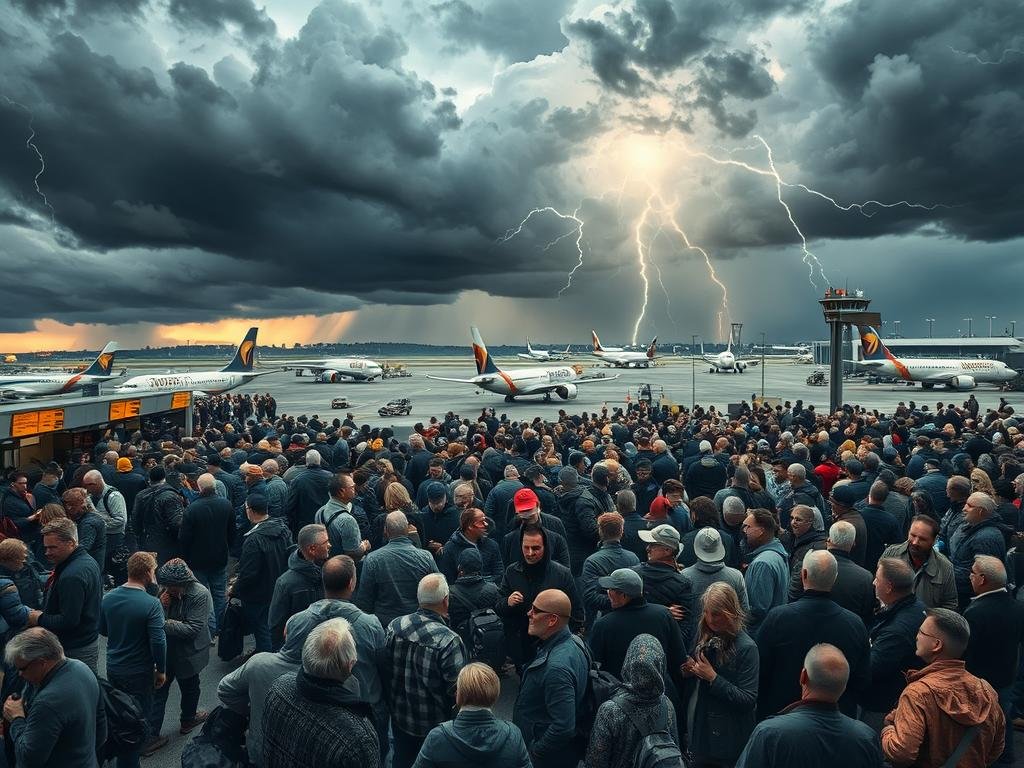
Weather added to the stress on thin crews and FAA rules. At each new york airport, schedules were tight due to fewer hands. Travelers faced longer taxi times at jfk aitport and other airports.
Frank McIntosh, the FAA’s air traffic chief, said airspace was restricted to slow flows. This choice, with staffing gaps, meant fewer slots for flights. The new jfk was hit hard as routes merged into a tight funnel.
Record cold across the eastern two-thirds of the U.S.
Record cold hit from southeast Virginia to the Gulf Coast. Temperatures dropped into the 20s and 30s. Ground crews at the new jfk moved slower in the cold.
Equipment checks took longer, causing delays. Each new york airport felt the impact.
Lake-effect snow causing Northeast slowdowns
Lake-effect snow hit from the Midwest to the Northeast. It caused delays at the jfk airpoet. Deice queues grew as pilots waited for clear taxiways.
Runway treatments were repeated, limiting flights. This strained the flow of flights.
How weather amplifies FAA-imposed throughput reductions
Snow squalls and cold reduced visibility and runways. With FAA caps, small delays became big holds. At jfk aitport, LaGuardia, and Newark, airspace was tight.
The new jfk adjusted gate turns to match slower flows. Airlines rerouted flights to calmer areas. This eased pressure but pushed later flights into busy evening times.
Each airport operated cautiously, adjusting to the cold and snow. This careful rhythm was necessary for the day’s operations.
Federal Aviation Administration Actions and Leadership Messaging
The federal aviation administration is moving from caution to firm limits as the shutdown drags on. Leadership messaging signals that safety will drive every decision, even as travel demand climbs at hubs like jfk international airport. In recent federal aviation administration news, officials say caps will stay until risk indicators ease.
Transportation Secretary Sean Duffy’s call for swift Congressional action
From Chicago O’Hare, Transportation Secretary Sean Duffy urged the House to pass a bipartisan bill to reopen the government. He warned that disruptions will swell into Thanksgiving, calling it the “Super Bowl of air traffic controlling.” Duffy said some airlines are even weighing temporary groundings if the impasse continues.
He noted reports of aircraft getting too close and more runway incursions as stress builds in the system. The federal aviation administration (faa) is tying any loosening of caps to measurable safety improvements. That stance, he said, is nonnegotiable as travelers crowd terminals from New York to Los Angeles.
FAA’s phased reductions at 40 high-traffic airports
The federal aviation administration order phases in 10% cuts at 40 high-traffic airports starting Friday at 6 a.m. local time. The plan escalated from 4% to 6%, then 8%, before reaching 10% as staffing and fatigue pressures mounted. According to federal aviation administration news, leadership will not lift the caps until safety metrics improve.
Airlines are trimming schedules at jfk international airport and other hubs while reshuffling crews and gates. Even with Senate movement, the federal aviation administration (faa) says the data must show stable separation and reduced incursions first. That means passengers should expect rolling adjustments as the phased reductions settle in.
Union safety perspective: preserving margins in the NAS
The National Air Traffic Controllers Association, led by Nick Daniels, backs the cuts to preserve safety margins in the National Airspace System. Controllers remain eligible for back pay under a 2018 law, and the White House has floated $10,000 bonuses for those who worked through the shutdown. At the same time, Duffy said repeated absences could draw action.
Union leaders argue that fewer movements help manage fatigue and complexity during peak waves. Their stance aligns with the federal aviation administration focus on safety over throughput, at jfk international airport. As federal aviation administration news continues to evolve, both labor and leadership are stressing margin first, schedules second.
Traveler Guidance: Refunds, Rebooking, and Workarounds
With federal cuts tightening schedules, travelers need to act quickly. They should keep their options open and follow simple rules to protect their trips. Busy airports like the new york airport jfk network may have longer connection times, weather delays, and gate shuffles.
Refund eligibility when flights are canceled due to the FAA mandate
When a flight is canceled due to the FAA order, airlines must give cash refunds for the unused ticket part. Credit or vouchers are optional, not the only choice.
Passengers should ask for the refund through the airline app or call center. Keep the cancellation notice. If a carrier rebooks them but the new timing doesn’t work, they may ask for a refund.
Pro tips: alternate routes, airports near JFK, off-peak travel windows
To reduce risk, consider alternate routings via LaGuardia, Newark, Philadelphia, or Bradley when john f kennedy airport faces peak constraints. Searches that include airports near jfk often find seats with shorter total travel time.
Outside rush periods, early mornings and late evenings can move faster as traffic lulls. When flying through nyc kennedy airport, build extra buffer for deicing and ramp holds. Opt for nonstop flights when possible.
If rebooking, compare fares and inventory across carriers before accepting changes at new york airport jfk. Same-day change tools can unlock better arrival times once seats open.
Ground transport and rental car shortages: what to expect
On the ground, demand spikes can drain rental fleets as travelers pivot to driving. Expect sellouts at terminals and higher one-way fees during storm windows and throughput cuts.
Reserve cars early, confirm pickup times, and hold backup options like rail or intercity buses. Rideshare surge pricing may rise around john f kennedy airport during misconnect waves.
| Scenario | Best Move | Why It Works | NYC Area Tip |
|---|---|---|---|
| FAA-related cancellation | Request cash refund, then rebook | Preserves flexibility and price shopping | Check LGA/EWR before accepting a voucher |
| Long connection at hub | Shift to earlier segment | Buffers against rolling delays | At nyc kennedy airport, target first bank departures |
| Limited seats at JFK | Search airports near jfk in one query | Opens inventory at nearby fields | Include PHL and BDL along with LGA and EWR |
| Rental car shortage | Book refundable rate in advance | Holds a vehicle without locking costs | Compare station locations near new york airport jfk |
| Weather plus staffing constraints | Fly off-peak, nonstop if possible | Fewer choke points and faster turns | At john f kennedy airport, avoid late afternoon banks |
Quick checklist:
- Use airline apps for same-day changes and push alerts.
- Track weather advisories and allow time for deicing.
- Build 3+ hours for tight connections through major hubs.
- Hold backup plans across LGA, EWR, PHL, and BDL.
Operational Recovery: How Long Until Schedules Normalize
Airlines and airports are slowly getting back to normal. They won’t just turn everything back on overnight. Safety and enough staff are key before they can increase flights.
Why cuts may persist beyond the shutdown’s end
Even after the shutdown ends, there are limits on flights. Leaders want to make sure everything runs smoothly before they increase flights. Airlines are carefully planning their return, matching their plans to the slow pace.
Controller retirements and attrition: 15–20 per day
Every day, 15–20 controllers retire. Some new ones leave due to pay issues and stress. This means training takes longer and flights are slower to return to normal.
Recovery scenarios: days vs. weeks, holiday travel outlook
Mike McCormick, a former FAA chief, thinks things could get back to normal in days. But Eric Chaffee from Case Western Reserve thinks it might take weeks. This is because of crew schedules, maintenance, and getting planes ready for busy times.
Airlines will slowly remove reroutes. They need to use tools that work with real-world situations, not just quick fixes. They’re planning for Thanksgiving with extra caution to avoid more problems.
Some people wonder about JFK’s history and how it relates to today’s flights. The answer is simple: New York’s airports often use historical terms. This is why people mention JFK’s past when talking about today’s flights and the recovery.
Airlines, Economics, and Policy Ripples
Airlines are facing big cost increases as changes at jfk airport spread to all new york airports. They’re losing money, paying more for overtime, and giving out refunds fast. Business and general aviation, like those with nbaa, are also feeling the pinch due to slot shortages near Teterboro.
Hundreds of millions in daily losses projected
Experts say airlines could lose hundreds of millions each day. This could change their plans for the fourth quarter. United and others are canceling flights, showing how hard it is to keep things running when you can’t fly as much.
Stories about aviation shutdown impacts show how tight budgets are. Old systems and not enough staff are making things even tougher.
Network unraveling: repositioning aircraft and crews after cuts
When flights stop, planes and crews get out of place. This leads to more cancellations to get things back on track. Airlines are switching planes to keep schedules going at hubs, including jfk airport.
Regional partners are cutting back too. At the new york airport complex, flights are being rerouted. This makes things even more complicated, pushing maintenance work later than planned.
Public statements, incentives, and accountability debates
There’s a lot of pressure on leaders to act fast. They’re talking about bonuses, when to pay back wages, and what to do with those who don’t show up. Sean Duffy wants quick help and promises to pay workers back soon.
Airlines want clear answers to plan their schedules again. Business and general aviation, including nbaa members near TEB, are okay with fewer slots. The media is covering how this affects everyone involved.
Conclusion
The federal aviation administration has cut flight numbers to 10% at 40 busy airports. This is to keep safety levels high during the shutdown. Shortages of controllers and TSA staff have raised big concerns.
More than 9,000 flights have been canceled, with over 1,200 on some days. Delays have also soared, hitting 2,000 on single days. These numbers have gone up from Oct. 30 to Nov. 9.
New York’s John F. Kennedy International Airport is at the center of this issue. The cuts affect LaGuardia and Newark too, causing more delays. Airlines are adjusting their schedules and crews to meet these new limits.
Even with a Senate deal to reopen, the flight caps will stay until safety improves. Travelers should be ready for changes in flight schedules and plan flexible routes.
They can use refund rights for canceled flights and try flying during off-peak times. Also, consider airports near JFK to avoid delays. These steps are helpful, given the challenges of weather and staffing, and the rise in holiday travel.
Getting back to normal will depend on Congress, winter storms, and when it’s safe to lift the caps. Controller shortages slow down the recovery. Airlines face big challenges, trying to keep flights reliable while dealing with losses.
For everyone, the main goal is to keep flights safe while reducing delays at JFK and across the network.
Be the first to comment