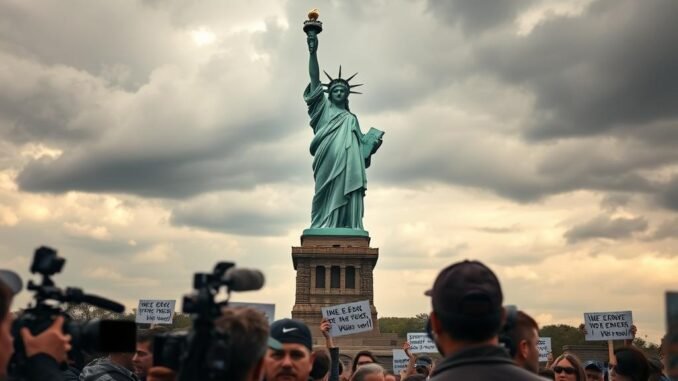

Recently, many people searched for information about the Statue of Liberty. They wanted to know when France gave it to the U.S. This interest came after a French MEP, Raphaël Glucksmann, suggested the U.S. should return the statue. His comment sparked a lot of statue of liberty news and fact-checks.
Glucksmann made this comment at a party convention. He joked that the U.S. should return Lady Liberty. He said this as a way to criticize Americans who support tyrants and suppress scientific freedom. His words were met with applause and controversy, making people curious about the statue’s history.
Here are the key points. France gave the statue to the U.S. in 1884 and it was dedicated in 1886. It is called “Liberty Enlightening the World.” The statue symbolizes freedom, democracy, and welcome to immigrants. Glucksmann’s comment has brought up a deeper discussion about symbols, alliances, and the ideals the statue represents.
Section 1 sets the scene: a pointed remark, a swift response, and a renewed look at history. It also sets up the questions readers are asking now—from when did france give us the statue of liberty to how a 19th-century gift became a 21st-century flashpoint.
Why a French lawmaker floated the idea of taking back Lady Liberty
A European voice sparked debate by asking if France wants the Statue of Liberty back. This question hit a nerve, touching on ideals, alliances, and the statue’s meaning across the Atlantic.
At stake is symbolism, not salvage. When headlines say France wants the Statue of Liberty back, they talk about values, not just the statue in New York.
Who is Raphaël Glucksmann and what he actually said
Raphaël Glucksmann is a French member of the European Parliament. He spoke to party supporters, saying, “Give us back the Statue of Liberty. We gave it to you as a gift, but apparently you despise it. So it will be just fine here at home.” The crowd cheered and whistled.
His words sparked a viral loop: does France want the Statue of Liberty back, or was it just theater? The remark used the statue as a mirror to reflect on American ideals.
Context: criticism of U.S. policy on Ukraine and scientific freedom
Glucksmann’s jab came after President Donald Trump suspended military aid and intelligence cooperation with Ukraine. European officials saw this as a tilt towards Moscow after Russia’s 2022 invasion, worrying about U.S. support.
He also talked about pressure on scientific freedom, citing cuts to climate and health research. He saw France as a safe haven for American scientists, turning a policy critique into a moral appeal.
The line about France wanting the Statue of Liberty back highlighted gaps between American promise and practice.
Tone and intent: a symbolic “wake-up call,” not a real demand
Glucksmann later clarified on X that his statement was symbolic—“a wake-up call.” He praised the United States and urged it to stick to its best traditions: resisting tyrants and welcoming the persecuted.
The aim was rhetorical, not legal. The question about France wanting the Statue of Liberty back was meant to stir reflection, using the statue as a symbol of shared democratic values.
Immediate U.S. response and political reactions

The exchange quickly made headlines about the statue of liberty. Reporters were eager for reactions, and Washington gave a quick answer. This debate also brought up the deep history between the U.S. and France, from the statue’s origins to their battles together.
White House press secretary Karoline Leavitt’s “absolutely not”
At the podium, Karoline Leavitt said “absolutely not,” dismissing the idea as just a show. She called it noise, not a serious policy issue. Her response was clear, quick, and decisive, setting the tone for many following the statue of liberty news.
References to World War II and the liberation of France
Leavitt mentioned U.S. troops who freed France in World War II and fought with French forces in World War I. She emphasized the importance of history in this debate. This reminder highlighted the strong alliance between the U.S. and France, often discussed in the context of the statue of liberty.
Glucksmann’s acknowledgment of U.S. sacrifices and rebuttal
Raphaël Glucksmann thanked the U.S. for freeing France, saying he might not be alive without the Normandy landings. He explained that his call was symbolic, not a plan to take back the monument. His words kept the focus on values and the legacy of the statue of liberty, while questioning current policies that he sees as out of line with that legacy.
| Key Voice | Core Message | Historical Anchor | Relevance to statue of liberty news |
|---|---|---|---|
| Karoline Leavitt | “Absolutely not” to taking back the monument | U.S. roles in WWI and WWII | Sets the official U.S. stance and frames debate boundaries |
| Raphaël Glucksmann | Thanks U.S. for liberation; call is symbolic | Normandy landings and allied sacrifices | Links current politics to heritage and who gifted the statue of liberty |
| Franco‑American Context | Allies in war; partners in ideals | From the American Revolution to WWII | Informs france statue of liberty debates and public memory |
Historical background: statue of liberty origins and symbolism
The Statue of Liberty’s story starts with ideas shared across the Atlantic. To grasp its origins and symbolism, we must understand who imagined it, who built it, and why its message endures.
Édouard de Laboulaye’s 1865 vision honoring the U.S. Declaration of Independence
In 1865, Édouard de Laboulaye, a French scholar, envisioned a monument for the U.S. Declaration of Independence. His idea linked French support for the American Revolution to the fight for liberty. He wanted to celebrate democratic progress after slavery ended.
Frédéric-Auguste Bartholdi’s design and collaboration with Richard Morris Hunt
Frédéric-Auguste Bartholdi created the copper figure, Liberty Enlightening the World. Richard Morris Hunt designed the pedestal. The project faced delays due to the Franco-Prussian War. Yet, it continued. For a detailed history, see this overview from the Statue of Liberty Museum.
Statue of Liberty meaning: freedom, democracy, and welcome to immigrants
The statue’s seven rays symbolize light, the tablet marks July 4, 1776, and broken chains signify freedom. Over time, it became a beacon for immigrants in New York Harbor. Emma Lazarus’s words added to its welcome message, inspiring equality and human rights efforts.
France statue of liberty gift date and gifting year
The statue’s gift date is celebrated in two moments. France presented it in Paris on July 4, 1884. The U.S. dedicated it in New York Harbor on October 28, 1886. These dates highlight the statue’s origins and enduring symbolism in America.
| Milestone | Place | Date | Significance |
|---|---|---|---|
| Concept Proposed by Édouard de Laboulaye | France | 1865 | Sets the purpose tied to U.S. independence and shared democratic ideals |
| Design by Frédéric-Auguste Bartholdi; Pedestal by Richard Morris Hunt | France and United States | 1870s–1880s | Artistic vision and architecture combine to shape the monument |
| France Presents the Statue | Paris | July 4, 1884 | Official france statue of liberty gift date marking the france statue of liberty gifting year |
| Dedication in New York Harbor | Liberty Island | October 28, 1886 | Public unveiling in the U.S., cementing statue of liberty symbolism of freedom and welcome |
How the gift worked: fundraising, construction, and transport

The story of the Statue of Liberty’s arrival in New York is a tale of teamwork and determination. It shows how neighbors on both sides of the Atlantic worked together. This answers the question of why France sent the statue, highlighting shared values and public support.
History of Statue of Liberty donation: joint French-American effort
The people of France gave the statue, and Americans promised to build the base. Édouard de Laboulaye’s idea was made real by citizens. Newspapers, schoolchildren, and workers all contributed what they could.
This effort shows why France sent the statue. It was a project of friendship and civic pride. It united people across classes and borders.
Pedestal funded in the U.S.; statue funded in France
France paid for the copper statue and its iron framework. The U.S. covered the pedestal on Bedloe’s Island. Publisher Joseph Pulitzer highlighted donors in the New York World, inspiring many to give.
This financing reflected the values behind the gift. It involved everyday people, keeping the excitement alive as deadlines approached.
Statue of Liberty construction timeline and 350-piece ocean crossing
The statue’s construction began in Paris and ended in New York. By 1884, Frédéric-Auguste Bartholdi had finished the 151-foot figure. Architect Richard Morris Hunt’s pedestal was rising over the harbor.
Workers then broke the statue into about 350 pieces and packed them. A French navy ship carried them across the Atlantic. In New York, crews, including many immigrants, reassembled it. On October 28, 1886, Bartholdi unveiled it, and the city celebrated.
Ownership, UNESCO status, and legal realities
Many readers wonder: who gave the Statue of Liberty to the U.S.? What does “statue of liberty france” mean legally? And when did France give it to us? The answers lie in history, treaties, and today’s management. This keeps the monument open to millions every year.
Who gifted the Statue of Liberty versus who owns it now
France gave the statue to the U.S. in the 1880s after a big campaign. The French nation gave it, led by Édouard de Laboulaye and created by Frédéric-Auguste Bartholdi. Gustave Eiffel also helped.
The statue was formally given in Paris on July 4, 1884. The New York dedication was in 1886. Now, it’s U.S. government property, run by the National Park Service.
UNESCO World Heritage listing and U.S. government ownership
UNESCO calls the statue a World Heritage Site for its global value. This doesn’t change who owns it; it just sets standards for care.
The National Park Service looks after the island, museums, and site. About three million visitors in 2023 show how French heritage and U.S. ownership work together.
Why “no one will come and steal the Statue of Liberty”
Even the lawmaker who made headlines knew it was symbolic. He said no one would take the statue, showing trust in the law.
The statue is an American icon with worldwide importance. It’s owned by the U.S., respected globally, and open to the public every day.
| Aspect | Key Facts | Why It Matters |
|---|---|---|
| Origin | France gifted the statue; conceived by Laboulaye, designed by Bartholdi, engineered with Eiffel | Clarifies who gifted the Statue of Liberty and the role of statue of liberty france in its creation |
| Dates | Presented July 4, 1884 (Paris); dedicated 1886 (New York) | Answers when did france give us the statue of liberty with precise milestones |
| Ownership | U.S. government property; managed by the National Park Service | Defines current legal control and ongoing stewardship |
| UNESCO Status | World Heritage Site; listing recognizes value but does not transfer title | Explains why international honor coexists with U.S. ownership |
| Public Access | Millions of visitors annually; museum and tours operated on Liberty Island | Shows how legal clarity supports preservation and education |
Statue of Liberty news: global reactions and media narratives
News spread quickly, sparking strong reactions. Headlines mixed drama with context. People wondered: does France really want the Statue of Liberty back?
How U.S. and European outlets framed the exchange
In the U.S., networks focused on the White House’s “absolutely not.” They also highlighted American support during World War II. This balanced tone portrayed the issue as brief and symbolic.
Across Europe, reports criticized recent U.S. policy changes. They mentioned Raphaël Glucksmann’s role in the European Parliament, not the French government. President Emmanuel Macron’s balancing act on cooperation and pressure was also noted.
Debate touchpoints: immigration, alliances, and democratic values
The debate touched on sensitive topics. Some linked Emma Lazarus’s lines to current border debates. Others discussed alliance cohesion, as aid to Kyiv faced delays.
Commentaries questioned democratic norms. They wondered if rhetoric that chills science or sidelines partners helps Moscow. The Statue of Liberty became a symbol of values, not just a monument.
Search trends around “france wants statue of liberty back”
Search data spiked as people looked up the basics. Queries about France wanting the Statue of Liberty back surged. People also searched about the statue’s origin and dedication in 1884 and 1886.
Social posts summarized the statue’s history and the Franco-American bond. This showed how quickly civic history resurfaces when headlines raise questions.
| Angle | U.S. Coverage | European Coverage | Audience Takeaway |
|---|---|---|---|
| Core Frame | Firm refusal; WWII gratitude | Symbolic critique; policy focus | Not a formal demand; a signal |
| Key Figures | White House, National Park Service | Raphaël Glucksmann, Emmanuel Macron | Political vs. institutional roles |
| Hot Topics | Immigration, national pride | Ukraine aid, trade frictions | Values vs. real‑world policy |
| Search Surges | Ownership, dedication date | Gift history, Franco‑U.S. ties | Refresher on 1884/1886 facts |
| SEO Keywords Reflected | statue of liberty news | france wants statue of liberty back | does france want the statue of liberty back |
France statue of liberty connections and replicas
The story of the Statue of Liberty doesn’t stop in New York Harbor. Across the Atlantic, a smaller version of the french statue of liberty exists. These smaller statues, public loans, and civic rituals keep the bond alive. They show how the statue of liberty france is a shared symbol of freedom.
Paris’s Seine Island replica and its orientation toward New York
In Paris, a bronze replica stands on the Île aux Cygnes above the Seine. It was built in 1889 to honor the French Revolution’s 100th anniversary. Initially, it faced central Paris. But in 1937, it was turned to face New York, linking it with its American counterpart.
This simple act was a powerful statement. It echoed the work of Frédéric-Auguste Bartholdi and Édouard de Laboulaye. Today, anyone walking the Pont de Grenelle can see this connection.
2021 “Little Lady Liberty” loan to the U.S. as a friendship symbol
In 2021, France sent a nine-foot bronze called “Little Lady Liberty” to the U.S. on a 10-year loan. It first appeared in New York, then moved to Washington, D.C. near the French ambassador’s home. This move mirrored the original gift’s journey, but on a smaller scale.
This exchange showed the strong bond between France and the U.S. through art and diplomacy. It brought people together, sparking interest and excitement.
Statue of Liberty France ties beyond New York
Replicas of the Statue of Liberty can be found from Paris to Las Vegas, and from Bordeaux to Tokyo. Museums and city squares display these scaled figures. They keep the story of the Statue of Liberty alive, showing how ideals can travel far.
Replicas and loans show a living map of friendship. The Statue of Liberty France is a beacon in many languages.
| Location | Type | Year Noted | Distinctive Detail | Cultural Link |
|---|---|---|---|---|
| Île aux Cygnes, Paris | Outdoor replica | 1889 | Rotated in 1937 to face New York | Embodies the french statue of liberty dialogue with America |
| Washington, D.C. | Loaned bronze statue | 2021 | “Little Lady Liberty” on a 10-year loan | Renews the statue of liberty france friendship through diplomacy |
| New York, New York | Temporary display | 2021 | Brief stop before D.C. installation | Connects the france statue of liberty legacy to today’s visitors |
| Bordeaux, France | Public square replica | 20th century | Local tribute to liberty and citizenship | Extends the french statue of liberty presence beyond Paris |
What the poem “The New Colossus” still asks of societies today
Emma Lazarus’s words have shaped the Statue of Liberty’s meaning for many years. Her sonnet, placed inside the pedestal in 1903, linked the statue’s torch to a promise of safety. This promise greeted those arriving at Ellis Island and continues to influence debates today.
The lines “Give me your tired, your poor” transformed the statue into a beacon of hope. It made the statue’s significance about people, not just its physical form. It raises questions about whether our policies reflect the welcome the statue’s light suggests.
Today, supporters of the poem advocate for a more open and united society. Opponents raise concerns about security and the rule of law. Both sides look to the sonnet because it redefines the statue’s purpose from a diplomatic gift to a test of our values.
By reading The New Colossus again, we can see how its message has shaped our collective memory. It turns the statue of liberty into a daily reminder, not just a museum piece. This view is woven into the statue’s history and the decisions made at our borders.
Conclusion
The recent controversy over Lady Liberty made many wonder about her origins. They asked when France gave us the statue, who gave it, and why. The story begins in the 1860s, when French thinkers were inspired by the U.S. Declaration of Independence.
The statue was unveiled in Paris on July 4, 1884. It was then dedicated in New York Harbor on October 28, 1886. This event was a true partnership between France and the U.S.
Frédéric-Auguste Bartholdi created the statue in France, while Richard Morris Hunt designed the pedestal in America. The statue was shipped in 350 pieces across the Atlantic. Today, it is a U.S. national monument and a UNESCO-listed site, owned by the federal government.
Raphaël Glucksmann’s comment to “take it back” was meant to spark debate, not demand action. He linked it to discussions on Ukraine policy and scientific freedom. The White House responded with a firm “no” to his request.
Yet, the exchange brought up a deeper question: when did France give us the Statue of Liberty? It reminded everyone that the statue’s torch continues to symbolize freedom, alliances, and welcome.
The timeline of the statue’s history is key. It was presented in 1884 and unveiled in 1886. The statue remains a symbol of the shared promise between France and America. It shows the people of France and Americans working together to create a beacon for the world.
Be the first to comment