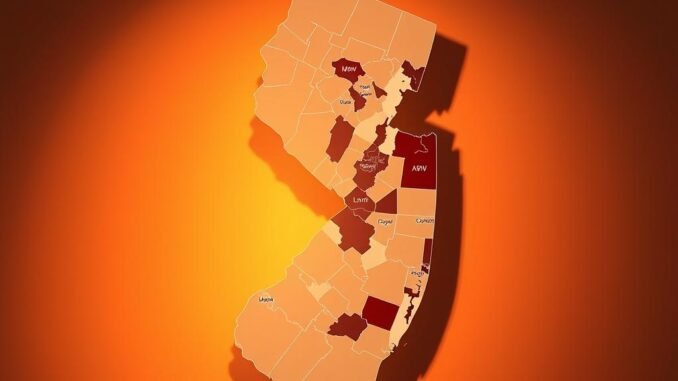

For the first time in 64 years, a party won three straight terms in New Jersey. Mikie Sherrill’s big win in the governor election changed the map and set new records. The results show a clear divide, with suburbs and shore towns voting differently.
By November 12, 2025, with 98% of votes counted, Sherrill was leading by almost 14 points. She got 56.64% of the vote, while Ciattarelli had 42.77%. This big win flipped Atlantic, Cumberland, Gloucester, and Morris counties to Democrats. Even in Monmouth and Ocean, long Republican strongholds, the gap narrowed by double digits.
The election results show a big change across the state. Democrats got more votes in every county, with the biggest increase in rural Sussex. This analysis suggests that college-educated suburbs voted for Sherrill, while Republican areas softened. The new map suggests lasting changes for 2026.
The Associated Press and major networks called the race quickly. This shows how clear the victory was. For New Jersey politics, this is a historic moment. Sherrill, a Democratic U.S. Representative, will be the state’s 57th governor. She will also be the first female military veteran to lead a U.S. state. The county-level story tells us how she won.
Overview of the New Jersey State Governor Race and County-Level Divide
New Jersey’s governor race ended with a clear winner and a sharp county split. This overview combines election results, electoral results, and analysis. It uses verified state election results and data.
Who won and by how much
Mikie Sherrill won with 56.64% to Jack Ciattarelli’s 42.77%, a 14-point lead. This was with 98% of votes counted by Nov. 12, 2025. Sherrill got 1,860,909 votes, while Ciattarelli got 1,405,137.
The electoral results show a bigger shift than just one election.
Why the race wasn’t as close as projected
Before the election, models thought it would be close like 2021. But 2025 was different. GOP strategists said discontent with Donald Trump and Ciattarelli’s views were key. Democrats also spent more on ads.
A message about sales tax was important too, according to analysis. This message helped undecided voters choose blue in suburbs and small cities.
How county maps reveal shifting coalitions
Four counties, Atlantic, Cumberland, Gloucester, and Morris, went for Sherrill. This shows South Jersey and suburban shifts. Sussex County had the biggest swing to the left.
Monmouth and Ocean counties also narrowed GOP leads. These changes show a new coalition. It’s based on more voters in commuter areas and mid-sized towns.
Democrats did better in every county than in 2021. This is seen in the final results and confirmed by county analysis.
Live Election Results and Reporting Status
New Jersey’s governor race is now close to final tallies. People looking for live election results and updates can see how the count is going. Major news outlets are providing the latest results as they come in.
Votes counted and outstanding ballots as of Nov. 12, 2025
By 5:45 p.m. EST on Nov. 12, 98% of the votes were reported. Only a few ballots were left, and officials said they wouldn’t change the outcome. This near-complete count matches what was predicted on election night.
The latest results show the same trends as election night. Most mail and provisional ballots were counted. This means the live results now match the statewide tally.
When the New Jersey Board of State Canvassers certifies results
State law allows the New Jersey Board of State Canvassers up to 30 days to certify results. For 2025, they must do it by Dec. 4, 2025. Until then, results are unofficial, but updates show a stable vote share.
Key dates: Election Day, certification, and inauguration
- Election Day: Nov. 4, 2025
- Certification Deadline: Dec. 4, 2025
- Inauguration: Jan. 20, 2026
The Associated Press and major networks called the race for Mikie Sherrill. They based their calls on county-level returns and the large margin. These calls came before certification but matched the election updates and results.
For those following live election results and coverage, only small changes are expected before Dec. 4. The final totals will be posted after the canvass is complete.
By the Numbers: Popular Vote, Margin, and Turnout
With 98% of votes counted by November 12, 2025, New Jersey’s mood has shifted decisively. The results show a broad coalition across suburban and urban areas. This is reflected in county tallies and local election results.
Total votes and percentage split: Sherrill 56.64%, Ciattarelli 42.77%
Mikie Sherrill leads with 56.64% of the vote, while Jack Ciattarelli has 42.77%. These numbers match precinct reports and county canvasses. They show trends in high-turnout areas and across North Jersey and the Shore.
Raw vote counts: 1,860,909 vs. 1,405,137
Sherrill got 1,860,909 votes, and Ciattarelli got 1,405,137. This margin reflects the percentage gap. These figures are consistent with county clerk updates and provisional ballot processing.
Comparing 2025 to 2021’s 3-point result
The 13.9–14.0 point lead is much larger than the 3.2-point margin in 2021. Today’s results show a bigger swing than expected. This is significant in commuter hubs and suburbs.
| Metric | 2025 | 2021 | Insight |
|---|---|---|---|
| Percentage Split | Sherrill 56.64%, Ciattarelli 42.77% | Murphy ~51.2%, Ciattarelli ~48.0% | Gap widens from ~3.2 points to ~13.9–14.0 points |
| Raw Votes | 1,860,909 vs. 1,405,137 | Lower raw margin | Higher absolute spread in the latest election result data |
| County Trend | Democratic gains in every county | Mixed county movement | Broader alignment with county-level electoral results |
Turnout patterns show steady participation in dense precincts. Mail-in returns also show steady trends. These data points together paint a clear picture of the statewide mandate.
County Flips and Vote Swings That Decided the Race
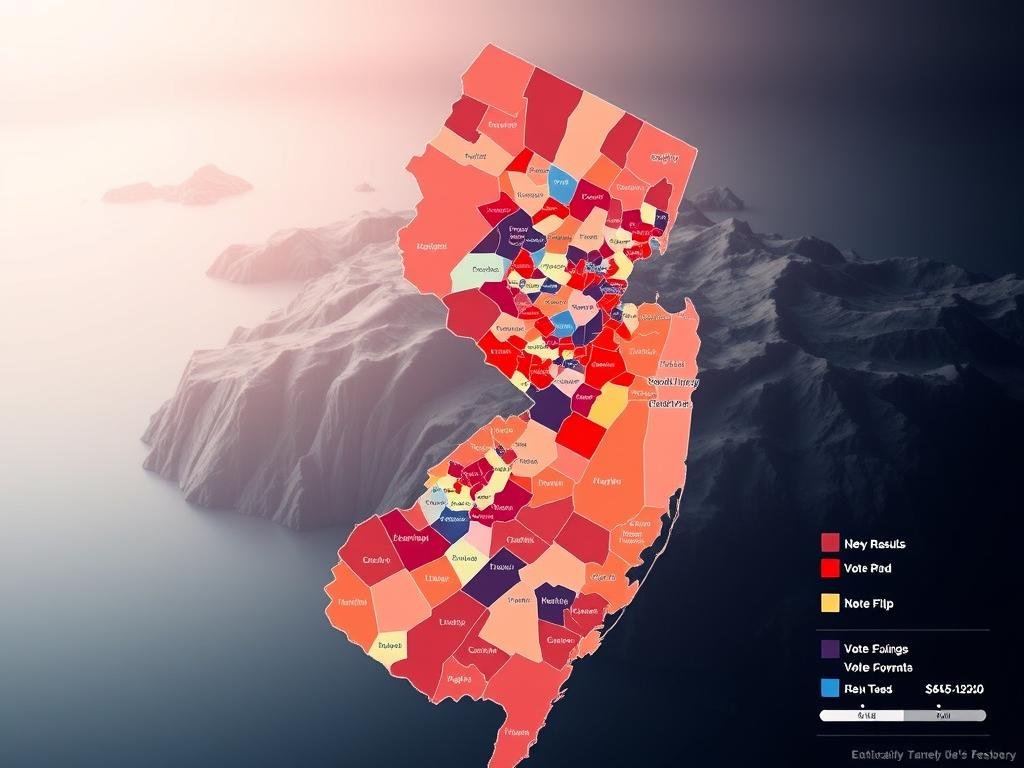
Changes at the county level changed the map and showed the most important election analysis. Across the state, patterns showed shifts in suburbs and blue-collar areas. These changes confirmed trends seen in election results and updates.
Counties that flipped to Sherrill: Atlantic, Cumberland, Gloucester, Morris
Four counties moved to the Democratic side: Atlantic, Cumberland, Gloucester, and Morris. These changes show gains in South Jersey’s working communities and North Jersey’s suburbs. The results show crossover votes and stronger turnout, matching statewide projections and updates.
Largest leftward swing: Sussex County
Sussex County had the biggest move to the left compared to 2021. It’s now less Republican but not fully Democratic. This shift is key in the state’s election results and shows gains outside the metro belt.
Republican strongholds shift: Monmouth and Ocean narrow the gap
Monmouth and Ocean stayed red but their margins dropped by double digits from 2021. The shore vote got tighter as independents and ticket-splitters returned. This early trend, confirmed by updates, suggests new limits for GOP dominance along the coast.
| County | 2021 Winner | 2025 Winner | Direction of Shift | Notable Change vs. 2021 | Takeaway for Election Result Analysis |
|---|---|---|---|---|---|
| Atlantic | Ciattarelli | Sherrill | Democratic flip | Blue-collar wards swung left | Union turnout matched by suburban gains in final election results |
| Cumberland | Ciattarelli | Sherrill | Democratic flip | South Jersey shift solidified | Consistent with late election projections and updates |
| Gloucester | Ciattarelli | Sherrill | Democratic flip | Margins reversed in townships | State election results show crossover among moderates |
| Morris | Ciattarelli | Sherrill | Democratic flip | Suburban consolidation | College-educated vote powered the election results |
| Sussex | Ciattarelli | Ciattarelli | Leftward swing | Biggest pro-Democratic shift | Validates trend seen in early election result analysis |
| Monmouth | Ciattarelli | Ciattarelli | Narrowed GOP margin | More than 10-point tightening | Election results align with suburban softening |
| Ocean | Ciattarelli | Ciattarelli | Narrowed GOP margin | More than 10-point tightening | Election result updates confirmed coastal erosion |
Electoral Results Map: County and Congressional District Patterns
New Jersey’s election maps show a clear split between dense suburbs and rural stretches. The electoral results reflect strong gains in commuter corridors, while local election results in exurban townships narrowed. Across congressional districts, election result data clusters by turnout hubs and shore communities, shaping the final election results county by county.
Where Sherrill exceeded 60%, 70%, and beyond
Sherrill crossed 60% in core Democratic counties and moved into the 70–80% range in deep-blue precincts anchored by cities and inner-ring suburbs. In the suburbs that flipped in recent cycles, gains were steady, reflecting momentum seen in Morris County and nearby districts.
These bands on election maps match local election results from precincts with high college-educated turnout. The electoral results in these zones point to consolidated support that stretched beyond 2021 benchmarks, according to election result data trends.
Where Ciattarelli held 50–60% and 60–70%
Ciattarelli’s map strength sat in 50–60% pockets and a few 60–70% areas across parts of the Shore and the rural north. Margins were slimmer than four years ago, but they remained durable in places with lower density and older voting patterns.
These local election results align with past GOP holds, yet the election results show tightening along commuter routes. Election result data from split-ticket towns indicates a softer edge compared with prior cycles.
Suburban versus rural performance contrasts
Suburban belts, including fast-growing town centers and rail-line communities, leaned blue and expanded their share. Rural regions like Sussex, on the other hand, favored Republicans, but the leftward swing reduced traditional cushions.
Viewed through election maps, the contrast is stark: suburban corridors delivered larger pluralities, while rural townships offered narrower wins for the GOP. Across the electoral results, these patterns echo local election results and confirm shifts visible in election result data from precinct-level reporting.
Election Analysis: Why Sherrill Outperformed Expectations
Sherrill’s win came from good timing, a strong message, and enough money. This analysis links national events to local choices in New Jersey. It shows how these factors influenced the election results.
Impact of national headwinds and the federal government shutdown
The government shutdown hurt Republicans across the state. It caused flight delays, affected food aid, and raised concerns about big projects. Even some GOP lawmakers called the timing bad, affecting voters’ moods.
In suburbs, commuters and workers felt the shutdown’s effects. This made voters question the GOP’s ability to lead. It led to a bigger swing than expected, based on early predictions.
Trump alignment costs among unaffiliated voters
Ciattarelli supported Trump and praised cuts to Medicaid and SNAP. But many independents saw this as a national issue, not a local one. Republicans were divided, with some like State Sen. Jon Bramnick pushing for a more moderate approach.
Unaffiliated voters made their voices heard, as reported by election coverage. This shift in counties supports the idea that the top of the ticket hurt the GOP.
Advertising gap and the sales tax narrative
Democrats spent about $23 million more on ads, according to AdImpact. They focused on Ciattarelli’s possible sales tax hike. He later denied this, but the damage was done.
Taxes are a big concern for New Jersey voters. Sherrill’s campaign set the tone with clear ads. This helped shape public opinion, backed by election coverage and late projections.
Issues and Messaging: Affordability, Energy, and Social Policy
Voters worried about prices and public services shaped the debate. Election results showed both sides focused on bills, wages, and stability. Early analysis linked clear messages to shifts in local election results.
Affordability contrasts: energy prices and taxes
Affordability was key. Mikie Sherrill vowed to control utilities and rates. Jack Ciattarelli blamed Democrats for higher costs, but his sales tax stance hurt his tax appeal.
Voters cared about their wallets. In commuter areas, energy bills and taxes influenced local election results. This showed how election updates were seen in different places.
Clean energy vs. pulling back on initiatives
Energy policy was a big divide. Ciattarelli wanted to reduce clean energy mandates. Sherrill backed clean energy and promised to keep rates affordable, appealing to suburban homeowners.
This debate was seen in election results. Coastal and exurban areas debated climate goals versus costs. Analysts noted how these choices affected election outcomes and policy trade-offs.
Healthcare, abortion, and housing stances shaping turnout
Healthcare, abortion, and housing drew clear lines. Democrats pushed for access and protections. Republicans focused on limits, local control, and zoning reform. Women and younger voters showed their views in county totals.
These patterns were seen in election updates. They influenced the final election outcomes. Local results near universities and suburbs showed social policy’s impact on turnout.
| Issue | Sherrill’s Emphasis | Ciattarelli’s Emphasis | Observed Impact in Election Results |
|---|---|---|---|
| Energy Prices | Oversight of utilities; block rate hikes | Cut mandates; slow cost drivers | Suburban gains where bills were top concern during election updates |
| Taxes | Targeted relief; enforcement on corporate loopholes | Lower tax burden; critique of Democratic increases | Sales tax narrative blunted GOP trust, noted in election result analysis |
| Clean Energy | Keep goals; add consumer protections | Pull back on initiatives | Coastal and commuter counties leaned to continuity in local election results |
| Healthcare | Coverage stability and cost caps | Market options and spending restraint | Higher margins near hospitals and union corridors in election outcomes |
| Abortion | Protect access under state law | More limits and parental involvement | Women’s turnout spikes marked in election updates |
| Housing | Incentives for affordable supply | Local control; zoning flexibility | Inner suburbs showed net shifts in local election results |
Election Coverage and Updates: From Projections to Final Calls
Election coverage sped up as county returns made the math clear. Real-time updates from major desks showed margins growing through the night. Election projections got sharper as urban and suburban precincts reported. By dawn, the latest results matched across outlets.
AP call for Sherrill and network election coverage context
The Associated Press called the race for Mikie Sherrill when a GOP comeback was no longer possible. ABC News, CBS News, NBC News, CNN, and Fox News followed the shift as their decision desks saw wider Democratic leads. Even as fox news election results updated, they matched AP’s benchmarks and steady updates.
How early county numbers signaled the outcome
Early returns showed Democrats leading in every county, beating their 2021 marks. Atlantic, Cumberland, Gloucester, and Morris flipped, and Sussex moved left, a rare move for a rural area. These trends led to quick election projections and clear coverage momentum before midnight.
Latest election results and projection methodology
Decision desks used precinct-level reporting, modeled outstanding ballots, and 2021 baselines. With 98% reporting by November 12, the latest results validated the models and supported prior updates. Cross-checks against historical turnout refined projections as late-counted mail ballots arrived.
| Decision Desk | Key Inputs | Trigger for Projection | Validation Step |
|---|---|---|---|
| Associated Press | Precinct returns, county trends, outstanding ballot models | Statewide GOP shortfall beyond plausible late-count gains | Comparison to 2021 baselines and real-time canvass reports |
| CNN | Turnout estimates, urban-suburban margins, historical swings | Converging leads across flipped counties | Cross-check with county election officials’ updates |
| NBC News | Precinct completeness, mail vs. in-person ratios | Projected mail ballot share unable to close gap | Backtesting against prior statewide cycles |
| Fox News | Live county boards, precinct-level vote share | fox news election results matched independent models | Reconciliation with certified interim tallies |
| CBS News | Reporting rates, demographic turnout patterns | Lead resilience after late mail drops | Audit of precinct lag and provisional counts |
Comparative Context: From 2021 Close Race to 2025 Landslide
New Jersey’s election results show a big change from close to landslide. The state’s election outcomes have changed a lot. This is due to new coalitions, stronger support in suburbs, and better turnout efforts.
Ciattarelli’s third bid versus 2021 near-miss
Jack Ciattarelli was close to winning in 2021 but lost. Then, he won the 2025 GOP primary. But, he lost to Mikie Sherrill by a big margin in the election. This shows how a close race can turn into a big win or loss.
Democrats gaining in every county across the state
In 2025, Democrats won more votes in all 21 counties. They even won in counties they lost before. Sussex County saw the biggest shift towards Democrats. Monmouth and Ocean counties also saw big changes.
Historical note: three consecutive Democratic terms
The 2025 election marked a big milestone. It was the first time in 64 years that the same party won three terms in a row. Mikie Sherrill will be New Jersey’s first female Democratic governor. This makes the election data very interesting for researchers.
Election Data Deep Dive: Turnout, Demographics, and Ground Game
New election data shows how turnout and persuasion affected the results. A detailed look at the data and coverage reveals where messages worked and where they didn’t. This helps both parties understand what went right and wrong.
Where GOP underperformed with independents and Hispanic voters
Republicans thought unaffiliated voters would support them late in the game. But, they lost ground in suburbs and urban areas. In three counties with a lot of Hispanic voters, Ciattarelli lost over 70,000 votes compared to 2021.
After the primary, the party’s stance on issues mattered. Praising Donald Trump’s Medicaid and SNAP policies, but not opposing the Gateway Tunnel, hurt their appeal to moderates. This made it harder to win over independents.
Ground game critiques: overreliance on rallies vs. persuasion
People like Camden County GOP chair Kimberley Stuart said the campaign focused too much on rallies. These rallies excited the base but didn’t win over undecided voters. The canvassing scripts didn’t focus enough on everyday costs, and training focused on getting people to vote, not changing their minds.
Field reports showed the campaign didn’t reach out enough to non-traditional GOP voters, like women in growing suburbs. There were fewer chances to explain policy at the door, which hurt the campaign’s late momentum.
Spending, messaging cadence, and ad impact
AdImpact found Mikie Sherrill and her allies spent about $23 million more on ads. Their steady message about sales taxes helped them. This message, repeated everywhere, helped them win over voters early on.
Republicans admitted they were too confident because of the national mood during the shutdown. Democrats’ consistent messaging helped them win in commuter counties and diverse cities.
Conclusion
The 2025 New Jersey gubernatorial election showed a clear winner: Mikie Sherrill with 56.64% of the vote (1,860,909). Jack Ciattarelli got 42.77% (1,405,137). By November 12, 2025, 98% of votes were counted.
County patterns were key. Democrats won in Atlantic, Cumberland, Gloucester, and Morris. They also made big gains in Sussex. In Monmouth and Ocean, they narrowed the gap.
These results match the latest election data. They show a clear shift towards Democrats.
Several factors influenced the election. The federal shutdown and dislike for Donald Trump’s policies were big. Ciattarelli’s ties to Trump lost him unaffiliated voters.
Democrats focused on affordability. They had a strong ad campaign. This helped them win the sales tax debate.
These elements explain the election results. They also give insight into the ongoing vote counts.
Networks like the Associated Press called the race early. The New Jersey Board of State Canvassers will confirm the results by December 4, 2025. Sherrill will be sworn in on January 20, 2026.
This will be the first time Democrats have won three straight terms in New Jersey. Sherrill will be the state’s first Democratic woman governor. She will also be the nation’s first female military veteran governor.
The election results show a realignment at the county level. Sherrill’s victory was broad and focused on issues. As the results are finalized, this election analysis suggests a lasting impact on New Jersey politics.
Be the first to comment