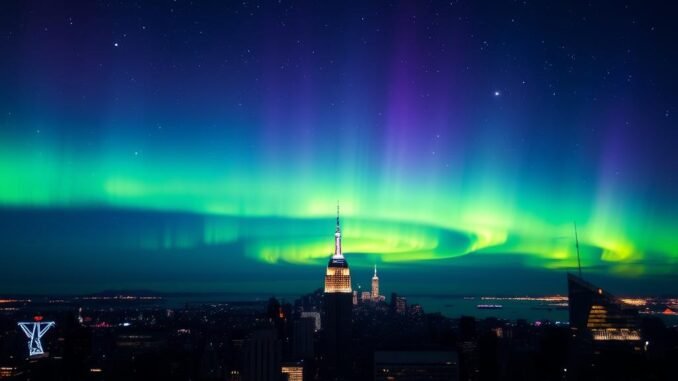

The northern lights were seen in New York City twice in two nights. This rare event happens only a few times a decade this far south. NASA warned of a G4 solar storm, which led to sightings from the Bronx to Cape May, and even in Brookfield, Connecticut.
This means aurora borealis new york alerts are real. A G4 event can light up the sky from Northern California to Alabama. This gives New York, New Jersey, and Connecticut a chance to see it. Strong storms can also mess with satellites, GPS, and the power grid, affecting travel and daily life.
In October 2024, New Yorkers saw pink and purple lights in the sky. In November 2025, photos by Adam Dean in Brookfield, Mary Corti in the Bronx, and Kashi Davis in Cape May confirmed the lights’ return. Now, many wonder if they’ll see the northern lights tonight in New York.
City lights make it hard to see the lights. But, darker spots in the Catskills, Hudson Valley, and northern New Jersey might show a soft arc. This guide will tell you when to look, where to look, and how weather and clouds can affect your view.
Stay updated with n.y. news and nj news for quick updates. Look for live models and local forecasts. With clear skies in parts of New Jersey and steady clearing to the north, the next chance might come soon. Keep an eye on new york weather and be ready to adjust if needed.
Latest Forecast: Aurora Borealis Possible Over the Tri-State Area
The noaa northern lights forecast shows a good chance for the Tri-State. It suggests a short window after dark, if clouds clear. Viewers can check a visible coverage map and tri state live updates to see how far south the lights might go.
NOAA’s geomagnetic storm watch and expected timing
NOAA has a G4 watch in effect, starting midday Wednesday. Their hourly OVATION model shows likely zones from 6 p.m. to 6 a.m. (Central Time). The strongest pulses often happen near twilight and late night, so checking the new york weather forecast alongside the noaa northern lights forecast helps set expectations.
For real-time context, regional broadcasters like fox 5 weather ny and tri state live feeds emphasize short bursts that can fade fast. Cloud breaks matter as much as storm strength, which is why cross-checking jersey weather can make the difference between a miss and a faint horizon glow.
G4 solar flare overview and visibility zone from Northern California to Alabama
A G4 event can push the auroral boundary to Northern California and Alabama. This expands the visible coverage map well beyond typical latitudes. But, it doesn’t guarantee overhead color everywhere; it simply widens the line where a glow may be seen low in the north.
Midday energy arrivals sometimes reload after sunset. A brief surge could lift the viewline over parts of the Tri-State. For a concise briefing on recent storm peaks and late-evening potentials, see this aurora update.
What “possible” visibility means for New York City, New Jersey, and Connecticut
In New York City, “possible” usually means a dim northern glow, not sweeping curtains, due to heavy light pollution. Farther north and west—central and northern New York, parts of northern New Jersey, and interior Connecticut—skies turn darker, and chances improve if the Kp stays elevated and clouds thin.
Viewers can pair the noaa northern lights forecast with the new york weather forecast and jersey weather to decide when to step outside. A quick check of fox 5 weather ny, tri state live radar, and a current visible coverage map helps spot any late spikes that might nudge the lights into view.
| Area | Expected Sky Glow | Best Check-In Times | Useful Sources |
|---|---|---|---|
| New York City (urban core) | Faint northern horizon glow, brief and low | After dusk, then 10 p.m.–2 a.m. | noaa northern lights forecast, fox 5 weather ny |
| Northern New Jersey | Low-sky glow with chances for thin bands | 9 p.m.–1 a.m.; reassess near midnight | visible coverage map, jersey weather |
| Connecticut (interior) | Improved odds under clear skies | 10 p.m.–2 a.m.; final check near 1 a.m. | tri state live updates, noaa northern lights forecast |
| Upstate New York | Higher chance of distinct arcs and pillars | 9 p.m.–2 a.m.; watch for bursts | visible coverage map, new york weather forecast |
Note: Cloud cover and timing pulses can shift quickly; align plans with the latest radar and short-term nowcasts while monitoring tri state live cues.
Best Places to See the Northern Lights Near New York and New Jersey
For a sky show close to home, they aim north and seek altitude. The best place to see the northern lights is where dark skies meet a clear northern view. The weather upstate new york often gives that edge. This guide highlights nearby spots and how to pick a site when the glow may sit low on the horizon.
Adirondack Mountains, Catskills, and Harriman State Park
The Adirondack Mountains offer broad lakes and high overlooks from Lake Placid to Tupper Lake. Farther south, the Catskills around Slide Mountain and Hunter Mountain trim city glare and boost chances when aurora arcs stay low. Closer to where new york meets suburb, Harriman State Park gives quick access with darker pockets near lakes and ridgelines.
These areas add easy add-ons to a night out, making them ideal for things to do in new york state when solar storms ramp up.
Northwestern New Jersey Highlands and Sussex County
In new jersey ny, the Highlands and Sussex County sit farther from the metro glow. High points near High Point State Park, Stokes State Forest, and the Kittatinny Ridge open clean views to the north. On strong nights, the low green band can peek above the tree line, specially after midnight.
Local backroads with farms and reservoirs help with sky exposure, a quiet option within the jersey 5 TV footprint.
Coastal and southern viewing chances: Cape May and beyond
Coastal views are rare, but they do happen in powerful events. Cape May faces a broad horizon with less clutter, and recent photos during fall storms proved the coast can surprise. South Jersey beaches and open bays give wide skies, though salt haze can dull faint color.
Watch offshore clouds and sea fog; a quick shift in wind can sharpen visibility along the sand.
How to choose dark, open spaces with a clear northern horizon
They look for open fields, lakeshores, or ridgelines that cut glare and expose the north. Avoid bright parking lots and aim away from city glow. Even thin cirrus can mute detail, so they pair site choice with real-time clouds and the weather upstate new york to time breaks in cover.
Bring a red-light flashlight, park safely, and allow 20 minutes for night vision. That simple routine often turns a faint arc into a clearer scene.
| Region | Sample Sites | Why It Works | Sky Quality Tips | Drive-Time Edge |
|---|---|---|---|---|
| Adirondacks (NY) | Lake Placid area, Tupper Lake overlooks | High elevation, dark wilderness, wide lakes | Face north across water; block roadside lights | Best for strong storms when traveling is one of the things to do in new york state |
| Catskills (NY) | Slide Mountain, Hunter Mountain pull-offs | Reduced light pollution, quick access to ridges | Pick turnouts with clear tree breaks to the north | Balanced option from where new york city meets the Hudson Valley |
| Harriman State Park (NY) | Lake Welch area, ridge lookouts | Close to the metro, darker than suburbs | Arrive early; choose unlit shorelines or high spots | Fast reach for after-work viewing runs |
| NW New Jersey Highlands | High Point State Park, Stokes State Forest | Higher ground, distance from dense lights | Scan above the treeline; avoid nearby lot lamps | Strong contender within the jersey 5 broadcast area |
| Cape May and Coast (NJ) | Open beaches, bayside overlooks | Flat, unobstructed northern horizon over water | Watch sea fog; choose dry, breezy nights | Good during peak storms in new jersey ny |
When to Look: Optimal Viewing Windows Tonight
They should plan around the darkest stretch of the night. For many tracking northern lights tonight new york, timing matters more than distance. A quick check of the new york weather forecast and jersey weather will shape the plan before they head out.
Prime hours: 10 p.m. to 2 a.m., with early evening possibilities
The most reliable window runs from 10 p.m. to 2 a.m. Skies are darker, and arcs often strengthen. If a strong burst is underway, 7 p.m. to 10 p.m. can also show color low on the horizon.
They should step outside for short checks every 20–30 minutes. If stars are sharp and steady, conditions are favorable across weather in jersey and southern New York suburbs.
Watching the hourly OVATION model between 6 p.m. and 6 a.m.
NOAA’s OVATION updates hourly between 6 p.m. and 6 a.m., and the visible coverage map helps viewers spot shifting bands. Pair that with the new york weather forecast to time breaks in clouds with higher intensity tracks.
They can set alerts at the top of each hour. If the model expands south, northern lights tonight new york could brighten with little notice.
Adjusting plans for cloud cover and real-time clearing
Clouds decide the outcome. AccuWeather notes “fair” visibility for parts of New Jersey, so driving a few miles can move them into clear sky. If they cannot see stars, they will not see the aurora.
Keep a flexible route using local radar for weather in jersey and nearby counties. As gaps open, the visible coverage map and jersey weather updates can guide a quick pivot to clearer horizons.
Why City Viewing Is Difficult in New York and New Jersey
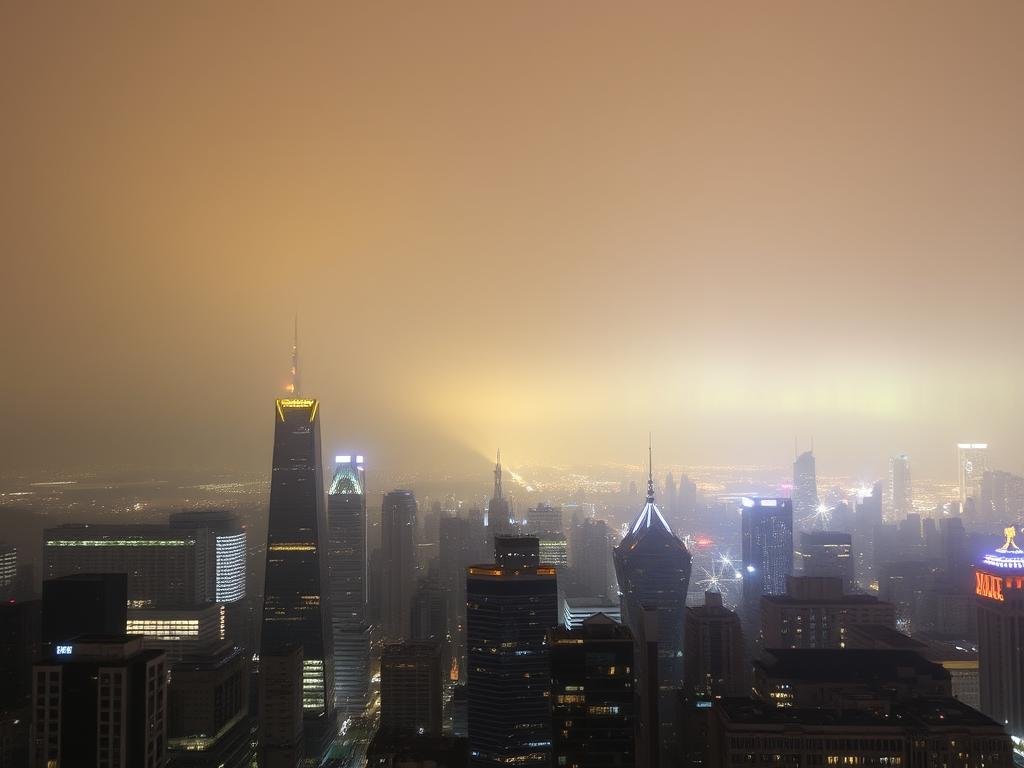
City skies make it hard to see auroras. Bright lights, signs, and cars hide the colors, even on clear days. The forecast might say there’s a big show, but the city’s layout and low ground block the view.
Impact of light pollution and low elevation on aurora visibility
Most auroras appear low on the horizon. In places like Manhattan, Jersey City, and Newark, the light from the city is too much. Even when the air is clear, the city’s lights and haze make it hard to see.
Going up high helps. Places like upstate New York have darker skies and better views.
What high Kp readings mean and why urban views are often a faint glow
High Kp readings mean strong magnetic activity. But, they don’t fight off city lights. During big activity, people often see a faint glow instead of bright curtains. Phones might show more, but it’s not as vivid from the city.
In the Bronx, even during the best times, the view is just a faint line. This shows that what looks bright on maps doesn’t always translate to real life.
Where to go from New York City for darker skies
Get away from the city lights. Places like Harriman State Park, the Catskills, or the Highlands in Sussex County offer better views. They have higher ground and clearer skies than the city.
Check the weather forecast before you go. Look for clear skies and aim for the north. For many, a two-hour drive can turn a dull haze into a clear display of colors.
What Causes the Northern Lights: Expert Insights
Scientists at NASA and NOAA keep an eye on the Sun for eruptions. These eruptions can light up the sky. Their alerts explain why the aurora borealis new york makes headlines in n.y. news.
From solar flares and CMEs to “dancing lights in the sky”
Solar flares and coronal mass ejections send energy and charged particles into space. Amie Gallagher, a planetarium director, says that magnetic fields on the Sun can snap. This sends CMEs racing outward.
During strong events, the effect grows. People call it “dancing lights in the sky.”
When storms get stronger, NOAA’s models show auroral ovals moving south. This is when n.y. news tracks aurora borealis new york more closely. For quick planning, readers check an infogram or the ovation tv schedule to time their night.
How charged particles interact with Earth’s magnetic field
Solar particles reach Earth and follow magnetic field lines to the poles. They spiral down and collide with gases in the upper atmosphere. These collisions release light, creating arcs, rays, and curtains that change and pulse.
This process explains why G4-level geomagnetic storms make the lights visible beyond Canada and into the Northeast. It’s why aurora borealis new york can appear after sunset. n.y. news updates spike with fresh radar loops and an infogram of expected coverage.
Colors explained: oxygen-driven pinks and greens; nitrogen blues and purples
Color depends on altitude and which gas gets excited. High-altitude oxygen glows green and sometimes pink near the edges of bright bands. Lower in the atmosphere, nitrogen creates blues and purples, showing up during strong impacts.
Photographers use a simple infogram of color by altitude to plan exposures. The ovation tv schedule timing helps predict peak hours. When storms surge, even aurora borealis new york can show subtle greens on the northern horizon.
| Driver | Where It Happens | Result in the Sky | Typical Color | What Viewers Track |
|---|---|---|---|---|
| Solar Flare | Sun’s surface and corona | Rapid energy release | Influences brightness | NOAA alerts, n.y. news updates |
| Coronal Mass Ejection (CME) | Ejected solar plasma | Geomagnetic storm | Expands visibility south | OVATION model, ovation tv schedule |
| Magnetic Field Interaction | Near polar regions | Particle funneling | Controls structure | Real-time infogram maps |
| Atmospheric Collisions | Upper atmosphere | Arcs, curtains, rays | Greens, pinks, blues, purples | aurora borealis new york visibility notes |
Real Sightings: Recent Aurora Over New York and New Jersey
When space weather gets strong, the northern lights can appear in our area. A map of northern lights in New York helps us know where to look. It shows where glows have shown up before, from city skylines to beach dunes.
Viewer photos from the Bronx, Brookfield, CT, and Cape May, NJ
In November 2025, Adam Dean took pictures of pillars in Brookfield, Connecticut. Mary Corti caught a soft arc over the Bronx. That night, Kashi Davis saw shimmering bands over Cape May, New Jersey.
These photos match a map of northern lights in New York. It shows where people have seen them before. Local news and archives say they’re more common away from city lights.
October 2024 and November 2025 events across the region
In October 2024, New York City’s skyline glowed pink and purple after dark. Cameras caught faint bands. The November 2025 event showed brighter pillars in suburbs and beaches.
Both nights had G4–G5 conditions. The sightings suggest that areas north and northwest of the city see more lights. This includes northern New Jersey and southern New England.
What these sightings suggest about tonight’s chances
With a G4 watch, the best spots are where it’s dark and the horizon is clear. The Hudson Valley and New Jersey Highlands often have great views. In jersey coty and new jersy city, you might see softer glows.
Checking the weather is as important as the solar wind. Use a map of northern lights in New York to find the best spots. This can turn a small chance into a real sighting, as seen in recent storms.
How to Track the Aurora: Tools and Live Maps
They can follow a simple plan. Pair national space weather alerts with local TV forecasts. Then, watch live maps as the sky changes. This mix helps them pick the best time and place for a clear view.
Using NOAA’s OVATION aurora forecast model and visible coverage map
The noaa northern lights forecast updates every hour. It shows risk zones with dynamic ovals. On the visible coverage map, deeper reds and bright greens mean stronger chances. Faded shades suggest a weaker glow.
Zoom in on the Tri-State region and watch the oval move. If it’s over the lower Hudson Valley or central New Jersey, a quick drive north can help a lot.
Monitoring fox 5 weather ny, fox philly weather, and tri state live updates
Local broadcasts add cloud and haze details that national tools miss. FOX 5 New York and fox philly weather often flag low ceilings, smoke, and clearing lines. These can open brief viewing gaps. During past bursts, anchors noted spillover into the Philadelphia suburbs.
Real-time tri state live updates, paired with radar and satellite loops, help time a short hop to a clearer patch. When alerts ping, they can be ready to move.
Comparing new york weather forecast with weather upstate new york and weather jersey
Clouds rarely break the same way from Manhattan to the Catskills. Cross-checking the new york weather forecast with weather upstate new york and weather jersey narrows the target zone. A lighter deck over Sussex County can beat thicker cover on Long Island.
For planning beyond tonight, the 5 day forecast philadelphia offers context on repeated chances and likely sky clarity for the next wave of activity.
Photography Tips: Capture Northern Lights With Your Phone
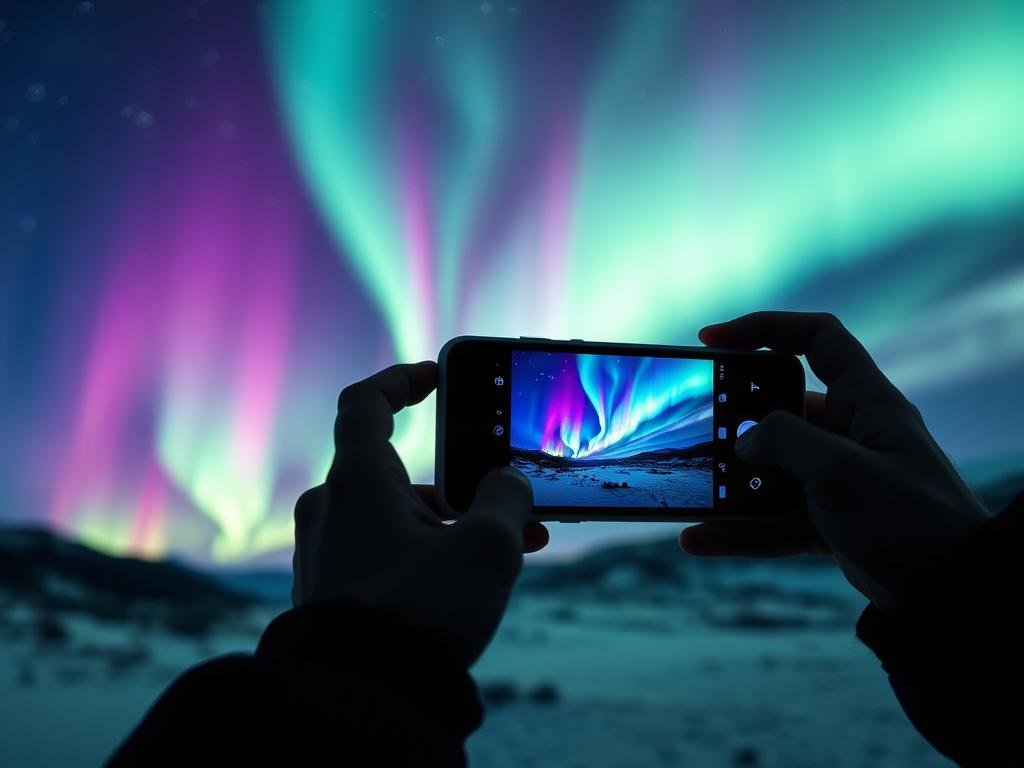
They can prep like a pro by scouting dark, open spots with a clear northern view. AccuWeather and FOX 5 New York suggest timing shots between 10 p.m. and 2 a.m., with a chance as early as 7 p.m. Check the weather in jersey and plan around gaps in cloud cover; if stars are hidden, the aurora will be too. For travelers coming from new york, this can be one of the rewarding things to do in new jersey when skies cooperate and new jersey time lines up with peak activity.
Night mode, long exposure, and turning off the flash
Open the camera’s night mode to extend exposure. If the phone allows manual control, select the longest exposure and a low ISO to cut noise. Turn off the flash and live photos to avoid glare and ghosting. These settings help reveal dim bands that often sit low on the horizon.
Stabilizing your device and framing the northern horizon
Use a tripod, a wall, or a steady railing to keep the phone steady during long shots. Tap to focus on a bright star, then lock focus and exposure if possible. Frame low toward the north where mid‑latitude aurora glows. This works well whether they head out from new york or choose coastal overlooks that match new jersey time windows and the current weather in jersey.
Why smartphones can reveal faint aurora better than the naked eye
Gallagher notes modern sensors gather light longer than the human eye, so weak arcs show up as color and texture on screen. A longer lens opening stacks photons and lifts subtle greens and pinks. If stars pop into view, the phone will likely catch the glow—another reason this ranks high among things to do in new jersey for night sky fans traveling from new york and timing the outing to new jersey time while monitoring real‑time weather in jersey.
nj news: Visibility, Safety, and Weather Considerations
Skies might offer a brief chance for aurora viewing in New Jersey. AccuWeather says there’s a “fair” chance, so timing and location are key. People near New Jersey NY should be ready to move fast if clouds change, keeping the northern horizon in sight.
Cloud impacts and “fair” viewing conditions across New Jersey
Patchy clouds will stick around tonight, with thin high cirrus clouds showing up sometimes. AccuWeather’s Brian Lada says if you can’t see stars, you won’t see the aurora. Quick drives can help find clearer skies, improving your chances.
Look for clear spots every 10 to 15 minutes. Even a thin cloud can dull colors, so dark, open areas in New Jersey are best. Those near New Jersey NY should look north and try to avoid light from nearby streets.
Potential disruptions to GPS, satellites, and parts of the power grid
NOAA and NASA warn that strong G4 geomagnetic storms can mess with Earth’s magnetic field. This might briefly mess with communications satellites and GPS. News 12 New Jersey has also warned about short app glitches if the storm gets worse.
Earlier G5 and G4 events in 2024 didn’t hurt power systems much, but caution is wise during peak activity. Travelers in New Jersey should double-check their routes, keep offline maps, and watch nj news alerts for updates.
Checking time in new jersey, jersey weather, and new jersey time before heading out
Before you go, make sure you know the New Jersey time and aim for the darkest hours. Check the jersey weather radar and cloud trends to match any clearings with your path. Those near New Jersey NY should also look at local winds, which can clear low clouds.
Set a reminder for New Jersey time milestones around midnight. If the skies clear, move fast to a darker spot. Planning around weather shifts and staying flexible can turn a faint glow into a stunning show.
Conclusion
A G4 geomagnetic storm watch has the Tri-State on high alert for a rare northern lights sighting. Photos from the Bronx, Brookfield, and Cape May confirm strong storms can bring aurora south. The best spots are north and northwest of the city, with clear skies and a northern view.
Timing and sky conditions are key. The best viewing time is 10 p.m. to 2 a.m. after sunset. Keep an eye on NOAA’s OVATION model and FOX 5 New York updates. Clouds can change the view quickly.
For the best view, go to open fields or hilltops with a clear northern horizon. Use a tripod and smartphone night mode. Point your camera north to catch faint colors.
Safety is important. Severe storms can affect GPS and satellites. Keep backups and watch for local alerts. If the storm hits, the sky might show a rare display.
Be the first to comment