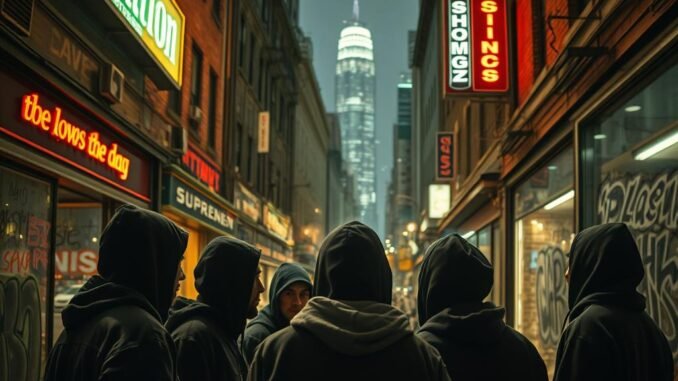

In New York City, 71% of teens say they hear gunshots monthly. A 2018–2019 study found 287 young people, ages 16–24, involved in gangs. This shows a big increase in gang violence and younger gang members.
Most are Black and male, with an average age of 21.2. Many live in NYCHA developments. Almost four in five grew up in public housing, and two in three had single parents.
Many have adult roles, like raising children, while facing danger. Colors, flags, and tagging signal risk in their world.
They face a lot of danger: 83% have been shot or shot at. 73% have seen someone shot, and 89% have had someone close to them wounded. Half don’t feel safe at night, and 51% limit their daily life because of violence.
Gangs offer protection, income, and a sense of belonging. But, gang violence in NYC causes more harm.
Police contact is common. In the last two years, 93% were stopped, 90% have been arrested, and two-thirds have been incarcerated. Many feel over-policed for small issues but not protected from shootings.
This situation affects how gangs recruit and teens decide to carry or join. Media often focuses on takedowns and crime spikes. But, people on the streets talk about poverty, unstable housing, and limited jobs as the real issues.
The story of gangs in NYC is also about access. It’s about safe space, work, and trusted adults. As the city deals with gangs and violence, the question is what support will help young people find another way.
Current landscape of gangs in New York City and why youth recruitment is rising
In New York City, gangs are found in areas with high rents, few jobs, and old buildings. Young people face a daily struggle: protect friends, earn money, and stay safe in areas ruled by gangs. The question of how many gangs are in NYC is urgent, as is the need for support when jobs and homes are scarce.
Gang involvement trends among NYC youth ages 16–24
Among 16–24-year-olds, joining a gang often ties to neighborhood connections. Crews form around schools, parks, and public housing. For them, gang violence is about status, money, and safety when walking home.
Being close to a gang offers quick protection but also attracts rivals and police. Youth feel the strongest pull after threats, fights, or job losses. For many, gangs are not just labels but networks that guide daily choices.
Neighborhood-level drivers: poverty, housing conditions, unemployment
Young residents link recruitment to low wages, few jobs, and high costs. They point to NYCHA buildings with peeling paint and suspected asbestos. One person linked new asthma to poor air quality in their unit.
With bills due, 33% turn to informal or illegal income to support family. In these areas, gangs mirror the economy, acting as brokers for small jobs or quick cash when formal work fails.
Perceived safety: gunshots heard monthly by 71% of interviewed youth
Youth hear gunfire often. Seventy-one percent hear shots monthly; nearly half weekly. Many limit errands, change transit routes, or skip evening events. Over half reduce daily activity due to violence and most want to move when possible.
These patterns shape how gangs in New York City are viewed. When threats seem near, joining a gang can seem like protection, even with rising risks.
How pandemic-era policies and “gang-free zones” shaped the conversation
During COVID, City Hall launched Safe Summer NYC under Mayor Bill de Blasio. Leaders promoted “gang-free zones” with targeted policing. Scholars and practitioners warn that suppression-first strategies miss root causes and fail without prevention.
Local coverage by reporters like Thomas Tracy, Graham Rayman, and Ali Watkins often focused on arrests and shootings. Pieces by Joseph Goldstein and Michael Winerip highlighted conditions and community responses. The debate shifted from how many gangs are in NYC to what supports reduce harm and stabilize neighborhoods.
Younger recruits emerging: how and why teens are drawn in

In many areas, teens feel a strong pull, almost like a must. Where gangs are around, safety is a big worry. Parents work long hours, schools are busy, and getting to and from places can be scary.
Here, a gang might seem like a safe haven, a way to belong, or just a group to watch your back.
Early recruitment pressures and protection dynamics in NYC neighborhoods
Recruiters look for kids who walk alone or seem scared. In some places, joining a gang starts before high school. Teens say gangs offer safety, like escorts home and alerts.
A 16-year-old from the Bronx talked about fear of rivals and police. They said gangs seem safer because they watch out for you.
Social belonging, status, and survival in the absence of supports
When jobs are hard to find and bills are due, teens might choose short-term gains. They might earn cash for small tasks or gain respect on the street. This can be important when money is tight.
Belonging is also about symbols and stories. Shared slang and neighborhood pride attract teens. In gangs, status can change quickly, making them seem like a way up when other paths fail.
School signals: colors, flags, tagging, and visibility
Hallways and cafeterias show who’s who. Surveys show most students notice gang colors or flags. Almost half see tagging in schools and streets, marking territories.
These signs teach who’s who and what to avoid. Being seen with a gang can make refusing harder. Teens might choose to join gangs for safety, even with risks.
- Pressure points: walking routes, after-school transit, and public housing corridors.
- Pull factors: safety-in-numbers, quick money, and identity in local sets.
- Signals: colors, flags, and tagging that broadcast presence of a gang in nyc.
Neighborhood safety, exposure to violence, and the decision to carry
In many New York City blocks, life is filled with risk. Youth often change their routes, go home early, and watch their surroundings. For them, nyc gang violence is real and affects every step outside.
People also link new york gang violence to stress at home and school. The sounds and rumors of violence push everyone to stay alert. In areas where gangs are present, making quick decisions can feel like a matter of survival.
Violence victimization data: 83% shot or shot at; 73% witnessed a shooting
Most gang-involved youth have been exposed to violence. Eighty-three percent have been shot at or shot. Seventy-three percent have seen someone get shot. They also face weapons like knives and bats in fights.
This violence is common in certain areas of New York. It spreads through social ties and shared spaces. For many, avoiding violence is not easy; it’s part of their daily commute.
Half feel safe at night; 51% limit activity due to violence
At night, safety drops. Only half feel safe. Many avoid certain areas to stay away from violence.
They shorten their trips, change their route, and travel in pairs. This costs them time, money, and opportunities. In 2023, gangs in New York made these precautions common in many areas.
Hearing of threats with guns weekly (36%): daily-life implications
Over a third of respondents hear gun threats weekly. Gunshots are common enough to affect their sleep and studies. This leads some to carry weapons, whether for protection or to match others.
In areas with new york gang violence, youth face risks from both gangs and police. This cycle can lead to more police stops and legal issues, even if the initial reason is fear.
| Exposure and Safety Indicators | Share of Youth | Implication for Daily Life | SEO Context |
|---|---|---|---|
| Shot or shot at | 83% | High risk prompts defensive routines and carrying | Reflects gang violence in new york intensity |
| Witnessed a shooting | 73% | Heightened vigilance on common routes | Signals nyc gang violence spillover |
| Feel safe at night | 50% | Curtailed travel after dark | Ties to new york gang violence patterns |
| Limit activities due to violence | 51% | Missed work, school, and services | Linked to gangs in new york 2023 realities |
| Hear of weekly gun threats | 36% | Persistent fear of escalation | Part of the gang new york risk calculus |
Across New York, these signs are seen in transit hubs, public housing, and schools. They show why carrying a weapon is a common choice, influenced by nyc gang violence.
Police encounters, labeling, and the cycle of criminalization
In many boroughs, young people linked to gangs talk about regular police stops. These stops affect their daily lives. They face stigma, even if they haven’t done anything wrong. The question of how many gangs are in New York City is tied to their experiences.
93% stopped by police in the last two years; 90% ever arrested
Many teens and young adults in gangs face stops and arrests. They often get held more than once. This creates fear and limits their freedom at night.
Perceptions of over-policing minor offenses and under-protection from violent crime
Youth say they get tickets for small things but struggle to get help for serious harm. They feel police respond quickly to minor issues but slowly to violence. This affects their trust and perception of risk.
Impact of “gang” labels on surveillance, arrests, and opportunities
The term “gang” can lead to more scrutiny and stops. It can also limit job and education opportunities. This shapes public views on gangs in New York City and affects individuals long after the initial incident.
Studies show that Black and Latino teens face more stops, highlighting the impact of labels and race.
- Key pattern: repeated stops raise stress and reduce mobility for new york gang members.
- Key concern: minor charges stack up and shape future choices for a nyc gang youth.
- Key effect: labeling of a gang in new york spreads consequences to friends and family.
Historical context: from Five Points to modern NYC gangs

New York’s street group history spans from Five Points to today’s crews. Researchers look into what gangs are in new york, and the answer changes over time. From loose sets to tight cliques, names from the past echo today.
The connection between old mobs and today’s gangs shows how they’ve evolved. Yet, they keep their local roots strong.
Early gangs: Forty Thieves, Bowery Boys, and Five Points lineage
In the 1820s, the Forty Thieves emerged near Five Points, marking the start of youth gangs. The Bowery Boys and others followed, linked to saloons and docks. These gangs showed off their style and identity in their territories.
By the early 20th century, gang activity decreased. But the legacy of Five Points gangs influenced later crews. They learned about turf, pride, and secret signals in public.
Postwar peaks and the evolution toward sets and cliques
From the 1950s to the late 1970s, youth crews grew with population shifts. Names like the Chamberlains and Mau Maus became part of borough lore. These gangs were big in their areas, not nationally.
In the 1990s, gangs changed again. Sets and cliques replaced old structures. Today, gangs are harder to track, with a focus on specific buildings and schools.
Notable groups cited in NYC history and today: Bloods, Crips, Latin Kings, MS-13
The Bloods arrived in New York in the mid-to-late 1990s. They had sets tied to jail and neighborhood protection. The Crips came later, with local sets that didn’t follow Los Angeles patterns.
The Almighty Latin Kings and Queens appeared in the mid-1980s, seeking a new image. MS-13 is more common in Long Island and parts of Queens and the Bronx. These groups add to New York’s street gang network.
Through it all, Manhattan gangs and borough crews have shown a common thread. Names change, structures shift, but identity remains strong in smaller circles. For those asking about NYC gangs, the answer is complex, influenced by neighborhoods, jails, and migration.
Demographics and lived realities of nyc gang members today
In the city, gang members talk about tight circles that feel like sets and cliques. They mention daily choices based on safety, stigma, and finding work. These stories help us understand the gangs in New York without just labeling people.
Place matters. The most visible gangs are in Brownsville, East New York, Bushwick, East Harlem, Jamaica, and the South Bronx. People say bad buildings, failing schools, and hard job searches lead to gangs. Gangs in New York are often local and change with the neighborhood.
A 2018–2019 NYC study found a mean age of 21.2, with 83% male. Most were raised in public housing. Many came from single-parent homes and took on caregiving roles early. For more details, see this NYC youth gang profile.
Every day, gang members make choices to stay safe. They set curfews and change their routes to avoid rivals. Some skip school or work to avoid danger. Police stops also shape their lives, affecting where they go and who they meet.
People often wonder about the most dangerous gang in New York. But on the streets, it’s different. Teens talk about small groups, loners, or temporary gangs for protection or quick money. Loyalty and time in the gang vary greatly.
| Measure | Detail | Why It Matters |
|---|---|---|
| Mean age | 21.2 years | Shows young entry and early adult responsibility among nyc gang members. |
| Gender | 83% male | Focuses outreach on young men but doesn’t ignore girls and nonbinary youth. |
| Race/ethnicity | Black 73%; Latinx 12%; Multiracial 10%; Other 5% | Highlights unequal risk in poor neighborhoods. |
| Housing | 79% in NYCHA | Links gangs to aging buildings and health hazards in neighborhoods. |
| Family structure | 65% raised by a single parent; 37% are parents | Shows how caregiving affects their choices and time. |
| Violence exposure | 83% shot or shot at; 73% witnessed a shooting; 89% know someone shot | Explains why carrying and group affiliation feel like survival. |
| Justice contact | 93% stopped by police; 90% ever arrested; 66% ever incarcerated | High surveillance limits school, jobs, and mobility for gangs. |
Economic stress is always there. One in three makes illegal money sometimes. Others look for temp jobs, music, or trade training. Dreams and records mix, limiting choices even with programs available.
Definitions change by block and borough. Simple counts of gangs in New York miss the dynamic nature of sets and crews. For many, joining is temporary, reactive, and tied to a few streets, not a single banner.
Policy responses and prevention models in New York
New York has tried different ways to deal with gangs. Some say we need tougher laws, while others believe in helping communities. Young people ask if gangs exist because of lack of safety or because punishments are too soft.
Suppression vs. prevention: federal, state, and city proposals
At the federal level, there have been laws aimed at fighting gangs. These laws focus on harsher sentences and making it illegal to recruit new members. Most of the money goes to law enforcement, not to help communities.
In New York State and City, there have been plans for stricter laws and more police power. Some ideas include better teacher training and programs to keep teens busy. After the pandemic, the city planned to focus on policing and making areas “gang-free.”
Experts like David Kennedy and Anthony Braga say just fighting gangs isn’t enough. They suggest a mix of solutions to really make a difference. People wonder which approach works best to reduce gangs in New York City.
Youth-informed recommendations: more jobs, programs, and alternatives to detention
Young people say the best way to fight gangs is through jobs, learning, and safe places to hang out. They want more summer jobs, later hours at parks and libraries, and mentors available after school and on weekends.
They also support programs that offer help instead of jail. Closing unused facilities and funding community programs can provide counseling, tutoring, and help for reentry. Families, churches, schools, and community groups want to play a bigger role in shaping the future.
These ideas aim to meet the needs that gangs exploit, like protection, belonging, and making money. They also try to reduce the number of young people in the justice system.
Focused deterrence, Cure Violence, and building safe space
Focused deterrence brings together police, service providers, and community voices. It sends a strong message and offers real help. When combined with housing support, job placement, and outreach, it can tackle gang violence hot spots.
Cure Violence and similar programs use trained workers to stop conflicts before they get out of hand. They create safe areas, solve problems, and connect teens to schools, clinics, and jobs.
These approaches work alongside law enforcement but focus on care. As people think about gangs in New York, they look for ways to reduce harm and keep doors open to education and work.
Media narratives vs. youth voices: reframing gang violence in nyc
Local headlines often focus on arrests and takedowns. Yet, youth describe daily life shaped by noise, fear, and scarcity. Their accounts give context to gangs in new york and clarify what gangs are in nyc beyond labels.
When interviews include these realities, the picture of gang violence in nyc becomes less about spectacle. It becomes more about the conditions that drive choices.
Why centering youth experience changes the solutions
Young people report hearing gunshots, avoiding certain blocks, and changing routes home. They see new york gangs as a school and neighborhood issue tied to safety, not fame. Their priorities point away from a narrow focus on raids and toward safe spaces, trusted adults, and steady work—needs that news cycles rarely highlight.
Media pieces and the search for a quick “gangs of new york stream” moment can miss this lived context. When youth speak, they link gangs in nyc to after‑school gaps, short staffing at community centers, and the need for trauma care. Listening shifts resources toward credible messengers and programs that meet them where they are.
Structural violence, housing quality, and economic exclusion
Interviews connect mold, broken elevators, and crowded apartments with stress and conflict. Poor housing and job scarcity make survival the daily task. In that environment, what gangs are in nyc is less a roster and more a map of who controls corners, safe passage, and social capital.
Discriminatory stops and broad “gang” labels deepen isolation. Youth describe constant watchfulness, which narrows options and pushes them toward peers who promise protection. Addressing gang violence in nyc then means improving housing quality, expanding paid internships, and restoring services that disappear after budget cuts.
From “are there gangs in new york” to “what supports reduce harm”
Young respondents move the conversation past counts of new york gangs. They ask for calm hallways, visible counselors, and real pipelines to union jobs. The shift reframes coverage from “are there gangs in new york” to which supports reduce risk on the walk to school and work.
Rather than tracking only what gangs are in nyc, youth call for precision against serious harm and trust built through consistent presence. When policy follows their lead, the cycle changes: fewer labels, more options, and a clearer path off the block for teens who would be swept into gangs in nyc.
Conclusion
New York’s history with gangs is both rich and ongoing. From the Five Points era to today, the city’s gangs have evolved. Recent studies show that many young people face danger, with half feeling unsafe at night.
Gangs in New York are not just a myth. They offer a sense of belonging and protection in a risky world. This is because the city lacks safe spaces and stable jobs.
Research paints a grim picture. Most young people have been stopped by police or arrested for minor crimes. This lack of safety and support drives them to gangs.
Gang violence in NYC is more than just crime. It’s linked to poor housing, low wages, and a lack of support. This makes gangs seem like the only option for many.
History shows that simply cracking down on gangs doesn’t work. Instead, a balanced approach is needed. This includes jobs, education, and programs that use trusted community members.
Looking ahead, New York can do better. By investing in housing and community health, and creating safe spaces, the city can reduce gang activity. This approach will help build trust and make neighborhoods safer.
Be the first to comment