

Did you know the U.S. has hosted more Olympic Games than any other country? By 2024, they will have hosted eight games. Los Angeles is set to host in 2028, and Salt Lake City in 2034, making it ten. This history shapes how fans remember the Olympics in the U.S. and how cities plan for the future.
Many people wonder, when was the last Olympics? The last one was in Paris in 2024. The last Olympics in the U.S. were in Salt Lake City in 2002. The Summer and Winter Games now alternate every two years, making it easier to follow.
This guide covers every U.S. host city, from St. Louis in 1904 to Atlanta in 1996. It also includes Lake Placid’s two Winter Games and Squaw Valley’s in 1960. It explores why venues are important, what legacies remain, and how the Olympics continue to shape the world. For those interested in the Olympic Games in the U.S., this is the perfect starting point.
Overview: Olympics in the United States and why host cities matter
The Olympics in America have changed cities for the better. They’ve built stadiums, improved transit, and enhanced public spaces. Each host city makes a lasting impact, turning a global event into local change.
Host cities set tone and tempo. The US Olympics often introduce new formats and technology. These innovations benefit athletes and fans, shaping youth sports, tourism, and media. They show the world what American venues and values are like.
How many times has the US hosted the Olympics?
The US has hosted the Olympics eight times, with two more on the way. This makes us the top host nation, showing our venue and broadcast capabilities.
The last Olympics in the US were in 2002 in Salt Lake City. By 2028 and 2034, we’ll have hosted ten times. This record highlights the Olympics’ big impact in America.
Summer vs. Winter: a quick breakdown of US Olympic host history
Summer Olympics focus on big cities, while Winter ones are in mountain areas. This shows the Olympics’ ability to adapt between urban and alpine settings.
- Summer: St. Louis 1904; Los Angeles 1932 and 1984; Atlanta 1996; Los Angeles 2028.
- Winter: Lake Placid 1932 and 1980; Squaw Valley (Olympic Valley) 1960; Salt Lake City 2002; Salt Lake City 2034.
| Season | US Editions (Held/Awarded) | Signature Cities | Noted Innovations |
|---|---|---|---|
| Summer | 5 (1904, 1932, 1984, 1996, 2028) | St. Louis, Los Angeles, Atlanta | Shorter 16-day format in 1932; large-scale reuse of venues in 1984 |
| Winter | 5 (1932, 1960, 1980, 2002, 2034) | Lake Placid, Olympic Valley, Salt Lake City | Artificial snow in 1980; inclusive medal milestones in 2002 |
United States at the Olympics: legacy, impact, and global standing
The US leads in hosting and medals, but its cultural impact is deeper. LA’s three times show long-term planning. Lake Placid proves small towns can host big events. These examples highlight why hosting the Olympics aligns with civic goals.
Media, university venues, and volunteers help the Olympics grow fast. This mix of public and private efforts keeps the US Olympics strong. It also gives cities blueprints for future improvements.
First-ever Olympics in the US: St. Louis 1904
St. Louis hosted the first Olympic games in the USA, marking a significant shift. The games were held across the city, blending into everyday life. This event set a new standard for the Olympics in the USA, broadening its appeal in history.
How St. Louis replaced Chicago and tied into the World’s Fair
The International Olympic Committee first chose Chicago for the 1904 Games. But, organizers of the Louisiana Purchase Exposition in St. Louis wanted to merge their World’s Fair with the Olympics. The IOC agreed, and the Games became part of the Fair’s schedule and venues.
Notable firsts: gold-silver-bronze medals and new sports
St. Louis introduced the gold-silver-bronze medal system. Fans saw new sports like boxing and freestyle wrestling. These changes showed a broader vision for the Olympics in the USA, shaping today’s events.
Where were the Olympics held across the city and for how long?
Events ran from July 1 to November 23, 1904, across the World’s Fair grounds in St. Louis. Unlike today, meets were held at various sites, not just one park. This 4.5-month schedule was one of the longest for the Olympics in the USA.
| Key Detail | St. Louis 1904 | Relevance to Olympics in the USA |
|---|---|---|
| Host Switch | Moved from Chicago to St. Louis | Shows early flexibility in awarding olympics in us |
| Integration | Aligned with the Louisiana Purchase Exposition | Set a pattern of partnering major events with olympic games in usa |
| Medal Standard | Gold, silver, bronze adopted | Became a global template from olympics in the usa |
| Program Debuts | Boxing, freestyle wrestling, decathlon | Expanded sport slate for future olympics in us |
| Timeline | July 1–November 23, ~4.5 months | One of the longest runs for olympics held in usa |
| Geographic Milestone | First Games outside Europe | Marked a wider horizon for olympics in the usa |
Los Angeles as a three-time Summer Games host: 1932, 1984, 2028
Los Angeles is unique among US Olympic cities. It has hosted the Olympics three times. This shows how the city has grown from early beginnings to modern times, focusing on sustainability.
The 1932 Games: shorter schedule and the LA Memorial Coliseum
In 1932, Los Angeles welcomed the world during the Great Depression. The city’s new Los Angeles Memorial Coliseum hosted a record U.S. Opening Ceremony crowd. This event introduced a 16-day program, a change that has lasted in the Olympic Games USA.
The city’s distance and economic crisis reduced athlete numbers. Yet, LA’s confidence in hosting the Olympics was clear. For fans, LA showed that even in tough times, the Olympics could be grand.
The 1984 Games: record participation despite the boycott
In 1984, Los Angeles was the only bidder. It turned this into a grand event. Despite a boycott, 140 National Olympic Committees participated, setting a record.
New Zealand archer Neroli Fairhall competed as a paraplegic athlete, a historic moment. LA84’s lean model and full stadiums marked a turning point for the Olympics in the US.
Looking ahead to LA28: dates, venues, and “Energy Positive Games” vision
LA28, jointly awarded with Paris 2024, will take place from July 21–August 6, 2028. The plan uses existing venues like the LA Memorial Coliseum and SoFi Stadium. It aims to be the first “Energy Positive Games,” generating more power than it uses.
As the next USA Olympics host, Los Angeles sets new standards for Olympic cities. LA28 promises to redefine the Olympics, showing the evolving goals of Olympics America.
Lake Placid’s double Winter legacy: 1932 and 1980
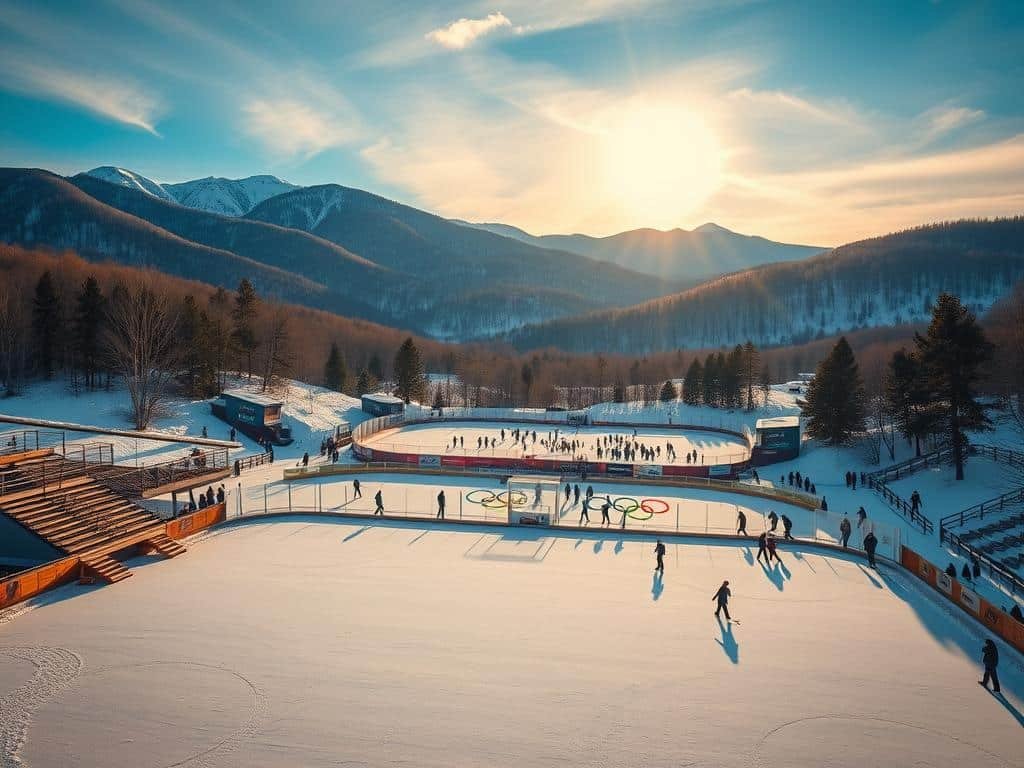
Lake Placid, in New York’s Adirondacks, made a small village famous. It hosted the Winter Games twice, showing how the Olympics in the US have grown. This town is a key part of the United States’ Olympic history, blending tradition and innovation.
The story of Olympic excellence in the US is told through Lake Placid’s venues. The American Museum and active venues keep the Olympic spirit alive all year. Visitors and athletes can feel the American Olympic spirit here.
1932 milestones: first victory podium and local hero Jack Shea
On February 4, 1932, New York Governor Franklin D. Roosevelt opened the first Winter Games in the US. Lake Placid, with less than 4,000 people, introduced the victory podium at a Winter Games.
Local speed skater Jack Shea was the first to win gold on a podium. He also won two golds at the same Winter Olympics. These moments made Lake Placid a key place in US Olympic history and boosted American pride.
1980 innovations: artificial snow and Eric Heiden’s five golds
The 1980 Games brought a big change: snow machines made artificial snow. This kept courses consistent, even when the weather was bad.
Eric Heiden then won five individual speed skating golds. He set records from 500m to 10,000m. His achievement is a highlight of the US at the Olympics and a key chapter in US Olympic history.
Why Lake Placid remains central to US winter sports history
Today, Lake Placid is a hub for training and public skating. It has an Olympic Museum that keeps the legacy alive. The village mixes competition venues with Adirondack culture, attracting teams and fans.
Lake Placid hosts trials, youth events, and coaching clinics. This connection between past and future strengthens the Olympic pipeline in the US. It shows how US Olympic locations can drive national progress.
| Year | Standout Firsts and Feats | Key Figures | Impact on Olympics US |
|---|---|---|---|
| 1932 | First Winter Games victory podium; local athlete wins two golds | Jack Shea; Franklin D. Roosevelt (opening) | Set ceremony standards and boosted early U.S. winter prestige |
| 1980 | Artificial snow ensures fair courses; five individual speed skating golds | Eric Heiden | Advanced event operations and elevated the united states at the olympics record |
| Today | Active venues, museum, and training hubs | Coaches, youth athletes, visiting teams | Long-term pipeline for american olympics success and enduring us olympic locations relevance |
Squaw Valley (Olympic Valley) 1960: a bold bid and Winter firsts
In the Sierra Nevada, a quiet valley became a key Olympic site. It shows how a bold idea can change a place. Among US Olympic sites, it’s known for its ambition and innovation.
Winning the bid before the resort existed
In 1955, lawyer Alexander Cushing led a bid for the Winter Games. The valley had little but a vision. He convinced the IOC it could host the world, making it a notable Olympic site.
Debuts and changes: men’s biathlon, women’s speed skating, no bobsleigh
The program marked a shift for the Olympics in the USA. Men’s biathlon and women’s speed skating debuted. Bobsleigh was missing due to low entries, showing how athletes shape events.
Metal skis make history: Jean Vuarnet’s breakthrough
French downhill star Jean Vuarnet won gold on metal skis, a first. His victory ended the wooden-ski era. It influenced future equipment, showing the Olympics’ role in sport-tech progress.
The valley’s legacy grew as it evolved with the resort. It attracts visitors who follow the Olympics’ history. Olympic Valley remains a key site, telling a story of risk, resolve, and snow.
Atlanta 1996: a modern Summer Olympics in the American South
Atlanta welcomed the world with a bold plan. It reshaped downtown and changed the olympic games usa story. This event marked a turning point, blending sport, culture, and media.
Full global participation: all recognized NOCs compete
All 197 recognized National Olympic Committees participated for the first time. This was a milestone for the olympics in the us. The cauldron lighting by Muhammad Ali became a lasting image, merging sport with American history.
New on the program: beach volleyball, mountain biking, softball
Atlanta introduced beach volleyball, mountain biking, lightweight rowing, women’s soccer, and softball. These additions broadened appeal and drew new athletes. They made the olympic games usa more diverse.
Centennial Olympic Park and the Games’ enduring legacy
Centennial Olympic Park transformed rail yards into a civic green. It anchors events and daily life. Despite the 1996 bombing, the park continues to serve communities and visitors.
The medal table showed a wider story. Athletes from 79 countries reached the podium, and 53 nations won gold. This breadth shows why the usa at the olympics is key to global sport. Atlanta’s showcase continues to resonate, reminding us of the olympics’ impact.
Salt Lake City 2002: the most recent Winter Olympics in the US
Salt Lake City was the last time the US hosted the Olympics. It’s a key moment for the country’s Olympic history. The Games were held along the Wasatch Front, known for its crisp air and packed venues.
Historic medal moments and groundbreaking representation
The Games saw a surge in American success on snow and ice. Vonetta Flowers became the first Black athlete to win a Winter Olympic gold medal in bobsledding. Jarome Iginla, playing for Canada, was the first Black male to win a Winter Olympic gold in men’s ice hockey.
These achievements made the 2002 Olympics more than just a date. They opened doors for athletes and fans who had been left out for too long.
Venues, mountains, and why Salt Lake will host again in 2034
The Wasatch mountains provided compact travel and reliable snow. Modern sites like Utah Olympic Park and the Salt Lake Ice Center were built for the Games. These venues stayed busy after the Olympics, helping Utah’s bid for 2034.
The IOC has chosen Utah as the host for 2034, with events in Salt Lake City. This decision highlights the city’s experience and readiness for future Olympics.
How the 2002 Games shaped Olympics in the US
The 2002 Games were known for their budget management and use of existing venues. They also promoted public transit. This approach gained community support and sponsor confidence, setting a new standard for future Games.
For those wondering when the US last hosted the Olympics, Salt Lake City is the answer. It combined high performance with accessibility, leaving a lasting legacy for future bids.
How many times has the US hosted the Olympics?

For those wondering, the US has hosted the Olympics eight times. This includes both Summer and Winter Games, from St. Louis in 1904 to Salt Lake City in 2002. With Los Angeles hosting in 2028 and Salt Lake City in 2034, the total will be ten.
Has the US hosted more Olympics than other countries? Yes. The US has hosted Summer Games in St. Louis, Los Angeles, and Atlanta. It has also hosted Winter Games in Lake Placid, Squaw Valley (Olympic Valley), and Salt Lake City. These events highlight the US’s rich Olympic history.
The last Olympics in the US were the 2002 Winter Games in Salt Lake City. The last Summer Games were in Atlanta in 1996. Paris hosted the Summer Games in 2024. The IOC usually picks hosts six to seven years ahead, with the 2024/2028 joint award made in 2017.
For a quick look at dates and cities, check out United States at the Olympics. It covers every American hosting and medals context.
Quick fact: Los Angeles will become a three-time Summer host in 2028, a rare milestone in Olympic history.
Which US cities have hosted the Olympics? A definitive list
This guide answers what us cities have hosted the Olympics by listing every edition on American soil. It also shows the olympic games in usa alongside other north american olympic host cities. This gives a full view of us olympics locations.
Summer hosts: St. Louis, Los Angeles, Atlanta, and the upcoming LA28
The summer Olympics in the US started in St. Louis in 1904. Los Angeles hosted in 1932 and 1984, and will again in LA28. Atlanta was the host in 1996, adding a modern chapter to olympic games in usa history.
These cities show a century of change, from early fairs to modern stadiums and urban legacies.
Winter hosts: Lake Placid, Squaw Valley (Olympic Valley), Salt Lake City
Lake Placid welcomed the world in 1932 and 1980. Squaw Valley, now known as Olympic Valley, hosted in 1960. Salt Lake City hosted in 2002 and will again in 2034, showing the depth of winter us olympics locations.
These winter games shaped training centers, ice venues, and mountain sites central to the olympic games in usa.
North American Olympic host cities and the US share
Mexico City (1968), Montreal (1976), Calgary (1988), and Vancouver (2010) are among the north american olympic host cities. The U.S. leads in total editions and will extend that lead with LA28 and Salt Lake City 2034.
This regional picture helps readers see what us cities have hosted the Olympics within the broader sweep of us olympics locations.
Global context: Paris hosted the Summer Games in 2024
Paris hosted the 2024 Summer Games. Milano–Cortina will host the 2026 Winter Games. Brisbane is set for Summer 2032, the French Alps for Winter 2030, and Salt Lake City for Winter 2034.
Against this timeline, the olympic games in usa fit into a global calendar. They show how us cities that have hosted the Olympics connect to worldwide cycles of sport.
Bidding, selection, and future US Olympic hosts
The way to choose a u.s. olympics host has changed over time. Before, cities would bid for years, spending a lot of money. Now, reforms aim to make things more efficient and beneficial for communities.
These changes also make it easier to follow when the US hosted the Olympics and when the last one was. The goals and timelines are clearer now.
From traditional bids to Olympic Agenda 2020 reforms
Oldly, cities would bid, then a Working Group would narrow it down. An Evaluation Commission would visit, and the IOC Session would vote. This whole process took about two years and was very expensive.
Olympic Agenda 2020 brought new ideas. It included continuous dialogue, using venues again, and focusing on the games’ legacy. This reform helped in the late 2010s and led to Brisbane 2032 being chosen first with this new method.
In 2017, a rare dual award happened. Paris 2024 and Los Angeles 2028 were chosen together. This showed a more flexible way to host the Olympics in the US.
Los Angeles and Detroit among America’s most frequent bidders
The US has bid many times, showing it has many capable cities. Los Angeles leads, with Detroit close behind. Other cities like Lake Placid, Philadelphia, and Chicago have also bid, each learning valuable lessons.
| City | Notable Bid Streak | Key Strength | Outcome Highlights |
|---|---|---|---|
| Los Angeles | Most U.S. bids | Existing venues and flexible plan | Selected for 1932, 1984, and 2028 |
| Detroit | Second-most U.S. bids | Great Lakes footprint and transport links | Multiple bids that shaped U.S. strategy |
| Lake Placid | Frequent winter bids | Compact alpine cluster | Hosted 1932 and 1980 Winter Games |
| Philadelphia | Early and mid-century bids | Historic sports culture | Helped refine national proposals |
| Chicago | Modern-era bids | Urban plan and lakefront assets | Influenced future bid policy |
Confirmed futures: LA28 Summer, Salt Lake City 2034 Winter
Los Angeles 2028 is set, with events from July 21–August 6. It aims to be “Energy Positive Games” by reusing venues. LA28 is the next big event for the US, showing the country’s commitment to hosting the Olympics.
Salt Lake City 2034 is also confirmed. It will host winter events along Utah’s famous winter corridor. This keeps the US’s Olympic tradition alive and helps plan future events.
Conclusion
The Olympics in the US have a rich history. They started with big dreams and bold plans. Cities like St. Louis, Los Angeles, and Atlanta have left their mark.
Lake Placid and Salt Lake City have shown what it means to host the Winter Games. They’ve set high standards for innovation and determination. These cities prove why the US is a top host for the Olympics.
For those wondering, the last Winter Olympics in the US were in Salt Lake City 2002. The last Summer Games were in Atlanta 1996. This shows the growth of the Olympics in the US, from the early days to today.
The Olympics continue to grow and change, as seen in Paris 2024. This shows the movement’s ongoing evolution.
Los Angeles is set to host the 2028 Summer Olympics with a focus on sustainability. They plan to reuse venues to reduce waste and increase access. Salt Lake City will host the 2034 Winter Games, building on their winter sports legacy.
This makes the US a leader in hosting the Olympics. It shows how cities can leave a lasting impact and benefit the community.
The US’s Olympic hosting record is more than just numbers. It’s about the lasting parks, the athletes trained, and the fans welcomed. This journey from St. Louis to today shows a bright future for the Olympics in the US.
Be the first to comment