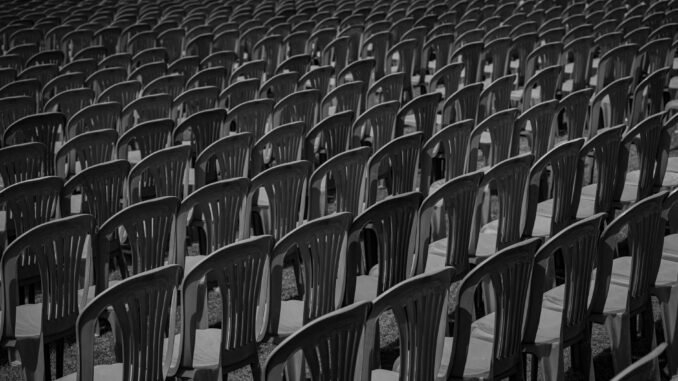
Bryant Park fills with 2,753 empty chairs ahead of 9/11 anniversary
Bryant Park in Midtown Manhattan filled with 2,753 empty chairs this week, a temporary installation marking the 25th anniversary of the September 11 attacks. According to the New York Times, the display arranges one chair for every person killed at the World Trade Center on September 11, 2001. It turns the park’s open lawn into a silent, visual roll call, standing in for the victims who cannot speak for themselves.
The chairs appeared in the days leading up to the anniversary, part of a wave of commemorative activity across New York City this September. Unlike the ceremonies held each year at the World Trade Center site in Lower Manhattan, the Bryant Park installation sits roughly three miles north, giving Midtown workers, tourists and residents a chance to encounter the scale of the loss without traveling downtown.
What the number represents: one chair for every life lost on September 11
The figure 2,753 corresponds to the number of people killed at the World Trade Center on 9/11, according to the New York Times report on the installation. Each chair stands for a single individual: office workers, first responders, visitors, and the passengers and crew aboard the two hijacked planes that struck the towers.
Organizers left the chairs empty rather than labeling them with names, a choice that turns the installation into an exercise in scale rather than biography. Visitors walking through the rows confront the sheer size of the loss in a way that a plaque or a single monument can’t easily convey. There’s no name, no photograph, no marker of who once might have sat there. That absence is the point. It asks people to imagine, rather than read, who is missing.
The layout: chairs arranged facing south toward the former Twin Towers site
The chairs were positioned facing south, oriented toward the site in Lower Manhattan where the Twin Towers once stood, according to the New York Times. That directional detail makes the installation more than a static field of seats. It links Bryant Park’s lawn, physically and symbolically, to Ground Zero, even though the two locations sit several miles apart.
The southward arrangement also shapes how visitors move through the space. Walking the rows means walking roughly in the same direction the chairs face, toward the skyline where the towers used to rise. For anyone who lived in New York in 2001, or who has visited the National September 11 Memorial downtown, the gesture recalls the shape of loss without a single word of explanation.
Bryant Park’s role in New York’s broader 9/11 commemoration
Bryant Park, wedged between Fifth and Sixth Avenues behind the New York Public Library, isn’t typically associated with 9/11 memorials. It’s better known for its lawn concerts, winter ice rink and lunchtime crowds of office workers. That makes this year’s installation notable: it brings a solemn, large-scale commemoration into a park built for leisure and daily foot traffic rather than remembrance.
The chairs joined a broader set of commemorative activities happening across the city this September, as institutions and public spaces marked the 25th anniversary in ways that extended beyond the traditional ceremony at the World Trade Center site. Bryant Park’s installation is one entry in that wider pattern: a physical, publicly accessible display placed where thousands of people pass through on an ordinary workday.
How this installation compares to the annual Tribute in Light and Ground Zero ceremonies
New York’s most recognized 9/11 commemorations happen at night and downtown. The Tribute in Light sends two vertical beams into the sky from Lower Manhattan each September 11, evoking the outline of the fallen towers and visible for miles across the region. At the World Trade Center site itself, the annual ceremony includes a reading of victims’ names, a ritual that has continued every year since 2002.
Bryant Park’s chairs work differently. Where the Tribute in Light operates after dark and from a distance, and the Ground Zero ceremony centers on spoken names, the chair installation happens during the day, is physical, and lets visitors walk directly among the seats. It doesn’t replace either tradition. Instead, it adds a tactile, close-up complement: something people can approach on a lunch break, without traveling to Lower Manhattan or waiting for nightfall.
Why a Midtown park was chosen as a display site
Locating the memorial in Bryant Park, rather than downtown near the actual attack site, puts it in front of a different audience. Bryant Park draws heavy foot traffic from Midtown’s office towers, from tourists visiting the library, and from commuters passing through nearby Grand Central and Times Square. Placing 2,753 chairs there means the installation reaches people who might not otherwise visit the 9/11 Memorial or attend a downtown ceremony on the anniversary.
The choice also shows how commemoration has expanded beyond the physical footprint of the attacks. Twenty-five years on, organizers appear to be bringing the scale of the loss to where New Yorkers already gather, rather than relying solely on people to seek it out at Ground Zero. A Midtown lawn, ordinarily used for reading, picnicking or watching outdoor film screenings, became instead a space for quiet confrontation with a number most New Yorkers know but rarely see made physical.
Public reaction and the visual impact of the empty chairs
The scale of 2,753 chairs, arranged row upon row across an open lawn, produces an effect that a single monument or a list of names on a wall doesn’t replicate as directly. Visitors passing through Bryant Park encountered a field of vacant seats stretching across the park’s grass, each one a stand-in for an individual life. The visual weight comes not from any single chair but from the accumulation, forcing a direct, physical sense of just how many people the number represents.
Described in the New York Times as a “moving memorial,” the installation relies on that scale to communicate loss without ornamentation. There are no speeches embedded in the display itself, no audio, no video. The chairs simply sit, empty, facing south, for as long as the installation remains in place, letting the number and the arrangement do the work that words might otherwise attempt.
Context: the 25th anniversary and how memorials are evolving over time
This year’s display arrives as the city marks 25 years since the attacks, a milestone anniversary that has prompted a wider range of commemorative gestures beyond the standard downtown ceremony. As firsthand memory of September 11, 2001 recedes for younger generations, and as the population of New Yorkers who lived through that day directly continues to shrink, institutions have looked for new ways to convey the scale of the loss to audiences who didn’t experience it.
Physical, immersive installations like the Bryant Park chairs are one answer to that challenge: a display that doesn’t require prior knowledge or context to register emotionally. A visitor unfamiliar with the details of the attacks can still walk among 2,753 empty seats and grasp, immediately, that each one stands for a person who is no longer here. As the 25th anniversary passes and future anniversaries approach with fewer people who remember the day firsthand, that kind of direct, visual reckoning may become an increasingly common way of keeping the scale of September 11 legible to new generations of New Yorkers.
Be the first to comment